Showing posts with label C.S. Lewis. Show all posts

Wednesday, March 18, 2015

THYME Magazine: The Crocus Chronicles

Citizen Journalism with a Better Flavor

Crocus
Volume IX, Issue IXa

The Crocus Chronicles

The first crocus made its appearance last week and the series of photographs I took of it suggested the coming of the much deferred Springtime in C. S. Lewis' classic, The Lion, the Witch and the Wardrobe. Some thought provoking quotations from that work have been included with the photographs, which hopefully capture the anticipation the characters in that story had as Aslan, the King drew closer!

IMG_5543
First Crocus I, Photo by Bob Kirchman

Well, sir, if things are real, they’re there all the time." "Are they?" said the Professor; and Peter did not quite know what to say." -- C.S. Lewis, The Lion, the Witch and the Wardrobe

IMG_5545
First Crocus II, Photo by Bob Kirchman

Wrong will be right, when Aslan comes in sight,
At the sound of his roar, sorrows will be no more,
When he bares his teeth, winter meets its death,
And when he shakes his mane, we shall have spring again."
-- C.S. Lewis, The Lion, the Witch, and the Wardrobe (Chronicles of Narnia, #1)

IMG_5547
First Crocus III, Photo by Bob Kirchman

Aslan is a lion- the Lion, the great Lion." "Ooh" said Susan. "I'd thought he was a man. Is he-quite safe? I shall feel rather nervous about meeting a lion"..."Safe?" said Mr Beaver ..."Who said anything about safe? 'Course he isn't safe. But he's good. He's the King, I tell you." -- C.S. Lewis, The Lion, the Witch, and the Wardrobe (Chronicles of Narnia, #1)


IMG_5604
First Crocus IV, Photo by Bob Kirchman

Friendship is unnecessary, like philosophy, like art.... It has no survival value; rather it is one of those things which give value to survival.” ― C.S. Lewis, The Four Loves

IMG_5606
First Crocus V, Photo by Bob Kirchman

But, first, remember, remember, remember the signs. Say them to yourself when you wake in the morning and when you lie down at night, and when you wake in the middle of the night. And whatever strange things may happen to you, let nothing turn your mind from following the signs. And secondly, I give you a warning. Here on the mountain I have spoken to you clearly: I will not often do so down in Narnia. Here on the mountain, the air is clear and your mind is clear; as you drop down into Narnia, the air will thicken. Take great care that it does not confuse your mind. And the signs which you have learned here will not look at all as you expect them to look, when you meet them there. That is why it is so important to know them by heart and pay no attention to appearances. Remember the signs and believe the signs. Nothing else matters.” ― C.S. Lewis, The Chronicles of Narnia

Aslan
First Crocus VI, Photo by Bob Kirchman

None of the children knew who Aslan was any more than you do; but the moment the Beaver had spoken these words everyone felt quite different. Perhaps it has sometimes happened to you in a dream that someone says something which you don't understand but in the dream it feels as if it had some enormous meaning--either a terrifying one which turns the whole dream into a nightmare or else a lovely meaning too lovely to put into words, which makes the dream so beautiful that you remember it all your life and are always wishing you could get into that dream again. It was like that now. At the name of Aslan each one of the children felt something jump in it's inside. Edmund felt a sensation of mysterious horror. Peter felt suddenly brave and adventurous. Susan felt as if some delicious smell or some delightful strain of music had just floated by her. And Lucy got the feeling you have when you wake up in the morning and realize that it is the beginning of the holidays or the beginning of Summer." -- C.S. Lewis, The Lion, the Witch, and the Wardrobe (Chronicles of Narnia, #1)

IMG_5602
First Crocus VII, Photo by Bob Kirchman

It is as hard to explain how this sunlit land was different from the old Narnia as it would be to tell you how the fruits of that country taste. Perhaps you will get some idea of it if you think like this. You may have been in a room in which there was a window that looked out on a lovely bay of the sea or a green valley that wound away among mountains. And in the wall of that room opposite to the window there may have been a looking-glass. And as you turned away from the window you suddenly caught sight of that sea or that valley, all over again, in the looking glass. And the sea in the mirror, or the valley in the mirror, were in one sense just the same as the real ones: yet at the same time they were somehow different - deeper, more wonderful, more like places in a story: in a story you have never heard but very much want to know. The difference between the old Narnia and the new Narnia was like that. The new one was a deeper country: every rock and flower and blade of grass looked as if it meant more.” ― C.S. Lewis, The Chronicles of Narnia

IMG_5549
"The Wood Between the Worlds." Painting by Bob Kirchman.

If we find ourselves with a desire that nothing in this world can satisfy, the most probable explanation is that we were made for another world.” ― C.S. Lewis

Saturday, January 3, 2015

THYME Magazine Epiphany Edition I

Citizen Journalism with a Better Flavor

thyme0702a
Volume IX, Issue Ia

Epiphany, Another Forgotten Season

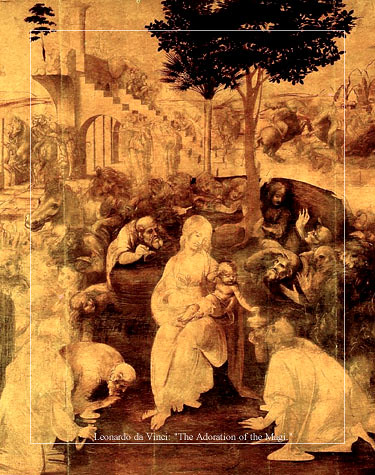
Celebrated by the Western Church on January 6th, Epiphany celebrates the revelation of Christ to the Nations, as pictured by the visitation of the Magi. Portrayed as three Eastern kings astride camels, they follow the Christmas star to worship the newborn King. Here is a profound telling of truth that is often lost in its cultural wrappings. If ever there was a celebration needed for today, it is Epiphany!

The biblical identification for these pilgrims is Magi. The Magi are an interesting group in temselves, originating in a hereditary priesthood of the Medes (the ancestors of modern day Kurds). They were installed as religious leaders and policy advisors to the Persian court by Darius and here they actually make their first appearance in Holy Writ. Daniel, carried into exile from the fallen kingdom of Judea, is assigned to this group when he surpasses the rest of them in his service to the king. Daniel correctly fortold the return of the exiles seventy years in the future.

Though he served a secular king and kingdom, Daniel never lost his connection to G-d and Jerusalem. His quarters had a window facing Jerusalem and he was 'busted' for praying when the king decreed that all his citizens bow only to him. Daniel's deliverance from this decree's punishment, by a Divine intervention, is an often told story by people of Faith. What must be conjectured, however, is the influence this man of Faith might have had on his fellow wizards.

Daniel never returned to Jerusalem, though he never forgot her. He grew old and died as a stranger in a strange land. Though he walked the halls of power in Persia, his citizenship remained in the Land of Promise. His book ends with descriptions of things far into the future, and is silent about the later life of Daniel himself. One might safely assume that he remained in the company of the Magi and continued to serve the Persian court.

A young spiritually minded person would have sought out men like Daniel as mentors. Thus it is highly likely that the hope of the coming King was wrapped into the fabric of Daniel's life and work in such a way that his apprentices would preserve it. Many years later it propelled some of them on a long and perilous journey to find that King. There is no Scriptural reference saying there were only three. That may be an assumption based on the mention of three specific gifts they brought; Gold Frankincense and Myrr.

And what did they find? A Child and his mother, ordinary in their appearance perhaps, but marked by Heavenly purpose! Picture the scene, if you will, of mighty clerics, who direct the affairs of empire by their counsel bowing before a woman and an infant!

Epiphany compells us to wrap our minds and hearts around ancient truth and promise. Epiphany compells us to fight the myopia of contemporary culture and look for the Hand of the Divine! Epiphany compells us to awaken from our slumber and if we hear the voice of G-d, to LISTEN! Epiphany is that discovery so wonderful it is a sin to conceal it. It is a truth that carries a blessing for ALL who will hear it and heed it.

So, as the world around us marks the beginning of a new year and marks down the merchandise of Christmas past, it is really time to continue unwrapping the wonder of G-d's redemptive relationship with His children. Old truths must be pondered, but the promise we find there demands action. The voice of G-d must be answered. History, you see, is not some endless cycle. It leads us on a journey to find a specific destination. The voice of the Divine speaks of far more than some warm feeling of self-actualization. It calls us to participate in the ushering in of a Greater Kingdom!

C. S. Lewis captured the hope and the message so well in this thought from "The Lion, the Witch and the Wardrobe:"

"When Adam’s flesh and Adam’s bone,

Sit at Cair Paravel in throne,

The evil time will be over and done."

Spoken to four rather ordinary children, the extaordinary hope of Aslan's rule creates a feeling of thrilled anticipation. Does the knowledge of the unfulfilled prophecies of G-d's Eternal Kingdom create in us today that feeling as well?

Epiphany's Meaning for Today

Around the world, the hope of Christ's Eternal Kingdom fires the passion of Christians in diverse and difficult situations. Coptic Christians in Egypt share this hope with hidden house church groups in China and North Korea. In Nigeria the faithful watch their churches destroyed, knowing that an Eternal Jerusalem awaits them.

Twelve men hiding in an upper room were propelled outward one Pentecost long ago to share that hope. These reluctant witnesses found themselves empowered by the Holy Spirit as they went. At first glance, history seems to tell us that the church eventually divided into many factions... today many at the tips of these branches hold tight to their distinctives, but miss the branching and rooting of a great tree. Today there are many distinctive groups within Christianity, but has the essential message survived? Next issue we will take a good look at how essential truth has indeed flowed like the lifeblood of this great tree.

Wednesday, December 24, 2014

THYME Magazine Special Christmas Edition II

Citizen Journalism with a Better Flavor

newthyme
Volume VIII, Issue XXVI

"Behold the Man!"

-- John 19:5b

Many years ago I celebrated Thanksgiving with our church family. There I met the first Nepali I have ever had the chance to speak with. His name was Prem Pradhan. This Gurkha warrior had served in Britain's Royal Air Force before returning to his native land. An accident had permanently injured him and he walked with a limp; but walk he did. In a land where foot travel is necessary to reach most of the villages, Prem walked. He had learned something amazing and he felt compelled to travel to the ends of this mountain kingdom to share it!

Walking all day to reach some remote village, Prem would seek out the men and elders of the place and say: "I have heard a NEW THING! I have heard about a man who died and came to life again!" Who would NOT be intrigued? Pradhan would go on to share his fresh vision of the risen Jesus... and many put their faith in Christ through the fresh telling of the old old story. Not everyone was thrilled to hear this 'Good News,' however. Prem had run afoul of the country's anti-conversion laws. He was put into prison, where he languished for seven years.

Nepali prisons are notorious. Prem's enemies sent him there knowing that it was a place to die. Like the amazing man Prem spoke of, he too was basically sentenced to death. But here he was, years later, telling me his story. He didn't die. While he was in prison he had a vision of the risen Lord, and was further strengthened in his resolve to tell the story of redemption. When he left prison he became involved in education and took in a lot of orphans. While proselytizers are discouraged in Nepal, educators are revered. Prem became a leader of his town and never stopped telling the amazing story.

The Babe of Bethlehem became a man. We have heard the Christmas story so many times that we fail to appreciate its audacity! Let us listen again to it with fresh hearing: "I have heard a NEW THING! I have heard about a man who died and came to life again!" Let us follow the grown Jesus to that time of his death. We first meet him on a hillside. An unlikely candidate for leader of a world religion, he attracts multitudes nonetheless. He teaches a simple message that "The Kingdom of G-d is at hand," and then withdraws to a lonely place with his disciples.

Children flock to Him. He is often surrounded by them and his disciples want to shoo them away. Jesus rebukes them. The Kingdom of G-d is meant for such as these. I met an Egyptian woman who had visions of this place. She says that in Heaven Jesus is SURROUNDED by children. This Jesus did not seek out the halls of power, but instead sought out the weak and simple people of this world. He was a carpenter. His disciples were fishermen, zealots and a tax collector. He spoke to women (most rabbis would not). He spoke "as one having authority." Indeed, one of the most amazing parts of the story is when Jesus stands before the Roman ruler Pilate, who's reaction to Jesus is worth noting.

The promises of Messiah were well known and many in Judea hoped for the coming of that leader who would free them from the oppression of Rome. There were many who claimed to be Messiah, looking to fire a zealot rebellion, and Rome was especially good at killing people. So when a maligned and fairly ordinary Galilean was brought before Pilate, why should he hesitate? There was the fact that he was not actually inciting any uprising... but something in Jesus caused this tough old Roman to pause. Pilate knew his job, but he also recognized authority and chain of command. This Galilean was not blustering about rebellion, in fact He was holding the details of His true mission close to His heart. Pilate saw more than met the eye about the man from Galilee. There is more searching than sneering in his question: "Are you a king?"

Pilate finds himself drawn into a higher sort of dialogue with this man... even asking Him: "What is Truth?" Already troubled by the man he sees, he is further troubled by his wife's dream of him. Indeed, he wants to "wash his hands" of this matter. The simple execution of a supposed rebel has become something far bigger. Pilate tries to release Jesus but is pressed to release Barrabas, a real insurrectionist, instead. The death and Resurrection of Jesus became the story that eventually captivated the Gurkha from Nepal.

The modern age brought about a dismissal of the unseen. Science and Naturalism pushed for concentration on what can be observed. The spiritual and invisible dimensions of life no longer dominated great thought... except to perhaps be broad brushed as simply unknowable. Had Pilate limited himself to that which was observable he would have quickly executed this ragged Galilean. There would be no need for angst, for though he SPOKE as one with authority, he had no physical evidence of that authority.

C.S. Lewis was a man of the modern age. He dismissed the faith as a young man, embracing the Naturalism of his day. As an enlightened Medieval scholar, he nonetheless dismissed the power of story to convey unseen truths. His friendship with men like J.R. R. Tolkien led him to become: "the most reluctant convert in all of England." Lewis, along with his friend Tolkien, discovered the power of the story to convey unseen truths. Imagination for them became the key to discover and share: "a NEW THING!"

"When the Pupil is Ready, The Master Will Appear"

CS Lewis-1
"Imagination is the organ of understanding." -- C. S. Lewis

If I find in myself desires which nothing in this world can satisfy, the only logical explanation is that I was made for another world.” -- C. S. Lewis

Saturday, October 25, 2014

THYME Magazine: The Voice of C. S. Lewis

Citizen Journalism with a Better Flavor

THYME0000
Volume VIII, Issue XVIIa

BBC Talks Encouraged Nation

A war-weary nation was once greatly encouraged by the BBC addresses of C. S. Lewis. These talks would later become the basis for his apologetic: Mere Christianity.I found an audio book version of this classic and was impressed at how the work flowed as it was read aloud. There is only one small fragment of BBC audio remaining of C. S. Lewis speaking and here it is presented for your enjoyment!


Wednesday, May 14, 2014

THYME Magazine: Rebuilding the Dream II

Citizen Journalism with a Better Flavor

THYME0721
Volume VII, Issue XXII

Restoration Begins in the Heart

The story is told of a man who sat down on a weekend afternoon to watch a football game. His wife had left him in charge of his small son, who eagerly sought to engage his father in play. Seeking to divert the boy's attention for a bit, the father came up with a game. He found a world map on one page of the newspaper and cut it into an impromptu jigsaw puzzle. "Hey son, put this together and bring it back to me, then we'll play some more!" The father was astounded at how fast the boy returned... map taped together perfectly! "How did you do this?" the amazed father asked. "It was simple," the boy replied, "On the other side of the page there was a picture of a man. I just put the man together and the world was together!" The father hugged his boy, touched by the truth that often comes "from the mouths of babes!"

I set out to write this week about revitalizing American technology. Then tragedy hit our small city as police discovered the body of Julian Parrot in a city park. He was my son's age. He was well known to many Staunton Braves fans as he often helped out at the ballpark. He walked people's dogs for them and though he was mentally disabled, he was known as a kind and friendly person. A sixteen year old juvenile was charged in the apparent murder.

It was time to step away from trying to put the world together.

The technology we used to go to the moon was originally built to blow us up. German scientists at Peenemünde created the ICBM to dominate the world. In a stroke of brilliance, Americans created the civilian space agency with the V2 Rockets they had captured along with their designer, Dr. Wernher von Braun, and reached for new heights. We went to the moon! The inventive Germans created the highways Eisinhower would eventually model the Interstate system after. Clearly the technology for an amazing new world was at hand... and almost led to the domination of the world by the darkest regime in modern history. Was there something in the American character that added discipline to the great march forward?

In the nineteen seventies, journalists from National Geographic went to Leningrad in the Soviet Union. They were not prepared for the welcome that greeted them. Arriving to photograph a dreary Soviet-style factory they were met by the drably-clothed elderly women who worked there. When the women realized that these were Americans, their countenances brightened. They smiled warmly and embraced the startled journalists with many tears. You must remember that after the terrible siege of Leningrad was broken in World War II, the American GIs arrived and were remembered for their kindness to the people. They shared their food and genuinely looked out for their well being. Decades later, the gratitude had not diminished!

So what is it that exists in our national spirit that creates such acts? What might there be to temper the violence of the warrior? The testimony of these Russian women, lectured by their leaders for three decades about the 'evils' of America, who rushed to embrace Americans nonetheless speaks volumes! And have we lost it? A cruel senseless murder and a growing sense that many youths have lost respect for life do not speak well of our national culture today. America's character was formed in the taming of hostile frontiers and adjusting to a new world (as my Bavarian ancestors had to). It was tested on the battlefields of Europe and the Pacific. But now, have we lost it in our luxury? Have we cast off as 'archaic' those values that once guided us to higher deeds on distant shores?

It was time to put the man together.

In the dark turmoil of our Civil War, Evangelist Dwight L. Moody reached out to scores of troops, giving them the hope of the Gospel. Lives were changed, just as lives had been changed in the Great Awakenings prior to this time. Faith gave hope and direction. Faith had a part in the forging of our national character. But Moody almost didn't get a chance to be the agent of the Divine that he surely became.

It is well-known history that in April 1855 Moody embraced Faith when his Sunday school teacher, Edward Kimball, explained how much G-d loved him. He would go on to become a great evangelist, yet it is not so well known that his first application for church membership, in May 1855, was rejected. He was not received as a church member until May 4, 1856. His teacher, Edward Kimball, stated:

"I can truly say, and in saying it I magnify the infinite grace of God as bestowed upon him, that I have seen few persons whose minds were spiritually darker than was his when he came into my Sunday School class; and I think that the committee of the Mount Vernon Church seldom met an applicant for membership more unlikely ever to become a Christian of clear and decided views of Gospel truth, still less to fill any extended sphere of public usefulness."

"The first meeting I ever saw him at was in a little old shanty that had been abandoned by a saloon-keeper. Mr. Moody had got the place to hold the meetings in at night. I went there a little late; and the first thing I saw was a man standing up with a few tallow candles around him, holding a negro boy, and trying to read to him the story of the Prodigal Son and a great many words he could not read out, and had to skip. I thought, 'If the Lord can ever use such an instrument as that for His honor and glory, it will astonish me.' As a result of his tireless labor, within a year the average attendance at his school was 650, while 60 volunteers from various churches served as teachers. It became so well known that the just-elected President Lincoln visited and spoke at a Sunday School meeting on November 25, 1860." [1.]

The rest is history, as they say. But it is more than that. It should serve as a challenge to us. We dare not leave it to our great institutions to identify greatness... we must seek for it around us and nurture it, fully prepared to be astonished!

Redeeming Restoration

Louisiana Governor Bobby Jindal spoke last weekend at Liberty University's commencement. He pointed out that those in power now actively stand in the way of the First Amendment's guarantee of freedom to exercise religious faith. He referenced the case of Hobby Lobby and the government's desire to mandate abortificants trumping conscience. The case is going to the Supreme Court. Secularists want to relegate faith to the level of a personal hobby, according to Jindal. Hillary Clinton's carefully crafted statements on "freedom of religion" bear this out. Secularists use the 'Establishment Clause' to exclude as much religious expression as they can from the public square. Jindal remarked:

“It is said that College is an intellectual pursuit, involving reason and logic. I went to Brown University in the Ivy League, a place that prides itself in intellectual reasoning. One of the good things about going to Brown is that I was able to become the President of the College Republicans on campus almost immediately. The other Republican student at Brown was the Vice President.

Some kids go off to college and lose their way, they become convinced that their faith is not an intellectual pursuit.

Nothing could be further from the truth. Reason and logic lead to truth…which means that reason and logic lead to G-d.

There is a general view among many of the elites in America that truly enlightened folks realize that all this faith and religion stuff is just quaint and antiquated thinking from an earlier era. Or that it is a nice restful place for those who are not as bright or as intellectually curious as they are.

Again, nothing could be further from the truth. True intellectual curiosity will inevitably lead to an understanding of the Creator.

I always noticed examples of this elitist view of faith when national political reporters, usually from places like Boston, New York, or Washington, would come down to Baton Rouge to interview me in my first years as Governor.

Inevitably during these interviews they say something like this – “you are a smart guy, we know you went to Brown and were a Rhodes Scholar, so tell me, how is it that you call yourself pro-life, and you say that you oppose gay marriage, and you say that you oppose gun control? You just say that stuff to get elected in the Deep South right?”

So of course, l liked to have a little fun with it, so I would lean over the desk, and in hushed tones, pretending to confide in him or her, I would say – well…just between us, do me a favor, go tell your editors the bad news, tell them that I absolutely believe everything I say. As you can imagine, those interviews ended rather abruptly.” [2.]

I know a university professor of great integrity, who says to his students who are possibly struggling with what they believe, that "someone, somewhere has wrestled with this question before." He points out that scholars like C. S. Lewis and Tolkien have likely struggled with it to the point of writing about it. Professors like him are truly an inspiration to young scholars.

This professor operates within what I would call: The Mapmaker's Ethic. Simply expressed, the Mapmaker's Ethic acknowledges the fact that people must rely on maps to safely navigate and avoid dangers as they proceed to their destination. Known conditions must be clearly and accurately rendered. To do less is to unnecessarily endanger the traveler!

On November 10th, 1975, the Great Lakes Freighter Edmund Fitzgerald sunk in a violent storm on Lake Superior. Captain Ernest M. McSorley decided to hug the Northern shore of the lake, hoping to gain protection from the raging tempest. Normally the 729 foot Fitzgerald would stay in the shipping lanes in the center of the lake. Surprised by the sudden November gale, the captain plotted a new course that would take him very close to Caribou Island. In all likelihood, the large vessel bottomed out on the treacherous Six-fathom Shoal, which jutted out from the island. Examination of the charts of the day showed that Six-fathom shoal was incorrectly placed. It was a half-mile off! We may never know, but it is quite likely that a small error on a map contributed to the deaths of 29 good men!

Those who would assert that reason and logic cannot coexist with faith would to well to pull out the old charts... the ones that provide plenty of evidence for the Divine. The people of old were exhorted to pile up stones and teach their children of the mighty acts of the Divine. We ignore such landmarks at our own... and our childrens' peril.




Wednesday, January 1, 2014

THYME Magazine Epiphany Edition I

Citizen Journalism with a Better Flavor

thyme0702a
Volume VII, Issue II

Epiphany, Another Forgotten Season

Celebrated by the Western Church on January 6th, Epiphany celebrates the revelation of Christ to the Nations, as pictured by the visitation of the Magi. Portrayed as three Eastern kings astride camels, they follow the Christmas star to worship the newborn King. Here is a profound telling of truth that is often lost in its cultural wrappings. If ever there was a celebration needed for today, it is Epiphany!

The biblical identification for these pilgrims is Magi. The Magi are an interesting group in temselves, originating in a hereditary priesthood of the Medes (the ancestors of modern day Kurds). They were installed as religious leaders and policy advisors to the Persian court by Darius and here they actually make their first appearance in Holy Writ. Daniel, carried into exile from the fallen kingdom of Judea, is assigned to this group when he surpasses the rest of them in his service to the king. Daniel correctly fortold the return of the exiles seventy years in the future.

Though he served a secular king and kingdom, Daniel never lost his connection to G-d and Jerusalem. His quarters had a window facing Jerusalem and he was 'busted' for praying when the king decreed that all his citizens bow only to him. Daniel's deliverance from this decree's punishment, by a Divine intervention, is an often told story by people of Faith. What must be conjectured, however, is the influence this man of Faith might have had on his fellow wizards.

Daniel never returned to Jerusalem, though he never forgot her. He grew old and died as a stranger in a strange land. Though he walked the halls of power in Persia, his citizenship remained in the Land of Promise. His book ends with descriptions of things far into the future, and is silent about the later life of Daniel himself. One might safely assume that he remained in the company of the Magi and continued to serve the Persian court.

A young spiritually minded person would have sought out men like Daniel as mentors. Thus it is highly likely that the hope of the coming King was wrapped into the fabric of Daniel's life and work in such a way that his apprentices would preserve it. Many years later it propelled some of them on a long and perilous journey to find that King. There is no Scriptural reference saying there were only three. That may be an assumption based on the mention of three specific gifts they brought; Gold Frankincense and Myrr.

And what did they find? A Child and his mother, ordinary in their appearance perhaps, but marked by Heavenly purpose! Picture the scene, if you will, of mighty clerics, who direct the affairs of empire by their counsel bowing before a woman and an infant!

Epiphany compells us to wrap our minds and hearts around ancient truth and promise. Epiphany compells us to fight the myopia of contemporary culture and look for the Hand of the Divine! Epiphany compells us to awaken from our slumber and if we hear the voice of G-d, to LISTEN! Epiphany is that discovery so wonderful it is a sin to conceal it. It is a truth that carries a blessing for ALL who will hear it and heed it.

So, as the world around us marks the beginning of a new year and marks down the merchandise of Christmas past, it is really time to continue unwrapping the wonder of G-d's redemptive relationship with His children. Old truths must be pondered, but the promise we find there demands action. The voice of G-d must be answered. History, you see, is not some endless cycle. It leads us on a journey to find a specific destination. The voice of the Divine speaks of far more than some warm feeling of self-actualization. It calls us to participate in the ushering in of a Greater Kingdom!

C. S. Lewis captured the hope and the message so well in this thought from "The Lion, the Witch and the Wardrobe:"

"When Adam’s flesh and Adam’s bone,

Sit at Cair Paravel in throne,

The evil time will be over and done."

Spoken to four rather ordinary children, the extaordinary hope of Aslan's rule creates a feeling of thrilled anticipation. Does the knowledge of the unfulfilled prophecies of G-d's Eternal Kingdom create in us today that feeling as well?

Epiphany's Meaning for Today

Around the world, the hope of Christ's Eternal Kingdom fires the passion of Christians in diverse and difficult situations. Coptic Christians in Egypt share this hope with hidden house church groups in China and North Korea. In Nigeria the faithful watch their churches destroyed, knowing that an Eternal Jerusalem awaits them.

Twelve men hiding in an upper room were propelled outward one Pentecost long ago to share that hope. These reluctant witnesses found themselves empowered by the Holy Spirit as they went. At first glance, history seems to tell us that the church eventually divided into many factions... today many at the tips of these branches hold tight to their distinctives, but miss the branching and rooting of a great tree. Today there are many distinctive groups within Christianity, but has the essential message survived? Next week we will take a good look at how essential truth has indeed flowed like the lifeblood of this great tree.

Wednesday, December 18, 2013

THYME Magazine Special Christmas Edition II

Citizen Journalism with a Better Flavor

newthyme
Volume VI, Issue XXIXa

"Behold the Man!"

-- John 19:5b

Many years ago I celebrated Thanksgiving with our church family. There I met the first Nepali I have ever had the chance to speak with. His name was Prem Pradhan. This Gurkha warrior had served in Britain's Royal Air Force before returning to his native land. An accident had permanently injured him and he walked with a limp; but walk he did. In a land where foot travel is necessary to reach most of the villages, Prem walked. He had learned something amazing and he felt compelled to travel to the ends of this mountain kingdom to share it!

Walking all day to reach some remote village, Prem would seek out the men and elders of the place and say: "I have heard a NEW THING! I have heard about a man who died and came to life again!" Who would NOT be intrigued? Pradhan would go on to share his fresh vision of the risen Jesus... and many put their faith in Christ through the fresh telling of the old old story. Not everyone was thrilled to hear this 'Good News,' however. Prem had run afoul of the country's anti-conversion laws. He was put into prison, where he languished for seven years.

Nepali prisons are notorious. Prem's enemies sent him there knowing that it was a place to die. Like the amazing man Prem spoke of, he too was basically sentenced to death. But here he was, years later, telling me his story. He didn't die. While he was in prison he had a vision of the risen Lord, and was further strengthened in his resolve to tell the story of redemption. When he left prison he became involved in education and took in a lot of orphans. While proselytizers are discouraged in Nepal, educators are revered. Prem became a leader of his town and never stopped telling the amazing story.

The Babe of Bethlehem became a man. We have heard the Christmas story so many times that we fail to appreciate its audacity! Let us listen again to it with fresh hearing: "I have heard a NEW THING! I have heard about a man who died and came to life again!" Let us follow the grown Jesus to that time of his death. We first meet him on a hillside. An unlikely candidate for leader of a world religion, he attracts multitudes nonetheless. He teaches a simple message that "The Kingdom of G-d is at hand," and then withdraws to a lonely place with his disciples.

Children flock to Him. He is often surrounded by them and his disciples want to shoo them away. Jesus rebukes them. The Kingdom of G-d is meant for such as these. I met an Egyptian woman who had visions of this place. She says that in Heaven Jesus is SURROUNDED by children. This Jesus did not seek out the halls of power, but instead sought out the weak and simple people of this world. He was a carpenter. His disciples were fishermen, zealots and a tax collector. He spoke to women (most rabbis would not). He spoke "as one having authority." Indeed, one of the most amazing parts of the story is when Jesus stands before the Roman ruler Pilate, who's reaction to Jesus is worth noting.

The promises of Messiah were well known and many in Judea hoped for the coming of that leader who would free them from the oppression of Rome. There were many who claimed to be Messiah, looking to fire a zealot rebellion, and Rome was especially good at killing people. So when a maligned and fairly ordinary Galilean was brought before Pilate, why should he hesitate? There was the fact that he was not actually inciting any uprising... but something in Jesus caused this tough old Roman to pause. Pilate knew his job, but he also recognized authority and chain of command. This Galilean was not blustering about rebellion, in fact He was holding the details of His true mission close to His heart. Pilate saw more than met the eye about the man from Galilee. There is more searching than sneering in his question: "Are you a king?"

Pilate finds himself drawn into a higher sort of dialogue with this man... even asking Him: "What is Truth?" Already troubled by the man he sees, he is further troubled by his wife's dream of him. Indeed, he wants to "wash his hands" of this matter. The simple execution of a supposed rebel has become something far bigger. Pilate tries to release Jesus but is pressed to release Barrabas, a real insurrectionist, instead. The death and Resurrection of Jesus became the story that eventually captivated the Gurkha from Nepal.

The modern age brought about a dismissal of the unseen. Science and Naturalism pushed for concentration on what can be observed. The spiritual and invisible dimensions of life no longer dominated great thought... except to perhaps be broad brushed as simply unknowable. Had Pilate limited himself to that which was observable he would have quickly executed this ragged Galilean. There would be no need for angst, for though he SPOKE as one with authority, he had no physical evidence of that authority.

C.S. Lewis was a man of the modern age. He dismissed the faith as a young man, embracing the Naturalism of his day. As an enlightened Medieval scholar, he nonetheless dismissed the power of story to convey unseen truths. His friendship with men like J.R. R. Tolkien led him to become: "the most reluctant convert in all of England." Lewis, along with his friend Tolkien, discovered the power of the story to convey unseen truths. Imagination for them became the key to discover and share: "a NEW THING!"

"When the Pupil is Ready, The Master Will Appear"

CS Lewis-1
"Imagination is the organ of understanding." -- C. S. Lewis


“If I find in myself desires which nothing in this world can satisfy, the only logical explanation is that I was made for another world.” -- C. S. Lewis

Friday, October 25, 2013

C. S. Lewis, Why He Matters Today

"When the Pupil is Ready, The Master Will Appear"

CS Lewis-1
"Imagination is the organ of understanding." -- C. S. Lewis


“If I find in myself desires which nothing in this world can satisfy, the only logical explanation is that I was made for another world.” -- C. S. Lewis

Tuesday, March 26, 2013

Stepping Into the Wardrobe...

A Magical Transformation in Central Virginia

Narnia
A late Spring snowstorm transforms the campus of Miller School in Albemarle into a wonderland.

Wednesday, March 6, 2013

Stepping Into the Wardrobe...

A Magical Transformation in Central Virginia

IMG_0744
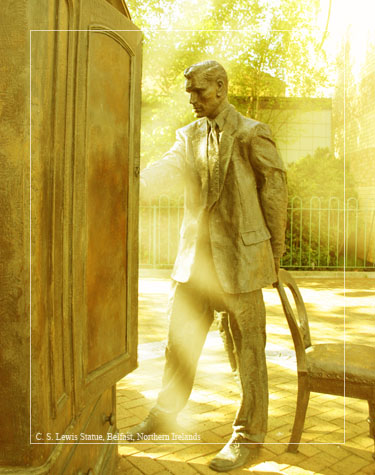
" "This must be a simply enormous wardrobe!" thought Lucy, going still further in and pushing the soft folds of the coats aside to make room for her. Then she noticed that there was something crunching under her feet. "I wonder is that more mothballs?" she thought, stooping down to feel it with her hand. But instead of feeling the hard, smooth wood of the floor of the wardrobe, she felt something soft and powdery and extremely cold." -- C. S. Lewis, The Lion the Witch and the Wardrobe

IMG_0741
The snow had created a magical transformation outside windows by late evening.

Thursday, February 28, 2013

THYME Magazine

Citizen Journalism with a Better Flavor

THYME0511
Volume V, Issue XI

C. S. Lewis' Trilemma, Why it Matters

The 'other' weekly news magazine this week features Oscar Pistorius [click to read]. The cover reads: "Man, Superman, Gunman." Indeed, when those we see as the greatest, and most exemplary among us, fall; questions must be raised. We are right to examine the lives of those we would hold up as role models.

But when we look at our fellow men in such positions, it is well to remember that Romans 3:23 tells us: "For all have sinned, and come short of the glory of God." This does not excuse our shortfallings, rather it offers an honest assessment of the human condition. Honest examination, while it may lead to disillusionment, is necessary if we are to offer solid example.

Pistorious has a great story of triumph over circumstances, but is guilty of either a great crime or (as he claims) a great error. If he is a role model for discipline in overcoming adversity, his lack of discipline, or lack of clear judgement, must also be presented as evidence.

When Jesus proclaims Himself the fulfillment of Scripture, He too invites our examination. C. S. Lewis puts it in these words:

C. S. Lewis' Trilemma: Who is this Man?

"Then comes the real shock. Among these Jews there suddenly turns up a man who goes about talking as if He was G-d. He claims to forgive sins. He says He has always existed. He says He is coming to judge the world at the end of time. Now let us get this clear. Among Pantheists, like the Indians, anyone might say that he was a part of G-d, or one with G-d: there would he nothing very odd about it. But this man, since He was a Jew, could not mean that kind of G-d. G-d, in their language, meant the Being outside the world, who had made it and was infinitely different from anything else. And when you have grasped that. you will see that what this man said was, quite simply, the most shocking thing that has ever been uttered by human lips.

One part of the claim tends to slip past us unnoticed because we have heard it so often that we no longer see what it amounts to. I mean the claim to forgive sins: any sins. Now unless the speaker is G-d, this is really so preposterous as to be comic. We can all understand how a man forgives offences against himself. You tread on my toes and I forgive you, you steal my money and I forgive you. But what should we make of a man, himself unrobbed and untrodden on, who announced that he forgave you for treading on other men’s toes and stealing other men’s money? Asinine fatuity is the kindest description we should give of his conduct. Yet this is what Jesus did. He told people that their sins were forgiven, and never waited to consult all the other people whom their sins had undoubtedly injured. He unhesitatingly behaved as if He was the party chiefly concerned, the person chiefly offended in all offences. This makes sense only if He really was the God whose laws are broken and whose love is wounded in every sin. In the mouth of any speaker who is not God, these words would imply what I can only regard as a silliness and conceit unrivalled by any other character in history. Yet (and this is the strange, significant thing) even His enemies, when they read the Gospels, do not usually get the impression of silliness and conceit. Still less do unprejudiced readers. Christ says that He is ‘humble and meek’ and we believe Him; not noticing that, if He were merely a man, humility and meekness are the very last characteristics we could attribute to some of His sayings.

I am trying here to prevent anyone saying the really foolish thing that people often say about Him: ‘I’m ready to accept Jesus as a great moral teacher, but I don’t accept His claim to be G-d.’ That is the one thing we must not say. A man who was merely a man and said the sort of things Jesus said would not be a great moral teacher. He would either be a lunatic—on a level with the man who says he is a poached egg—or else he would be the Devil of Hell. You must make your choice. Either this man was, and is, the Son of G-d: or else a madman or something worse. You can shut Him up for a fool, you can spit at Him and kill Him as a demon; or you can fall at His feet and call Him Lord and G-d. But let us not come with any patronising nonsense about His being a great human teacher. He has not left that open to us. He did not intend to."

-- C.S. Lewis, Mere Christianity (1952; Harper Collins: 2001) 51-52.

C. S. Lewis was a skeptic and an Oxford scholar. His honest scholarship led him to conclude that Christ is indeed who He says He is. Josh McDowell, a journalist, also set out to disprove the Gospel message. Instead, he ended up writing a book called Evidence that Demands a Verdict. In it he lays out a compelling case for Jesus the Christ.

Interestingly enough, I have read an Atheist's thoughts to the effect that Jesus can still be a great moral teacher even if we find delusion or outright prevarication in his message (of course, wanting to claim that He is ONLY a great moral teacher and nothing more). I do not think that is possible. We demand a standard of integrity that is higher for even those who are men like we are that we would hold up as models for our lives. The sad story of Oscar Pristorius proves it.

bible

Thursday, February 7, 2013

THYME Magazine

Citizen Journalism with a Better Flavor

THYME0508
Volume V, Issue VIII

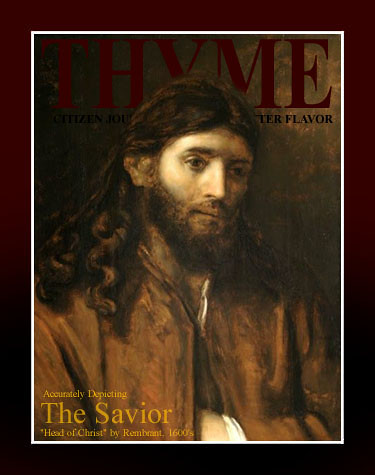
Rembrandt Harmenszoon van Rijn depicted Christ in the workaday clothes of a medieval artisan.

Accurately Depicting the Savior

There is a recurring vision somewhere in my subconscious, where having reached Heaven, I see Jesus in all His glory. Falling on my face, I am overwhelmed. After a while, His hand softly touches my shoulder as He bids me rise: "Come see what I'm working on." He says and then we walk to His workshop.

So many times I have visited an artist or a craftsman, and received that blessed invitation to enter the place where they create. It is an honor to be cherished, especially when a Master invites you as a fellow artisan. Such is the feeling of Christ's invitation in my dream.

Prior to Rembrant, the Seventh Century Master, artists routinely depicted Christ with crisp European features, either as a very heroic figure or in great agony. [1.]

In 1631, Rembrant moved from his hometown of Leiden, The Netherlands, where he was born in 1606, to the port city of Amsterdam, where he purchased a house in the city's Jewish Quarter.Ten years later, he was using the Shepardic Jews in his neighborhood as models. Since Jesus lived in the Middle-east and not Europe, Rembrant's portrayals strike a strong chord of reality in their composition.

The painting above has Jesus wearing the workaday clothes of a medieval artisan. You can just imagine the smells of the workshop still lingering in those clothes. I've met a few stonemasons who's honest features remind me of this picture.

Depicting Messiah has long been a challenge to the serious artist, [2.] and the theologian as well! There seem to be a lot of thoughts about who Christ is. Some of them seem as overworked as the paintings. Scripture gives us a good basis for knowing Christ's nature though. Ironically, it is two English scholars who give us some of the better word portraits. Clive Staples Lewis [3.]and John Ronald Reuel Tolkien [4.] both wrote great depictions.

Lewis portrayed Christ in the character of Aslan, the Lion of Judah. Tolkien's Aragorn (think of the book character more than the movie one here), also displays characteristics of the Redeemer.

Today, more than ever, it behooves us to present as honest a picture of Christ as we can. Much of our society puts little value in our faith, but are they perhaps looking at an incorrect picture? A faulty rendering can discredit something that is actually of great value! [5.]

Looking at the lives of John Newton, William Wilberforce, Florence Nightingale, Charles Dickens, William H. Howland, George Müller and a host of others actually reads like a companion volume to the Hall of Faith described in Hebrews 11. Their stories and their testimonies must be honestly examined before we discard the Faith that moved them. [6.]

This week the 'other' weekly news magazine presents Marco Rubio [click to read] as 'Savior' of the Republican Party. We at THYME would like to gently suggest that the term is greatly overused when referring to political figures.

thymebanner

Tuesday, April 29, 2008

Why Knowledge of the Divine Matters

Our Place and Purpose are Defined by It

I am listening to a series of messages by Ravi Zacharias, one of the great minds of our time. The message series is called Is There Meaning in Pain and Suffering and one of the reasons the series is so powerful is the panel discussion at the end. A leading scientist represents the atheistic perspective. A hindu scholar joins him as well. Such discussions, when carried on with integrity and mutual respect, are a valuable part of understanding the human experience.

Francis Collins, I feel, adds similar depth to our discussion of origins. Can you imagine peeking into the Divine's working drawings? Although Collins does not promote intelligent design he sees G-d's hand in things, perhaps more as architect and less as builder. The writings of C.S. Lewis influenced Collins who was not a believer earlier in his life, to come to faith. There is no testimony more powerful than that of the honest inquirer's.

Belief, or non-belief, colors our discussion of such matters as purpose, pain and suffering and even how should we live our lives.

Here be Dragons

Really old maps fascinate me. You see the well-rendered survey of known lands and the nebulous shapes of imagined and unexplored realms. I love how the old mapmakers would draw very imaginitive sea-serpents cavorting in the margins with the notation: "Here be dragons." So what has changed? We render well what we know and imagine what we don't. Yet navigation has always been a matter of life and death.

My son and several friends were venturing to New York City for New Year's eve in Times Square and I asked them if they needed any directions. The fellow in their group from Australia announced decisively "we've got GPS!" We didn't have that in the 1970's when I did the same trip.

I wonder if he was driving when the car, registered to me, went through an EZ-pass lane? I got the missed toll bill later? There is always a point where our knowledge is limited even though we see more than our forefathers. Knowledge should be freely sought, but we shall never come to a point where it will eclipse our need for faith and further exploration.