Showing posts with label Dennis Prager. Show all posts

Wednesday, July 16, 2014

THYME Magazine: What Makes a Nation Great?

Citizen Journalism with a Better Flavor

thymerrrrrr
Volume VIII, Issue III

What Makes a Nation Great? II

In the end, the state of the Union comes down to the character of the people. I sought for the greatness and genius of America in her commodious harbors and her ample rivers, and it was not there. In the fertile fields and boundless prairies, and it was not there. In her rich mines and her vast world commerce, and it was not there. Not until I went into the churches of America and heard her pulpits, aflame with righteousness, did I understand the secret of her genius and power. America is great because she is good, and if America ever ceases to be good, America will cease to be great.
-- Attributed to Alexis de Tocqueville, though it is not a direct quote from his work: Democracy in America.

In the quest to restore and revitalize our great land, one often hears great solutions proposed but often very little in the way of addressing the real problem. We can create all the great economic models we want to, but if we allow greed and self-serving policies to prevail, we will see ever more of the type of destruction we saw in the mortgage crisis. If we attempt to spend our way out of our problems by creating more money, we will end up as a vassal to China. We need Revival! THYME has looked at the problem of Restoring the American Dream [click to read] before. Whether or not we can definitively find the quote in de Tocqueville's writings, the work of Alvin Schmidt [1.] and others documents well the evidence for Faith as a force in making better the human condition.

That is not to say that we don't need to seek and consider better ways to conduct our affairs. There is a practical side to problem solving that cannot be ignored. Consider how George Müller changed the lives of thousands of orphans in Bristol, England. First let us set the stage. The elimination of the slave trade by William Wilberforce in the Nineteenth Century destroyed not only a vile institution, but as an unintended consequence the city of Bristol, a major slave port, was thrown into decline. G-d had two chosen instruments to revitalize Bristol. There was Isambard Kingdom Brunel, [2.] who built bridges, railroads and great steamships to link Bristol to the world! But Bristol needed more than just economic development!

The city's decline had led to thousands of children either losing their parents or being put out on the streets by their desperate parents. George Müller was G-d's next instrument in the revitalization of Bristol. Young Müller came to the city as a minister of the Gospel. As he sought to minister to the soul of a great city, the plight of her orphans tugged at his heart. He, depending on G-d alone, was able to provide five large houses for these unwanted children. He apprenticed all the boys in various trades but took great pains to educate the young women as office workers, nurses, teachers and housekeepers. They stayed at the homes until they were seventeen. This was a practical policy that kept them from being exploited by those engaged in viler trades.

Those who seek to revitalize our own nation would do well to do no less. We must first address the poverty of our national soul before we set into the very necessary business of restoring her fortunes!

A Case for Faith 

On page 563 of his latest biography — John Quincy Adams: American Visionary — author Fred Kaplan (biographer of Abraham Lincoln, Charles Dickens, Mark Twain, and Gore Vidal among others) cites this insight of the sixth president:

Christianity had, all in all, he believed, been a civilizing force, “checking and controlling the anti-social passions of man.”

That insight is pretty much all an American needs to know in order to understand why the American Founders considered religion — specifically ethical monotheism rooted in the Hebrew Bible — indispensable to the American experiment; and why the America we have known since 1776 is in jeopardy." -- Dennis Prager.

In an article entitled: America Won't be Good without G-d [click to read] Prager lays out a pretty compelling argument. He writes:

"It is easy to respect secular Americans who hold fast to the Constitution and to American values generally. And any one of us who believes in God can understand why some people, given all the unjust suffering in the world, just cannot believe that there is a Providential Being.

But one cannot respect the view that America can survive without the religious beliefs and values that shaped it. The argument that there are moral secularists and moral atheists is a non sequitur. Of course there are moral Americans devoid of religion. So what? There were moral people who believed in Jove. But an America governed by Roman religion would not be the America that has been the beacon of freedom and the greatest force for good in the world."

Here Dennis Prager is spot-on in his analysis of the nature of man. The academy may tell us that we can effectively control the passions that drive us, but history, honestly pursued, tells us otherwise. Prager points out that: "Our prisons are filled with people whose consciences are quite at peace with their criminal behavior. As for reason, they used it well — to figure out how to get away with everything from murder to white-collar crime.

But our prisons are not filled with religious Jewish and Christian murderers. On the contrary, if all Americans attended church weekly, we would need far fewer prisons; and the ones we needed would have very few murderers in them."

Prager goes on to describe the wreckage of the great socialist experiments of the Twentieth Century, and the wreckage of "anything goes" philosophies that encourage casual sex and tell us that fathers are "unnecessary!" Indeed, if the academy would produce more honest studies of the results of the philosopies they have espoused, they might recoil at the burden they have placed on society.

Prager concludes with this sobering thought: "For proof of the moral and intellectual consequences of the secularization of America, look at what has happened to the least religious institution in America, the university. Is that the future we want for the whole country?"

The film: 'Expelled' is a pretty powerful documentary. G-d is getting some pretty bad press these days from esteemed writers such as Richard Dawkins and Christopher Hitchens. The Intelligent Design movement, though it is not specifically theistic, is uniformly vilified in the academy. Why is an inquiry into the observable order of the universe so dangerous, especially when open inquiry is such a cherished part of scientific investigation? Perhaps such 'open inquiry' inevitably leads to the 'wrong' conclusions.

Theodore Dalrymple writes in City Journal: "What the New Atheists are Missing." Himself a non-believer, he points to a time when a teacher's hypocrasy led him to question. Dalrymple does not, however, reject the realm of faith as a force in creating and ordering societies. He see's naturalistic explainations and philosophies quite insufficient for dealing with all of human existence. Richard Dawkins' assertions that religious education is tantamount to child abuse, for example seem to Dalrymple no more than the rebellious ranting of a child who's just learned that his parents are not perfect. All of us have experienced some sort of disillusionment in our youth. I remember a time when a nun of the 'Sisters of Mercy' punished me for some infraction I had not [at least in my recollection] committed. I too questioned a lot of things. The Cuban missle crisis fueled more unanswered anxiety as I careened into adolescence.

But something happened in my teenaged years that is etched firmly in my memory. It was a dark and stressful winter day when I decided to walk in the woods near Triadelphia Reservoir. Something spoke to me that afternoon that was more eloquent than the ranting of hormones and the perceived unfairness of life. The buds of the trees were growing fat. here was the hope of spring and new life. Clearly spring would come. The buds gave evidence of an event hoped for. They were indeed the substance of something yet unseen!

"For the invisible things of him from the creation of the world are clearly seen, being understood by the things that are made, even his eternal power and Godhead; so that they are without excuse:" -- Romans1:20 KJV

Holy writ makes the point that the order and beauty of the creation speaks eloquently of the creator. Thus Intelligent Design, though it merely points out the complex mechanisms of nature, leads one to seek the source of such wisdom. I look to that time in the trees as an affirmation of personal faith in a creator. Though at that point it was pretty detatched and intellectual at best.

"...for he that cometh to G-d must believe that he is, and that he is a rewarder of them that diligenly seek him." Hebrews 11:6b KJV

As a young adult I embraced faith in Christ as redeemer and rewarder. The journey of faith had begun with the fat buds years before though.Therefore I must conlude that those who consider the design of the universe dangerous information have good reason if they fear that others may follow the path I have walked. Dawkins would prefer me to credit space aliens with seeding life to this planet and thus push the hard questions of origin to another world.

Darwinism, in its purest form, rejects the idea that this world is some sort of intentional creation. Of course this leads to the rejection of theism and ultimately the rejection of certain absolutes. 'Expelled' takes a good look at 'eugenics' and how it is supported by a darwinian world view. In the first half of the Twentieth Century certain proponents of eugenics sought to speed evolution along by eliminating the reproduction of certain undesirable types of persons. The results were forced sterilization of the mentally ill and the holecaust. Contrast that movement with Dorethea Dix and others who, motivated by Christian faith, improved conditions for the mentally ill.

Alvin Schmidt makes a good case in his book 'Under the Influence' that faith is a builder of society rather than a force to destroy it. Dalrymple the non-believer would concur. Thus the danger of Intelligent Design leading to dangerous conclusions is much inflated. One might even conclude that the free discussion of order and design,wherever it is found, is wholesome. Certainly there is no basis for its exclusion from the academy.

The argument will no doubt be made: "what about the crusades, what about jihad, religion is dangerous?" Yes, it is certainly something that may be misused, but that must be countered with an honest look at how the so-called "good" science of evolution was the foundation of eugenics. Millions of people were killed in this misguided attempt to improve humanity. Ironically, such brilliant men as Albert Einstein met the criteria for elimination. We reduce the world to only naturalistic explainations at our own peril. The argument for open inquiry stands.

Leaves
Autumn Leaves. Photo by Bob Kirchman

"When through the woods,and forest glades I wander,
and hear the birds sing sweetly in the trees;
when I look down,from lofty mountain grandeur,

and hear the brook and feel the gentle breeze"
-- "How Great Thou Art" Verse 2

A Case for Summer Vacation
By Bob Kirchman

How does one nurture the creative genius of a Brunel, or the vision of a Wilberforce or a Müller? I would suggest that men and women of that ilk are often found walking on the "road less traveled!" Walking home alone from a prayer meeting along a quiet street, the great designer, R. G. LeTourneau says he was inspired with the design for a rather complex machine that had stymied his most brilliant designers for weeks. Could it be true that not only should we hold off on 'formal' education a bit, but we should make sure children are not scheduled to the point of losing free, creative time.

If indeed the creative muse shows up in the quiet times, if problems are indeed solved through the exploration of play, wouldn't it make sense for us to esteem these times in the sense their descriptive originally suggests: re-creation?! The 'other' Weekly News Magazine [click to read] once argued that Summer Vacation is over romanticized and merely stands in the way of the kids retaining all that book-learning they'll need so they can work for the Chinese some day. OK, I'll give you the point that a certain amount of knowledge is 'lost' as kids pursue other activities... but as one who's life and career was shaped by Summers of 'other activities' I'll raise a clear protest: "Not so fast!"

I spent my Summers drawing, building things, going to camp and playing for hours in the woods. I was Lewis and Clark when I set off to explore the woods surrounding Triadelphia Reservoir... with no Sacajawea to help with directions. Mom got a big bell to ring when it was time to come in for dinner. Sometimes I actually heard it. More often than not my appetite finally brought me back to a plate of cold food. Now I loved my groceries as much as any young boy, but didn't Simon Kenton eat cold biscuits while he was exporing the Ohio Valley?

When my younger siblings were old enough, Dad loaded us in Mom's VW Microbus [Mom was there first when it came to the minivan] and we took road trips. Man, I loved road trips. We'd go to places like Gettysburg and crawl into sniper's nests. We'd imagine what it must have been like rushing up the hill in Pickett's Charge. Then we'd go to Antietem and wonder some more. When I turned sixteen, Dad actually let me drive on the trips. Oh the white-knuckle thrill of the Capital Beltway! The endless perspective of NC Route 12 heading to Hatteras and the rollercoaster ride down US 29 to Grandma's. Life was good in the Summer. I hired myself out to the local farmers to bale hay and other jobs. Hot, nasty work is good for the teenaged soul.

One farmer had a wife who'd make us grape juice and lemonade. I've never found sweeter refreshment in all my life.

One Summer Dad decided I needed to build a greenhouse. He let me draw up the plans and he took them to the county... I was thirteen at the time. He gave me a budget and set me loose. I learned to lay block, build walls, buy old storm windows and pretty much whatever it took. The guys at Talbott's Lumber Yard in Ellicott City gave me lots of free advice. They pretty much convinced me I could do it. I wonder how much Dad was paying them?

I was not a licensed electrician... that presented a problem for hooking up the power. Dad said it wasn't a problem. He had a buddy who was licensed and came out and did the whole job in exchange for a bottle of Jack Daniels [Black Label] that Dad cheerfully 'donated' to the building fund. In addition to the electric heater, we got the brilliant idea that it would benefit the plants with both heat and moisture if we ran the dryer vent in there.

What to do about lint? Well, here's where it got really interesting. When we discovered that a discarded nylon stocking fit over the vent and caught the lint while allowing air to flow, we had our problem solved. Dad enjoyed the 'conversation piece' that resulted too.

The greenhouse, built of redwood, served our family for many years. Finally it succumbed to termites after I was gone and married. It's lessons are still with me today.

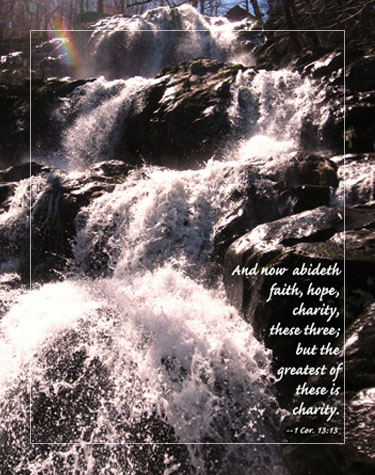
Cover Photo: Dark Hollow Falls Rainbow by Bob Kirchman.

Thursday, November 1, 2012

THYME Magazine Election Edition

Citizen Journalism with a Better Flavor

THYME0446
Volume IV, Issue XLVI

The 'other' weekly news magazine presents a special report: The Choice [click to read]. We at THYME are flattered that they chose to copy our shaded cover border, but feel compelled to stress that this election is not so much a choice between two men, but a choice between two visions.

Today two competing ideologies are vying for the hearts and minds of the American people. Red America is based on the values of Faith and Freedom that are familiar to most of us. Blue America has a very different vision... one that most of us would not recognize. Here are some thoughts to help us recognize the two divergent visions.

We Must Strive for Civil Debate, but Not Compromise

"There are now two Americas. Not a rich one and a poor one; economic status plays little role in this division. There is a red one and a blue one." --Dennis Prager

Politicians of all persuasions express a desire to bring Americans together bound by a common vision for the common good. Dennis Prager Points Out the Fallicy of this Reasoning [click to read] in Jewish World Review. Really, it's time to admit that there are two different ideologies out there and they are in fierce competition for the heart and soul of the Nation. Without this basic understanding of the conflict it is impossible to understand why it must be debated. Indeed the political manifestation of this conflict is merely the tip of a cultural rift caused by very different world views.

Our founders looked to the order of Judeo-Christian principles as they framed a government based on a balance of tensions that would reign in human tendencies in order to create an orderly society. Individual liberties and individual responsibilities played a large part and government was purposely limited to avoid tyranny. Certain Truths were held to be self-evident. Man was seen as a special creation who bore the mark of his Creator, yet was fallen in nature--often acting along the lines of these baser inclinations. Thus government sought at once to reign the base and give liberty and expression to the higher aspirations of mankind.The secular humanism that has come to replace a sense of Divine order has given rise to a new paradigm where government, individual liberties and individual responsibilities are re-prioritized. Thus we no longer see the Divine stamp, Imagio Deo, on humanity. On one hand we have created arguments that if man is all there is [no G-d], then man's self-actualization is the main thing. A sense of greater purpose such as that that drove the American Revolution is impossible but we can grab for the highest experiences to justify ourselves. On the other hand, if man is the end of things, then what's so special. The extinction of some rare snail can be elevated above the plight of starving children in Africa. Indeed some radical environmental groups are making that exact argument.

The American left is actually a coalition of many of these often contradictory conclusions and yet they are strongly united in the desire to cast off the "old" constricting beliefs of our forefathers. That is why you will see those who promote the value of free speech in most areas suddenly veer into an irrational supression of religious speech in the public square. The state is now asked to take an even greater role in promoting the well-being of its citizens. The answer must for them be secular, not spiritual. If there is no higher authority it is left to us to pragmatically define and enforce 'virtue.' How else can you explain the fact that after Fannie Mae and Freddie Mac failed from reasons stemming from corruption in government oversight, the answer can only be more government oversight

The Left and Right See 'Freedoms' Differently

The ACLU was founded ninety years ago by Roger Baldwin. He was a socialist thinker who said things like: "America must follow the example of Stalin's Soviet Union where greater freedoms exist than anywhere else in the world". Wow, I never would have known from the history I read! Knowing America would never follow the path to 'social u[dys]topia because of her Judeo-Christian foundations, Baldwin set out to diminish the influence of Christianity in America.

For 80 years the ACLU has twisted the Constitution to exclude Christianity from the public square and the public discourse. That sense of mission is what drives the endless stream of lawsuits against prayer and Christian expression. That is why your kid's 'religious' message is excluded from the poster contest. That's why the school 'Winter Holiday' assembly is devoid of sacred traditional music. Thankfully there is the Alliance Defense Fund [click to read] which was founded to counter this destructive movement.

The Left and Right See Different Americas Altogether

First you have President Obama saying: "You go into some of these small towns in Pennsylvania, and like a lot of small towns in the Midwest, the jobs have been gone now for 25 years and nothing’s replaced them. … And it’s not surprising then they get bitter, they cling to guns or religion or antipathy to people who aren’t like them or anti-immigrant sentiment or anti-trade sentiment as a way to explain their frustrations."

Or consider this quote from Senator Mark Warner: "One of the things you are going to see is a coalition that is just about completely taken over the Republican Party in this state and if they have their way it’s going to take over state government. It is made up of the Christian Coalition, but not just them. It is made up of the right-to-lifers, but not just them. It’s made up of the NRA, but not just them. It is made up of the home-schoolers, but not just them. It’s made up of a whole coalition of people that have all sorts of differing views that I think most of us in this room would find threatening to what it means to be an American."

What does Senator Warner mean: "threatening to what it means to be an American?" Dennis Prager [click to read] writes in his columns that there are two visions for America in competition. One is the vision passed down to us by our WWII parents, the other: a diminished America and an increased role of government, (in a secularized society), we might take a lesson from Nehemiah, chapter 4:

“But it came to pass, that when Sanballat heard that we builded the wall, he was wroth, and took great indignation, and mocked the Jews. And he spake before his brethren and the army of Samaria, and said, What do these feeble Jews? will they fortify themselves? will they sacrifice? will they make an end in a day? will they revive the stones out of the heaps of the rubbish which are burned?

Now Tobiah the Ammonite was by him, and he said, Even that which they build, if a fox go up, he shall even break down their stone wall. Hear, O our God; for we are despised: and turn their reproach upon their own head, and give them for a prey in the land of captivity: And cover not their iniquity, and let not their sin be blotted out from before thee: for they have provoked thee to anger before the builders.

So built we the wall; and all the wall was joined together unto the half thereof: for the people had a mind to work. But it came to pass, that when Sanballat, and Tobiah, and the Arabians, and the Ammonites, and the Ashdodites, heard that the walls of Jerusalem were made up, and that the breaches began to be stopped, then they were very wroth, And conspired all of them together to come and to fight against Jerusalem, and to hinder it.

Nevertheless we made our prayer unto our God, and set a watch against them day and night, because of them. And Judah said, The strength of the bearers of burdens is decayed, and there is much rubbish; so that we are not able to build the wall. And our adversaries said, They shall not know, neither see, till we come in the midst among them, and slay them, and cause the work to cease. And it came to pass, that when the Jews which dwelt by them came, they said unto us ten times, From all places whence ye shall return unto us they will be upon you. Therefore set I in the lower places behind the wall, and on the higher places, I even set the people after their families with their swords, their spears, and their bows. And I looked, and rose up, and said unto the nobles, and to the rulers, and to the rest of the people, Be not ye afraid of them: remember the Lord, which is great and terrible, and fight for your brethren, your sons, and your daughters, your wives, and your houses.

And it came to pass, when our enemies heard that it was known unto us, and God had brought their counsel to nought, that we returned all of us to the wall, every one unto his work.”

Indeed, those of us who are involving ourselves in this great work must not be distracted. The rebuilding needs to begin with prayer and revival. Our greatest woes are not economic. Yet that does not free us from the task of rebuilding our section.

That should not preclude civil debate, but there are times when, like Nehemiah, we must say to those who oppose us: “I am doing a great work, so that I cannot come down: why should the work cease, whilst I leave it, and come down to you?” — Nehemiah 6:3.


2016, Obama's America
The Movie You Must See Before You Vote

deneshgeorge
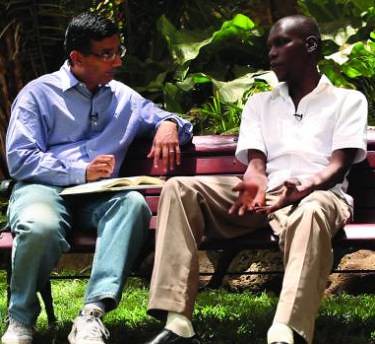
Denesh D'Souza, shown here interviewing the President's brother George Obama, presents a scholarly explanation of who our President really is and who influences his policies.

netflix

The  Full-length Version [click to view] of the film may now be viewed on Netflix. You may view it with a Netflix account or at a theatre near you if at all possible. It is well worth the money and the artists who made it are deserving of our support. One viewer writes:

"I expected a movie that would be a "rant" about Obama. But, instead, it was a well-researched documentary from a man with a similar background who sees the world from a broader perspective than most Americans--much as Obama probably sees it having lived in Indonesia and have an African father.The movie explains the philosophical influence of Obama's father through interviews with friends of his father. It also delves into the mentors that Obama has in his youth. No doubt, the influence Obama has had on the U.S. reflects this view of a European country, which is essentially what America is, and how we interact with the rest of the world. The premise of the film is how America will change by 2016 during a second obama term based on the decisions he has made and his underlying philosophy that has become more apparent as he is in office. In effect, the military cuts, heavy indebtedness, philosophy outlined in speeches in foreign countries, dislike of Israel, etc. are considered from the world view of Obama's father and his mentors who were largely communist, socialist, far left ideologues or generally anti-American and anti-white. The film is well-researched and, while much of the information is available, has not been provided to the voters in America. Without a doubt, any voter should see this movie before the next presidential election before deciding how to case a ballot."

2016_728x90_InTheatersNow
thymebanner

Wednesday, October 3, 2012

Nehemiah: Competing Visions for America

We Must Strive for Civil Debate, but Not Compromise

Recovery
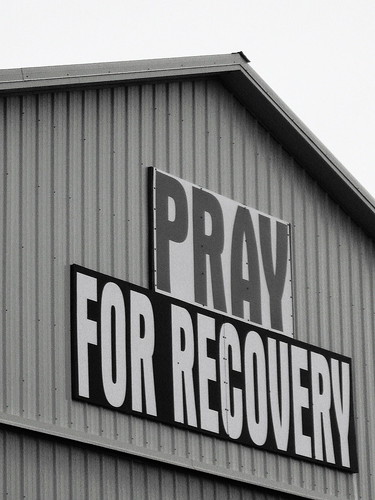
A sign on L. E. Woods heavy equipment dealership in Fishersville, Virginia says it clearly: Pray for recovery.

"There are now two Americas. Not a rich one and a poor one; economic status plays little role in this division. There is a red one and a blue one." --Dennis Prager

Politicians of all persuasions express a desire to bring Americans together bound by a common vision for the common good. Dennis Prager Points Out the Fallicy of this Reasoning [click to read] in Jewish World Review. Really, it's time to admit that there are two different ideologies out there and they are in fierce competition for the heart and soul of the Nation. Without this basic understanding of the conflict it is impossible to understand why it must be debated. Indeed the political manifestation of this conflict is merely the tip of a cultural rift caused by very different world views.

Our founders looked to the order of Judeo-Christian principles as they framed a government based on a balance of tensions that would reign in human tendencies in order to create an orderly society. Individual liberties and individual responsibilities played a large part and government was purposely limited to avoid tyranny. Certain Truths were held to be self-evident. Man was seen as a special creation who bore the mark of his Creator, yet was fallen in nature--often acting along the lines of these baser inclinations. Thus government sought at once to reign the base and give liberty and expression to the higher aspirations of mankind.The secular humanism that has come to replace a sense of Divine order has given rise to a new paradigm where government, individual liberties and individual responsibilities are re-prioritized. Thus we no longer see the Divine stamp, Imagio Deo, on humanity. On one hand we have created arguments that if man is all there is [no G-d], then man's self-actualization is the main thing. A sense of greater purpose such as that that drove the American Revolution is impossible but we can grab for the highest experiences to justify ourselves. On the other hand, if man is the end of things, then what's so special. The extinction of some rare snail can be elevated above the plight of starving children in Africa. Indeed some radical environmental groups are making that exact argument.

The American left is actually a coalition of many of these often contradictory conclusions and yet they are strongly united in the desire to cast off the "old" constricting beliefs of our forefathers. That is why you will see those who promote the value of free speech in most areas suddenly veer into an irrational supression of religious speech in the public square. The state is now asked to take an even greater role in promoting the well-being of its citizens. The answer must for them be secular, not spiritual. If there is no higher authority it is left to us to pragmatically define and enforce 'virtue.' How else can you explain the fact that after Fannie Mae and Freddie Mac failed from reasons stemming from corruption in government oversight, the answer can only be more government oversight

The Left and Right See 'Freedoms' Differently

The ACLU was founded ninety years ago by Roger Baldwin. He was a socialist thinker who said things like: "America must follow the example of Stalin's Soviet Union where greater freedoms exist than anywhere else in the world". Wow, I never would have known from the history I read! Knowing America would never follow the path to 'social u[dys]topia because of her Judeo-Christian foundations, Baldwin set out to diminish the influence of Christianity in America.

For 80 years the ACLU has twisted the Constitution to exclude Christianity from the public square and the public discourse. That sense of mission is what drives the endless stream of lawsuits against prayer and Christian expression. That is why your kid's 'religious' message is excluded from the poster contest. That's why the school 'Winter Holiday' assembly is devoid of sacred traditional music. Thankfully there is the Alliance Defense Fund [click to read] which was founded to counter this destructive movement.

The Left and Right See Different Americas Altogether

First you have President Obama saying: "You go into some of these small towns in Pennsylvania, and like a lot of small towns in the Midwest, the jobs have been gone now for 25 years and nothing’s replaced them. … And it’s not surprising then they get bitter, they cling to guns or religion or antipathy to people who aren’t like them or anti-immigrant sentiment or anti-trade sentiment as a way to explain their frustrations."

Or consider this quote from Senator Mark Warner: "One of the things you are going to see is a coalition that is just about completely taken over the Republican Party in this state and if they have their way it’s going to take over state government. It is made up of the Christian Coalition, but not just them. It is made up of the right-to-lifers, but not just them. It’s made up of the NRA, but not just them. It is made up of the home-schoolers, but not just them. It’s made up of a whole coalition of people that have all sorts of differing views that I think most of us in this room would find threatening to what it means to be an American."

What does Senator Warner mean: "threatening to what it means to be an American?" Dennis Prager [click to read] writes in his columns that there are two visions for America in competition. One is the vision passed down to us by our WWII parents, the other: a diminished America and an increased role of government, (in a secularized society), we might take a lesson from Nehemiah, chapter 4:

“But it came to pass, that when Sanballat heard that we builded the wall, he was wroth, and took great indignation, and mocked the Jews. And he spake before his brethren and the army of Samaria, and said, What do these feeble Jews? will they fortify themselves? will they sacrifice? will they make an end in a day? will they revive the stones out of the heaps of the rubbish which are burned?

Now Tobiah the Ammonite was by him, and he said, Even that which they build, if a fox go up, he shall even break down their stone wall. Hear, O our God; for we are despised: and turn their reproach upon their own head, and give them for a prey in the land of captivity: And cover not their iniquity, and let not their sin be blotted out from before thee: for they have provoked thee to anger before the builders.

So built we the wall; and all the wall was joined together unto the half thereof: for the people had a mind to work. But it came to pass, that when Sanballat, and Tobiah, and the Arabians, and the Ammonites, and the Ashdodites, heard that the walls of Jerusalem were made up, and that the breaches began to be stopped, then they were very wroth, And conspired all of them together to come and to fight against Jerusalem, and to hinder it.

Nevertheless we made our prayer unto our God, and set a watch against them day and night, because of them. And Judah said, The strength of the bearers of burdens is decayed, and there is much rubbish; so that we are not able to build the wall. And our adversaries said, They shall not know, neither see, till we come in the midst among them, and slay them, and cause the work to cease. And it came to pass, that when the Jews which dwelt by them came, they said unto us ten times, From all places whence ye shall return unto us they will be upon you. Therefore set I in the lower places behind the wall, and on the higher places, I even set the people after their families with their swords, their spears, and their bows. And I looked, and rose up, and said unto the nobles, and to the rulers, and to the rest of the people, Be not ye afraid of them: remember the Lord, which is great and terrible, and fight for your brethren, your sons, and your daughters, your wives, and your houses.

And it came to pass, when our enemies heard that it was known unto us, and God had brought their counsel to nought, that we returned all of us to the wall, every one unto his work.”

Indeed, those of us who are involving ourselves in this great work must not be distracted. The rebuilding needs to begin with prayer and revival. Our greatest woes are not economic. Yet that does not free us from the task of rebuilding our section.

That should not preclude civil debate, but there are times when, like Nehemiah, we must say to those who oppose us: “I am doing a great work, so that I cannot come down: why should the work cease, whilst I leave it, and come down to you?” — Nehemiah 6:3.

Tuesday, May 15, 2012

"Probably the Most Important Speech"

Dennis Prager on Romney's Commencement Address


"Moral certainty, clear standards, and a commitment to spiritual ideals will set you apart in a world that searches for meaning." -- Mitt Romney

Here is the Speech [click to read] that Dennis Prager considers perhaps the most important in this campaign:

"Harvard historian David Landes devoted his lifelong study to understanding why some civilizations rise, and why others falter. His conclusion: Culture makes all the difference. Not natural resources, not geography, but what people believe and value..."
-- Dennis Prager

Tuesday, May 10, 2011

Mulling Over Leftism's Muddled Morality

Clear Thinking from Dennis Prager

IMG_3134
Forest floor near Headwaters.

Dennis Prager [click to read] in Jewish World Review has some thoughts on the left's need to make America responsible for the world's crimes.

"Asking what America did to elicit the hatred of Muslim terrorists is morally equivalent to asking what Jews did to arouse Nazi hatred, what blacks did to cause whites to lynch them, what Ukrainians did to arouse Stalin's hatred or what Tibetans did to incite China's hateful treatment of them." -- Dennis Prager

IMG_3133

Saturday, April 9, 2011

THYME Magazine

Citizen Journalism with a Better Flavor

thyme0315 Volume III, Issue XV

There are Two Americas

Red and Blue America are Worlds Apart

The 'other' weekly news magazine asks why we're still fighting the Civil War. THYME asks why the media ignores the real rift in America today. Dennis Prager [click to read] in Jewish World Review has the story that matters.

Wednesday, April 6, 2011

Joy in the Journey

The Art and Skill of Creating More Moments of Joy

hayley_mills-------Hayley Mills played 'Pollyanna.'

Rabbi Zelig Pliskin writes on the art of living in the here and now His Article [click to read] in Jewish World Review will inspire you to make the most of every day.

"Here is the way to achieve lives of joy, courage, love and serenity is to live in the moment, to see the wonders of the present, to feel gratitude for what is happening right this minute. Right now we're writing our life stories, and we can choose how the script will read." -- Rabbi Zelig Pliskin

Many of us remember the movie 'Pollyanna' with Hayley Mills. While the theme may have been overstated in the story it is aa good one to remember nonetheless. Many of us have dealt with the depressed economy and underemployment -- even unemployment. It is a good thing to remember that the condition of our spirit does not depend directly upon the fulfillment of our physical well-being.

The Almighty Isn't Doing too Well

Dennis Prager [click to read] has some insight into that in Jewish World Review. This is a brilliant column!

Tuesday, June 8, 2010

Broken Compass

Let's Hope the World is Right About 'Evil' Israel

Compass
Can we trust the world's compass if it is that broken?

Dennis Prager [click to read] in Jewish World Review.

"The reason mankind has to hope that the world, its leaders, its newspapers, its so-called human rights organizations and the United Nations are right about Israel is quite simple: If Israel is the decent party in its war with the Palestinian Authority and Hamas — and nearly all the world's countries, nearly all the world's media and the United Nations are morally wrong — what hope is there for humanity? If the world's moral compass is that broken, are we not sailing into a dark age?"

The Plain Truth about Israel [click to read] by Caroline B. Glick.

Friday, June 4, 2010

"We Are All Arizonans at this Moment"

Dennis Prager On the Left's War on American Values

I'm listening to Dennis Prager who is a guest on Dr. James Dobson's new program, Family Talk [click to read]. He's pointing out that the Left's war on Arizona is unprecidented in American history. We didn't boycott Berkeley when they kicked military recruiters off campus. Even though we disagree, there is no intent on the part of the Right to harm those who we consider fellow Americans. That, says Prager, is why we need to rally behind Arizona now.

The Left, however, while they believe we need to 'understand' jihadists, clearly believe Tea Partiers are the enemy. They do not want to work with us, they want to defeat us. What of the concept of E Pluribus Unum, out of many, one? America is in fact one of the least racist societies in the world -- if you don't believe me visit Saudi Arabia. The Right sees America as a unification of people from diverse backgrounds. We came into being with all of the prejudices and inequities that are all too common to the human condition, but the mandate to change came from within our society -- often driven by people who saw G-d as the author of their struggle.

Prager points out that the Left values equality of results over Liberty. He points out that the Left considers Cuba equal to America in healthcare because all have access to the same miserable results. They prefer equal delivery to a system like ours where exceptional results are obtained but not immediately available to all. They fail to consider how markets actually work to bring the better results to an ever increasing number of people.

Prager now points out that American society is based on the ideaa that G-d is the grantor of human rights. The Left does not acknowledge this history. This is what is behind the drive to remove all reference to America's Christian roots from her public squares.

"The bigger the government, the smaller the citizen" -- Prager points out that the increase in the role of the state diminishes the role of the citizen. Removal of the Divine only places the state in an awkward position of assuming his duties in managing the universe.

Prager also reminds us The Left and Right do not Want the Same America [click to read].

Wednesday, January 27, 2010

The Real Engine of Blue America

District by District Voting Patterns Show Two Americas
Blue Cities Surrounded by Red Suburbs and Countryside

Steven Malanga in City Journal [click to read] shows how a closer analysis of 'Blue America' finds it very much an urban phenomenom, fueled in part by public sector unions [read SEIU here].

"Is it really true that America is politically divided between conservative “Red” states in the southern and middle sections of the country and liberal “Blue” states on both coasts? Not exactly: a close look at the district-by-district voting patterns of the coastal states in the 2004 elections brings into crystal-clear focus the real nature of our political divisions. There’s really no such thing as a Blue state—only Blue metropolitan regions. Indeed, the electoral maps of some states that went for John Kerry in 2004 consist mostly of Red suburban and rural counties surrounding deep Blue cities."

Virginia's 2006 and 2008 voting patterns, which are supposed to 'prove' that Virginia is 'purple' only reflect the continuing urbanization of Northern Virginia. Virginia is still very much a place that values well articulated Conservative values. A collected survey of the campaign rhetoric of both Democrats and Republicans shows that it is important to present yourself as a champion of fiscal responsibility and an affirmer of Conservative values. Jim Webb did not run as a progressive... he ran as a Reagan Conservative who "was better at it than George Allen." His voting record, especially on the monster healthcare bill, does not square with that claim.

Mark Warner, speaking to some of the urban elite during his Senate run said: "One of the things you are going to see is a coalition that is just about completely taken over the Republican Party in this state and if they have their way it’s going to take over state government. It is made up of the Christian Coalition, but not just them. It is made up of the right-to-lifers, but not just them. It’s made up of the NRA, but not just them. It is made up of the home-schoolers, but not just them. It’s made up of a whole coalition of people that have all sorts of differing views that I think most of us in this room would find threatening to what it means to be an American." [1.]

Clearly there is a need for the progressive candidate to pitch the blue urbanites in intimate settings while presenting himelf in public as the champion of the very gun-totin' Bible thumpin' people his true supporters find 'threatening.' It's hard to have to maintain two messages but the media seems all to eager to oblidge. [2.] When a friend of mine tried to explain Warner's comment in a letter to the editor, the newspaper declined to print it.

Dennis Prager [click to read] points out that the Left and Right's visions for America are not reconcilable. An informed electorate, asking some hard questions, will be able to point that out.

Wrigley Building
Chicago's Wrigley Building.

"What makes these cities so Blue is a multifaceted liberal coalition that ranges from old-style industrial unionists and culturally liberal intellectuals, journalists, and entertainers to tort lawyers, feminists, and even politically correct financiers. But within this coalition, one group stands out as increasingly powerful and not quite in step with the old politics of the Left: those who benefit from an expanding government, including public-sector employees, workers at organizations that survive off government money, and those who receive government benefits." -- Steven Malanga

Wednesday, December 23, 2009

Defender of the Faiths

Why I Love Binyamin Jolkovsky

Jewish World Review ought to be on every Christian's morning reading list. This web publication of opinion, faith and generally usefull content is the brainchild of New York journalist Binyamin Jolkovsky. He's a professional, I'm an amateur. He's Jewish, I'm a follower of Jesus. He lives in the big city, I live in rural Virginia. He observes Saturday, I Sunday. If you say we have nothing in common you'd be dead wrong.

Both of us are citizens of Dennis Prager's first America... the one our founders crafted. Both of us are not friends of the 'other' Amerika... the one the left wants to remake us into. [1.] Both of us try to live our faith seven days a week... not just Saturday [or, in my case, Sunday].

I first learned of Jewish World review from the man that President Obama does not want us to listen to: Rush Limbaugh. Our local newspaper was devoid of much in the way of good opinion and Binyamin's work filled that void very nicely. I got on Binyamin's email distribution list and have used his publication as a source more times than I can number.

But Jewish World Review cannot rest on the back of one man forever. Please give his publication a try and if you think it is as great as I do please think of it as worthy of your personal investment. To me it is worth way more than a subscription to TIME or a lot of other publications. Why not bless Mr. Jolkovsky with a gift to help the publication grow this year.

Jewish World Review [click to read].

Michelle Malkin Talks about Binyamin [click to read].

Tuesday, November 3, 2009

Mad Mad World...

A Society that Venerates Lawyers More Than Doctors

Dennis Prager Writes in Jewish World Review [click to read].

"If the 1,990-page House Health Care Bill becomes law, the average American will receive worse health care, American physicians will decline in status and income, American medical innovation will dramatically slow down and pharmaceutical discoveries will decline in number and quality. And, of course, the economy of the United States will deteriorate, perhaps permanently.

However, we are also certain that there is one American group that will thrive — trial lawyers. The very existence of a 1,990-page law guarantees years of, if not more or less permanent, lawsuits. And the law actually specifies that states that do not limit attorneys' fees in cases of medical malpractice shall be financially rewarded."

Augusta Court House
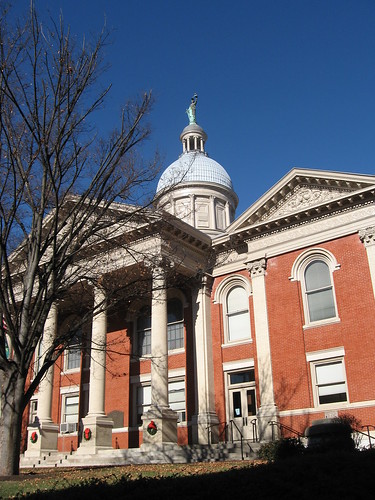
Augusta County Courthouse.

Tuesday, March 17, 2009

Reinvigorating the Value of Virtue

Brilliance is Overrated, Virtue is Underrated in Our Day

Do you remember when Dangerous Home Schooler [click to read] Noah Riner who was then student body president delivered this address to the incoming freshmen at Dartmouth?

"You've been told that you are a special class. A quick look at the statistics confirms that claim: quite simply, you are the smartest and most diverse group of freshmen to set foot on the Dartmouth campus. You have more potential than all of the other classes. You really are special.

But it isn't enough to be special. It isn't enough to be talented, to be beautiful, to be smart. Generations of amazing students have come before you, and have sat in your seats. Some have been good, some have been bad. All have been special.


In fact, there's quite a long list of very special, very corrupt people who have graduated from Dartmouth. William Walter Remington, Class of 1939, started out as a Boy Scout and a choirboy and graduated Phi Beta Kappa. He ended up as a Soviet spy, was convicted of perjury and beaten to death in prison.

Daniel Mason '93 was just about to graduate from Boston Medical School when he shot two men – killing one – after a parking dispute.

Just a few weeks ago, I read in the D about PJ Halas, Class of 1998. His great uncle George founded the Chicago Bears, and PJ lived up to the family name, co-captaining the basketball team his senior year at Dartmouth and coaching at a high school team following graduation. He was also a history teacher, and, this summer, he was arrested for sexually assualting a 15-year-old student.

These stories demonstrate that it takes more than a Dartmouth degree to build character.

As former Dartmouth President John Sloan Dickey said, at Dartmouth our business is learning. And I'll have to agree with the motto of Faber College, featured in the movie Animal House, "Knowledge is Good." But if all we get from this place is knowledge, we've missed something. There's one subject that you won't learn about in class, one topic that orientation didn't cover, and that your UGA won't mention: character.


What is the purpose of our education? Why are we at Dartmouth?

Martin Luther King, Jr. said:
"But education which stops with efficiency may prove the greatest menace to society…. We must remember that intelligence is not enough. Intelligence plus character – that is the goal of true education."


We hear very little about character in our classrooms, yet, as Dr. King suggests, the real problem in the world is not a lack of education.

For example, in the past few weeks we've seen some pretty revealing things happening on the Gulf Coast in the wake of hurricane Katrina. We've seen acts of selfless heroism and millions around the country have united to help the refugees. On the other hand, we've been disgusted by the looting, violence, and raping that took place even in the supposed refuge areas. In a time of crisis and death, people were paddling around in rafts, stealing TV's and VCR's. How could Americans go so low?

My purpose in mentioning the horrible things done by certain people on the Gulf Coast isn't to condemn just them; rather it's to condemn all of us. Supposedly, character is what you do when no one is looking, but I'm afraid to say all the things I've done when no one was looking. Cheating, stealing, lusting, you name it - How different are we? It's easy to say that we've never gone that far: never stolen that much; never lusted so much that we'd rape; and the people we've cheated, they were rich anyway.

Let's be honest, the differences are in degree. We have the same flaws as the individuals who pillaged New Orleans. Ours haven't been given such free range, but they exist and are part of us all the same.

The Times of London once asked readers for comments on what was wrong with the world. British author, G. K. Chesterton responded simply: "Dear Sir, I am."

Not many of us have the same clarity that Chesterton had. Just days after Hurricane Katrina had ravaged the Gulf Coast, politicians and pundits were distributing more blame than aid. It's so easy to see the faults of others, but so difficult to see our own. In the words of Cassius in Shakespeare's Julius Caesar, "the fault, dear Brutus is not in our stars but in ourselves."
Character has a lot to do with sacrifice, laying our personal interests down for something bigger. The best example of this is Jesus. In the Garden of Gethsemane, just hours before his crucifixion, Jesus prayed, "Father, if thou be willing, remove this cup from me: nevertheless not my will, but thine, be done." He knew the right thing to do. He knew the cost would be agonizing torture and death. He did it anyway. That's character.


Jesus is a good example of character, but He's also much more than that. He is the solution to flawed people like corrupt Dartmouth alums, looters, and me.

It's so easy to focus on the defects of others and ignore my own. But I need saving as much as they do.

Jesus' message of redemption is simple. People are imperfect, and there are consequences for our actions. He gave His life for our sin so that we wouldn't have to bear the penalty of the law; so we could see love. The problem is me; the solution is God's love: Jesus on the cross, for us.

In the words of Bono:
[I]f only we could be a bit more like Him, the world would be transformed. …When I look at the Cross of Christ, what I see up there is all my s—- and everybody else's. So I ask myself a question a lot of people have asked: Who is this man? And was He who He said He was, or was He just a religious nut? And there it is, and that's the question.


You want the best undergraduate education in the world, and you've come to the right place to get that. But there's more to college than achievement. With Martin Luther King, we must dream of a nation – and a college – where people are not judged by the superficial, "but by the content of their character."

Thus, as you begin your four years here, you've got to come to some conclusions about your own character because you won't get it by just going to class. What is the content of your character?

Who are you? And how will you become what you need to be?"

Brilliance alone is not enough. In fact Read What Dennis Prager Has to Say [click to read] and you may come to the same conclusion. Our brilliance is wasted if it has no light to guide it.

Noah
Noah Riner.

Wednesday, October 1, 2008

Divine Order or Random Happening?

Your View of the Creation Affects How You Live

View
Is it orderly or totally random?

Dostoevsky wrote "Without G-d, all is permitted." Indeed a lot of modern thought seeks to cast off religion as restrictive of human freedom and religion is also blamed for much of society's ills. This Piece by Dennis Prager points out that far from restricting human potential for good, the knowledge of the divine actually curbs our destructive tendencies and historically has allowed for societies to grow and thrive. Our Constitution invokes G-d as the giver of those basic human rights it elaborates and protects.

Dennis Prager's Fourteen Arguments Here are certainly important if we seek to honestly understand our lives and our world.

100
If G-d is involved in creation, life is a purposeful journey and His mileposts should be visible in inspired writings.

If the Almighty Doesn't Exist, Prager points out the ultimate tragedy and despair that come from a G-dless worldview. Take note what happens in the arts.

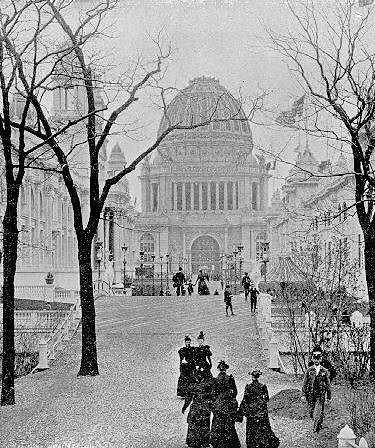
At the turn of the Century some of our country's greatest works of art and architecture were created. The 'White City' of the 1893 Chicago World's Fair inspired a nation to high ideals. Prager points out the post-modern artistic works reject outright that sense of order, beauty and truth. I was quite moved by Ravi Zacharias' description of his experience visiting the first post-modern building in America. The building had stairways going to no particular place that ended in mid-air, walls placed out of context as were windows and doors. Roof planes were broken in arbitrary fashion. Zacharias had this one question: "Did he [the architect] take similar liberties with the foundation as well?"

In a world where many conflicting philosophies present themselves, some claiming that the door is not a door and order is unimportant, that's a fair question.

1893
A scene from the 1893 Columbian Exposition, the Chicago World's Fair.

Tuesday, September 30, 2008

Every Generation is Tested by Great Evil

Dennis Prager Gives a Historical Perspective

This Piece by Dennis Prager caught my attention. We seem to be reticent to identify evil these days and modern philosophies seem so unable to aid us. In fact, what has for generations been seen as 'good' is now questioned in a post-modern environment.

But Mr. Prager points out the recurring nature of this phenomenom. Some people once thought Nazi Germany was a good thing. Prager goes on to say:

"It would appear that every generation confronts a major moral test. A great evil presents itself as a good, and the world that is not victimized by that evil is tested: Can it recognize the evil and confront it?
The pattern is eerily and depressingly repetitive.


1. The evil takes hold.
2. The evil has myriad defenders even among otherwise decent people.
3. The evil is vanquished after destroying an uncountable number of lives.
4. After the evil is vanquished, there is virtually unanimous agreement that it was indeed evil."


So it seems we are able to recognize Good and Evil after all.

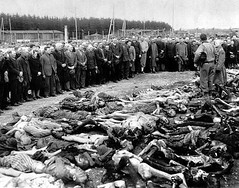
Holocaust
The aftermath of the Holocaust.