Showing posts with label Phillip Blond. Show all posts

Thursday, April 29, 2010

The Challenge of Restoring Civil Society

Is There Something Missing from Our Modern Discussion

First of all, here is Phillip Blond [click to read] in The American Conservative. He offers an interesting perspective in light of our current alternating possession politics. Perhaps he's on to something when he says that Civil Society has been lost.

Taken in light of Rabbi Yonason Goldson's Observations [click to read] that the best foundations of Conservative thought are found in the traditions inspired by Divine revelation. Then Rabbi Goldson points out that the noblest aspirations of Liberalism are also so rooted.

We all love the story of Star Parker [click to read] but deep down we lament that we're not creating more stories like hers. Big government provides the serfdom of the welfare state but a capitalism that excludes all but the best, brightest, and well funded from the marketplace does not reach those who need it with something better. Educational choice is a great starting point. In an honest discussion [excluding the teachers' unions] it would seem that both Liberal and Conservative could embrace the empowering reality of programs like the DC Opportunity Scholarships.

Policies that are Pro-Market more than simply Pro-business might make it possible for more people to create businesses and products. As Blond points out, this is another point where the common man must be empowered. Why CAN'T there be small players in every industry. The Tucker Car Company [click to read] in Chicago might be a good example of the kind of company Americans should be creatiing. Unforunately Preston Tucker was put out of business by the US Attorney Otto Kerner. Even though Tucker was eventually proven innocent of the charges brought against him, the trial bankrupted his company. The whole concept of government stepping in to rescue failing companies that are 'too big to fail' means effectively that government is taking sides. The loser is the smaller company, who's failure is not deemed so threatening.

Regulatary mechanisms unfortunately are often the means for creating efffective monopolies and decreasing value as protectors of the public interest. Corporations regularly make large contributions to politicians so that the legislation they craft -- often hurtful to ALL industry, hurts them less than their competitors. Our goal should be a marketplace with reasoned rules that encourage a variety of creative solutions to enter the marketplace.
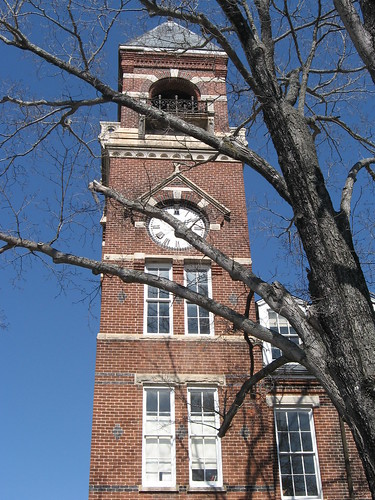
Bell Tower
Samuel Miller, a wealthy Lynchburg businessman, founded this school for disadvantaged youth in his native Albemarle County.

Giving that Worked [click to read] by Marvin Olasky in World Magazine. People of faith need to reclaim their heritage as healers in the world. With "work tests" for the able-bodied and disdain for indiscriminate givers, Christians in the past fought urban poverty with generosity plus discernment

A Habit of Thrift [click to read] by Marvin Olasky. John D. Rockefeller’s economy and efficiency led to a better life for millions.


Friday, April 9, 2010

Creative Construction Capitalism

Creating a Free Market that Empowers Individuals

Dogwood
A dogwood blossom displays balance in design.

Two economic ideologies vie for the right to control the affairs of men. The idea of individual liberty and free markets stands against the ideas of Socialism, Statism and central planning. That the Statist's greatest success story is the old Soviet Union, which replaced a top-heavy aristocracy and serfdom, should give us pause. Clearly free markets are better but the problem of the disenfranchised dogs Capitalism constantly. 'Creative Destruction' which results in more and more disenfranchised citizens can be the vehicle by which Statists rise to stifle the marketplace.

Suzanne Fields writes in Towards a New Capitalism [click to read] that "If market capitalism is to survive the assaults of statists and populists, the former far more dangerous than the latter, we need what might be called a neo-orthodoxy — the development of new adaptations of the basic truth taught by great economists from Adam Smith to John Maynard Keynes. From these adaptations might emerge a new capitalism, the latest form of this most resilient of economic systems" -- Irwin Stelzer

Ms. Fields points out that: "Both Ronald Reagan and Margaret Thatcher accepted aspects of a socialistic past they didn't construct and didn't like because they recognized futile fights in dismantling the past and fertile soil in which to plant their own new ideas."

"Ronald Reagan, for example, accepted advice from Irving Kristol, who told him that conservatives should accept much of the New Deal even though it ran counter to their philosophy because it was now part of the economic architecture of America, "complete and irreversible." Reagan went on to change attitudes and spread a revolution of the values of individual obligation and responsibility."

"Swallowing hard, Margaret Thatcher left socialized medicine in Britain intact, but successfully privatized many of the enterprises Labor governments had stifled under state control. Tony Blair, who succeeded her, made the changes permanent, putting limits on the uncontrolled trade unionism that crippled British initiative and innovation."

Philip Blond may have some insight into how the modern free market may need to provide for people who have traditionally been thought of as the dependent class. Here is a Synopsis of Blonnd's Ideas [click to read]. "Blond told us how it began to go wrong when Disraeli failed to offer an economic stake to the poor. You cannot be a capitalist without capital, you cannot be part of a capitalist society without having access to capital, and in our society a significant proportion of the population will never have this access. During the 1960s and 70s the liberal left tried to pursue social justice through the state. In the 1980s and 90s the liberal right tried to encourage the creation of wealth by getting the state to back the financial market. New Labour tried to find the middle ground between the two but failed to foster a true ‘stakeholder society’. This failure was inevitable as Tony Blair et al were addicted to the liberal political settlement of post-war Britain. Politicians always confuse and conflate the term freedom with liberalism. For Blond, freedom cannot exist unless you have continued access to capital. The ‘free market’ is anything but free. It rigidly serves those who have capital to spare."

Blond offers such solutions as reformatting public assistance so that people and communities have more say in how the monies are spent. Indeed, if one looks at the modern welfare state honestly, it has destroyed community. Even the Soviet-style Le Corbusier blocks of human filing cabinets known as public housing tell this story.[1.] Better results come when people have a stake in their community and resources to invest.

Knowledge is Power

The DC Opportunity Scholarships [click to read], I would suggest, are an example of how Conservatives already own this type of empowerment. They involve using vouchers to enable students access to schools that will give them the tools they need to participate in the marketpace. It is very telling that our Socialist President is against them and most of us Conservatives are for them. Beyond programs like this, might we see new programs in apprenticeship undertaken by industry to bring people into the new market economy.

George Müller's Model [click to read] took orphans and gave them basic necessities, but the vision included apprenticing the boys to local tradesmen at fourteen. The young ladies remained in the homes until they were seventeen and received training as nurses, teachers and domestics. Could we accomplish great things by breaking the monopoly of the academy and providing similar career paths for young people today?

At the very least we should see more programs like the co-op program at Virginia Tech where students in the Engineering department spend a substantial amount of time actually working in private employment. At best, we would see industry create programs within the private sector to meet the challenges of providing an intelligent articulate workforce for the 21st Century.

Failure is Always an Option

The modern attempt to eliminate risk and provide equal but mediocre results needs to be replaced by a true safety net that does not create an entitlement mentality. Compassion will not allow your neighbor to starve but I would argue that compassion also will not allow your neighbor to be warehoused in public housing when he might be building up his community.

In fact, wouldn't charity require that we somehow bring our neighbors into the true spirit that built America, neighbor helping neighbor, working together, bringing in each other's harvests? Now that's an American Dream all of us can relate to.

Blue Ridge Parkway
Split rail fence at Humpback Rocks.

Phillip Blond Speaks [click to watch]. ht/Steve K