Friday, April 13, 2012

Crozet Shopping Center Murals Refreshed

Retaining Wall Tells the Story of Crozet Community

IMG_7386
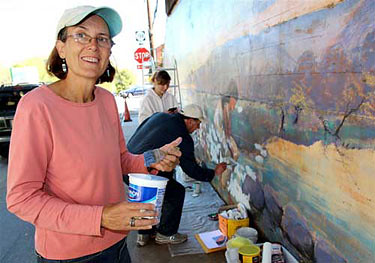
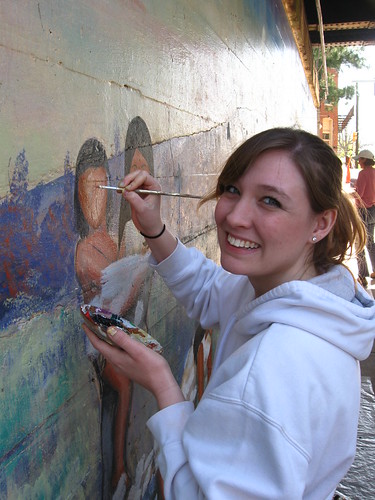
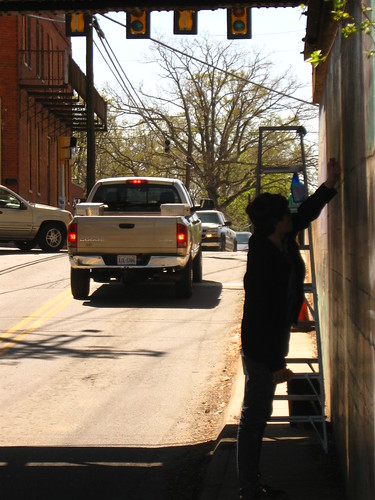
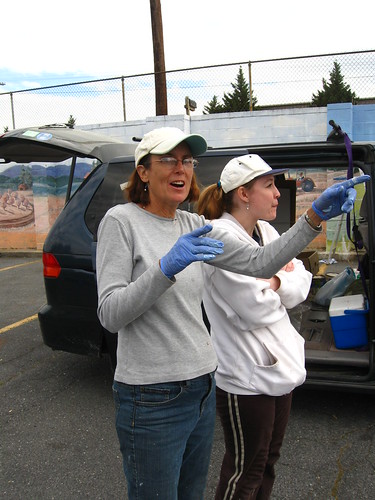
Meg West has created a treasury of Crozet scenes on the retaining walls...

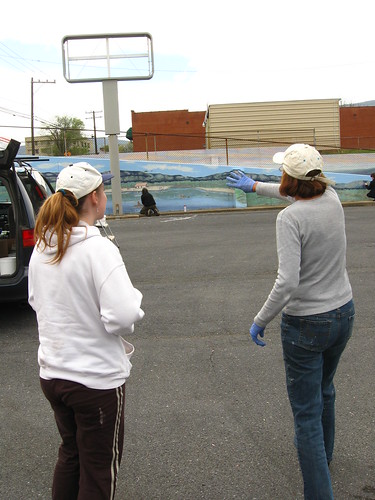
IMG_7385
...and led volunteers in refurbishing them last week as well as the trestle murals. Here she discusses the restoration with Laney Riley.

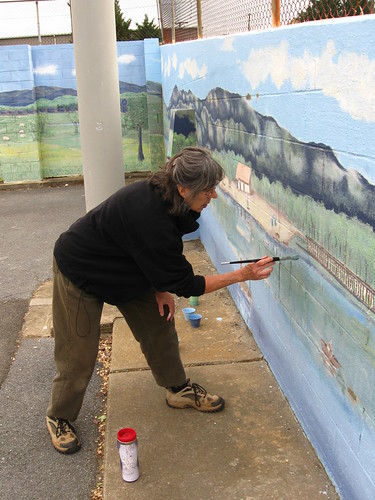
IMG_7388
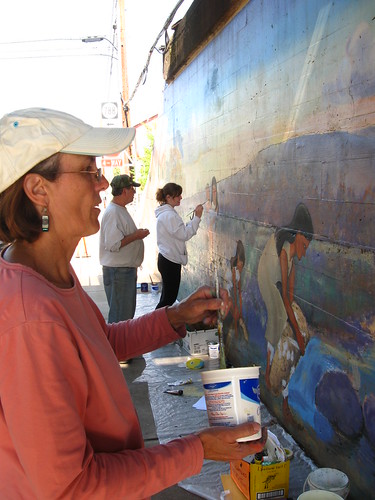
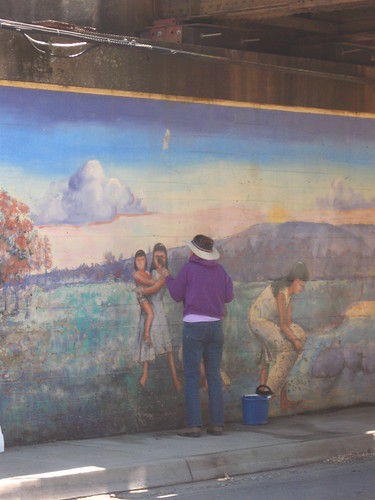
Debbie Little touches up the mural of Mint Springs Park's beach...

IMG_7389
...while Morgan Munson repaints a mountain.

IMG_7391
The Blue Ridge Mountains.

IMG_7390
We have no idea who created this chalk drawing on the wall of the shopping center itself.

laneyadvrt

Thursday, April 12, 2012

THYME Magazine

Citizen Journalism with a Better Flavor
thyme0415
Volume IV, Issue XV

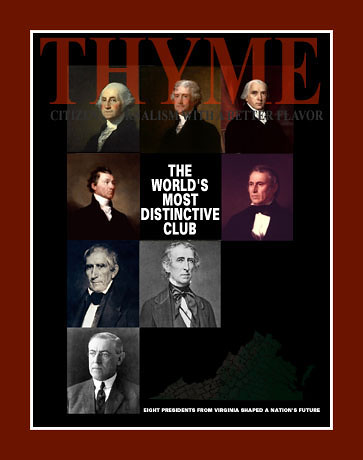
The World's Most Distinctive Club

Eight men from Virginia shaped the world we live in. The 'other' weekly news magazine this week calls the fraternity of Presidents: "the most exclusive club in the world." Virginia is sometimes referred to as the "Mother of Presidents" because eight U.S. Presidents come from the state.

George Washington led the fight that preceded our founding. He was President of the Continental Congress and led the Continental Army. When Congress failed to pay the Continental Army, Washington rode out to intervene, saving the young nation. He was the first President of the young United States. John Adams of Massachussetts followed as the second President. Then three other Virginians followed.

Thomas Jefferson, who drafted the Virginia Statute of Religious Freedom and the Declaration of Independence was our third President. He bought the Louisiana Purchase from France and more than doubled the size of the country for 15 million dollars. Napoleon Bonaparte badly needed the money. The Mississippi River would open up a whole new world. Jefferson also asserted America's right to the seas by standing up to the Barbary Pirates.

James Madison, our fourth President, is known as the Father of our Constitution. He was President during the War of 1812 when Washington City was burned by the British.

James Monroe was next in line. He had been sent by Jefferson to France to negotiate the Louisiana Purchase. His Monroe Doctrine told European powers to stay out of South America.

William Henry Harrison was our ninth President. He had fought in the War of 1812. He has the dubious distinction of having been killed by his inaugural address. Contracting pneumonia after giving the speech on a very cold day, Harrison died a month after taking office. His was the shortest term of office of any American President.

John Tyler, his Vice-president succeeded him, becoming the tenth President of the United States. He was referred to as "His Accidency" because of this. He was the first President to be married while in office.

Zachary Taylor, of Orange County, Virginia, became our twelfth President. A career soldier who had fought in the Mexican War, President Taylor died after sixteen months in office.

Woodrow Wilson, born right here in Staunton, Virginia, became our 28th President. He was President during World War I and aferwards worked to establish the League of Nations. A leader of the Progressive Movement, Wilson pursued an agenda that included the Federal Reserve Act, Federal Trade Commission Act, the Clayton Antitrust Act, the Federal Farm Loan Act and an income tax. Interestingly enough, Wilson's early career took place far from Virginia. He was President of Princeton University and then Governor of New Jersey before running for President in 1912.

oped2112chu

Raising Five Kids Isn't Work, Staffer Says

Obama staffer Hilary Rosen has hit a nerve when she says that Ann Romney hasn't 'worked.' In Rosen's eyes, taking care of five children is not 'work' of importance. My Mother raised five of us and once rolled her eyes when Barbara Walters admitted she didn't know where to buy Gatoraid! Mom had worked in the engineering department of the Martin Company. After she married Dad, she would take her slide rule to the A&P Grocery Store and do her own 'unit pricing' before the stores instituted it. She would illustrate Zeno's Paradox by continually dividing the last piece of the last piece of pie.

This was one of Mom's best lectures. She'd cut the pie into eight pieces instead of the flawless seven she usually did. Then she'd keep dividing until the pie filling refused to cooperate with the lesson. Her kitchen was a place full of learning and wonder.

We raised our young daughter with a program called Joy School in her preschool years. Mom would have loved it. Richard and Linda Eyre, a couple in Utah invented it. [1.] I'm sure Ann Romney availed herself of resources like this.

The administration distanced themselves from Rosen's remark, but the remark was an honest window into the thinking of those who are running the country right now.

"Of course they had to disown Hilary Rosen. She was egregiously honest. She told people exactly what she genuinely believed. She has no understanding of; and no respect for a woman who could do anything with her life and considers raising her children the highest possible calling. Hillary Rosen considers this a waste of time and talent. It makes her a perfect representative of the anti-traditional left. The only thing she did wrong, in the reptilian eyes of David Axelrod, was publically admitting it." -- Red State

In fact, Red State wonders about The Administration's Record [click to read] on paying female employees.

On March 15, 2012, THYME Wrote:

"But looking at Proverbs 31, we run the risk of cheapening the true value of a person if we reduce her to simply a wage earner, albeit a powerful one. A while ago I asked a young artist to help me in the studio. I told her: "I'm not going to pay you what you're worth, I'll pay you what the job is worth. If I had to pay you what you are worth I couldn't afford you." That distinction comes to mind as we ruminate on the value of our wives and daughters to our family and society. Every now and then someone will try to assign a number value to the service of a women who takes care of her home and family (not working outside the home). It is always in six figures and that calculation makes a great point. There are many great people who's influence far exceeds their monitary earnings and society is the richer for it."

Lynn Has This to Say [click to read] as a homeschooling Mother who raised and educated her own children:

"So some parents don't think it "takes a village" to raise our children ... we take the responsibility of doing it ourselves. Not every stay-at-home mom is rich ... we sacrifice, scrimp, and do without to create a family atmosphere. Barack Obama's "female gap" advantage may have just taken a blow. Why can't liberals MYOB?" -- Lynn Mitchell

My suspicion is that the administration is well aware of what an asset Mrs. Romney is to her husband and her family. Otherwise, why would they bother to attack her?

16303803305723521838

Monday, April 9, 2012

Homage to Thomas Kinkade

The 'Painter of Light' Enters the Kingdom of Light

thomas-kinkade
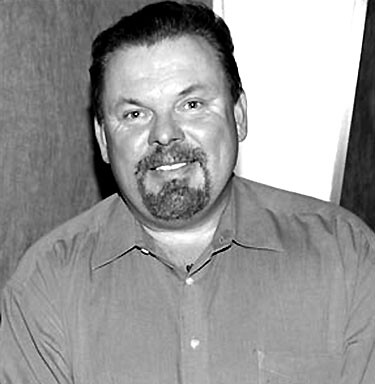
Thomas Kinkade.

A Milestone Monday Feature

“There was a time when artists were cultural leaders, revered within society as visionaries, people who might point the way to a better world, a better life. America's nineteenth century landscape painters embodied the notion of eminent domain, for example their visions of the overwhelming, overpowering beauty of vast landscapes of the American West were captured in paintings that, to the common imagination, became icons of Westward expansion. They became messages of America's power that was yet untapped; a very powerful, constructive form of art that really symbolized the times. I could cite dozens of other examples where art was not only a part of society, but when the artists became important leaders in society." --
Thomas Kinkade


Homage to Thomas Kinkade
With an economy of deft strokes, Kinkade was able to capture the play of light on leaves. Details of his paintings are a masterful composition of abstracts that blend to create his glowing scenes.

Saturday, April 7, 2012

Easter Greetings from the Journey

Celebrating Ressurection and Renaissance

IMG_1400aaa
Have a blessed Easter.

Work Continues Today on Crozet Mural

Crozet Gazette Features Restoration Project
A_Crozet_Mural
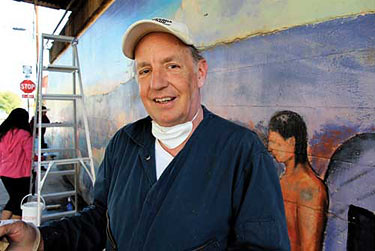
Bob Kirchman, Laney Riley, Soobin Choi and Shuhui Wu begin the mural restoration. Photo by Mike Marshall for the Crozet Gazette, used with permission.

The Crozet Gazette featured the story: Trestle Murals Get Refurbished [click to read] in the latest issue.

A_Murals-Meg-West

A_murals-Laney-Riley

A_murals-Bob-Kirchman
The project artists: Meg West (top), Laney Riley (center), and Bob Kirchman. Photos by Mike Marshall for the Crozet Gazette, used with permission.

laneyadvrt

Thursday, April 5, 2012

Work Continues Today on Crozet Mural

Bridge Mural is Now Mostly Repainted

at1

at2

at3
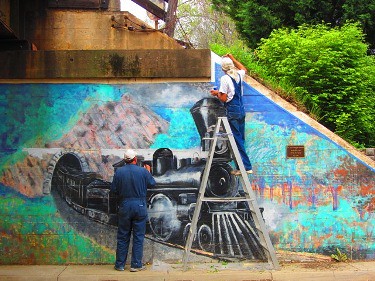
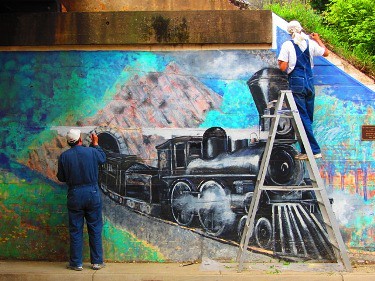
Repainting the train. Photos by Linda McNeil.

IMG_7380
Freshly repainted Monacan.

THYME Magazine

Citizen Journalism with a Better Flavor

thyme0414
Volume IV, Issue XIV

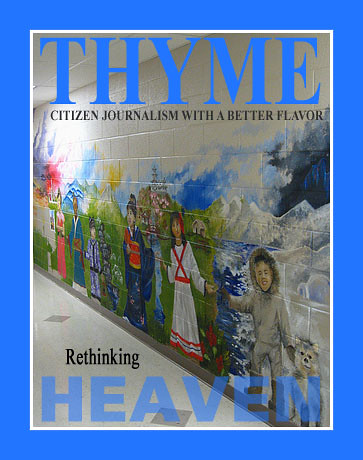
Rethinking Heaven

The 'other' Weekly News Magazine [click to read] has the cover story: "Rethinking Heaven." With Easter just around the corner I held my breath for another intellectual brusharound of the subject of Faith. I was happily surprised to see the story open with a mention of "Heaven is for Real" by Todd Burpo. The book describes what a young boy saw when he had a unique experience during an emergency appendectimy. Here is the video version:

A Little Boy Describes His Time in Heaven


Unfortunately the article then wanders off into the realm of modern theologians who deny the existence of Heaven or Hell. Toying with the obvious behavior modification advantages it might have created in the hands of the Church:

"The main article in this week’s Time Magazine, Rethinking Heaven, by author John Mecham, calls into question the concept of Heaven; Hell, too. Many recent biblical scholars have overtly stated that neither exists despite what is said in Sunday School. Of course, with that reward-punishment concept gone, the leverage of ‘the church’ is also weakened. For it is in the pews where good Christians are taught and warned about sin, where the carrot of Heaven and the stick of Hell are dangled over their heads by the good preacher. But, what if it was all just a hoax? A ruse? A control-agent? Well, then, there wouldn’t be a need for a Sunday worship service. And no money in the collection plate." -- Man with the Muckrake Blog [1.]

Unfortunately, those who would diminish Heaven must overcome some serious history.

You Can't Understand Western Civilization Without It

IMG_0972
Leaves in a pool of water in Jarman's Gap.

This Survey [click to read] featured in Jewish World Review should give one cause to consider the implications of education as an entirely secular pursuit.

"You can't understand Western civilization unless you understand religion," she said. "How can you understand your cultural heritage in terms of art? How do you understand literary allusions in novels? Even a non-religious person needs religious literacy to understand he artifacts of our civilizations."

Indeed, I have written before about how much of what we value in our culture today has its roots firmly in faith that prompted men and women to live out their convictions and in the process they made society a better place.

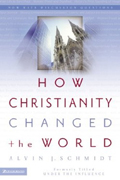
How Christianity Changed the World
Schmidt
Originally published as:
Under the Influence,
Alvin J. Schmidt
Zondervan, 2001

Here is a book that really ought to be on your reading list. As we prepare to celebrate the wonder of Emmanuel -- "G-d With Us," it would be interesting to consider the historical influence of the Christian faith in out civilization. Obviously many modern writers consider it not all that great, or even destructive. They point to such events as the Crusades and the Spanish Inquisition and conclude that religion is not such a great influence on society. An atheist group in England is buying bus ads that say "why believe in G-d, Just be good for goodness' sake." Just in time for Christmas, no less, and using red and green lettering.

But such thinking ignores a vast body of history where men and women, inspired by their faith, abolished slavery, instituted humane treatment of the poor and mentally ill and generally lifted the situation of their fellow citizens. What good is "good for goodness sake" if good is not defined from a higher source. Indeed one can then make the conclusion that it is 'good' to kill six million members of another race. It happened in Twentieth Century Germany. Hitler may have appealed to Christianity in his speeches, but his actions go against the clearly understood teachings of the Faith. Study the life and death of Deitrich Bonhoffer and you will understand where the principles of his beliefs led one citizen to actively oppose the policies of Hitler.

It is a mistake to assume that Western Civilization is automatically 'Christian.' Schmidt looks back to the days of the Roman Empire, when Christians were the ones who rescued unwanted children from destruction and the Middle Ages, when Christians cared for the victims of plague that most simply shunned. Time and time again, Christianity is seen leading men and women to challenge the default direction of Western civilization.

We will read Dicken's 'A Christmas Carol' this coming Christmas season, but will we stop to think of how Charles Dickens was addressing social issues of his day. And what of William Wilberforce, the British parliamentarian who, moved by his faith, labored half a century to abolish slavery in the British possessions? When Dorethea Dix and Florence Nightengale improved healthcare methods, it was their faith that moved them.

Schmidt provides a great body of scholarly research to bring this forgotten history to light again. One point I take from his writing is that Christianity is at its best when it speaks into culture. It has been rendered less effective by its present 'mainstream' status [as when it is seen as a branch of the Republican Party]. It is all too easy to hijack the language of faith without embracing its life-changing path of discipleship.

Theodore Dalrymple writes in City Journal: "What the New Atheists are Missing." Himself a non-believer, he points to a time when a teacher's hypocrasy led him to question. Dalrymple does not, however, reject the realm of faith as a force in creating and ordering societies. He see's naturalistic explainations and philosophies quite insufficient for dealing with all of human existence. Richard Dawkins' assertions that religious education is tantamount to child abuse, for example seem to Dalrymple no more than the rebellious ranting of a child who's just learned that his parents are not perfect. All of us have experienced some sort of disillusionment in our youth. I remember a time when a nun of the 'Sisters of Mercy' punished me for some infraction I had not [at least in my recollection] committed. I too questioned a lot of things. The Cuban missle crisis fueled more unanswered anxiety as I careened into adolescence.

But something happened in my teenaged years that is etched firmly in my memory. It was a dark and stressful winter day when I decided to walk in the woods near Triadelphia Reservoir. Something spoke to me that afternoon that was more eloquent than the ranting of hormones and the perceived unfairness of life. The buds of the trees were growing fat. here was the hope of spring and new life. Clearly spring would come. The buds gave evidence of an event hoped for. They were indeed the substance of something yet unseen!

"For the invisible things of him from the creation of the world are clearly seen, being understood by the things that are made, even his eternal power and Godhead; so that they are without excuse:" -- Romans1:20 KJV

Holy writ makes the point that the order and beauty of the creation speaks eloquently of the creator. Thus Intelligent Design, though it merely points out the complex mechanisms of nature, leads one to seek the source of such wisdom. I look to that time in the trees as an affirmation of personal faith in a creator. Though at that point it was pretty detatched and intellectual at best.

"...for he that cometh to G-d must believe that he is, and that he is a rewarder of them that diligenly seek him." Hebrews 11:6b KJV

As a young adult I embraced faith in Christ as redeemer and rewarder. The journey of faith had begun with the fat buds years before though.Therefore I must conlude that those who consider the design of the universe dangerous information have good reason if they fear that others may follow the path I have walked. Dawkins would prefer me to credit space aliens with seeding life to this planet and thus push the hard questions of origin to another world. Darwinism, in its purest form, rejects the idea that this world is some sort of intentional creation. Of course this leads to the rejection of theism and ultimately the rejection of certain absolutes. The film 'Expelled' takes a good look at 'eugenics' and how it is supported by a darwinian world view. In the first half of the Twentieth Century certain proponents of eugenics sought to speed evolution along by eliminating the reproduction of certain undesirable types of persons. The results were forced sterilization of the mentally ill and the holecaust. Contrast that movement with Dorethea Dix and others who, motivated by Christian faith, improved conditions for the mentally ill.

Alvin Schmidt makes a good case in his book 'Under the Influence' that faith is a builder of society rather than a force to destroy it. Dalrymple the non-believer would concur. Thus the danger of Christian principles such as 'intelligent design' leading to dangerous conclusions is much inflated. One might even conclude that the free discussion of order and design,wherever it is found, is wholesome. Certainly there is no basis for its exclusion from the academy.The argument will no doubt be made: "what about the crusades, what about jihad, religion is dangerous?" Yes, it is certainly something that may be missused, but that must be countered with an honest look at how the so-called "good" science of evolution was the foundation of eugenics. Millions of people were killed in this misguided attempt to improve humanity. Ironically, such brilliant men as Albert Einstein met the criteria for elimination. We reduce the world to only naturalistic explainations at our own peril. The argument for open inquiry, with men and women of Faith seated at the table, stands.

New Maple

"When through the woods,and forest glades I wander,
and hear the birds sing sweetly in the trees;
when I look down,from lofty mountain grandeur,
and hear the brook and feel the gentle breeze"
-- "How Great Thou Art" Verse 2

IMG_3241
Detail of a Mural by Laney Riley and Bob Kirchman depicting the promise of a New Heaven and a New Earth.

Heaven, the great hope of Saints of old has grown less "real" to modern man. Insulated from death and many of the challenges of our forefathers, the hereafter takes less of a place in our minds. Yet life is but for a short span. We do well to consider the implications of eternity.

Jesus

Wednesday, April 4, 2012

Work Continues Today on Crozet Mural

John Pembroke, My Fellow Crozet Muralist

IMG_7317aaa
Nineteen years ago, John and I partnered to create the Crozet Mural project for the Crozet Community Association.

Fix the Economy and You Fix Education

A Healthy Economy is Essential to Future Generations

openlawn
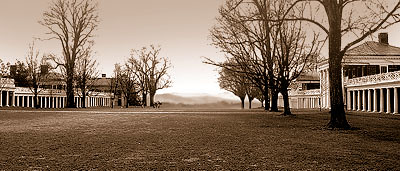
Jefferson's 'Academic Village originally opened to the surrounding farms of Albemarle County. Photos and rendering overlay by Bob Kirchman.

Guest Editorial by Michael Cogar

Today, Vice President Biden is in Virginia speaking about making college affordable. This is quite ironic considering the fact that since President Obama has taken office, the cost of tuition at a four year in-state college has increased 25%. Furthermore, in Virginia the average college student graduates with $23,327 in student loan debt.

For someone who was so concerned with the youth in 2008, he has an interesting way of showing it. Obama’s most recent plan for increasing college affordability has done next to nothing to address the problem; rather, it is simply pandering to get the youth vote. In fact, it is estimated that his proposals would save the average student less than $10 a month.

“If the President wants to help recent college graduates, why are 40% of us forced to move back in with our parents? Why is our unemployment rate still much higher than the national average? Mr. President thanks, but no thanks. We don’t need your handouts. I’d rather elect a President who can fix the economy and reduce the size of government in order to get my generation back in the workforce.” – Michael Cogar, College Republican Federation of Virginia Chairman

It's Time to Refound Our Universities

They've Strayed Too Far from the Noble Purposes of their Founders

Rotunda
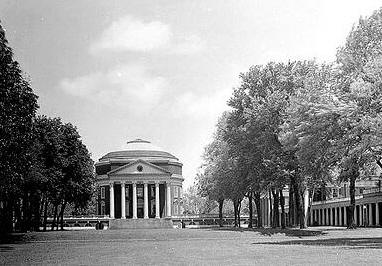
Jefferson's Rotunda, the center of his 'Academic Village.' Photo by Rufus Holsinger.

Did you know that Hamas enjoys more positive praise on some of our college campuses than it does on the West Bank? Just ask Khaled Abu Toameh, an Arab Muslim with Israeli citizenship who used to be with the Palestinian media but chose to move to the Israeli press where he was free to speak what was on his heart.

Toameh has observed a 'Pro Palestinian Junta' taking place on U.S. campuses as Middle-Eastern studies professors promote a pretty one-sided picture of a complex situation.

There is a problem here. Most of the kids attending 'Code Pink' antiwar presentations have never been to Israel and are swayed by the speech of people who conveniently ignore the nature of jihad and the refusal of Palestinian spokesmen to recognize Israel's right to exist. Playing on sympathy for the victims of this situation, they ignore the reality that many Hamas policies have continued the harm. They forget that the pullout from Gaza left the people there with beautiful greenhouses and the possibility of taking part in the 'miracle' agriculture that the region had enjoyed under Jewish control. The Palestinians trashed the facilities, shot rockets at Sderot and chose instead to live supplied through tunnels from Egypt.

Years ago, my sister-in-law was a young idealist who chose to go live with the Sandinistas for a bit, obviously inspired by some academic. Problem was when you actually got there you saw that the Sandinistas were not such idealists at all.

May I make the controversial statement that $20,000 a year is a bit much to be paying for such indoctrination.

Guardians of the Gate

Why do they get away with it? There is only one reason. They are the 'guardians of the gate' to a number of important and well paying careers. The computer revolution has begun to chip away at that as many young people have been able to bypass the four or five year path that was traditionally perscribed for success. That is not a bad thing, howls about lacking "well roundedness" aside.

In the Seventeenth Century colleges were founded in this land to train well read leaders and reach the Native population with the Gospel. That's why Dartmouth and William and Mary have Indians as mascots. A gentleman such as Thomas Jefferson was schooled in practical arts, such as Architecture, along with his Classical education.

Fast forward to the Twenty-first Century. Western Civilization has been effectively eliminated from the curriculum. Beauty and truth have been reduced to relative terms. They still exist, but not at the academy.

A Modest Proposal

Every year large coprporations hire the graduates of such prestigious institutions and then lament that they are then required to actually train them for the work! To add insult to injury, they are cooerced through alumni associations and endowments to pony up to maintain the status quo.

Here is the modest proposal. Industry and medicine need to reinstate the apprenticeship system of old and take the money they are throwing into a failed sytem to found their own institutes of Art, Architecture, Engineering, Medicine [yes, Medicine]! Hospitals need to own and operate the training of physicians.

Building upon the existing Community College system, they can provide the well-rounded education that Seventeenth Century students received. Prolonged adolescence would be replaced by a productive young adulthood and knowledge would be acquired over a lifetime instead of in a four year attempt to "force feed" young people who are frankly more interested in other things.

Citizens would pursue continuing education in their field and also in arts and letters. My own Father is my perfect man as a model of the Citizen-Scholar. He barely made it through high school and his advisor wrote a letter saying that he could not recommend that my Father pursue Engineering as a career. Dad went to a junior college for a year before applying to Notre Dame where he did indeed pursue his Engineering degree. Upon graduation he went to Wright doing structural analysis on aircraft. Eventually he ended up at the Martin Company in Baltimore doing structural analysis on the seaplanes used in the Pacific Theatre during WWII.

He married his chief number cruncher and eventually left Martin to start his own lab. He had one of those shop/garage units that plumbing contractors rent and he built shock and vibration test equipment in there. Eventually he was hired to write the test procedures for NASA. He became a department head there, having created a lot of the quality assurance methodology for spacecraft.

But I've digressed. In Dad's day they really did train Engineers who couldn't read and Liberal Arts Scholars who couldn't count. Dad slowly aquired a magnificent library and schooled himself in letters. He read all the noble works of Western literature and probably could have taught the courses! He was equally at home reading Plato or dissecting a roto-tiller. My complete man!

When I was twelve, he said "build me a greenhouse" and offered more moral support than knowledge as I did my own research and drew plans for the thing. He gave me a budget and helped me place the rafters. When I secured a good price for a set of old storm windows I think he was pleased. The redwood structure didn't succumb to termites until Reagan was president.

Farmington
Thomas Jefferson designed this addition to Farmington as well as Monticello and the University of Virginia.

Tuesday, April 3, 2012

Work Continues Today on Crozet Mural

Restoring the Mural Continues with Repainting

IMG_7292
Meg West works on the forground...

IMG_7288
...While Laney Riley repaints the Monacans.

IMG_7295
All day long people stopped to watch. Here Meg and Laney work while a gentleman observes the progress. Many people shouted "thank you!" to the muralists as they worked.

More Pictures [click to view].

laneyadvrt

First Iris in the Springtime Garden

Warm Weather Wonder in Full Force

IMG_1386
An iris blossom greeted me when I returned from muralling yesterday.

Monday, April 2, 2012

Work Begins Today on Crozet Mural

Monacans, Settlers and Railroad Builders

IMG_7277
Student volunteers clean the mural...

IMG_7276
...while Meg West touches up damage.

laneyadvrt

The Painting of the Crozet Historical Mural

Scenes from the Original Painting of the Mural

crozet0001
On October 26, 1993 the work began with power washing the concrete...

crozet0000
...then continued with Western Albemarle High School students painting the landscape...

crozet0003
...and was finished by December of that year. An earlier post incorrectly dates the mural to 1992.

laneyadvrt

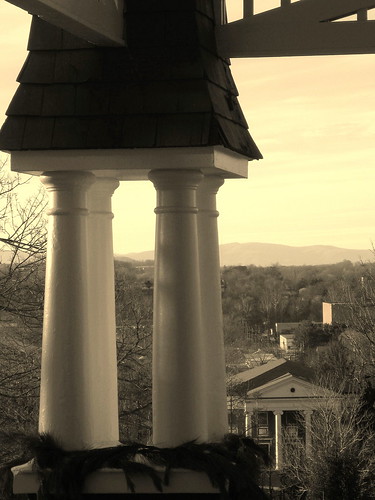
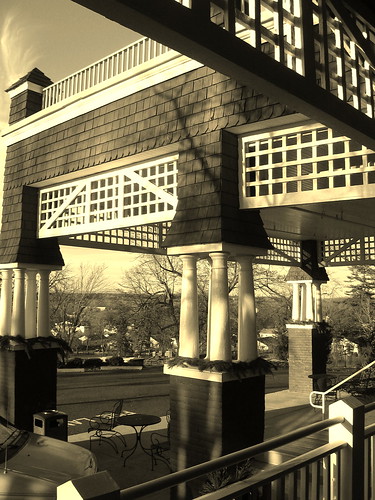
Fairfax Hall, the Old Brandon Hotel

Basic City Landmark Lives On as Apartments

Fairfax Hall

Columns

Portico

Sunday, April 1, 2012

The Greatness of the Grid

The Perfect Example of Basic City is Basic City

Basicmap
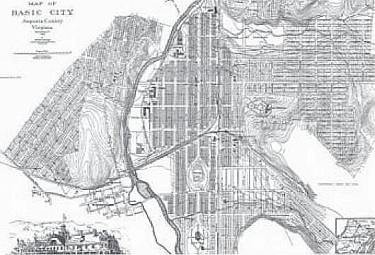
Basic City, laid out in 1890, eventually became the Eastern portion of modern Waynesboro.

"If the intelligence of a city can arise from the circuitry of its streets, then the street grid made a genius out of New York. In 1811, three state commissioners laid down Manhattan’s rectangular blocks. From First Street to 155th Street south to north and First Avenue to Twelfth Avenue east to west, their new grid obliterated the old lanes and farmhouses dotting the Manhattan countryside north of Houston Street, with few exceptions. Yet in trading away its past, the city built its future. The grid became the urban version of a super computer, a chipset to super-charge the city’s growth." -- James Panero

James Panero explores The Greatness of the Grid [click to read] in City Journal, discssing the 1811 plan that defines Manhattan today, a city who's first commissioners could hardly have envisioned. The grid they laid down has become a tool for the design of this great metropolis along with some important intrusions such as Broadway and Central Park.

The American city that developed in the Nineteenth Century almost exclusively is built around the grid and interesting variation overlaying it. Washington DC is basically the grid overlaid with the Hunting Gardens of Versailles. Philadelphia has its squares. Small cities have their courthouse squares and pre-planned parks, such as those in Basic City, Virginia, now the Eastern portion of Waynesboro. Harrisonburg, Virginia's Romanesque Courthouse dominates a central square and becomes iconic.

San Francisco's topography intrudes nicely into the grid and here is where true urban genius can be seen. It is the variations that make it magnificent. Intrusion is what is missing in some of the more mundane grid cities of the plains.

Hopefully there is a lesson here that might enliven our future economic development efforts. The grid was a great engine of planning and in the end created better design than a lot of our modern 'Town Centers,' which are nothing more than Brobdenagian Cul-de-sac neighborhoods with ample parking.

Early Incubator of Innovation and Industry

The founders of Basic City looked at the converging railroads and saw an opportunity to develop a steel industry. The Basic City Mining, Manufacturing and Land Company laid out an ambitious city grid. A Natural Gas Company, founded in 1891, even drilled a test oil well which failed to produce. The great blast furnace envisioned by founder Jacob Reese never was finished. The Panic of 1893 ended the first era of optmism.

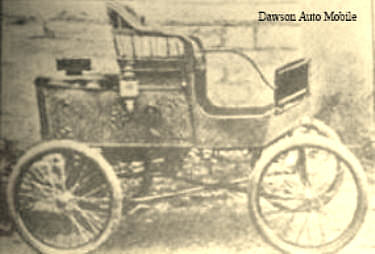
Other industries did rise and flourish however. The Dawson Manufacturing Company built the first automobile to be built in Virginia, a steam powered automobile! In the Twentienth Centry the great Dupont plant employed thousands. Today the region still stands at the crossrads of major transportation arteries and has the opportunity to design itself as a center of ecomnomic activity for the Twenty-first Century.

Dawson
Steam powered car built by Dawson Manufacturing Company in Basic City.

Fairfax Hall
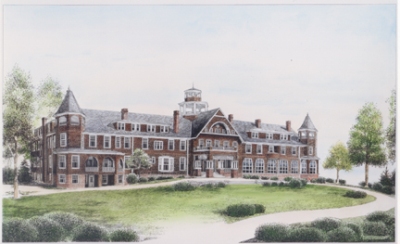
Fairfax Hall, originally the Brandon Hotel, once lured visitors to Basic City. Drawing by Bob Kirchman.