Wednesday, March 30, 2011

Robert E. Lee's Artist Father-in-law

George Washington Parke Custis' Arlington House

IMG_2699 The columns of Arlington House.

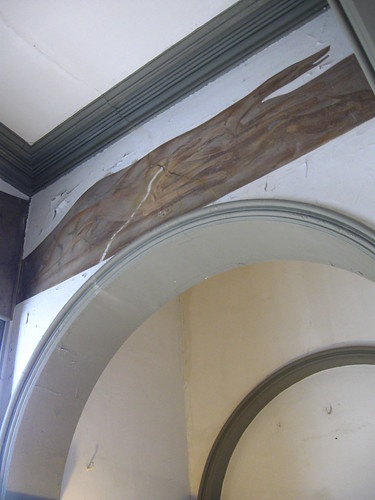
George Washington Parke Custis was the Father-in-law of Robert E. Lee. He built Arlington House as a tribute to his step-grandfather George Washington. The hallway features frescoes above the doorways that Custis painted of hunt scenes.

IMG_2828Hounds pursue a rabbit.

Tuesday, March 29, 2011

Cherry Blossoms in Washington

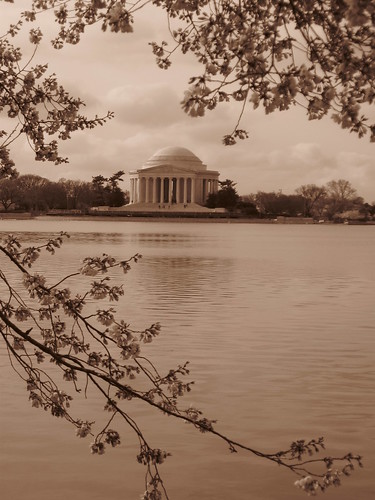
A Cold Morning by the Tidal Basin---------------------- _________________________IMG_2815 Cherry blossoms frame the Jefferson Memorial. Photo by Bob Kirchman. We have been working at Fort Meyer and stopped over in Washington to see the Japanese cherry trees. They seemed really beautiful this year. More Photos [click to view].

Friday, March 25, 2011

THYME Magazine

Citizen Journalism with a Better Flavor
thyme0313
Volume III, Issue XIII

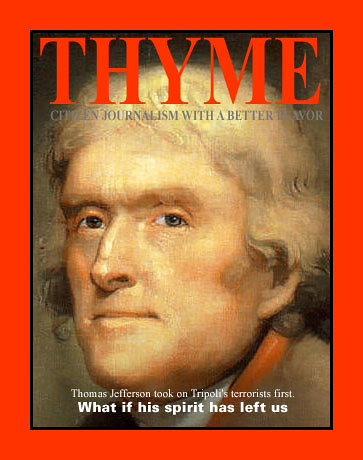
Remember the Barbary Pirates?

Jefferson's Muslim problem came about long before the current issue of the 'other' weekly news magazine asked of Col. Muammar el-Qaddafi: "What if he doesn't go?"

The real question is how long will it take for us to realize what a bad idea it is to diminish America's reputation for strength and decisiveness in world situations.

At the beginning of the Nineteenth Century, America faced the threat of North African pirates who captured our ships and imprisoned their crews. Jefferson was advised by other nations to pay tribute money like they did in order to protect our sailors. He sent the Marines instead.

The rest is history and Tripoli is still remembered in the story of our Nation's beginnings. A Century later, the White Fleet would circle the globe. America stood in the way of the National Socialists as they sought to take over Europe. Then she stood in the way of the Communists. More often than not, American strength has stood in the way of tyrannies that would render the world we live in a very bleak place.

Concert at Christ Lutheran Church

An Evening of Beautiful Music Offered to the LORD

pipeorganfront2
The organ at Christ Lutheran Church in Staunton.

Tonight my lovely wife and I were treated to an evening of beautiful music played by Jonathan Greer, organist for Christ Lutheran Church. He performed beaurtifully pieces by J. S. Bach, Theodore Dubois and Louis Vierne.

After a wonderful offering of organ pieces, he sang a duet with Laney Riley (my muralist friend) of "Nella Fantasia." His tenor voice and her soprano blended beautifully to convey these beautiful thoughts:

(English Translation)

In my fantasy I see a just world,
Where everyone lives in peace and honesty.
I dream of souls that are always free
Like the clouds that float
Full of humanity in the depths of the soul.

In my fantasy I see a bright world
Where each night there is less darkness.
I dream of spirits that are always free,
Like the clouds that float
Fullof humanity in the depths of the soul

In my fantasy exists a warm wind,
That blows into the city, like a friend.
I dream of souls that are always free,
Like the clouds that float
Full of humanity in the depths of the soul.

Wednesday, March 23, 2011

We've Been Dating 32 Years Today!

One Really Great Thing that Happened in 1979

Old Rag
My lovely wife and I climbed Old Rag together! Photo by Maggie Stein.

Today I celebrate the anniversary of my first date with the most amazing and lovely human being that I know. I first met Pam at the little church we both attended in Charlottesville. We became friends largely through the ministry of Louise Via, a woman who loved to encourage young people and had a potluck supper in her home. Little did we know that G-d was to use Mrs. Via as a matchmaker for several couples... including us!

In fact, some of us guys found our inner chivalrous selves around Louise and the beautiful young women she befriended. One evening I found myself shovelling snow from Mrs. Via's steps for the sheer joy of service! I had no idea what the LORD was up to. Ulterior motives?, Nah, I was ready to head for Alaska. Maybe working in an oil camp or some adventure was what my restless soul needed.

Our friends Coy and Nancy were already engaged (Louise's magic at work). He was in school in Atlanta now and she was working at UVA medical center. One evening Nancy's car wouldn't start. I went to see if I could start it with Nancy and Pam. Coy was coming in for the weekend so when he showed up later that evening... I was taking my future bride home.

Now, dear reader, I must take issue with anyone who would deny that G-d is a romantic of the strongest type! As both of us conversed about our past unrequited loves, a spark of out-of-the box Divine Epiphany took hold. I asked her out!

We went to dinner at Sal's Italian Restaurant in Shopper's World on 29 North. Imagine us at Maria's or Scotto's. Emilio's would be way too fancy compared to Sal's. We went to see Norma Rae with Sally Field... a movie that begins with beautiful shots of mill interiors and chronicles the early attempts to unionize Southern America's now largely defunct textile industry.

What started out as a nice evening shared with a beautiful friend has gone on for 32 years now. I asked her to go hiking with me. We walked from Milam Gap to Hoover Camp and ate sandwiches that I made for the occasion. I really enjoyed being in the woods with her.

I brought her daffodils. She accused me of stealing them out of someone's yard! We started spending a lot of time together. Alaska would just have to wait.

Our friends Coy and Nancy needed to move her furniture to Atlanta. We packed it into the back of my large black Ford pickup and Pam and I drove it to Georgia.

I wanted to show Pam Stone Mountain. My college friends and I had visited this granite mountain a number of times. We rode the tram to the top and walked down.

We got caught in the rain... a sudden storm drenched us. We were laughing and walking down the trail when I said to her: "I want you to be my wife!" She replied: "I want you to be my husband!" Then she asked: "Does this mean we're engaged?" I assured her that it did... I didn't have a ring yet; this was totally a Divinely inspired moment.

We were married on May 24, 1980.

Monday, March 21, 2011

Virginia Woman Killed in Tsunami

After Quake She was Reuniting Parents and Children

taylor-anderson
Taylor Anderson

RICHMOND – Governor Bob McDonnell issued the following statement today as the family of Chesterfield teacher Taylor Anderson was informed that her remains had been discovered in Japan following the earthquake and tsunami, making her the first American confirmed to have been killed in the natural disasters.

“It is with great sadness that we learned today of the tragic loss of Taylor Anderson, the selfless young teacher from Chesterfield County who has become the first American known to be killed in the Japanese earthquake and tsunami. We have watched the events unfold in Japan with heavy hearts and compassion for all of those who were impacted in this significant natural disaster. The discovery of Taylor’s body earlier today brings home to Central Virginia the emotions and impact of these terrible events that we have watched unfold on television. We have held out hope that this graduate of St. Catherine’s School and Randolph-Macon College would be found alive and well. And, we have prayed for her family during the difficult time of uncertainty since Taylor was last seen leaving the school where she taught English to Japanese students following the earthquake. Fittingly, she was last seen helping parents safely reunite with their children following the earthquake, an act which illustrates her dedication to her students and to the Japanese people she served. Today we join the Anderson family in mourning the loss of a wonderful young Virginian who personified the selflessness and sense of duty that Americans serving abroad have become known for. Our thoughts and prayers remain with Taylor’s family and friends during this difficult time. ”

Miracles are All Around Us

Keep Your Eyes Open... G-d has Wonders to Show You

Dogwood
"People can't see who the real G-d is because they can't see the simple miracles around them anymore." -- Laney Riley
Photo by Bob Kirchman.

Miracles
by Walt Whitman

WHY! who makes much of a miracle?
As to me, I know of nothing else but miracles,
Whether I walk the streets of Manhattan,
Or dart my sight over the roofs of houses toward the sky,
Or wade with naked feet along the beach, just in the edge of the water,
Or stand under trees in the woods,
Or talk by day with any one I love—or sleep in the bed at night with any one I love,
Or sit at table at dinner with my mother,
Or look at strangers opposite me riding in the car,
Or watch honey-bees busy around the hive, of a summer forenoon,
Or animals feeding in the fields,
Or birds—or the wonderfulness of insects in the air,
Or the wonderfulness of the sun-down—or of stars shining so quiet and bright,
Or the exquisite, delicate, thin curve of the new moon in spring;
Or whether I go among those I like best, and that like me best—mechanics, boatmen,
farmers,
Or among the savans—or to the soiree—or to the opera,
Or stand a long while looking at the movements of machinery,
Or behold children at their sports,
Or the admirable sight of the perfect old man, or the perfect old woman,
Or the sick in hospitals, or the dead carried to burial,
Or my own eyes and figure in the glass;
These, with the rest, one and all, are to me miracles,
The whole referring—yet each distinct, and in its place.

To me, every hour of the light and dark is a miracle,
Every cubic inch of space is a miracle,
Every square yard of the surface of the earth is spread with the same,
Every foot of the interior swarms with the same;
Every spear of grass—the frames, limbs, organs, of men and women, and all that
concerns
them,
All these to me are unspeakably perfect miracles.

To me the sea is a continual miracle;
The fishes that swim—the rocks—the motion of the waves—the ships, with men
in
them,
What stranger miracles are there?

Coal Fired Fashion Fantasies

The Gown And the Volt Share this in Common

coalfiredfashion
Coal Fired Fashion! Photo by Laney Riley.

Consumer Reports Tests Coal Powered Car

Most of our electricity is generated by coal fired power plants. That is not news. April's Consumer Reports got its hands on a Chevy Volt. I eagerly opened the magazine to see the bastion of consumer information's opinion of the newest coal fired automobile. To my surprise, there were no big surprises.

The volt is a plug-in hybrid. (Think 'Hack your Prius' technology here). You charge it up by plugging it in to your electric service overnight. The car claims to offer 25 to 50 miles of range on this charge, then a gasoline generator kicks in and extends the range to about 300 miles. Consumer reports has been getting the low end of the electric only range: 23 -28 miles. To be fair, they blame the low distance on the unusually cold winters. They say: "The car's electric range is very susceptible to cold weather, primarily because the heater runs on electricity. We also found that an extended highway cruise shortens the electrical range."

Obviously your driving needs will determine how efficient the Volt is for you.

Mike lives in Fishersville and works in Charlottesville. He has a mountain between him and his place of employment. Most days he'll be lucky to get to Crozet on his electric charge. Then he'll be getting about 30mpg. I'll cruise by him in my 1991 Mazda getting around 38. Since electricity isn't free, I doubt Mike would get any real savings from buying a Volt.

Consumer Report's Volt cost them $48,700. I paid several thousand for the Mazda. Who's ahead, especially when you consider the Volt's heavy government subsidies?

Consumer Reports concludes: "So far, the Volt works as an electric car with a gas backup, but it's not really much of a money saver in many places. Cheaper electricity or more expensive gas could tip the scales in its favor. For now, it seems that owning a Volt is an expensive way to be green." -- a FASHION STATEMENT, perhaps?

Saturday, March 19, 2011

THYME Magazine

Citizen Journalism with a Better Flavor

thyme0312
Volume III, Issue XII

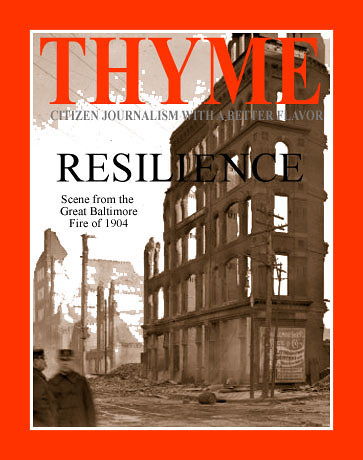
A (Very) Brief History of Resilience

Today our hearts go out to the Japanese people as they face a crisis of enormous proportions. History tells us of how the Japanese people have faced massive devastation before and created the 'Japanese Miracle' in the face of it.

It is interesting to note that the one nation on Earth to actually experience nuclear devastation uses nuclear energy to such a great extent that most of its power needs are supplied by reactors.
One must be careful to do honest assessments of the risks and dangers involved without falling prey to those who would exploit disasters to inhibit energy production. We need to improve our methods in deep water oil production and design better backup procedures for cooling nuclear facilities, but that does not mean we cannot use them at all.

In the wake of the oil spill in the Gulf of Mexico, the administration shut down ALL production. Governor McDonnell of Virginia speaks directly to such overreaction:

“Virginia’s efforts to become the energy capital of the East Coast include innovative, safe and affordable plans for investment in nuclear energy, coal, offshore exploration for oil and natural gas, and offshore wind energy development. It will only be through a combination of these energy sources that the nation will be able to meet its energy demands and curtail its dependence upon foreign oil. Our plans to develop Virginia’s offshore oil and natural gas supplies have been thwarted by the Obama administration’s failure to include drilling 50 miles off the coast of Virginia in the five-year lease plan. Once again, rising gas prices are hurting families and small businesses due to the shortsightedness of overzealous federal regulators.”

More importantly, the unwillingness of the administration to allow domestic energy production makes for a dangerous situation as America must depend on energy sources in unstable areas of the world and pay premium prices for them... putting our national security at risk.

This is not acceptable.

Hall of Industry
The Hiroshima Prefecture Hall of Industry was gutted by the nuclear explosion. Photo by Bob Kirchman.

Hiroshima Peace Memorial Park
Today a bustling city surrounds Hiroshima's Peace Park. Photo by Bob Kirchman.

Close to the turn of the Century a number of American cities burned to the ground. In 1904 the city of Baltimore burned to the ground. San Francisco's great earthquake and the Chicago fire are more well known, but the fact remains that great disasters have affected much of the world throughout history and America has seen her share too.

Hurricane Katrina is often compared to Camille. In 1969 Hurricane Camille came inland and poured torrents of rain upon Nelson County Virginia. This severe drenching caused entire mountainsides to move and many died in the massive mudslides.

Lovingston, the county seat, was cut off from the outside world by musdslides. VDOT had recently completed a four lane bypass of US 29 around Lovingston which was quickly turned into an airstrip for rescue and relief operations. Today US 29 has been rebuilt and Nelson County is a beautiful place to visit. One can still see the scars in the mountains from the great mudslides though.

After the great fire, Chicago rebuilt herself. The early Twentieth Century saw the 'Cities Beautiful' movement recreate the centers of our great metropolises.

Our prayers are with the Japanese people at this time. We pray for their courage, strength and determination as they write the next chapter in the story of human resilience.

Wednesday, March 16, 2011

Thinking Outside the Box...

...Inside a Pipe Organ at Ft. Meyer, Virginia

DSCN6903
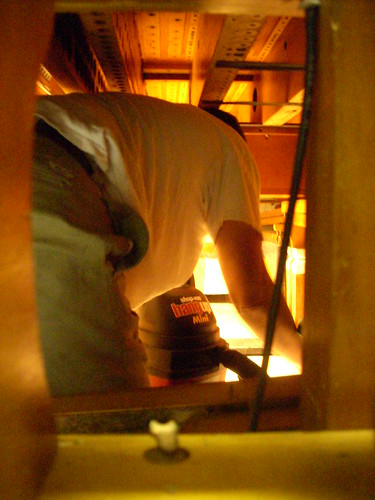
Xaver Wilhelmy is restoring this 1935 Möller Organ in place at Old Post Chapel in Ft. Meyer. We are working right next to the Arlington National Cemetary.

DSCN6902
Here I am after a morning of removing old leather. Photo by Xaver Wilhelmy.

DSCN6904
Cleaning under the wind chest. All the valves have been removed for restoration in the shop. Photo by Xaver Wilhelmy.

IMG_2705
Spring buds in Arlington National Cemetary.

Murder of Innocents in Israel

The World Ignores the Massacre of the Fogel Family

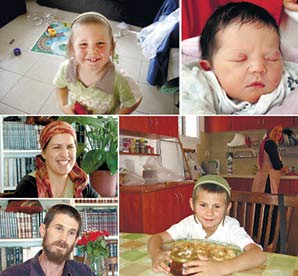
fogel_family
The victims of a knife wielding terrorist.

Dennis Prager [click to read] in Jewish World Review.

"The human being does not have to learn to hate. It seems to come pretty naturally. Nor does the human being have to learn to murder, steal or rape. These, too, seem to be in the natural human repertoire of evils.

But the human being does have to learn to hate children and babies, and to regard the torture and murder of them as morally desirable acts. It takes years of work to undo normal protective human attitudes toward children.

That is precisely what the Nazis did and what significant parts of the Muslim world have done to the word "Jew." To them, the Jew is not just sub-human; the Jew — and his or her children — is sub-animal." -- Dennis Prager


Caroline B. Glick [click to read] in Jewish World Review.

Saturday, March 12, 2011

Prayer for the People of Japan

Devastation in Northern Japan

Japanese Maple
Maple leaves open like an origami crane.

In my garden there are two Japanese maple trees. Every time I look upon them I think of the two wonderful visits to that land. Today I pray for the people of that beautiful land... as they struggle through this time of unthinkable devastation.

Last night I learned that a couple we know who lie near Narita is safe. They didn't even lose their power. Still, the news images of swaying buildings and destructive waves tells me that many lives have been devastated. Pray for the people of Japan.

Thursday, March 10, 2011

Thyme Magazine

Citizen Journalism with a Better Flavor

thyme0311
Volume III, Issue XI

You're Being Tracked.... Search Engine Stalkers

It is not news that the internet search engines are on a mission to know all about you, nor is it news that this information is analyzed, traded and sold. The story is about the rights of ordinary citizens in the 'information age.'

Some information is simply private. The 'other' weekly news magazine this week says: "You're being watched, your information is being sold. Get used to it."

No, thank you. Certainly most data, such as what coffee you prefer, is harmless market study; but there comes a point where the computer search engines begin to look like the telescreen from 1984. The rights of individuals cannot be ignored in this 'brave new world.'

Space Shuttle Launch from an Airplane


Here is a rare sight, the space shuttle taking off as seen from an airliner. Tuesday night I got to see the shuttle pass over Staunton thanks to a visitor we had from the Stokesville Observatory speaking to a 4H group that meets at our church. ht/Joy

Tuesday, March 8, 2011

The First Celebration of Commmunion...

...on the Moon! Apollo Astonaut Remembers


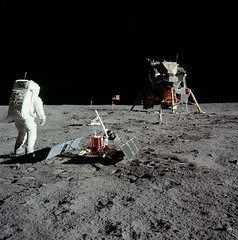
Forty years ago two human beings changed history by walking on the surface of the moon. But what happened before Buzz Aldrin and Neil Armstrong exited the Lunar Module is perhaps even more amazing, if only because so few people know about it.

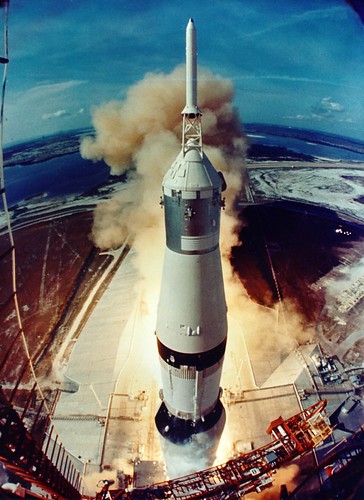
Apollo001
Apollo 11 Lifts off on its way to the moon.

Apollo002

Apollo003
Armstrong after the famous first steps on the moon.

These photos are from The Apollo Archive, one of the best collections of NASA photos I have ever seen. Click Here to enjoy many more fine photos taken by our astronauts.

Friday, March 4, 2011

THYME Magazine

Citizen Journalism with a Better Flavor

thyme0310
Volume III, Issue X

Still First in Freedom to Many in this World

The ‘other’ weekly news magazine is celebrating... er, I mean reporting that America is in decline. I say the ‘reports of her death are greatly exaggerated.’

When the thirteen colonies broke away from England in 1776 they were no world power, yet the Constitutional government they hammered out in the naiscant days of the United States was to become a light for the rest of the world.

True, we no longer possess the tallest building and the strongest economy. Our young people are woefully undereducated in the story of America’s foundations... but those foundations are still to be found, and in many cases they are amazingly strong.

Only about a third of our original citizens favored the Revolution. Another third were Tories and the rest didn’t care. The percentages haven’t changed all that much in recent years. Witness the Tea Party movement. It is substantial, yet there is still a firmly entrenched liberal faction that resists them in our halls of government. Political campaigns are largely targeted at the ‘undecided’ voters... that really don’t care enough to educate themselves and form their own opinions.

The great nation that De Toqueville observed in the Nineteenth Century was no world power, but she allowed the influence of Faith and Virtue to mold her people in ways that would serve her well in difficult days. She was not untouched by sin. Human slavery was institutionalized and events like the removal of the Cherokee Nation are dark chapters in our national conscience, but the values that are our foundations tell us that these chapters are repugnant.

In the 1860’s, our nation was almost destroyed by a vicious Civil War. We survived that period and entered the Twentieth Century. A number of our major cities burned completely to the ground in the first decade of that century. We found the will and means to rebuild them. The ‘Cities Beautiful’ Movement gave us great icons of Classical architecture. The ‘White Fleet’ circumnavigated the world.

Ordinary American boys grew up during the Depression and planted the flag on Mt. Suribachi. General Marshall led the rebuilding of the great cities of Europe.

The sixties brought new challenges as American cities burned and students questioned not only authority, but our foundations as well. Today a lot of these radicals are professors at those same universities. These elites would squander the hard-won peace and prosperity given to them by their fathers. They fail to see the tempering effects of Faith and Virtue. Professing belief in the innate goodness of man, they seek to emasculate America in the mistaken belief that that will allow for the evolution of world societies. The failures of National Socialism and Communism remain unheeded by these thinkers. Still, the Tea Party movement underscores the fact that there is a large group of Americans who have not bought in to their ideas.

These are the leaders of the ‘leaderless movement.’ They are the ones who will look to Faith and Virtue for the perilous days ahead.

IMG_2613
The hands planting the flag on Mt. Suribachi on Iwo Jima.

Monday, February 28, 2011

THYME Magazine

Citizen Journalism with a Better Flavor

thyme0309
Volume III, Issue IX

Understanding Pain at the Pump

This week the 'other' weekly news magazine's Asia edition dealt with Moammar Kadafi while the US edition published 'Understanding Pain.' THYME goes where few venture to tread, so we're combining TWO covers of the 'other' news magazine to deal with understanding pain at the pump.

It is no surprise that unrest in Libya has sent gas prices through the roof. What IS surprising is that our nation's leaders continue to ignore the need to produce our own. While our President's party tilts toward windmills, real threats exist in lands we depend on for the free flow of oil at market prices.

Gasoline and other fossil fuels are still relatively abundant and the market is telling us so. Green technology requires massive subsidies to compete. Virginia's Governor wants to drill offshore but the President's moratorium, overturned by a Federal Judge, still stands. Ignoring the rule of law and the will of the people, the President continues to promote experimental and unreliable 'green' solutions. I have a 1991 Mazda that gets close to 40 miles per gallon. It does not require the battery array needed for a Prius or a Volt. It will not require the replacement of said array, which is not all that environmentally friendly to produce. It does not need to be charged on the electrical grid. Cars charged on the grid are in effect 60% coal powered.

Improving the efficiency of simple engines might be the best short-term investment besides domestic energy production. Energy independence should be a priority for security reasons along with economic ones.

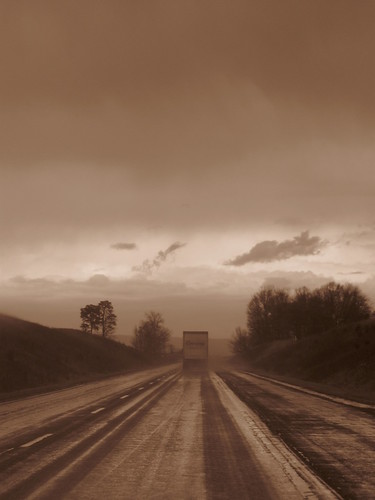
IMG_2598
A rainy day driving on Interstate 81.

Thursday, February 24, 2011

Mural at Staunton Alliance Church

A Bavarian Boy in Lederhosen Takes Shape

IMG_2587
Neushwanstien Castle and the Alps will be in the background.

Wednesday, February 23, 2011

The Incredible Journey of Henry 'Box' Brown

For Him, Thinking Outside the Box Meant Getting in One

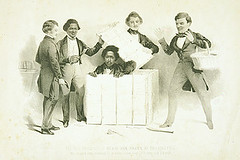
'Henry
Henry 'Box' Brown

He was born a slave in Louisa County Virginia in 1815. On March 29, 1849 Henry 'Box' Brown literally mailed himself to freedom, no mean feat for the two-hundred pound 5' 8" man, who had a carpenter build him a special wooden shipping container.

Mr. Brown was a worker in one of Richmond's tobacco factories but when his family was sold and taken away to North Carolina he grieved their loss and eventually knew that he wanted to seek his freedom. He sought out an agent of the Underground Railroad who arranged contacts for him in the city of Philadelphia [Pennsylvania was a free state]. Brown devised his unique escape and had a carpenter build the box. Care was taken to provide inconspicuous air holes and the box was clearly labled "This Side Up With Care."

Cleverly disguised as a shipment of dry goods, Brown was transported by wagon to the RF&P Railroad for a trip to the Potomac. A ferry took him accross the river to continue his journey by train to Philadelphia. The box was handled roughly and was placed upside down a few times but Brown was able to remain silent and avoid detection. The journey lasted 26 hours.

He arrived at the doorstep of James Miller McKim, a Philadelphia abolitionist, who had agreed to receive the shipment. He greeted the men who uncrated him, saying "How do you do gentlemen," then sang a hymn that he had chosen to celebrate his freedom.

Mr. Brown became a popular speaker and when the Fugitive Slave Law was passed in 1850 he went to Britian. In 1875 he returned to the U.S. and continued as a popular speaker and entertainer.

'But Smooth the Road...'

Recognizing Transportation's Role in Virginia's Vitality

"But smooth the road once, and make easy the way for them, and then see what an influx of articles will be poured upon us; how amazingly our exports will be encreased by them, and how amply we shall be compensated for any trouble and expence we may encounter to effect it." -- George Washington in a letter to Virginia Governor Benjamin Harrison, October 10, 1784

_N4O3090
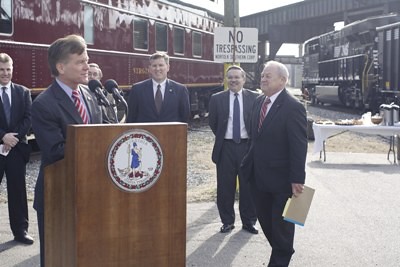
Governor Bob McDonnell announced that Norfolk Southern Railway Company is acquiring 1,500 new railcars from Chicago-based FreightCar America, Inc . The high-capacity coal cars will be manufactured at FreightCar America’s facility in Roanoke beginning in May of 2011. The order totals more than $100 million.

In the early days of our history, men like George Washington saw the need for a strong transportation system. Washington served as a director of the Chesapeake and Ohio Canal Company. Later the railroads would create the smooth road West that Washington saw as so essential. Claudius Crozet would later pioneer the construction of railroads through Virginia's mountainous regions. The region's prosperity in the decades that followed owes much to the forward thinking of such leaders.

Modern Virginia Governors do well to be equally committed to 'smooth the road' for Virginia's commerce. Governor Bob McDonnell, through a number of initiatives, is showing that the current administration shares in the vision of men like Washington and Crozet.

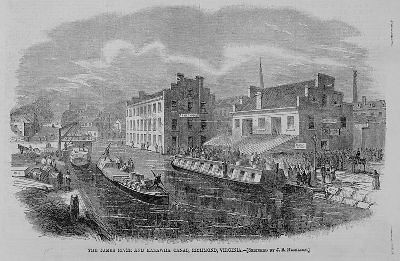
James River and Kanawha Canal
James River and Kanawah Canal.

Mount Vernon, October 10, 1784.

Dear Sir:

Upon my return from the western Country a few days ago, I had the pleasure to receive your favor of the 17th. ulto. It has always been my intention to pay my respects to you before the chance of another early and hard winter should make a warm fireside too comfortable to be relinquished. And I shall feel an additional pleasure in offering this tribute of friendship and respect to you, by having the company of the Marqs. de la Fayette, when he shall have revisited this place from his Eastern tour; now every day to be expected.

I shall take the liberty now, my dear sir, to suggest a matter, which would (if I am not too shortsighted a politician) mark your administration as an important era in the Annals of this Country, if it should be recommended by you, and adopted by the Assembly.

It has been long my decided opinion that the shortest, easiest, and least expensive communication with the invaluable and extensive Country back of us, would be by one, or both of the rivers of this State which have their sources in the Apalachian mountains. Nor am I singular in this opinion. Evans, in his Map and Analysis of the middle Colonies which (considering the early period at which they were given to the public) are done with amazing exactness. And Hutchins since, in his topographical description of the Western Country, (a good part of which is from actual surveys), are decidedly of the same sentiments;
as indeed are all others who have had opportunities, and have been at the pains to investigate and consider the subject.

But that this may not now stand as mere matter of opinion or assertion, unsupported by facts (such at least as the best maps now extant, compared with the oral testimony, which my opportunities in the course of the war have enabled me to obtain); I shall give you the different routs and distances from Detroit, by which all the trade of the North Western parts of the United territory, must pass; unless the Spaniards, contrary to their present policy, should engage part of it; or the British should attempt to force nature by carrying the trade of the upper Lakes by the river Outawaies into Canada, which I scarcely think they will or could effect. Taking Detroit then (which is putting ourselves in as unfavourable a point of view as we can be well placed, because it is upon the line of the British territory) as a point by which, as I have already observed, all that part of the trade must come, it appears from the statement enclosed, that the tide waters of this State are nearer to it by 168 miles than that of the river St. Lawrence; or than that of the Hudson at Albany by 176 miles.

Maryland stands upon similar ground with Virginia. Pennsylvania altho’ the Susquehanna is an unfriendly water, much impeded it is said with rocks and rapids, and nowhere communicating with those which lead to her capital; has it in contemplation to open a communication between Toby’s Creek (which empties into the Alleghany river, 95 miles above
Fort Pitt) and the west branch of Susquehanna; and to cut a canal between the waters of the latter, and the Schuylkill; the expence of which is easier to be conceived than estimated or described by me. A people however, who are possessed of the spirit of commerce, who see, and who will pursue their advantages, may achieve almost anything. In the mean time, under the uncertainty of these undertakings, they are smoothing the roads and paving the ways for the trade of that western World. That New York will do the same so soon as the British Garrisons are removed, which are at present, insurmountable obstacles in their way, no person who knows the temper, genius, and policy of those people as well as I do, can harbour the smallest doubt.

Thus much with respect to rival States; let me now take a short view of our own; and being aware of the objections which are in the way, I will enumerate, in order to contrast them with the advantages.

The first and principal one is, the unfortunate Jealousy, which ever has and it is to be feared ever will prevail, lest one part of the State should obtain an advantage over the other part (as if the benefits of trade were not diffusive and beneficial to all); then follow a train of difficulties viz: that our people are already heavily taxed; that we have no money; that the advantages of this trade are remote that the mostdirect rout for it is thro’ other States, over whom we have no controul; that the routs over which we have controul, are as distant as either of those which lead to Philadelphia, Albany or Montreal; That a sufficient spirit of commerce does not pervade the citizens of this commonwealth; that we are in fact doing for others, what they ought to do for themselves.

Without going into the investigation of a question, which has employed the pens of able politicians, namely, whether trade with Foreigners is an advantage or disadvantage to a country. This State as a part of the confederated States (all of whom have the spirit of it very strongly working within them) must adopt it, or submit to the evils arising therefrom without receiving its benefits; common policy therefore points clearly and strongly, to the propriety of our enjoying all the advantages which nature and our local situation afford us; and evinces clearly that unless this spirit could be totally eradicated in other States, as well as in this, and every man made to become either a cultivator of the Land, or a manufacturer of such articles as are prompted by necessity, such stimulas should be employed as will force this spirit; by shewing to our Countrymen the superior advantages we possess beyond others; and the importance of being upon a footing with our Neighbours.

If this is fair reasoning, it ought to follow as a consequence, that we should do our part towards opening the communication with the fur and peltry trade of the Lakes; and for the produce of the Country which lies within; and which will, so soon as matters are settled with the Indians, and the terms on which Congress means to dispose of the Land, and found to be favourable, are announced, settle faster than any other ever did, or any one would imagine. This then when considered in an interested point of view, is alone sufficient to excite our endeavours; but in my opinion, there is a political consideration for so doing, which is of still greater importance.

I need not remark to you Sir, that the flanks and rear of the United States are possessed by other powers, and formidable ones too; nor how necessary it is to apply the cement of interest, to bind all parts of the Union together by indissoluble bonds, especially that part of it, which lies immediately west of us, with the middle States. For, what ties, let me ask, shou’d we have upon those people? How entirely unconnected with them shall we be, and what troubles may we not apprehend, if the Spaniards on their right, and Gt. Britain on their left, instead of throwing stumbling blocks in their way as they now do, should hold out lures for their trade and alliance. What, when they get strength, which will be sooner than most people conceive (from the emigration of foreigners who will have no particular predilection towards us, as well as from the removal of our own citizens) will be the consequence of their having formed close connexions with both, or either of those powers in a commercial way?
It needs not, in my opinion, the gift of prophecy to foretell.

The Western settlers, (I speak now from my own observation) stand as it were upon a pivot; the touch of a feather, would turn them any way. They have look’d down the Mississippi, until the Spaniards (very impoliticly I think, for themselves) threw difficulties in their way; and they looked that way for no other reason, than because they could glide gently down the stream; without considering perhaps, the fatigues of the voyage back again, and the time necessary to perform it in; and because they have no other means of coming to us but by a long Land transportation and unimproved roads. These causes have hitherto checked the industry of the present settlers; for except the demand for provisions, occasioned by the increase of population, and a little flour which the necessities of Spaniards compel them to buy, they have no incitements to labour. But smooth the road once, and make easy the way for them, and then see what an influx of articles will be poured upon us; how amazingly our exports will be encreased by them, and how amply we shall be compensated for any trouble and expence we may encounter to effect it.

A combination of circumstances makes the present conjuncture more favourable for Virginia, than for any other State in the Union, to fix these matters. The jealous and untoward disposition of the Spaniards on one hand, and the private views of some individuals, coinciding with the general policy of the Court of Great Britain, on the other, to retain as long as possible the Posts of Detroit, Niagara, and Oswega &c. (which, tho’ done under the letter of the Treaty, is certainly an infraction of the spirit of it, and injurious to the Union) may be improved to the greatest advantage by this State; if she would open the avenues to the trade of that Country, and embrace the present moment to establish it. It only wants a beginning; the Western
Inhabitants wou’d do their part towards its execution. weak as they are, they would meet us at least half way, rather than be driven into the arms of, or be made dependant upon foreigners; which would, eventually, either bring on a separation of them from us, or a war between the United States and one or the other of those powers, most probably with the Spaniards.

The preliminary steps to the attainment of this great object, would be attended with very little expence, and might, at the same time that it served to attract the attention of the Western Country, and to convince the wavering Inhabitants thereof of our disposition to connect ourselves with them, and to facilitate their commerce with us, would be a mean of removing those jealousies which otherwise might take place among ourselves.

These, in my opinion are; to appoint Commissioners, who from their situation, integrity and abilities, can be under no suspicion of prejudice or predilection to one part more than to another. Let these Commissioners make an actual survey of James river and Potomack from tide-water to their respective sources. Note with great accuracy the kind of navigation, and the obstructions in it; the difficulty and expence attending the removal of these obstructions; the distances from place to place thro’ the whole extent; and the nearest and best Portages between these waters and the Streams capable of improvement which run into the Ohio; traverse these in like manner to their junction with the Ohio, and with equal accuracy. The navigation of this river (i.e., the Ohio) being well known, they will have less to do in the examination of it; but nevertheless, let the courses and distances of it be taken to the mouth of the Muskingum, and up that river (notwithstanding it is in the ceded lands) to the carrying place with Cayahoga; down the Cayahoga to Lake Erie, and thence to Detroit. Let them do the same with big Bever creek, although part of it is in the State of Pennsylvania; and with the Scioto also. In a word, let the Waters East and West of the Ohio, which invite our notice by their proximity, and the ease with which Land transportation may be had between them and the Lakes on one side, and the rivers Potomac and James on the other, be explored, accurately delineated, and a correct and connected Map of the whole be presented to the public. These things being done, I shall be mistaken if prejudice does not yield to facts; jealousy to candour, and finally, that reason and nature thus aided, will dictate what is right and proper to be done.

In the mean while, if it should be thought that the lapse of time which is necessary to effect this work, may be attended with injurious consequences, could not there be a sum of money granted towards opening the best, or if it should be deemed more eligible, two of the nearest communications, one to the Northward and another to the Southward, with the settlements to the westward? And an act be passed (if there should not appear a manifest disposition in the Assembly to make it a public undertaking) to incorporate, and encourage private
Adventurers if any should associate and sollicit the same, for the purpose of extending the navigation of Potomac or James river? And, in the former case, to request the concurrence of Maryland in the measure. It will appear from my statement of the different routs (and as far as my means of information have extended, I have done it with the utmost candour), that all the produce of the settlements about Fort Pitt can be brought to Alexandria by the Yohoghancy in 304 Miles; whereof only 31 is land transportation: And by the Monongahela and Cheat river in 300 miles; 20 only of which are land carriage. Whereas the common road from Fort Pitt to Philadelphia is 320 miles, all Land transportation; or 476 miles, if the Ohio, Toby’s Creek, Susquehanna and Schuylkill are made use of for this purpose: how much of this is by land, I know not; but from the nature of the Country it must be very considerable. How much the interests and feelings of people thus circumstanced would be engaged to promote it, requires no illustration.

For my own part, I think it highly probable, that upon the strictest scrutiny (if the Falls of the Great Kanhawa can be made navigable, or a short portage be had there), it will be found of equal importance and convenience to improve the navigation of both the James and Potomac. The latter I am fully persuaded, affords the nearest communication with the Lakes; but James river may be more convenient for all the settlers below the mouth of the Gt. Kanhawa, and for some distance perhaps above, and west of it: for I have no expectation that any part of the trade above the falls of the Ohio will go down that river and the Mississippi, much less that the returns will ever come up them; unless our want of foresight and good management is the
occasion of it. Or upon trial, if it should be found that these rivers, from the beforementioned Falls, will admit the descent of Sea vessels; in which case, and the navigation of the former’s becoming free, it is probable that both vessels and the cargoes will be carried to foreign markets and sold; but the returns for them will never in the natural course of things, ascend the long and rapid current of that river; which with the Ohio to the Falls, in their meanderings, is little if any short of 2000 miles. Upon the whole, the object, in my estimation is of vast commercial and political importance: in these lights I think posterity will consider it, and regret (if our conduct should give them cause) that the present favourable moment to secure so great a blessing for them, was neglected.

One thing more remains, which I had like to have forgot, and that is the supposed difficulty of obtaining a passage tho’ the State of Pennsylvania. How an application to its Legislature would be relished, in the first instance, I will not undertake to decide; but of one thing I am almost certain, such an application would place that body in a very delicate situation. There is in the State of Pennsylvania at least 100,000 souls west of the Laurel hill, who are groaning under the inconveniences of a long land transportation; they are wishing, indeed they are looking for the improvement and extension of inland navigation; and if this cannot be made easy for them, to Philada (at any rate it must be lengthy), they will seek a mart elsewhere; the consequence of which would be, that the State, tho’ contrary to the policy and interests of its Sea-ports, must submit to the loss of so much of its trade, or hazard not only the trade but the loss of the Settlement also; for an opposition on the part of Government to the extension of water transportation, so consonant with the essential interests of a large body of people, or any extraordinary impositions upon the exports or imports to, or from another State, would ultimately bring on a separation between its Eastern and Western Settlements; towards which, there is not wanting a disposition at this moment in that part of it, which is beyond the mountains. I consider Rumsey’s discovery for working Boats against stream, by mechanical powers (principally) as not only a very fortunate invention for these States in general, but as one of those circumstances which have combined to render the present epocha favourable above all others for fixing, if we are disposed to avail ourselves of them, a large portion of the trade of the Western Country in the bosom of this State irrevocably.

Lengthy as this letter is, I intended to have written a fuller and more digested one, upon this important subject, but have met with so many interruptions since my return home, as almost to have precluded my writing at all. What I now give is crude; but if you are in sentiment with me, I have said enough; if there is not an accordance of opinion I have said too much and all I pray in the latter case is, that you will do me the justice to believe my motives are pure, however erroneous my judgment may be on this matter, and that I am with the most perfect esteem etc.

IMG_2572
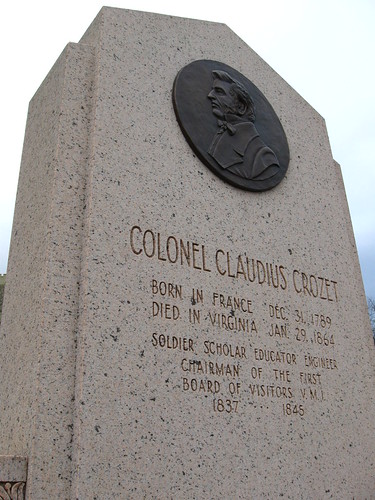
Claudius Crozet first pushed the railroad through Rockfish Gap in the Blue Ridge Mountains. His Monument may be seen today on the grounds of the Virginia Military Institute.

Monday, February 21, 2011

Fire Closes Trails in Shenandoah Park

North District Affected by Forest Fires

IMG_1636
The Appalachian Trail near Sawmill Ridge Overlook in Shenandoah National Park.

Lynn Reports [click to read] in the Washington Examiner on the fires burning in Shenandoah National Park.

Fiscal Health and Local Government

Visible Debate by Visible Lawmakers... A Healthy Sign

IMG_2091
The Augusta County Government Center.

Nichole Gelinas in City Journal writes about the indicators of health in local and state finances. Her article: Hidden in Plain Sight [click to read] says that disclosure requirements are a step in the right direction, but they alone will not fix the situation.

Think of our own local government and the recent property assessment battle. The historical pattern had always been one where assessments were performed in a rather casual way to follow the then predictable rise in real estate values. Governments planned expenditures based on this pattern and boards of supervisors rubber stamped the whole process.

In a steadily growing economy there was no need for questioning reality, after all. The can kicked down the road was highly unlikely to roll back on you.

After 2006, reality changed. The appraisal and budget process that followed underscored the need for lively and open debate. Tracy Pyles, supervisor from the Pastures District, took the bold and necessary step of addressing flaws in the process that would eventually come back to bite us. The assessors were using values derived from a real estate bubble that had already burst. There was no reality in letting tax rates be driven by these numbers. Furthermore, the inflated numbers created a false report to state revenue agencies, resulting in reduced payments to the county from state taxes collected.

The inability of other local elected officials to throw themselves into this debate is telling. In low-crime Mayberry, Barney Fife can keep his service revolver empty and his bullet in his pocket. If revenues can be counted on to rise 'safely,' we can afford to let the supervisors kick the can down the road, or so it might seem. Actually the need for open and honest debate is even more important when we might plan honestly for a range of contingiencies. The best reforms happen quietly and in a timely manner. They may never show up in print.

The 2011 campaign for supervisor's seats in Augusta County should create no less than a mandate for the kind of debate that will monitor county vital signs BEFORE a fiscal disaster occurs.

Note: The Author of this post actively serves in the campaign of David Karaffa for Supervisor.


Taking a different path. Governor McDonnell in support of Governor Walker.

Friday, February 18, 2011

Bill Bolling's 4th Annual Bloggers' Day

Citizen Journalism with a Better Flavor at the Capitol

IMG_2459
David Karaffa and Jason Bibeau at the Capitol.

Lynn captured it so well. Four Bloggers [click to read] from the Valley got to spend the day as guests of Lt. Governor Bill Bolling and his staff. Here We are [click to read] at the morning briefing. In an economic climate that is abysmal on a national level, the administration was able to list a balanced budget and real job creation among its accomplishments. Lively discussion and a straight-up approach to addressing real issues appeared to be a genuine priority.

Delegate Ben Cline [click to read] and Senator Mark Obenshain [click to read] took the time to visit with us. These fine Conservative leaders genuinely value input and discussion of the bills before them.

Several times during the day I heard the expression: "in a perfect world..." usually referring to the need to find compromise or develop attainable goals. There was some good discussion about economic incentives. "In a perfect world..." companies would need no additional incentive to locate in Virginia. In the world we live in, it is sometimes necessary to make concessions in order to secure the committment of a company like Northrup/Grumman. Economic development sometimes requires investment.

The Transportation Bill was often part of our discussion as well. The Administration pooled money found in the VDOT audit, bonding authority already in place and some new borrowing to put our infrastructure needs on the front burner. Exit 91 on Interstate 64 will receive a much needed upgrade to handle traffic near the hospital. This will allow development to happen in this growing area without restrictions caused by the present narrow bridge.

After making hard cuts in the overall budget, the infrastructure investment is an investment in Virginia's long term future that can be safely made.

Here are Pictures [click to read] of us observing the legislative sessions.

Lynn Writes [click to read] in the Washington Examiner about Bloggers' Day.

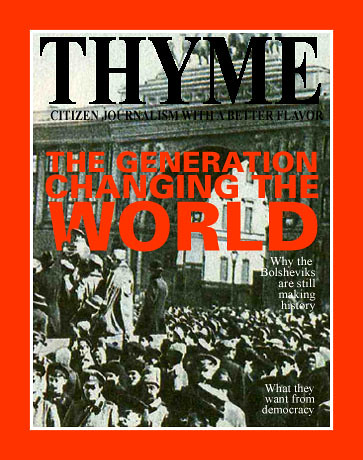
THYME Magazine

Citizen Journalism with a Better Flavor

thyme0308
Volume III, Issue VIII

Ten Days that Shook the World

The 'other' Weekly News Magazine [click to read] is calling the young revolutionaries in Egypt 'the Generation that is Changing the World.' The more things change, the more they stay the same.

Back when Russia last had a real Tsar, Nicholas II, to be exact, a lot of his political enemies were in exile. The year was 1917 and Russia was at war with Germany.

In February of that year, Nicholas II abdicated his throne. The war was going badly and people in Petrograd [St. Petersburg] were starving. A provisional government consisting of a coalition of conservative, moderate, and liberal socialists came into power. Aleksandr F. Kerensky, the minister of justice, was an important figure in the Provisional Government.

One of the first actions of the provisional government was to free the political prisoners. Vladimir Ilich Lenin returned from exile. The stage was being set for the October Revolution. On October 24 and 25, 1917, pro-Bolshevik soldiers, sailors, and Red Guards stormed the Winter Palace and arrested members of the Provisional Government. A period of civil war followed this 'bloodless coup' that placed the Bolsheviks in power.

Many who sought legitimate reform were swept away and the Soviet State came in to being. Reform was soon lost in a new form of repression that would last for decades.

The same pattern was to repeat itself in every hemisphere of the world. The best and brightest young minds would be recruited to press for change. They would eagerly join the movement and flood the squares.

When the new regime came into power, however, they would often find themselves the object of surpression by the government they had fought to install.

Workers' Strikes in Wisconsin

Today the public sector employees of Wisconsin are striking to protect their collective bargaining priviledges. The language of this upheaval is disturbingly familiar. The state's economy is in deep trouble but the workers are resisting a move to have them contribute to their own pension plans. Resisting this reasonable reform creates an unsustainable situation where the state will not be able to pay out what it is obligated to.

At that point there will be no choice but to cut as much spending as possible and cut positions. The benefits will then become an albatross around the public employees' necks.

The path from revolution to wreckage is wide and well paved.

Another Path is Needed

One state that will not make the news, but is making history by making hard choices early is Virginia. The Virginia pension system is exploring the possibility of having workers contribute 5% to their plans. Virginia's current administration inherited a $6 billion deficit and in a bold stroke moved budget spending to 2006 levels.

Resisting the calls for more taxation, Virginia insead concentrated its efforts on creating a more hospitable environment for business growth. Even in this deep recession, state revenues are up 12.6% and job growth is happening. Much of the economy, building in particular, are still in trouble but the overall climate is attractive to companies looking to flee high tax states such as New York and California. That translates into a private sector that provides employment opportunities and real resources on which to build economic growth.

The pension bomb still needs to be dealt with, but the discussions in Richmond point to a future where the state will avoid going the way of those now near default. By monitoring her vital signs early, Virginia might lead a true revolution... one that need not ride the back of upheaval.

Egypt's Unborn Revolution

While a political transformation continues, an economic one has yet to begin. Egypt's Unborn Revolution [click to read] by Guy Sorman in City Journal.

"Many Westerners, watching the revolution in Egypt, are wondering whether the outcome will be true democracy. Less often asked but equally important is whether Egypt can reform its economy in ways that are necessary for democracy to thrive. As history has demonstrated in such places as Russia under Putin, Chile under Allende, and Iran under the mullahs, nations can be democracies at least in a technical sense—that is, they have elected leaders—but a democracy without a free economy has no future." -- Guy Sorman