Showing posts with label Culture. Show all posts

Wednesday, May 6, 2015

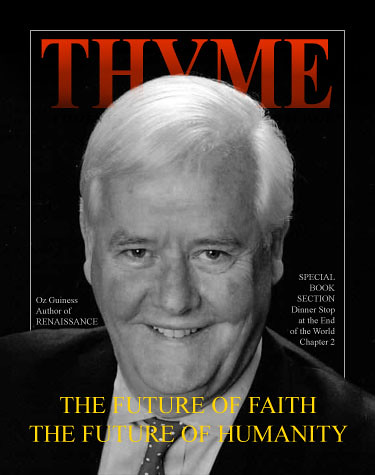
THYME Magazine: The Future of Humanity

Citizen Journalism with a Better Flavor

GuinessTHYME
Volume IX, Issue XX

Where are the Christians setting out the huge constructive vision of what the Gospel means for the human future?" -- Oz Guiness

What is the Future of Christian Faith?
by Intervarsity Press

Is it possible for society to have redemption and renewal? Is the Christian faith still relevant in the very global world of today? Os Guinness, in his new book Renaissance, declares a hopeful yes. We are in a time of renewal, of change, of continuous reformation, and, as Os writes in chapter one, “a movement that is led by the Spirit of God, which involves the people of God returning to the ways of God and so demonstrating in our time the kingdom of God, and not in word only but in power and with the plausibility of community expression.”

Although we are in a time when the problems of western worldliness — exploitation of the poor, prevalence of prosperity gospel, to name a few — seem to be overtaking the church and the world more broadly, Os believes there is hope for the future. Throughout the book, he describes how the Christian faith influenced and shaped culture over the last two hundred years. Christians have established universities, built great cathedrals, brought literacy to cultures, and generally displayed God’s goodness through art, literature and science. Drawing on great thinkers like John Baillie, Christopher Dawson, C. S. Lewis, Thomas Cahill and others, Guinness shows that the church is in a moment of great transition, but it has been here before. In light of this, readers will see that now is the time to rely wholly on God’s provision, knowing that with it the Christian faith can continue to be the cultural influence it’s always been.

For decades Os Guinness has been one of the most nuanced, realistic, yet hopeful voices calling Christians to engagement with culture,” Tim Keller writes. “This latest volume from him should not be missed by anyone. Os summarizes some of the most helpful recent discussions, updates many of his own lifelong challenges to the church, and provides many fresh insights.”

Renaissance leads readers back to a center point and challenge for the faith of the future. Os writes, “[This challenge] is, I believe, that we trust in God and his gospel and move out confidently into the world, living and working for a new Christian renaissance and thus challenge the darkness with the hope of Christian faith, believe in an outcome that lies beyond the horizon of all we can see and accomplish today.”

Os closes each chapter with thought-provoking discussion questions and brief, stirring prayers that challenge and motivate readers to take action, however dark the times may seem.

Skye Jethani, executive editor at Leadership Journal, declares this book an essential resource: “Os helps us see our present circumstances in the right light. He illuminates why the catastrophizing done by many Christians amid cultural change is unwarranted, but also soberly addresses the genuine challenges we face with new clarity and gravity. Most helpful of all, Os directs our sight back to Christ, the author and completer of our faith, in whom we find both the courage and the resources to be his people in our time. You will not regret a single minute invested in this book.”

Interview with Oz Guinness [click to listen]

BannerforDinner

Special Book Section

Last week we began the serial presentation of "Pontifus, The Bridge Builder's Tale in Three Parts." [1.] This week we present the second chapter of the first book: "Dinner Stop at the End of the World" below.
Wednesday, June 4, 2014

THYME Magazine: Essential Knowledge

Citizen Journalism with a Better Flavor

THYMEemp
Volume VII, Issue XXV

Essential Knowledge

Never before in history have we been surrounded by more information. Never before have we wanted so severely for essential knowledge!

It is easy and simplistic to lament the replacement of  "old" communications technology with new. In a way that misses the real point. Yes, I can use a search engine to find just about any published fact I want to know. Yes I can search for and look at thousands of news stories. Still a friend of mine lamented that real investigative journalism is sorely lacking these days. Very little 'reporting' gets very far beneath the surface. "There's not the money for it;" he opined. We are likely to hear over and over again what a handful of 'experts' think happened to a missing Malaysian airliner while no one bothers to lay out the background of the situation in Ukrania. In fact, on election night in 2008, we hear reporters celebrate the election of 'their' candidate, Obama, and almost in the same breath they admit: "We know very little about him.!"

There is no excuse for that. Bill Ayers helped him write a book and if you really wanted to understand the man who would be President, all you had to do was read it. Read in the context of who his parents and mentors were, it would tell you exactly what anti-colonial principles drove him. Vetting a Presidential candidate, even one who did NOT have an average American childhood, going instead to a Muslim school in Indonesia, is not rocket science. [1.]

But even more disturbing than the inability to investigate a candidate is the inability to pass along to our next generation the foundational truths our society and our great nation were built on.

I watched a little movie this past weekend that nicely packaged a bit of very important truth in an unlikely medium. It spoke of how the Divine is able to speak into a life through a simple interaction between two human beings. The movie, The Letter Writer shows how one person can speak the truth of Imago Dei into the life of another.


The Letter Writer (2011) puts essential knowledge in a new perspective using a most traditional medium.

Lessons from The Letter Writer

I use modern technology for a lot of my communications. This is no Luddite rant against it. The printing press was once new technology and it put the Bible in the hands of the people. I can read the Holy Scriptures on my Iphone now. I also communicate with family using it. FaceTime with my granddaughter is a great blessing. Facebook helps me pray for those close to me. Smugmug is the family photo album we can all share. Yet, when my young friend and colleague and her fiancee graduated from college recently, I felt a REAL card was in order. Clicking the 'LIKE' button does lack the personal touch that paper and ink provide.

This is the wonderful discovery that Maggie Fuller makes as she receives a mysterious letter from someone she does not know. Tracking down the source brings Maggie into a wonderful journey discovering how her life can serve as a beacon to others. The young singer tracks down the letter writer and finds an unlikely community of mentorship in love and servanthood. Her Epiphany comes about as she joins her new friends in singing Henry Alford's famous hymn: Come Ye Thankful People, Come [click to read more]. The story speaks of how truth and values can and should be passed from one generation to another. Unrealistic? A lot of secular critics dismissed the film and its message, but think of how Jewish culture places the transferal of great truth in the context of the Passover Meal. Think of the Redemptive message of the celebration of the Eucharist.

Walking with my little granddaughter on the tree shaded campus of the nearby college, I find myself humming the tune of Come Ye Thankful People, Come. She smiles as I show her squirrels and bright flowers. Is the message of the movie really so unrealistic? Our Pastor shared with us the story of a little church in our denomination (Mennonite) that prayed for a vision of what G-d might do through them... not a program that THEY would do, but the true seeking of an opportunity to allow G-d to work through them. Through much prayer they felt drawn to minister to the youth of their community. There was a problem, however, as the YOUNGEST member of the congregation was in her sixties!

They shared the vision with their Pastor and continued to pray. There was NO WAY this congregation was ever going to pull off the youth coffee house type of outreach or anything of the kind! But a funny thing happened. The older people, now with enlarged vision for the young people in their neighborhoods, found themselves building relationships where once they might have been saying: "Keep off my grass!" Kids started conversing with older neighbors. Gradually they ventured onto the front porch. Eventually they were enjoying warm cookies and milk in the kitchen. These kids didn't need another youth-centered event, they needed some FAMILY!... and that is just what the church was able to give them.

(to be continued)

Tuesday, January 21, 2014

THYME Magazine: A Case for Vision II

Citizen Journalism with a Better Flavor

THYME0705a
Volume VII, Issue V

"Sing, O barren, thou that didst not bear; break forth into singing, and cry aloud, thou that didst not travail with child: for more are the children of the desolate than the children of the married wife, saith the Lord.

Enlarge the place of thy tent, and let them stretch forth the curtains of thine habitations: spare not, lengthen thy cords, and strengthen thy stakes;

For thou shalt break forth on the right hand and on the left; and thy seed shall inherit the Gentiles, and make the desolate cities to be inhabited.

Fear not; for thou shalt not be ashamed: neither be thou confounded; for thou shalt not be put to shame: for thou shalt forget the shame of thy youth, and shalt not remember the reproach of thy widowhood any more.

For thy Maker is thine husband; the Lord of hosts is his name; and thy Redeemer the Holy One of Israel; The God of the whole earth shall he be called." -- Isaiah 54:1-5

A Case for Vision II

For three hundred years following the Reformation, many church leaders neglected the command of Christ to reach the nations. Towards the end of the Eighteenth Century, a newly ordained Baptist leader in England spoke to challenge this misapplication of the doctrine of election. "Young man, sit down! You are an enthusiast. When God pleases to convert the heathen, he'll do it without consulting you or me," said an older minister. The young man's name was William Carey. He was a cobbler by trade, but his calling would take him far beyond the walls of his little cobbler's shop. Carey's vision, you see, was as wide as the map of the world that he hung on his shop's wall. Gathering some like-minded friends, he began to pray for the fulfillment of his vision.

Carey admired the work of the Moravians [click to read], who at one point were one of the foremost sending congregations, planting churches around the world. They even founded churches among America's Cherokee Nation. Dismayed by his own denomination's lack of zeal for such work, he penned An Enquiry Into The Obligations Of Christians To Use Means For The Conversion Of The Heathens. Seeing the Great Commission as applying to the church of his day, he said: "Multitudes sit at ease and give themselves no concern about the far greater part of their fellow sinners, who to this day, are lost in ignorance and idolatry."

In 1792, Carey organized a missionary society and called for his fellow believers to: "Expect great things from God; attempt great things for God!" Few men today would have the patience and tenacity of Carey who said: "I can plod, I can persevere to any definite pursuit." Carey offered to become the first missionary of his society to the great subcontinent of India, offering to go if his friends back home would "hold the ropes." After a fourteen month journey and many personal tragedies, Carey labored on for seven years before he saw his first convert, Krishna Pal. Two months later he published his first Bengali New Testament. He and his colleagues would go on to publish translations of the entire Bible in Bengali, Oriya, Marathi, Hindi, Assamese, and Sanskrit, as well as hundreds of lesser used dialects.

Carey was instrumental in significant social reform in India. His work and advocacy resulted in the abolition of infanticide, widow burning (sati), and assisted suicide. Thus did a man's love for his Saviour result in the affirmation of Imago Dei in a whole new part of the world. When William Carey died, he had served the people of  India for 41 years!

When Isaiah wrote the book that bears his name, Israel had forgotten the G-d given mission to be a light to the nations. Losing sight of this important purpose, the people sank into idolatry and pleasure-seeking. Every generation faces the very real danger of missing the great calling. Ours is no exception. Pastor Bruce Hankee related the story of Carey to his congregation, challenging us to program our lives for G-d's purpose through an understanding of Isaiah 54:1-5. He challenged us to enlarge our capacity for G-d's purpose, as Carey did. Ephesians 3:19 exhorts us: "And to know the love of Christ, which passeth knowledge, that ye might be filled with all the fulness of God." Indeed this is a great reason to expand our tent, that we might contain more of the love of G-d for our fellows! In lengthening our cords, we are expanding our influence. Just as a cobbler in the middle of England became a major pioneer in world missions, we too can have a greater influence if we will persevere in the pursuit of a great vision.

Tuesday, February 7, 2012

How the Western World was Lost

Rabbi Daniel Lapin on the Fight for Civilization

B-Signing_of_Declaration_of_Independence_by_Armand-Dumaresq,_c1873
The Signing of the Declaration of Independence by Armand Dumaresq, c1873.

Rabbi Daniel Lapin [click to listen] talks about the beginnings of our culture's moral free-fall:

The Battle for Civilization, Part I [click to listen]
The Battle for Civilization, Part II [click to listen]

"In surveying America’s current political and economic unrest, have you ever wondered if there’s truly hope for changing the direction of our country? Today, you will hear how our nation got to this point, and what it’s going to take to right the ship. It’s a discussion no American should miss."

Saturday, December 18, 2010

Everyday Life in Modern Day Coruscant

Asian Megacities as Political Theatre

le-corbusier-paris_001
What Le Corbusier would have wrought in Paris has become the new reality of Bejing and Shanghai.

Le Corbusier once wrote of his Plan Voisin for Paris: “Since 1922 [for the past 42 years] I have continued to work, in general and in detail, on the problem of Paris. Everything has been made public. The City Council has never contacted me. It calls me ‘Barbarian’!” -- Le Corbusier’s writings, p. 207.

Fast forward to the Twenty-first Century and Shanghai [Le Corbusier on steroids]. It all seems like the realization of the fictional Coruscant from Star Wars... a completely urban environment that stretches as far as the eye can see. The entire planet of Coruscant is one continual city.

Guy Sorman discusses the rise of Asian 'Super Megagopolises' [click to read] in City Journal. Looking at the Mega-model of Shanghai, one could begin to wonder: "can Coruscant be that far off." Sorman points out, however, that Shanghai is largely a political creation...designed to create the impression that China is ready for business with the world. [1.]

Every day the city teems with life and every night the workers necessary to make it function vacate the pristine city. It is like Disney World, where the 'cast members' descend into 'Utilidor,' remove their costumes, and disappear to homes elsewhere.

For Shanhai workers, 'homes elsewhere' often means crowded andsubstandard. Just as China's factories are seldom seen by Westerners,those who maintain the stage for world commerce live in a vastlydifferent world than the one they 'portray' in their 'day jobs.'

Or perhaps, the Death Star in Star Wars is a better analogy. Its scale is way beyond human. It is intended to convey a sense of awe. Might we be looking at the work of some latter day Nimrod, seeking to elevate himself to the heavens?

Sorman points out how the mad rush into the 21st Century has obliterated the traditional spaces of Shanghai and Bejing, which were much more human in size and scate. Again Star Wars comes to mind. Green beautiful planets like Naboo and Alderon risk elimination as the Empire expands its grasp.

shanghai-model_001
This scale model of Shanghai dwarfs the people in the room...

Coruscant_at_night_001
...and calls to mind the fictional city of Coruscant.

In the 'Sixties America sought to 'remake' her major cities. Le Corbusier style housing blocks were constructed to elevate the urban poor. Many of these 'projects' have since been torn down. While we were building them Moscow was building similar blocks of apartments. Today in Moscow, urban youths flock to the rooftops. [2.] Called 'Roofers,' these young people seek the rooftops simply for the openness and the view.

How to Return to the Village
Returning Government to the People in the 'Audience'

Nineteenth Century America was a nation of villages. Great centers of commerce existed, but they were fed by a vibrant countryside. When Thomas Jefferson created his ideal 'Academic Village' to house the University of Virginia he purposefully left one side open to the surrounding agricultural land. From the steps of the Rotunda one could look upon the rolling hills of Albemarle County.

Architect Stanford White convinced the University to fill the void with Old Cabell Hall a long time ago. The recently completed South Lawn attempts to recreate a space leading off into the trees of Charlottesville. The challenge of getting back to the garden is ever before us.

Rooftop Gardens [click to read] offer one method of getting people and open spaces together. Reclaiming existing environments is another. Aging strip malls could be recycled into village centers for the surrounding suburban homes, offering a place residents could walk or bicycle to. Vacant lots and neglected riverfronts can become parks and gardens.

Crozet
Proposed Renewal of the Crozet Shopping Center.

Suburb bashing has always been a fashionable intellectual pastime.That is one reason I like Robert A. M. Stern. He sees the reasons people seek out single family dwellings of a traditional form. I have a friend who lives on the upper West side and his penthouse with a view of the Hudson is very nice but give me my gardens.People put up with the wretched infrastructure overload and strip centers because the village is still appealing. The residential areas become landscaped oasis for their residents. Kids play outside the house in view of the kitchen window. People visit at the back fence.Moreover the suburbs are seen by their dwellers as affirming opportunity and safety. If people had no emotion for their homes they would be fine with Le Courbusier type high rises but that is simply not the case.The problem is really one of infrastructure and public space [or lack therof]. Strip malls and box stores create a sterile wasteland but they may become the village centers of the future.

Time magazine once featured a piece called 'Repurposing Suburbs' which shows some fine examples of recreating this type of public space. This Crozet project turns a tired strip mall into a village center. One cannot wait for Crozet's redesigner to get his creative hands on some of the new "Town Center" projects which are now just collections of big box stores. Some time ago I drew a concept where the CSX tracks between Staunton and Charlottesville became a light rail line connecting Staunton, Fishersville, Waynesboro, Crozet, Ivy, The University of Virginia Medical Center and Downtown Charlottesville. The result would be a series of village centers and a better utilization of existing infrastructure.

City Journal's writers draw conflicting conclusions. Houston is touted as encouraging its middle class while Gotham offers limited options. Dense urban areas do tend to create energy efficiency. The trick is to see opportunities to improve the communities we have already created.That would certainly involve offering condominiums and a pedestrian friendly center to suburban communities and reclaiming all those wonderful old low density neighborhoods of our cities.

There is more to solving this problem than finding architectural solutions. Redemption too, must begin on a human scale. In a future post I will explore the role of 'New Monasticism' and activists like Star Parker in this aspect of redemptive work in our culture.

Next: Counterpoint to Coruscant [click to read].
___________________________________________________

laneyadvrt

Monday, November 29, 2010

Fragile Urban Families, Loutish Youths

The Decline of Marriage Hurts Those Who Need it Most

THYME [click to read] just reported on TIME reporting on the Pew study's finding that more people are abandoning 'traditional marriage.' Further study might make them want to rethink it. As modern culture seeks to take apart and discard an institution that has served society for thousands of years, the evidence of the destructive fallout of such thinking is already mounting.

Fragile Urban Families [cick to read] by Kay S. Hymowitz in City Journal.

"Poverty is on the rise, according to census data, and now affects 14.3 percent of the population, up from 13.2 percent in 2008. A stumbling economy obviously explains the recent uptick. But those who think that poor urban families’ problems have an economic fix would do well to pick up the fall issue of The Future of Children, a journal jointly published by the Woodrow Wilson School of Public and International Affairs and the Brookings Institution (I sit on its advisory board). The articles in the issue are based on findings from the Fragile Families and Child Wellbeing Study, which has followed 5,000 children and their urban, primarily minority, parents since the kids were born in the late 1990s. The FFCWS now constitutes the most extensive, long-term database on the family lives of the urban poor we’ve ever had, and the dismal picture that it paints of low-income, unmarried couples and their children has nothing to do with the Great Recession." -- Kay S. Hymowitz

Solidarity Forever [click to read] by Theodore Dalrymple in City Journal.

"In these dark times, any sign of social progress is welcome. By social progress we mean, of course, equality between the races and sexes, or—as we must now call them—the genders. The good news comes from Lyon, the second or third city of France, where last month a group of youths, generously outraged by the prospect that their elders and betters will not now be able to retire at 60, but will have to work until they’re 62, decided to throw stones through storefront windows and overturn parked cars as a gesture of intergenerational solidarity. Who says that youth are inconstant? They did it three nights running." -- Theodore Dalrymple

Roman Ruins
Roman amphitheatre and ruins in Lyon...

Santiago Caletrava
...and Santiago Calatrava's futuristic TGV train station next to Lyon's Saint Exupéry Airport. Photos by Bob Kirchman.

Last night I visited STRIVE, a ministry to [and by] young adults in our community. Mark, a local youth Pastor talked about Servant Leadership. It was obvious that this young man was an example of such thinking in his own life and he exhorted those listening to learn to lead by learning to serve.

Outside of the military it is rare to hear young adults being given such a message in our modern culture. Mark spoke of the joy in deferring personal gratification for greater gain. His simple talk, free of theological jargon, covered so many points that I cannot do it justice in the telling. More importantly, we all were listening.

We need to be cultivating the next generation of leaders, praying earnestly that G-d would raise up a new generation of D. L. Moodys and George Müllers. It is comforting to think that I shook hands with one last night!

Thursday, June 11, 2009

Redeeming Stand-up Comedy

One Can Look Up Instead of in the Gutter

Steve Harvey, A Breath of Fresh Air [click to read]. Yes, you can use your art to inspire people instead of tearing them down.

"You can’t listen to most stand-up comedians without bad words, immoral references, and disrespect for G-d and his people." -- Randy Alcorn

ht/Randy Alcorn