Showing posts with label William Wilberforce. Show all posts

Wednesday, June 24, 2015

THYME Magazine: The Bridge Builder's Tale IX

Citizen Journalism with a Better Flavor

Chapter9ds

Of all the wonderful feats I have performed, since I have been in this part of the world, I think yesterday I performed the most wonderful. I produced unaninimity among fifteen men who were all quarreling about that most ticklish subject -- Taste." -- Isambard Kingdom Brunel

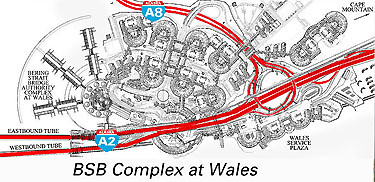
Zimmerman's complex at Wales was originally meant to be simply a construction camp and to continue as a port of entry to the Americas. It was a city in itself that seemed determined to outgrow whatever space was alloted to it. The buildings were fabricated in the same shipyards that produced the components of the great bridge. Indeed one felt like one was inside a cruise ship walking through the endless connecting corridors. Pat Zimmerman had come up with her husband in the early days but hated the hallways. Her poor circulation made the cold outside unbearable, but the "Labyrinth of Exile," as her husband called the sprawling complex, simply depressed her.

bsbcomplexweb
The "Labyrinth of Exile."

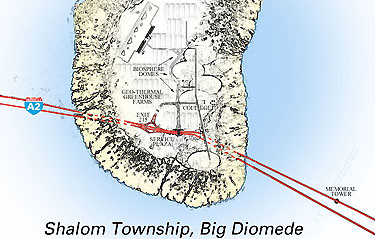
diomedemapweb

He'd taken the name from a biography of Theodor Herzl by that title and it stuck. It was a machine produced environment created of necessity. In great design rooms people like Pat's granddaughter were creating wonders like the Big Diomede Biospohere and the tundra farms. Still, if the design studios were a rich world, the connective tissue of the hallways and public spaces was an impoverished one. The small band of overachievers engaged in this great work required little in the way of diversions. Pat could not survive in such a sterile world. With great sorrow, Rupert resigned himself to the life devoid of family that so many of the world's great innovators seemed to be sentenced to.

The Biosphere and the calling of the Greenes was born largely out of a desire to correct this. Pat had been initially impressed when she visited and saw the richness of Kris' little house in contrast to Rupert's sterile hallways. She thought it an anomality though and didn't want to lose the circle of supportive friends she had in Virginia. The Biosphere was nice, but it was a small circle of light in a very large entity that seemed to Pat more like an oil camp on steroids. If she took notice of how Rupert seemed drawn to the Biosphere and its gardens, she must have been skeptical of it. Rupert had always befuddled his wife. He loved to photograph the flowers in their Virginia garden but often forgot to water them. He was her own real-life version of James Thurber's fictional "Walter Mitty," often seeming to inhabit another world. Unlike the fictional Mitty, Zimmerman was building his 'other world' and a world starved for such endeavors embraced him for it.

Zimmerman wondered at how such basic needs as breathing and the need to walk required no motivation, yet standing in a man's full potential eluded the ability to teach. He devoted himself to studying how men might develop the hunger to rise to the height of their potential and walk in it. He sparred often with Greene over how to inspire men. Marx had called religion the "Opiate of the Masses," yet Rupert thought it was more like the pills drivers took to keep them awake on the long road to Yakutsk. It was, to Zimmerman, a necessary boost in the driver's inate alertness. "Truck Wrecks on the Siberia Highway" were a macabre subject of continual fascination on the internet. The fact that these incidents were few and often photoshopped did nothing to shatter the myth. The road was truly dangerous.

Rupert pondered great moments in history. There was the Battle of Trenton where a band of weary patriots turned the tide of America's Revolution. The American response to the attack on Pearl Harbor and the resolve to win the world's most horrific war on multiple fronts preceeded the establishment of Herzl's vision. Yet in his own lifetime, Zimmerman had seen the 2001 attacks on New York and Washington met with an initial resolve that soon withered. America resigned herself to whatever forces the world would throw it. Such Fatalism went against Zimmerman's constitution. As students of engineering found their way to his studios, Zimmerman rounded out their education with a healthy dose of history... and that history full of the stories of overcomers!

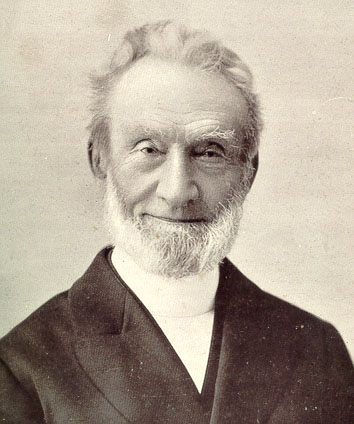
Rupert's school also looked at life through the Macro-lens as well. He learned that infants, no different from his granddaughter he surmised, had been placed in an orphanage in Tehran, Iran. The attendants of this place merely fed and changed the infants. There was no cuddling, no interaction, there simply wasn't time for that. An appalling percentage of these precious souls never sat up, never walked... they simply died. He studied long and hard the transformation in society's view of orphans in the Victorian Era. Men like Charles Dickens and George Müller had seen the wretched street urchins most people despised as jewels to be polished. Müller, relying solely on Divine provision, built five large houses for Orphans at Ashley Downs in Bristol, England. He trained the girls to be nurses, teachers, clerical workers and domestics. He apprenticed all the boys in various trades. He was excoriated for training these unwanted children "above their station." He ignored the critics.

George Müller
George Müller.

When William Wilberforce had ended the slave trade in the British Empire, he had thrown the city of Bristol into economic depression. The port there was heavily devoted to that wretched business and suffered heavily when it was brought to a sudden halt. The unintended consequence had been a rise in children condemned to a life of poverty. Ending the vile business of enslaving Africa's children had resulting in England's society spurning the needs of her own.

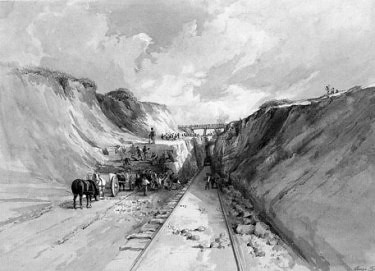
In 1831, 24 year old Isambard Kingdom Brunel was awarded a contract to bridge the Avon Gorge. It was the dream of a prosperous wine merchant who provided the initial funding. The completed bridge would become the symbol of the city, but lack of funding dogged the project. It took thirty years to complete it. For years only the towers stood completed. In 1833 Brunel began work on the Great Western Railway, which would become the instrument of Bristol's economic revitalization. The nicknames: "Great Way Round" and "God's Wonderful Railway" seem to describe well Brunel's great work.

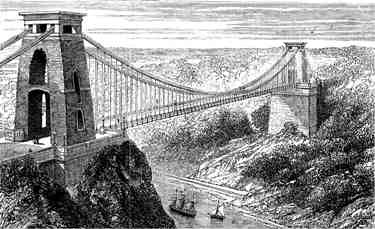
suspension-bridge001
Brunel's Clifton Suspension Bridge became the symbol of the City of Bristol.

greatwesternrr001
Building the Great Western Railway.

Zimmerman and his apprentices studied the work of men like Brunel, who in the Nineteenth Century had built shipyards and had designed the first propeller driven transatlantic steamship. Like the steelworkers in Bodine's photographs, they seemed involved in the pouring of some fiery inventiveness beyond their ability to create on their own. In fact, the stuff of creativity seemed dangerous, its mishandling capable of reducing its handler to ash. The more Zimmerman accomplished, it is safe to say, the less ownership he felt of the work he'd seen accomplished.

mullerbldg006
Children at Ashly Down.

mullerbldg008
Children at Ashly Down received education and training for future employment. the day started at 6am for the orphans, normal for working-class children of Victorian times.

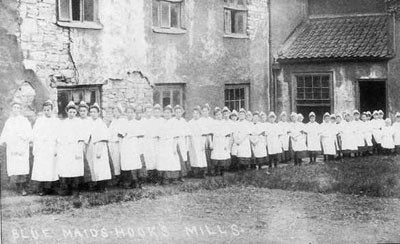
mullergirls
While boys would be placed in apprenticeships at age 14, the young ladies would remain until 17. They received training to be Nurses, Teachers and Domestic Servants [as the group in maids' uniforms above].

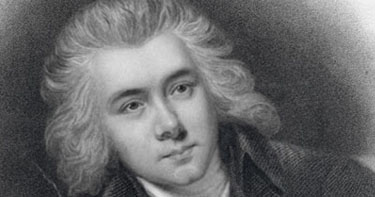
William-Wilberforce-006-570x300
William Wilberforce.

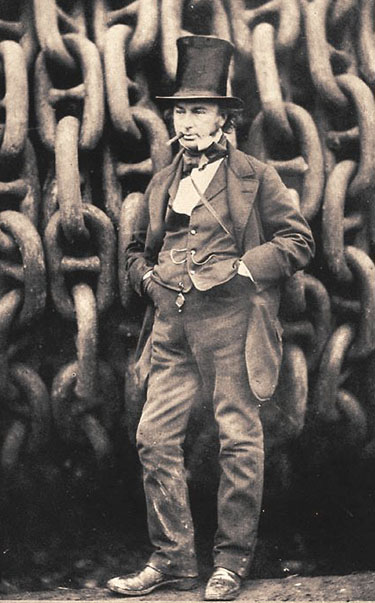
IKBrunelChains2
Isambard Kingdom Brunel.

(to be continued) [click to read]

Previous Chapter | Next Chapter
[click to read ]

Copyright © 2015, The Kirchman Studio, all rights reserved

Wednesday, March 25, 2015

THYME Magazine: Building the Kingdom II

Citizen Journalism with a Better Flavor

THYME0913
Volume IX, Issue XIII: William Wilberforce (1759-1833).
Portrait by Karl Anton Heckel, 1794


Building the Kingdom II

The term Social Justice is often used in the discussion of finding solutions to societal problems today. Jonah Goldberg describes what it often means today in the following video. But, has the noble quest for human rights and dignity been hijacked from its original purpose? Is there a proper application in the building of the Kingdom of G-d? Today the term is largely associated with government intervention and redistribution, but that was not always the case.

Jamie Casler, Director of Trevecca Nazarine University's J.V. Morsch Center for Social Justice [1.] believes there is indeed a place for Scriptural social justice, saying: "We draw our definition of social justice from the Scripture, not so much from the secular terminology, We try to be very careful to say we're about biblical social justice, not about secular social justice. What we call today 'social justice' the church has commonly called 'compassion ministries'-showing compassion to your neighbor and helping those in need." Casler seeks a return to the Church's role in fostering this sort of compassion.

Carlton Hayes wrote, "From the wellspring of Christian compassion, our Western civilization has drawn its inspiration, and its sense of duty, for feeding the hungry, giving drink to the thirsty, looking after the homeless, clothing the naked, tending the sick and visiting the prisoner." As one writer put it, missionaries and other Christians lived as if people mattered. Revolutionary!

Christianity exploded onto a brutal, heartless Greco-Roman culture. Believers in this radical new religion set a new standard for caring for the ill, downtrodden, and abused, even at risk of death. Through their transformed Christlike outlooks, they established countercultural ways that lead to later innovations: orphanages, hospitals, transcendent art and architecture, and systems of law and order based on fairness, to name a few. In the early church, every congregation had a list of needy recipients called a matriculum. Enormous amounts of charity were given. "Pagan society, through its excesses, teetered on the brink of extinction. Christianity, however, represented . . . a new way." [2.]

THYME presents here the lives of several reformers who's work was clearly rooted in the principles of Scripture.Their work should serve as a model for the building of the Kingdom in our own time.


Without foundations in timeless values, 'Social Justice' becomes simply an excuse for government intervention and redistribution.

The Abolition of Slavery
William Wilberforce

Born to privelege and prone to enjoy the pleasures his status afforded, William Wilberforce would have seemed an unlikely candidate for world changing reformer but G-d in his wisdom had bigger plans for the young dandy. He prepared himself for a life of politics while studying at St John's College, Cambridge.

Then, as now, religion was something considered good 'but not in excess.' Still Wilberforce found himself spiritually hungry and found faith. He sought out the council of John Newton, former slaver turned clergyman. Wilberforce was ready to forsake his place in Parliament to serve G-d but Newton convinced him that his service in Parliament could indeed be a great service to his Creator!

Wilberforce became convinced of two great missions: "the abolition of slavery and the reformation of manners." That is to say reform of society's priorities and treatment of people.

Wilberforce labored for almost half a century to end slavery in the British possessions. He pressed himself to exhaustion and stressed himself to the detriment of his health, but eventually he prevailed. The movie "Amazing Grace" tells of his life and gives a broader picture of the man. He was concerned about mistreatment of animals, healthcare, prison reform and a host of issues that press mankind still.

His work is far from finished. Human Trafficking [click to read] is an issue that modern day persons desiring to follow the lead of Wilberforce must step up to address.

Compassion for Orphans
The House that Faith Built Cared for Thousands

George Müller
George Müller.

What Can One Do, 
Motivated by G-d's Love?

Our small group has been discussing the book Crazy Love [1.] by Francis Chan. There is a brief mention of George Müller, the Nineteenth Century evangalist who is famous for his work with orphans. Müller's story begins in Prussia and continues as he comes to faith as a young man. Motivated by his love for G-d he moves away from some practices in the church such as 'renting' pews. In those days people of means would pay handsomely for the best seats and the Pastor would make a good living from these monies.

George Müller's love for G-d soon moved him to reliance on G-d. When he came to take a church in Bristol, England he declined the salary. He wanted to show people how vast and great G-d really is by trusting Him for his supply. Müller prayed and told his needs to no one, then ministered to the needs of his congregation. When his needs were supplied he gave G-d the glory. In times of waiting for supply he gave G-d the glory.

Seeing the needs of orphan children, George Müller went to his knees on their behalf and G-d provided the means for him to care for them. He eventually built five orphan houses and never once made an appeal for money!

We often read of how G-d worked in the lives of the saints of old. We read Hebrews 11 and see how men and women motivated by the love of G-d lived out that love, but with George Müller's story we have photographs. Here are some old post card views of the orphan house at Ashly Down, built in 1849.

mullerbldg003
Nineteenth Century rendering of the house at Ashly Down.

mullerbldg002
The house at Ashly Down.

mullerbldg006
Children at Ashly Down.

mullerbldg008
Children at Ashly Down received education and training for future employment. the day started at 6am for the orphans, normal forworking-class children of Victorian times.

mullergirls
While boys would be placed in apprenticeships at age 14, the young ladies would remain until 17. They received training to be Nurses, Teachers and Domestic Servants [as the group in maids' uniforms above].

More on the Life of George Müller [click to read].

The George Müller Foundation [click to read].

Redefining 'Social Justice' [click to read] from World Magazine.

Beck vs Wallis [click to read]. More thoughts on 'Social Justice.'

mullerbldg007
The house at Ashly Down today. Although the building might seem austere by today's standards it featured high ceilings and three hundred large windows [all donated by a window maker]. By Victorian standards it was a bright environment.

The Story of George Müller
One Man's Journey of Faith Changed History

George was born in Prussia on September 27, 1805 and was in college studying to be a preacher when he became a Christian. In those days some young men saw preaching as a well paying job, not necessarily as a service to G-d. The University at Halle, where young George was studying was a place where one could find bad company.

His father was a tax collector for the government. He gave George a lot of money, and he spent it very foolishly. Young Mueller was known for his wild out of control lifestyle, But his life was transformed when he came to know Christ.

Therefore, if anyone is in Christ, he is a new creation; the old has gone, the new has come!" -- 2 Cor. 5:17

Müller turned from his old ways but still struggled in his desire to follow Christ. He finished his studies and headed for England to begin his career as a preacher.

Soon after coming to England Müller received a deeper Christian experience which entirely revolutionized his life. He became very ill and was at the point of death when he saw what a bad life he had led but realized all his sins were completely forgiven -- that he was washed and made clean, completely clean, in the blood of Jesus. The result of this was great peace. "I longed exceedingly to depart and to be with Christ..." he wrote.

He was sick for two weeks. Then his Doctor said he was better. He was sad. "I wanted to be in Heaven with the Lord, but he gave me grace to do his will.”

He became pastor of Ebenezer Chapel in Devonshire. His marriage to Miss Mary Groves, a Devonshire lady,followed. Their married life was a very happy one.

In those days the church ”rented” pews to the people. Rich families would pay for the best seats while the poorer brother sat in the far corner. Large salaries were paid to the minister.

George did not think this right. He ended the practice of collecting pew rent in his chirch and forsook a salary. He stated that he would look to the Lord he served to meet his needs, not to men.

He and his wife told their needs to no one but the Lord. Occasionally reports were spread that they were starving; but though at times their faith was tried, their income was greater than before. He and his wife gave away freely all that they had above their present needs, and trusted the Lord for their "daily bread."

For therein is the righteousness of God revealed from faith to faith:as it is written, The just shall live by faith." -- Romans 1:17

He and his wife eventually settled in Bristol, England, where they saw many orphans roaming the streets -- uncared for, unfed, often sick, and virtually guaranteed death at a young age. At this time writers like Charles Dickens and William Blake had not yet brought attention to the plight of these children, and NOTHING was being done to help them.

Müller began his labors in Bristol in 1832, as co-pastor with his friend Mr. Craik, who had been called to that city. Without salaries or rented pews their labors were greatly blessed at Gideon and Bethesda Chapels. The membership more than quadrupled in numbers in a short time. Ten days after the opening of Bethesda there was such a crowd of persons inquiring the way of salvation that it took four hours to minister to them.

George and Mary decided to start an orphanage that would be entirely free of charge, and for which they would never ask any money or support. When they had needs they would go to G-d alone, trusting that he would give them everything they needed.

Pure religion and undefiled before God and the Father is this, To visit the fatherless and widows in their affliction, and to keep himself unspotted from the world." -- James 1:27

Among the greatest monuments of what can be accomplished through simple faith in G-d are the great orphanages covering thirteen acres of ground on Ashley Downs, Bristol, England. When G-d put it into the heart of George Müller to build these orphanages, he had only two shillings (50 cents) in his pocket. Without making his wants known to any man, but to G-d alone, over a million, four hundred thousand pounds ($7,000,000) were sent to him for the building and maintaining of these orphan homes. At the time of Mr. Müller's death, there were five immense buildings of solid granite, capable of accommodating two thousand orphans. In all the years since the first orphans arrived the Lord had sent food in due time, so that they had never missed a meal for want of food.

Confess your faults one to another, and pray one for another, that ye may be healed. The effectual fervent prayer of a righteous man availeth much" -- James 5:16

But my God shall supply all your need according to his riches in glory by Christ Jesus." -- Phillipians 4:19

I have been young, and now am old; yet have I not seen the righteous forsaken, nor his seed begging bread." -- Psalm 37:25

Hundreds of children were saved from the mean streets. They knew love and happiness in the care of George and Mary.

In 1875, at the age of 70, the remarkable George Müller decided to devote the next period of his life to a world-wide ministry of preaching and teaching.

During his seventeen years of missionary travel he toured the United States of America three times, India twice and on three occasions toured Australia and the Colonies. In addition, George Müller preached in forty-two countries including China and Japan. By land and sea he traveled 200,000 miles, an extraordinary feat in the nineteenth century.

Charles Dickens
With Six Children to Feed, the Author Needed a Miracle

Francis_Alexander_-_Charles_Dickens_1842
Frances Alexander's 1842 painting of the famous author.

The Year was 1843 and he needed a miracle. With six children to feed and a large house in London to maintain, his slipping sales as a writer were of great concern. His installment novel: Martin Chuzzlewit, was selling poorly, unlike earlier works like Nicholas Nickleby, which had given him some measure of success.

Christmas was coming as he bitterly confided to a friend that his checkbook was empty. Walking the streets, he came up with a 'Ghost of an Idea' and set to work. He published 6000 copies in time for Christmas distribution. They sold out, but because he had splurged on hand-coloured illustrations by John Leech he barely broke even. [3.] Yes, even in Nineteenth Century England, good illustration cost you something! [4.]

Fortunately the little work went on to be a classic. It reinvigorated the career of its creator. Today we still love A Christmas Carol and its author: Charles Dickens, not only as a writer, but as one who helped to bring about much needed social reforms in his day.
______________________________________________

Binyamin Netanyahu's Big Win

Binyamin
Prime Minister Binyamin Netanyahu of Israel.

Early predictions had Binyamin Netanyahu and the Likud Party not likely to win a clear majority. Major media outlets were predicting a tie at best with the Zionist Party, meaning perhaps a rotating Prime Ministership. Still, as the actual voting occurred a week ago, as "official" exit polls hovered around a tie, The Prime Minister declared the race a victory and began the important process of building coalitions to govern. How could that be possible?

Phillip Pasmanick, who writes: Israel and Stuff [click to read] put it best: "Wait until the IDF votes are counted. He'll have thirty seats!" Sure enough, as the hard results started coming in on Wednesday, Likud had secured the promised thirty seats. You need to know something about Phillip. He's in the IDF and he's up defending the border with Lebanon. Alongside him are arabs; soldiers, also in the IDF. This should begin to give you a glimpse into the under-reported life of this amazing country the size of New Jersey.

It is indeed the only place in the Middle-East where the religious and political minorities live in peace with their majority neighbors, not only enjoying protection from persecution but representation in the Kenesset! Netanyahu's win, remaniscent of Ronald Reagan's unexpected win in 1980, says that there is solid support for his strong stance in defending the stability of the region. Those who truly desire peace in the region will do well to listen to him.

Ivote

vote
______________________________________________

Restoring Harmony

Harmonic


I have been in Stephens City much of the past week helping master restorer and organ builder, Xaver Wilhelmy as he restores the Estey pipe organ in Trinity Evangelical Lutheran Church. The instrument was likely built sometime in the early Twentieth Century, though we have no known opus number. Here are some photographs from the trip.

IMG_5643
The sanctuary itself was completed in 1906.
Photo by Bob Kirchman

IMG_5666
The church windows illuminated from within.
Photo by Bob Kirchman


IMG_5649
The organ itself was probably installed in the 1930's, having been moved from a church in Baltimore. Photo by Bob Kirchman

IMG_5669
Here are some of the motors that play the 1200 pipes.
Photo by Bob Kirchman


apipes
Front Pipes. Photo by Bob Kirchman
Wednesday, August 13, 2014

THYME Magazine: The Mapmaker's Ethic II

Citizen Journalism with a Better Flavor

THYME0807
Volume VIII, Issue VII

The Mapmaker's Ethic II:
Reliable Directions for an Important Journey

Maps are an important tool for navigating what is often to the user unknown regions. The users' success and ultimately their safety in the journey requires that the mapmaker strive to provide the most accurate depiction his or her art can produce of the ways of travel, their conditions, and possible dangers!

No one would in any seriousness suggest that the only place that was significant or real was the part of the landscape he could see from his house, and that the rest, because it was unseen, either didn't exist or was of no consequence. Indeed, if you encountered such a person, you might refer to the most accurate map you could find. Pinpointing his house, you would proceed to show him the main arteries, the rivers, mountains and towns that await him outside of the realm he can see. Yet a scholar like Richard Dawkins can essentially use the same reasoning in writing The G-d Delusion and be lauded as brilliant!

But Dawkins as much as admits that he is 'not sure' if G-d exists in a discussion at Oxford University. [1.] It is time, I would say, to pull out the maps. Dawkins publicly dismisses religion because he feels it is the 'root of mankind's evils.' The problem is that if we look to history, we find a firm challenge to that mindset. In Why Religious Literacy Matters [click to read] we find that the evidence does NOT point us away from faith, rather it shows us instances where mankind has been lifted by something he clearly did not produce on his own.

One who wants to rest his argument on the premise that religion causes wars simply needs to look at the culture BEFORE the arrival of the religion he wishes to impune. In fact,honest history shows us that men's baser instincts resulted in a cycle of raiding and retribution LONG before white Christians ever arrived. Slavery existed for centuries where there was NO Christian influence, and succumbed to the influence of men like John Newton and William Wilberforce [2.] who were MOTIVATED by that faith.

The film: G-d's Not Dead [click to read] takes a look at the rational 'reasonable' men have for attacking faith. Indeed, the notion that unresolved evil discredits the existence of the Almighty is presented in a straightforward manner. The writings of great people OF faith, such as C. S. Lewis actually have much to say about this. The fact is that Lewis was as hard an Atheist as Dawkins, but guided by his friend and mentor: J. R. R. Tolkein, he found himself: "The most reluctant convert in all of England!"

The Catholic Tolkein had at his disposal a vast library of fine maps. The Christian recognizes Moses and the Prophets, just as G-d's Chosen do. Looking first to those texts that claim the authority of Divine Authorship through Inspired Writers, one then overlays them with good history to see what they reveal. It is not at all unlike the exercise employed in creating my historical map of Rockbridge County. [3.] One may wish to question the accuracy of the historic texts, but here more history witnesses to their reliability.

981 texts on scrolls discovered between 1946 and 1956 at Khirbet Qumran in the West Bank inside caves about a mile inland from the northwest shore of the Dead Sea, written in Hebrew, Aramaic, Greek, and Nabataean, mostly on parchment but with some on papyrus and bronze, are associated with the Essenes.What is fascinating is the fact that more modern texts are spot-on with these ancient manuscripts, save for a few punctuations and such.

The scribes who copied these documents worked to an ethic as rigorous as that of the mapmaker. A scribe would 'practice' reproducing texts and his work would be rejected for so much as a character omitted or out of place. Dawkins likes to claim that "we are all atheists" concerning most of the gods people have worshiped. Put it in the perspective though, that most such 'dieties' were slimly documented local gods associated with seasons, fertility and harvest. In 1 Kings 18:40 we see the prophet Elijah take on the priests of Baal. There were many such dieties, seemingly demanding that mankind placate them in return for good harvest.

Gods like Molech demanded the sacrifice of children by burning them. Indeed, if the G-d of Creation is like them then Dawkins has a point. But that the great body of revealed Scripture teaches a people that through them: "All the Nations of the Earth shall be blessed." and in a world of raiding and retribution teaches the new concept of kindness toward the stranger who lives in your midst, then we need to reexamine the wholesale dismissal of faith. The map will not allow us to.

Also, quite importantly, the Mapmaker's Ethic requires that we draw an accurate representation of faith as it runs through the landscape that we inhabit. We need to see the true course that it runs. That means we consider accurately the Crusades as well as Dorethea Dix and Florence Nightingale, who motivated by their faith, made strides in the care for the mentally ill and in the profession of nursing, respectively. We need to consider the very real occurrence of hypocrisy: those who speak in terms of faith but do not live as it requires. History is full of these as well.

But it must be noted that people of faith have often stood against the viler things. Slavery was maintained by professing Christians in the United States until the Abolition, but it was the teachings of Christianity itself that led to that Abolition. Martin Luther King's famous demand: "Let MY people go!" is a restatement of Moses' demand of Pharaoh.

Glimpses into a World Unseen

The electron microscope further reveals amazing patterns.

sectiondna
Vertical section of the human dna.

Evidence of Divine Design, Great and Small
"The Heavens Declare the Glory of G-d;
The Skies Proclaim the Work of His Hands." -- Psalm 19:1

IMG_0037
Moth wing pattern.

I saw this little creature outside my studio one morning. It got me reflecting on the creative wonder, both large and small, that surround us.

m51spiral
M 51 Spiral Galaxy, NASA photo from the Hubble Space Telescope.

xsructure001
Detail of the 'X Structure' in M 51, NASA photo from the Hubble Space Telescope.

The artist is amazed. So much beauty and wonder in the very large cosmos and in the very small things as well! Can a G-d who spins galaxies into being be concerned with things small and personal? Such order and grace in the extreme scales of our world, yet often what we see before us is chaotic and makes no sense.

That is why we present here Lee Strobel's Case for a Creator. Also recommended are Strobel's Case for Faith and Case for Christ. You may view them Here [click to view]. If you had stepped into that Bethlehem stable many years ago, you would have not necessarily seen beauty and redemption. The smells of animals and the pain of labor and delivery would have overwhelmed contemplation. Yet Christians around the world will contemplate the wonder of that night; for what happened there ultimately made its mark on human history.


The Case for a Creator by Lee Strobel.

(to be continued).

Wednesday, May 7, 2014

THYME Magazine

Citizen Journalism with a Better Flavor

THYMEfibonacci
Volume VII, Issue XXI

"We hold these truths to be self-evident, that all men are created equal, that they are endowed by their Creator with certain unalienable Rights, that among these are Life, Liberty and the pursuit of Happiness." -- American Declaration of Independence.

The Divine Design
In Defense of 'Self Evident Truth'

There is in nature an element of beauty that transcends functionality. Observation of the created world leads us to see something of the nature of the Creator. Thus it is significant that the framers of our original documents saw the dignity and significance of individual men as rooted in the concept of Imago Dei -- that mankind was created in the image of the Divine. Consider the impact that observation has had on the affairs of mankind. Two hundred years ago these principles were invoked as the foundations for our nation. No, slavery was not immediately abolished and sin was not obliterated... but that such principles were laid as foundation for our revolution led to a place where they formed a clear and unmistakable map for our future direction.

Indeed these principles predate the American experiment, finding expression in the work of men such as John Locke. England's own move from absolute monarchy to Parliamentary government, as seen in her 'Glorious Revolution,' gave wind to the sails of representative government and individual dignity. William Wilberforce's faith led him to fight for decades to abolish slavery. He is most remembered for this but he also championed reform of the culture and humane treatment of animals. History shows us time and time again, that conviction and passion lead to action. What a person truly believes will direct his steps. That is why we should indeed ask our leaders what they believe. It affects their leadership!

Well into the Twentieth Century, we still find faith directed persons in conflict with the degrading of humanity. Dietrich Bonhoeffer is a prime example. The Lutheran theologian could not keep his faith 'personal' as the National Socialists oppressed the Jews. He spoke out against it. Then he joined in an attempt to assassinate Adolf Hitler. Many 'modern thinkers' will likely be repelled by the thought that a Christian's faith could be reconciled with the assassination plot. But consider this: Hitler's 'beliefs' in a superior race led to the deaths of millions of people. Hitler implemented HIS beliefs unashamedly. When the smoke had cleared over six million Jews, scores of Gypsies and other 'undesirables,' homosexuals and "Righteous Gentiles" lay dead!

Why do we universally condemn Hitler? 'Self Evident Truth' tells us to. In fact, without such self evident truth, we can actually argue for the elimination of those 'not like us' with some authority. This is the frightening dark side of Relativism. If nothing is 'right' or 'wrong,' then NOTHING is 'right' or 'wrong!' Pro-choice arguments for abortion reside here. Locke is careful to temper the reality of human freedom with the moral obligation to respect the freedoms of others. This underlying concern leads us to condemn slavery, leads to the actions of the 'Righteous Gentiles' and now leads us to plead the cause of the unseen unborn!

So, what do we do when modern leaders insist that we not question their beliefs? I think history tells us to question them anyway! What a man truly believes will indeed shape his actions. Simple due diligence requires that we ask our leaders to share the basis upon which they will act. To be fair, Barack Hussein Obama did so in his book: Dreams of My Father. The Obamas occassionally attend St. John’s Church, an Episcopalian church in Washington, but when he was a young Chicago politician he freely chose to attend the church of the Reverend Jeremiah Wright, a disciple of Black Liberation Theologian James Cone. This association with Liberation Theology would be in keeping with his father's stated Anti-colonialism.

Of course, privately held beliefs have no effect on public policy, right? If you consider Obama's policies carefully, you will find a Justice Department that overlooks VOTER INTIMIDATION by the New Black Panther Party while Obama's State Department virtually ignores the plight of evangelical Pastor Saeed Abedini, an American imprisoned in Iran! Obama's boyhood is remarkably removed from that of a typical American who would have experienced church picnics, Fourth of July celebrations and such. He studied at a Muslim school in Indonesia and was introduced to Hanuman the Monkey God by his stepfather Lolo.

While the American experience is quite tolerant of diversity, it is not at all unreasonable to ask a PRESIDENT what he believes. When Obama made a quite contorted and subservient bow to the Saudi King, Americans are right to ask what this means? If I am disturbed that Eric Holder's acceptance of voter intimidation seems similar to the 'righting of wrongs' between tribes in post-colonial Africa, is it unreasonable for me as a citizen journalist to draw comparisons to the ideals of Dreams of My Father? One only has to look at Uganda and Rwanda to see the results when settling the score for the oppressed peoples of the world becomes the goal rather than elevating the human condition.

The American experiment, rooted in a sense of Divinely ordained principle, created unprecedented opportunity for scores of people. Contrast that with the wreckage of a slew of Socialist 'utopias' that descended all too rapidly into dystopia. It would seem to me that America's founding, based on Divine insight into the nature of man, has produced far more good than subsequent attempts to 'reform' institutions with NO regard for Divine insight. That is at the heart of why I must be in Washington on May 16 to stand against those who would 'fundamentally change' that nation based on self evident truths.

Standing for Truth [click to listen], Some thoughts from Eric Metaxas, New York Times bestselling author of Amazing Grace: William Wilberforce and the Heroic Campaign to End Slavery.

How Do You Kill 11 Million People [click to listen], Are there really similarities between Nazi Germany and the government of the United States?  NY Times Best-selling author Andy Andrews answers that very question, while also helping us discover a way to turn our country back to the truth on which it was founded.

advert

Thursday, November 14, 2013

THYME Magazine American Renewal Issue IV

Citizen Journalism with a Better Flavor

THYME0625
Volume VI, Issue XXV

Isambard Kingdom Brunel
What a Nineteenth Century Innovator Can Teach Us Now
© 2013 The Kirchman Studio, All rights reserved.

“They say that the condition for a miracle is difficulty, but the condition for a great miracle is impossibility” -- Angus Buchan, “G-d's Farmer”

When William Wilberforce [1.] had ended the slave trade in the British Empire, he had thrown the city of Bristol, England into economic depression. The port there was heavily devoted to that wretched business and suffered heavily when it was brought to a sudden halt. The unintended consequence had been a rise in children condemned to a life of poverty. Ending the vile business of enslaving Africa's children had resulting in England's society spurning the needs of her own. Into this world came George Müller [2.], who, relying on faith in G-d alone, provided redemption for thousands of orphans. Many of these children were cast-offs of a society in economic despair.

George Müller [3.] had seen the wretched street urchins most people despised as jewels to be polished. Muller, relying solely on Divine provision, built five large houses for Orphans at Ashley Downs in Bristol, England. He trained the girls to be nurses, teachers, clerical workers and domestics. He apprenticed all the boys in various trades. He was excoriated for training these unwanted children "above their station." He ignored the critics.

Müller looked to G-d alone, but Bristol needed an outfowing of Divine provision to provide for her children. G-d's provision for Bristol was to come in the form of inspiration and innovation, embodied in the work of a young pioneer of civil engineering. He also ignored his critics.

suspension-bridge001
Brunel's Clifton Suspension Bridge became the symbol of the City of Bristol.

greatwesternrr001
Building the Great Western Railway.

In 1831, 24 year old Isambard Kingdom Brunel [4.] was awarded a contract to bridge the Avon Gorge. It was the dream of a prosperous wine merchant who provided the initial funding. The completed bridge would become the symbol of the city, but lack of funding dogged the project. It took thirty years to complete it. For years only the towers stood completed. In 1833 Brunel began work on the Great Western Railway, which would become the instrument of Bristol's economic revitalization. The nicknames: "Great Way Round" and "G-d's Wonderful Railway" seem to describe well Brunel's great work.

Brunel was an innovator. He probably experienced as many failures as successes in his short lifetime. Born on April 9, 1806, the son of Sir Marc Brunel, he assisted his father in building a tunnel under the Thames. He would later become the resident engineer of that project. At twenty years of age, he designed a suspension bridge to cross the Avon river. A modified version of his plan was actually constructed.

At 26, Brunel was building the Great Western Railway, commissioned to maintain Bristol's importance as a port and position her for  trade with America. This wide-gauge railroad linked Bristol and Western regions of England to London. Bristol's prosperity as a port was assured and the work of Müller created solid citizens with strong spiritual foundations to benefit.

But Brunel was not content to simply build a better railway. He looked across the Atlantic, envisioning fleets of ocean greyhounds -- great steamships that would complete the linking of his Great Western Railway to America! The S. S. Great Britain was his creation. It was the first metal-hulled propeller-driven ocean ship and became the prototype for modern ocean liners.

Building the South Devon Railway as a spur to the Great Western, Brunel experimented with an alternative to steam engines -- Vacuum tube powered trains. Stationary vacuum plants evacuated tubes laid along the center of the track that powered the movement of trains.

atmosenginesmall
Brunel's 'Atmospheric Railway.'

"The technology required the use of leather flaps to seal the vacuum pipes. The natural oils were drawn out of the leather by the vacuum, making the leather vulnerable to water, rotting it and breaking the fibres when it froze. It had to be kept supple with tallow, which is attractive to rats. The flaps were eaten, and vacuum operation lasted less than a year, from 1847 (experimental service began in September; operations from February 1848) to 10 September 1848.[45] It has been suggested that the whole project was an expensive flop. In Brunel's favour, it has been noted that he had the courage to call a halt to the venture instead of struggling on with it at greater cost." -- Wikipedia

Like alternative transportation prototypes of our day, the vacuum tube system was more expensive. The accounts of the SDR for 1848 show that atmospheric traction cost 3s 1d (three shillings and one penny) per mile compared to 1s 4d/mile for conventional steam power.Though considered a failure at the time, vacuum powered trains may have been a distant precursor to Evacuated Tube Technology [5.] which is now being developed to move entire transport capsules through large tubes -- essentially powered in the same way as Brunel's South Devon train. Brunel was simply two Centuries before his time on this.

What can we learn from Brunel today? Plenty! Inspiration and innovation are needed now as they were needed then. Brunel teaches us valuable lessons about expanding vision with proven technologies and wisely exploring alternatives (and abandoning them when they do not work as planned).

Praying people see the diaconate role of economic development as an integral part of G-d's provision. In “Resources for Deacons, Love Expressed Through Mercy Ministries,” [6.] Tim Keller states his belief in three “levels” of mercy in diaconal ministry:

The first Level Is Simple Relief: That is taking care of the immediate need.

The Second Level Is Economic Development: That is teaching the poor how to get out of poverty by teaching them how to handle money, property, etc. and furnishing them with the means to do so. “Not handouts, but ownership is the way to break the cycle of poverty.”

The Third Level Is Social Reform: Christians should be involved in the culture in an effort to change the social structure.

We see it very localized in a place like Zambia, where people of faith instruct widows to become seamstresses (and people in America gift them with sewing machines). But, can we believe G-d for ever greater inspiration? What vision would G-d give us for our family, our company of employment, our city and county... and beyond? Müller said "the age of miracles is not past." Angus Buchan [7.], in the turmoil of Zambia and South Africa, looked to G-d for inspiration. G-d met him in a corn field where he learned the power of prayer!

Buchan had packed his family up during the unrest in Zambia in the late 'seventies and moved them to South Africa. A successful farmer in Zambia, he felt that he would be happy if he could acquire another farm in South Africa. It didn't. Experiencing deep depression, Buchan was angry and confused. Wandering into a lay-witness Sunday at the local Methodist Church, Angus heard builders, tradesmen and fellow farmers tell of what Jesus meant in their lives. For the first time he saw men crying, he wept unashamedly himself as he responded to an altar call. He took the Lord seriously about the changed life promise.

Buchan went back to his farm and learned to pray in his own corn field. Then he sought to minister to his Zulu workers. His farm manager, Simeon Bhengu, told him: "that's women's religion..." But G-d met Angus and spoke through his friendship with Simeon. Today the men are brothers in faith and brothers in every way. "My children are his and his are mine." Angus says of his Zulu brother. Angus expanded his farming operations and G-d's miraculous provision was seen at every turn. The movie "Faith like Potatoes" is the true story of Angus Buchan and it is quite inspiring! Buchan used machinery but avoided totally mechanizing the farm, looking to provide steady employment to his Zulu neighbors.

In the early 1980's Buchan became aware of a new tragic development. AIDS was ravaging families and creating untold numbers of orphans. Buchan reached out to these orphans but had no place to house them. A local school had temporary classrooms they were going to demolish and Angus received permission to take them apart and reassemble them at Shalom, which he had named his complex at the farm. At first the children lived in dormitories but gradually Angus was able to create "houses" where one "mother" cared for a smaller number.

South Africa in her recent history has experienced much uncertainty and Buchan's experience is instructive as we look to address the turmoil in our own country today. Isambard Kingdom Brunel should serve as an inspiration as well.

"Let no man despise thy youth; but be thou an example of the believers, in word, in conversation, in charity, in spirit, in faith, in purity." -- 1 Timothy 4:12

His Simple Faith Gave Hope to Street Children


George Müller changed the way those around him saw the plight of orphans.

Next Week in THYME: Metamorphosis
Bob Kirchman writes on: "Transforming a Culture... One Person at a Time"

Thursday, October 17, 2013

THYME Magazine: Looking to the Future

Citizen Journalism with a Better Flavor

THYMEO621
Volume VI, Issue XXI

Motivated by the Hope Unseen

"Give me one hundred men who fear nothing but sin and desire nothing but G-d, and I care not whether they be clergyman or laymen, they alone will shake the gates of Hell and set up the kingdom of Heaven upon the earth.” -- John Wesley

Consider for a minute the amount of energy expended worldwide to persecute people of Faith. Organizations like Voice of the Martyrs [1.] report that it is at an all time high. Christians and Jews seem to often find themselves in the cross hairs of world opinion. Why should this be? Could it be that those who want to set up earthly kingdoms or earthly Utopias know better than the Saints the true power of the Kingdom of G-d?

In his book Under the Influence [2.] Alvin Schmidt lays out a compelling case for the positive influence those who have pursued the Kingdom of G-d have had on the world. Far from being of "no earthly good," people of faith have revolutionized healthcare, care for orphans and the poor and generally improved the welfare of the places they have been carried to, in fulfillment of the admonition in Jeremiah 29:

"Thus saith the Lord of hosts, the G-d of Israel, unto all that are carried away captives, whom I have caused to be carried away from Jerusalem unto Babylon;

Build ye houses, and dwell in them; and plant gardens, and eat the fruit of them;

Take ye wives, and beget sons and daughters; and take wives for your sons, and give your daughters to husbands, that they may bear sons and daughters; that ye may be increased there, and not diminished.

And seek the peace of the city whither I have caused you to be carried away captives, and pray unto the Lord for it: for in the peace thereof shall ye have peace."

Generally the abuses so quickly cited as reasons for limiting the influence of the church occurred as kings and clerics misappropriated the language of faith in pursuit of earthly power. The National Socialists in Germany may have artfully spun the language of the church, but why then did they find men like Dietrich Bonhoeffer [3.] so dangerous? In earlier times men like Meno Simonsz [4.] stood in opposition to what they saw as the church succumbed to the culture around her.

Presenting a clear alternative to the prevailing paradigms of the culture, men and women of faith serve an unseen kingdom and in doing so influence the world. William Wilberforce eliminated the vile institution of slavery [5.] in England. George Müller changed the way society viewed orphans [6.] along with Charles Dickens [7.]. Florence Nightengale and Dorethea Dix [8.], inspired by faith, worked tirelessly to improve the human condition.

Which brings me back to the original question: Why should a society so diminish those institutions and people who have contributed so much? Perhaps it is time to take another look at the power and place of faith... especially the place it has in one's own life. To that end Billy Graham, one of America's most prominent spokespersons for faith, presents: My Hope America [click to view]. This series of programs, culminating in November of 2013, offers a foundation of hope to a nation who's moorings have been deeply shaken.

Monday, September 16, 2013

Public Service as a Holy Calling

William Wiberforce and the Abolition of Slavery

William Wilberforce (1759-1833)
William Wilberforce (1759-1833).

A Milestone Monday Feature

Born to priveledge and prone to enjoy the pleasures his status afforded, William Wilberforce would have seemed an unlikely candidate for world changing reformer but G-d in his wisdom had bigger plans for the young dandy. He prepared himself for a life of politics while studying at St John's College, Cambridge.

Then, as now, religion was something considered good 'but not in excess.' Still Wilberforce found himself spiritually hungry and found faith. He sought out the council of John Newton, former slaver turned clergyman. Wilberforce was ready to forsake his place in Parliament to serve G-d but Newton convinced him that his service in Parliament could indeed be a great service to his Creator!

Wilberforce became convinced of two great missions: "the abolition of slavery and the reformation of manners." That is to say reform of society's priorities and treatment of people.

Wilberforce labored for almost half a century to end slavery in the British possessions. He pressed himself to exhaustion and stressed himself to the detriment of his health, but eventually he prevailed. The movie "Amazing Grace" tells of his life and gives a broader picture of the man. He was concerned about mistreatment of animals, healthcare, prison reform and a host of issues that press mankind still.

His work is far from finished. Human Trafficking [click to read] is an issue that modern day persons desiring to follow the lead of Wilberforce must step up to address.

Thursday, February 14, 2013

THYME Magazine

Citizen Journalism with a Better Flavor

THYME0509
Volume V, Issue IX

Our Once and Future Hope

This week the 'other' weekly news magazine features The Once and Future Pope [click to read]. The issue deals with the politics of the Vatican. Certainly the modern Pope wields a great amount of power in the affairs of nations. That was not always the case.

Consider the man, Peter, whom Christ mentored to serve His first small band of disciples. He was a common man, a fisherman. Certainly he was no stranger to dangerous situations, but when Jesus was being tried by religious and secular bodies prior to His crucifixion, Peter's flesh grew weak and he denied Christ three times. The story is recorded in Luke 22 and shows the human frailty of a great saint.

In Matthew 8:14 we learn Peter had a Mother-in-law. The first elder of the Church was married and ran a household. He was given to impetuous reactions, as when he cut off the ear of a high priest's servant. (John 18:10). He perhaps had more confidence in his courage than he should have (Luke 22: 33-34). Most of us can relate to his humanity in some way. Yet Jesus beckoned him to step into the work of a better Kingdom!

Matthew 14:22-33 Tells us the story:  "And straightway Jesus constrained his disciples to get into a ship, and to go before him unto the other side, while he sent the multitudes away. And when he had sent the multitudes away, he went up into a mountain apart to pray: and when the evening was come, he was there alone. But the ship was now in the midst of the sea, tossed with waves: for the wind was contrary. And in the fourth watch of the night Jesus went unto them, walking on the sea. And when the disciples saw him walking on the sea, they were troubled, saying, It is a spirit; and they cried out for fear. 

But straightway Jesus spake unto them, saying, Be of good cheer; it is I; be not afraid. And Peter answered him and said, Lord, if it be thou, bid me come unto thee on the water. And he said, Come. And when Peter was come down out of the ship, he walked on the water, to go to Jesus. But when he saw the wind boisterous, he was afraid; and beginning to sink, he cried, saying, Lord, save me. And immediately Jesus stretched forth his hand, and caught him, and said unto him, O thou of little faith, wherefore didst thou doubt? And when they were come into the ship, the wind ceased. Then they that were in the ship came and worshipped him, saying, Of a truth thou art the Son of G-d." 

As long as Peter's attention was focused on Christ, he could follow Him onto the water. When he took his eyes off of Jesus and concentrated on the churning seas, he sank. There is a lesson for leaders here, and history bears it out in the lives of men like William Wilberforce and George Müller, men who found incredible strength for the tasks they undertook. But it was not a strength found in themselves that spurred them on, rather it came from a Faith fixed on the person of Jesus. Wilberforce labored for decades to end the scourge of slavery in British lands [1.] and Müller provided homes for thousands of orphans without ever making one single appeal for money. [2.]

These were not superior men, I would argue. They were men who had a firm sense of their hope and promise in G-d. That led them to perform great works, drawing on a power that could only be found in The Divine, they changed the world.

Jesus

Thursday, February 7, 2013

THYME Magazine

Citizen Journalism with a Better Flavor

THYME0508
Volume V, Issue VIII

Rembrandt Harmenszoon van Rijn depicted Christ in the workaday clothes of a medieval artisan.

Accurately Depicting the Savior

There is a recurring vision somewhere in my subconscious, where having reached Heaven, I see Jesus in all His glory. Falling on my face, I am overwhelmed. After a while, His hand softly touches my shoulder as He bids me rise: "Come see what I'm working on." He says and then we walk to His workshop.

So many times I have visited an artist or a craftsman, and received that blessed invitation to enter the place where they create. It is an honor to be cherished, especially when a Master invites you as a fellow artisan. Such is the feeling of Christ's invitation in my dream.

Prior to Rembrant, the Seventh Century Master, artists routinely depicted Christ with crisp European features, either as a very heroic figure or in great agony. [1.]

In 1631, Rembrant moved from his hometown of Leiden, The Netherlands, where he was born in 1606, to the port city of Amsterdam, where he purchased a house in the city's Jewish Quarter.Ten years later, he was using the Shepardic Jews in his neighborhood as models. Since Jesus lived in the Middle-east and not Europe, Rembrant's portrayals strike a strong chord of reality in their composition.

The painting above has Jesus wearing the workaday clothes of a medieval artisan. You can just imagine the smells of the workshop still lingering in those clothes. I've met a few stonemasons who's honest features remind me of this picture.

Depicting Messiah has long been a challenge to the serious artist, [2.] and the theologian as well! There seem to be a lot of thoughts about who Christ is. Some of them seem as overworked as the paintings. Scripture gives us a good basis for knowing Christ's nature though. Ironically, it is two English scholars who give us some of the better word portraits. Clive Staples Lewis [3.]and John Ronald Reuel Tolkien [4.] both wrote great depictions.

Lewis portrayed Christ in the character of Aslan, the Lion of Judah. Tolkien's Aragorn (think of the book character more than the movie one here), also displays characteristics of the Redeemer.

Today, more than ever, it behooves us to present as honest a picture of Christ as we can. Much of our society puts little value in our faith, but are they perhaps looking at an incorrect picture? A faulty rendering can discredit something that is actually of great value! [5.]

Looking at the lives of John Newton, William Wilberforce, Florence Nightingale, Charles Dickens, William H. Howland, George Müller and a host of others actually reads like a companion volume to the Hall of Faith described in Hebrews 11. Their stories and their testimonies must be honestly examined before we discard the Faith that moved them. [6.]

This week the 'other' weekly news magazine presents Marco Rubio [click to read] as 'Savior' of the Republican Party. We at THYME would like to gently suggest that the term is greatly overused when referring to political figures.

thymebanner

Wednesday, January 23, 2013

Public Service as a Holy Calling

William Wiberforce and the Abolition of Slavery

William Wilberforce (1759-1833)
William Wilberforce (1759-1833).

A Milestone Monday Feature

Born to priveledge and prone to enjoy the pleasures his status afforded, William Wilberforce would have seemed an unlikely candidate for world changing reformer but G-d in his wisdom had bigger plans for the young dandy. He prepared himself for a life of politics while studying at St John's College, Cambridge.

Then, as now, religion was something considered good 'but not in excess.' Still Wilberforce found himself spiritually hungry and found faith. He sought out the council of John Newton, former slaver turned clergyman. Wilberforce was ready to forsake his place in Parliament to serve G-d but Newton convinced him that his service in Parliament could indeed be a great service to his Creator!

Wilberforce became convinced of two great missions: "the abolition of slavery and the reformation of manners." That is to say reform of society's priorities and treatment of people.

Wilberforce labored for almost half a century to end slavery in the British possessions. He pressed himself to exhaustion and stressed himself to the detriment of his health, but eventually he prevailed. The movie "Amazing Grace" tells of his life and gives a broader picture of the man. He was concerned about mistreatment of animals, healthcare, prison reform and a host of issues that press mankind still.

His work is far from finished. Human Trafficking [click to read] is an issue that modern day persons desiring to follow the lead of Wilberforce must step up to address.

Monday, October 25, 2010

Public Service as a Holy Calling

William Wiberforce and the Abolition of Slavery

William Wilberforce (1759-1833)
William Wilberforce (1759-1833).

A Milestone Monday Feature

Born to priveledge and prone to enjoy the pleasures his status afforded, William Wilberforce would have seemed an unlikely candidate for world changing reformer but G-d in his wisdom had bigger plans for the young dandy. He prepared himself for a life of politics while studying at St John's College, Cambridge.

Then, as now, religion was something considered good 'but not in excess.' Still Wilberforce found himself spiritually hungry and found faith. He sought out the council of John Newton, former slaver turned clergyman. Wilberforce was ready to forsake his place in Parliament to serve G-d but Newton convinced him that his service in Parliament could indeed be a great service to his Creator!

Wilberforce became convinced of two great missions: "the abolition of slavery and the reformation of manners." That is to say reform of society's priorities and treatment of people.

Wilberforce labored for almost half a century to end slavery in the British possessions. He pressed himself to exhaustion and stressed himself to the detriment of his health, but eventually he prevailed. The movie "Amazing Grace" tells of his life and gives a broader picture of the man. He was concerned about mistreatment of animals, healthcare and a host of issues that press mankind still.

His work is far from finished. Human Trafficking [click to read] is an issue that modern day persons desiring to follow the lead of Wilberforce must step up to address.

Monday, January 11, 2010

THYME Magazine

Citizen Journalism with a Better Flavor

THYME Volume II, Issue II
Volume II, Issue II

Designer Genes

Francis Collins calls the genetic code "The Language of G-d." Indeed there is a beautiful blueprint for life that causes us to wonder.There is the predictability that is the hallmark of great design but there is more to this wonder than meets the eye. Science suggests that environment and choices we make can have an effect, positive or negative, on how the design unfolds.

The science of epigenetics suggests that our environment and the choices we make in light of it may shape the direction of our development and that of our children. The code, it would seem, is written in such a way as to allow for the creature to be 'modified' to better function in an ever changing environment.

For years biologists assumed that Alaska had two distinct species of brown bear. More recently they discovered that the large Kodiak and the Grizzly were really genetically the same animal. The bigger bears enjoyed a diet rich in salmon and their smaller cousins' diet was a mixture of forage and small game. Environment and diet obviously contributed to the difference in execution of the same genetic plan.

Scientists studying human biology have discovered similar findings. The children of one people group that endured alternating periods of want and plenty showed that the offspring of those who endured famine tended to live longer lives than those born of those who could eat all they wanted. The implication is that we can make the tough choices in the way of diet and lifestyle and better that of our sons and daughters.

But on a deeper level, is it possible to look beyond the "Language of G-d" and be influenced by the designer's mind of the Creator. Can it be that our beings, made in the manner perscribed by our DNA, may begiven to the noblest of purpose or the basest?

History is full of people who have experienced some sort of personal redemption. That is to say they have moved from lives of dark deeds to noble ones. A prime example is John Newton, an English slave trader. He repented of the foul business of trading in human lives and wrote the hymn "Amazing Grace" to explain the redemptive experience that changed his life. Newton would go on to be a major encourager of William Wilberforce, the Parliamentarian who fought for decades to end the slave trade.

Newton, so well depicted by Albert Finney in the film "Amazing Grace" clearly had the capacity to destroy human lives by enslaving them --yet it was Newton who discovered himself to be the slave to the wretched life of a slaver. There is a line in his famous hymn where he says "[I] was blind but now I see!" If man has a spiritual aspect to his character, described by some 'spiritual DNA,' Newton's was clearly and forever altered for the better.

Francis Collins
Dr. Francis Collins.

Healthcare: The Saga Continues

On January 6th about 200 Virginians [click to read] showed up at the local offices of Senators Warner and Webb to voice their concerns about so-called healthcare 'reform.' As you know, the President who promised 'transparency' is now pushing for the conference in secret to work out the differences between House and Senate versions of the bill.

Our Senators didn't want to meet with us for town hall meetings so the people had to go to them. ht/SWAC Girl

IMG_5669
We tried. David Karaffa set up a forum for the Senators to expain the healthcare legislation but both declined.

Creating a Race of Thugs

Yankee Phil [click to read] Reports on a disturbing trend in British law enforcement... arrest the self-reliant citizen and give rights and protections to the criminal. What kind of citizenry and society will emerge from this trend?

tenth
We now have 750 RSVPs. Help push us over 1,000!!!!!

Email at rsvp@richmondteaparty.com [click to respond] and simply put in the subject line how many people you will bring. It is that easy!

Here is the 'companion' TIME Issue [click to read]. I was told that since many Conservatives don't bother to look at the 'Professional' weekly news magazine anymore, someone might miss the full impact of my 'cover commentary.'