Volume VIII, Issue III
What Makes a Nation Great? II
In the end, the state of the Union comes down to the character of the people. I sought for the greatness and genius of America in her commodious harbors and her ample rivers, and it was not there. In the fertile fields and boundless prairies, and it was not there. In her rich mines and her vast world commerce, and it was not there. Not until I went into the churches of America and heard her pulpits, aflame with righteousness, did I understand the secret of her genius and power. America is great because she is good, and if America ever ceases to be good, America will cease to be great.
-- Attributed to Alexis de Tocqueville, though it is not a direct quote from his work: Democracy in America.
In the quest to restore and revitalize our great land, one often hears great solutions proposed but often very little in the way of addressing the real problem. We can create all the great economic models we want to, but if we allow greed and self-serving policies to prevail, we will see ever more of the type of destruction we saw in the mortgage crisis. If we attempt to spend our way out of our problems by creating more money, we will end up as a vassal to China. We need Revival! THYME has looked at the problem of Restoring the American Dream [click to read] before. Whether or not we can definitively find the quote in de Tocqueville's writings, the work of Alvin Schmidt [1.] and others documents well the evidence for Faith as a force in making better the human condition.
That is not to say that we don't need to seek and consider better ways to conduct our affairs. There is a practical side to problem solving that cannot be ignored. Consider how George Müller changed the lives of thousands of orphans in Bristol, England. First let us set the stage. The elimination of the slave trade by William Wilberforce in the Nineteenth Century destroyed not only a vile institution, but as an unintended consequence the city of Bristol, a major slave port, was thrown into decline. G-d had two chosen instruments to revitalize Bristol. There was Isambard Kingdom Brunel, [2.] who built bridges, railroads and great steamships to link Bristol to the world! But Bristol needed more than just economic development!
The city's decline had led to thousands of children either losing their parents or being put out on the streets by their desperate parents. George Müller was G-d's next instrument in the revitalization of Bristol. Young Müller came to the city as a minister of the Gospel. As he sought to minister to the soul of a great city, the plight of her orphans tugged at his heart. He, depending on G-d alone, was able to provide five large houses for these unwanted children. He apprenticed all the boys in various trades but took great pains to educate the young women as office workers, nurses, teachers and housekeepers. They stayed at the homes until they were seventeen. This was a practical policy that kept them from being exploited by those engaged in viler trades.
Those who seek to revitalize our own nation would do well to do no less. We must first address the poverty of our national soul before we set into the very necessary business of restoring her fortunes!
A Case for Faith
On page 563 of his latest biography — John Quincy Adams: American Visionary — author Fred Kaplan (biographer of Abraham Lincoln, Charles Dickens, Mark Twain, and Gore Vidal among others) cites this insight of the sixth president:
Christianity had, all in all, he believed, been a civilizing force, “checking and controlling the anti-social passions of man.”
That insight is pretty much all an American needs to know in order to understand why the American Founders considered religion — specifically ethical monotheism rooted in the Hebrew Bible — indispensable to the American experiment; and why the America we have known since 1776 is in jeopardy." -- Dennis Prager.
In an article entitled: America Won't be Good without G-d [click to read] Prager lays out a pretty compelling argument. He writes:
"It is easy to respect secular Americans who hold fast to the Constitution and to American values generally. And any one of us who believes in God can understand why some people, given all the unjust suffering in the world, just cannot believe that there is a Providential Being.
But one cannot respect the view that America can survive without the religious beliefs and values that shaped it. The argument that there are moral secularists and moral atheists is a non sequitur. Of course there are moral Americans devoid of religion. So what? There were moral people who believed in Jove. But an America governed by Roman religion would not be the America that has been the beacon of freedom and the greatest force for good in the world."
Here Dennis Prager is spot-on in his analysis of the nature of man. The academy may tell us that we can effectively control the passions that drive us, but history, honestly pursued, tells us otherwise. Prager points out that: "Our prisons are filled with people whose consciences are quite at peace with their criminal behavior. As for reason, they used it well — to figure out how to get away with everything from murder to white-collar crime.
But our prisons are not filled with religious Jewish and Christian murderers. On the contrary, if all Americans attended church weekly, we would need far fewer prisons; and the ones we needed would have very few murderers in them."
Prager goes on to describe the wreckage of the great socialist experiments of the Twentieth Century, and the wreckage of "anything goes" philosophies that encourage casual sex and tell us that fathers are "unnecessary!" Indeed, if the academy would produce more honest studies of the results of the philosopies they have espoused, they might recoil at the burden they have placed on society.
Prager concludes with this sobering thought: "For proof of the moral and intellectual consequences of the secularization of America, look at what has happened to the least religious institution in America, the university. Is that the future we want for the whole country?"
The film: 'Expelled' is a pretty powerful documentary. G-d is getting some pretty bad press these days from esteemed writers such as Richard Dawkins and Christopher Hitchens. The Intelligent Design movement, though it is not specifically theistic, is uniformly vilified in the academy. Why is an inquiry into the observable order of the universe so dangerous, especially when open inquiry is such a cherished part of scientific investigation? Perhaps such 'open inquiry' inevitably leads to the 'wrong' conclusions.
Theodore Dalrymple writes in City Journal: "What the New Atheists are Missing." Himself a non-believer, he points to a time when a teacher's hypocrasy led him to question. Dalrymple does not, however, reject the realm of faith as a force in creating and ordering societies. He see's naturalistic explainations and philosophies quite insufficient for dealing with all of human existence. Richard Dawkins' assertions that religious education is tantamount to child abuse, for example seem to Dalrymple no more than the rebellious ranting of a child who's just learned that his parents are not perfect. All of us have experienced some sort of disillusionment in our youth. I remember a time when a nun of the 'Sisters of Mercy' punished me for some infraction I had not [at least in my recollection] committed. I too questioned a lot of things. The Cuban missle crisis fueled more unanswered anxiety as I careened into adolescence.
But something happened in my teenaged years that is etched firmly in my memory. It was a dark and stressful winter day when I decided to walk in the woods near Triadelphia Reservoir. Something spoke to me that afternoon that was more eloquent than the ranting of hormones and the perceived unfairness of life. The buds of the trees were growing fat. here was the hope of spring and new life. Clearly spring would come. The buds gave evidence of an event hoped for. They were indeed the substance of something yet unseen!
"For the invisible things of him from the creation of the world are clearly seen, being understood by the things that are made, even his eternal power and Godhead; so that they are without excuse:" -- Romans1:20 KJV
Holy writ makes the point that the order and beauty of the creation speaks eloquently of the creator. Thus Intelligent Design, though it merely points out the complex mechanisms of nature, leads one to seek the source of such wisdom. I look to that time in the trees as an affirmation of personal faith in a creator. Though at that point it was pretty detatched and intellectual at best.
"...for he that cometh to G-d must believe that he is, and that he is a rewarder of them that diligenly seek him." Hebrews 11:6b KJV
As a young adult I embraced faith in Christ as redeemer and rewarder. The journey of faith had begun with the fat buds years before though.Therefore I must conlude that those who consider the design of the universe dangerous information have good reason if they fear that others may follow the path I have walked. Dawkins would prefer me to credit space aliens with seeding life to this planet and thus push the hard questions of origin to another world.
Darwinism, in its purest form, rejects the idea that this world is some sort of intentional creation. Of course this leads to the rejection of theism and ultimately the rejection of certain absolutes. 'Expelled' takes a good look at 'eugenics' and how it is supported by a darwinian world view. In the first half of the Twentieth Century certain proponents of eugenics sought to speed evolution along by eliminating the reproduction of certain undesirable types of persons. The results were forced sterilization of the mentally ill and the holecaust. Contrast that movement with Dorethea Dix and others who, motivated by Christian faith, improved conditions for the mentally ill.
Alvin Schmidt makes a good case in his book 'Under the Influence' that faith is a builder of society rather than a force to destroy it. Dalrymple the non-believer would concur. Thus the danger of Intelligent Design leading to dangerous conclusions is much inflated. One might even conclude that the free discussion of order and design,wherever it is found, is wholesome. Certainly there is no basis for its exclusion from the academy.
The argument will no doubt be made: "what about the crusades, what about jihad, religion is dangerous?" Yes, it is certainly something that may be misused, but that must be countered with an honest look at how the so-called "good" science of evolution was the foundation of eugenics. Millions of people were killed in this misguided attempt to improve humanity. Ironically, such brilliant men as Albert Einstein met the criteria for elimination. We reduce the world to only naturalistic explainations at our own peril. The argument for open inquiry stands.

Autumn Leaves. Photo by Bob Kirchman
"When through the woods,and forest glades I wander,
and hear the birds sing sweetly in the trees;
when I look down,from lofty mountain grandeur,
and hear the brook and feel the gentle breeze"
-- "How Great Thou Art" Verse 2
A Case for Summer Vacation
By Bob Kirchman
How does one nurture the creative genius of a Brunel, or the vision of a Wilberforce or a Müller? I would suggest that men and women of that ilk are often found walking on the "road less traveled!" Walking home alone from a prayer meeting along a quiet street, the great designer, R. G. LeTourneau says he was inspired with the design for a rather complex machine that had stymied his most brilliant designers for weeks. Could it be true that not only should we hold off on 'formal' education a bit, but we should make sure children are not scheduled to the point of losing free, creative time.
If indeed the creative muse shows up in the quiet times, if problems are indeed solved through the exploration of play, wouldn't it make sense for us to esteem these times in the sense their descriptive originally suggests: re-creation?! The 'other' Weekly News Magazine [click to read] once argued that Summer Vacation is over romanticized and merely stands in the way of the kids retaining all that book-learning they'll need so they can work for the Chinese some day. OK, I'll give you the point that a certain amount of knowledge is 'lost' as kids pursue other activities... but as one who's life and career was shaped by Summers of 'other activities' I'll raise a clear protest: "Not so fast!"
I spent my Summers drawing, building things, going to camp and playing for hours in the woods. I was Lewis and Clark when I set off to explore the woods surrounding Triadelphia Reservoir... with no Sacajawea to help with directions. Mom got a big bell to ring when it was time to come in for dinner. Sometimes I actually heard it. More often than not my appetite finally brought me back to a plate of cold food. Now I loved my groceries as much as any young boy, but didn't Simon Kenton eat cold biscuits while he was exporing the Ohio Valley?
When my younger siblings were old enough, Dad loaded us in Mom's VW Microbus [Mom was there first when it came to the minivan] and we took road trips. Man, I loved road trips. We'd go to places like Gettysburg and crawl into sniper's nests. We'd imagine what it must have been like rushing up the hill in Pickett's Charge. Then we'd go to Antietem and wonder some more. When I turned sixteen, Dad actually let me drive on the trips. Oh the white-knuckle thrill of the Capital Beltway! The endless perspective of NC Route 12 heading to Hatteras and the rollercoaster ride down US 29 to Grandma's. Life was good in the Summer. I hired myself out to the local farmers to bale hay and other jobs. Hot, nasty work is good for the teenaged soul.
One farmer had a wife who'd make us grape juice and lemonade. I've never found sweeter refreshment in all my life.
One Summer Dad decided I needed to build a greenhouse. He let me draw up the plans and he took them to the county... I was thirteen at the time. He gave me a budget and set me loose. I learned to lay block, build walls, buy old storm windows and pretty much whatever it took. The guys at Talbott's Lumber Yard in Ellicott City gave me lots of free advice. They pretty much convinced me I could do it. I wonder how much Dad was paying them?
I was not a licensed electrician... that presented a problem for hooking up the power. Dad said it wasn't a problem. He had a buddy who was licensed and came out and did the whole job in exchange for a bottle of Jack Daniels [Black Label] that Dad cheerfully 'donated' to the building fund. In addition to the electric heater, we got the brilliant idea that it would benefit the plants with both heat and moisture if we ran the dryer vent in there.
What to do about lint? Well, here's where it got really interesting. When we discovered that a discarded nylon stocking fit over the vent and caught the lint while allowing air to flow, we had our problem solved. Dad enjoyed the 'conversation piece' that resulted too.
The greenhouse, built of redwood, served our family for many years. Finally it succumbed to termites after I was gone and married. It's lessons are still with me today.
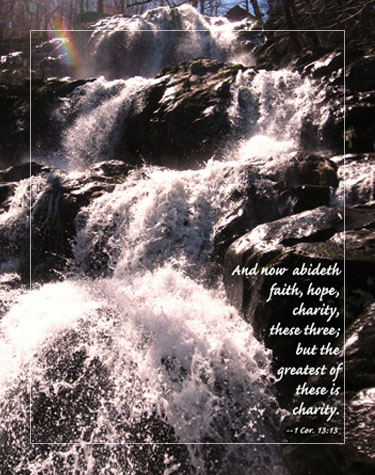
Cover Photo: Dark Hollow Falls Rainbow by Bob Kirchman.