Showing posts with label Alvin Schmidt. Show all posts

Wednesday, September 17, 2014

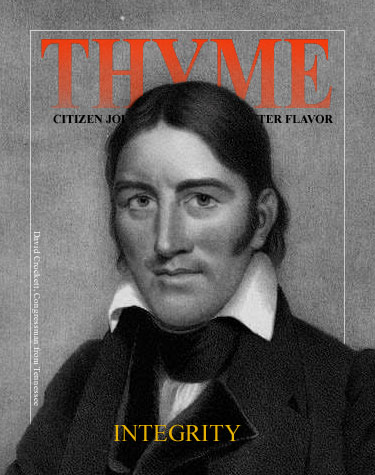
THYME Magazine: Special Election Issue

Citizen Journalism with a Better Flavor
 
THYME0812
Volume VIII, Issue XII

INTEGRITY: Special Election Issue


Davy Crockett's speech to Congress about the 'Indian Bill.' We need more like him!

The scene above is one of my all-time favorites from the movie starring Fess Parker. It brings tears to my eyes as Parker's portrayal of Davy Crockett shows us how a man of integrity stands on his word, even when it costs him his political career! As we move toward an important Senate Race it is imperative that we seek out men and women of integrity today. Watch the scene above if you haven't already. It is a model for what we need to restore to our civic discourse today.

The real skalwags in this here capital of the brave and free is us! YOU and ME, and I'm the worst of the lot!" -- Fess Parker as Davy Crockett, addressing Congress regarding the 1830 Indian Removal Bill.

David Crockett's Speech
by Rep. Dana Rohrabacher

Mr. Speaker, below is the text of a detailed report of a speech given on the floor of the House of Representatives that I believe will be of interest to my colleagues. The description was included in a book titled ``Speeches on the Passage of the Bill for the Removal of the Indians,'' published by Perkins and Marvin in 1830. The speech was given by Rep. David Crockett of Tennessee on May 19, 1830, in opposition to the Indian Removal Act. Unfortunately, the Congress disregarded Crockett's objections and passed the bill, which was then signed into law by President Jackson.A Sketch of the Remarks of the Hon. David Crockett, Representative From Tennessee, on the Bill for the Removal of the Indians, Made in the House of Representatives:

Mr. Crockett said, that, considering his very humble abilities, it might be expected that he should content himself with a silent vote; but, situated as he was, in relation to his colleagues, he felt it to be a duty to himself to explain the motives which governed him in the vote he should give on this bill. Gentlemen had already discussed the treaty-making power; and had done it much more ably than he could pretend to do. He should not therefore enter on that subject, but would merely make an explanation as to the reasons of his vote, He did not know whether a man (that is, a member of Congress) within 500 miles of his residence would give a similar vote; but he knew, at the same time, that he should give that vote with a clear conscience. He had his constituents to settle with, he was aware; and should like to please them as well as other gentlemen; but he had also a settlement to make at the bar of his God; and what his conscience dictated to be just and right he would do, be the consequences what they might. He believed that the people who had been kind enough to give him their suffrages, supposed him to be an honest man, or they would not have chosen him. If so, they could not but expect that he should act in the way he thought honest and right. He had always viewed the native Indian tribes of this country as a sovereign people. He believed they had been recognised as such from the very foundation of this government, and the United States were bound by treaty to protect them; it was their duty to do so. And as to giving to giving the money of the American people for the purpose of removing them in the manner proposed, he would not do it. He would do that only for which he could answer to his G-d. Whether he could answer it before the people was comparatively nothing, though it was a great satisfaction to him to have the approbation of his constituents. Mr. Crockett said he had served for seven years in a legislative body. But from the first hour he had entered a legislative hall, he had never known what party was in legislation; and G-d forbid he ever should. He went for the good of the country, and for that only. What he did as a legislator, he did conscientiously. He should love to go with his colleagues, and with the West and the South generally, if he could; but he never would let party govern him in a question of this great consequence. He had many objections to the bill--some of them of a very serious character.

One was, that he did not like to put half a million of money into the hands of the Executive, to be used in a manner which nobody could foresee, and which Congress was not to control. Another objection was, he did not wish to depart from from the foundation of the government. He considered the present application as the last alternative for these poor remnants of a once powerful people. Their only chance of aid was at the hands of Congress. Should its members turn a deaf ear to their cries, misery must be their fate. That was his candid opinion. Mr. Crockett said he was often forcibly reminded of the remark made by the famous Red Jacket, in the rotundo of this building, where he was shown the pannel which represented in sculpture the first landing of the Pilgrims, with an Indian chief presenting to them an ear of corn, in token of friendly welcome. The aged Indian said ``that was good.'' The Indian said, he knew that they came from the Great Spirit, and he was willing to share the soil with his brothers from over the great water. But when he turned round to another panel representing Penn's treaty, he said ``Ah! all's gone now.'' There was a great deal of truth in this short saying; and the present bill was a strong commentary upon it. Mr. Crockett said that four counties of his district bordered on the Chickasaw country. He knew many of their tribe; and nothing should ever induce him to vote to drive them west of the Mississippi. He did not know what sort of a country it was in which they were to be settled. He would willingly appropriate money in order to send proper persons to examine the country. And when this had been done, and a fair and free treaty had been made with the tribes if they were desirous of removing, he would vote an appropriation of any sum necessary; but till this had been done, he would not vote one cent. He could not clearly understand the extent of this bill. It seemed to go to the removal of all the Indians, in any State east of the Mississippi river, in which the United States owned any land; Now, there was a considerable number of them still neglected; there was a considerable number of them in Tennessee, and the United States' government owned no land in that State, north and east of the congressional reservation line. No man could be more willing to see them remove than he was if it could be done in a manner agreeable to themselves; but not otherwise.

He knew personally that a part of the tribe of the Cherokees were unwilling to go. When the proposal was made to them, they said, ``No; we will take death here at our homes. Let them come and tomahawk us here at home: we are willing to die, but never to remove.'' He had heard them use this language. Many different constructions might be put upon this bill. One of the first things which had set him against the bill, was the letter from the secretary of war to colonel Montgomery--from which it appeared that the Indians had been intruded upon. Orders had been issued to turn them all off except the heads of the Indian families, or such as possessed improvements Government had taken measures to purchase land from the Indians who had gone to Arkansas. If this bill should pass, the same plan would be carried further; they would send and buy them out, and put white men upon their land. It had never been known that white men and Indians could live together; and in this case, the Indians were to have no privileges allowed them, while the white men were to have all. Now, if this was not oppression with a vengeance, he did not know what was. It was the language of the bill, and of its friends, that the Indians were not to be driven off against their will. He knew the Indians were unwilling to go: and therefore he could not consent to place them in a situation where they would be obliged to go. He could not stand that. He knew that he stood alone, having, perhaps, none of his colleagues from his state agreeing in sentiment. He could not help that. He knew that he should return to his home glad and light in heart, if he voted against the bill. He felt that it was his wish and purpose to serve his constituents honestly, according to the light of his conscience.

The moment he should exchange his conscience for mere party views, he hoped his Maker would no longer suffer him to exist. He spoke the truth in saying so. If he should be the only member of that House who voted against the bill, and the only man in the United States who disapproved it, he would still vote against it; and it would be matter of rejoicing to him till the day he died, that he had given the vote. He had been told that he should be prostrated; but if so, he would have the consolation of conscience. He would obey that power, and gloried in the deed. He cared not for popularity, unless it could be obtained by upright means. He had seen much to disgust him here; and he did not wish to represent his fellow citizens, unless he could be permitted to act conscientiously. He had been told that he did not understand English grammar. That was very true. He had never been six months at school in his life; he had raised himself by the labor of his hands. But he did not, on that account, yield upon his privilege as the representative of freemen on this floor. Humble as he was, he meant to exercise his privilege. He had been charged with not representing his constituents. If the fact was so, the error (said Mr. Crockett) is here, (touching his head) not here (laying his hand upon his heart). He never had possessed wealth or education, but he had ever been animated by an independent spirit; and he trusted to prove it on the present occasion. [1.]

5th Grader Takes on 'Nanny State'

Eleven year old Grace Karaffa is not exactly a stranger to politics. Her father is Augusta County Supervisor David Karaffa, who ran for the office as an independent to restore integrity to local politics. His campaign stressed open dialogue and the practical addressing of issues, even when doing so was hard. Since second grade, Grace has suffered from bleeding lips and this causes her quite a bit of discomfort in school. When she asked if she could use Chapstick, she was told that it was not allowed. She could not use the over the counter lip balm because it was 'prohibited' as it was considered a 'medication.' Grace was forced to wet her cracked and bleeding lips in the school washroom as an alternative.

This year, encouraged by her father, Grace brought a petition before the Augusta County School Board asking for the ban on lip balm to be overturned. Citing concerns that students might 'share' medications, the board responded saying they would study the matter. We at THYME have covered 'Nanny State' overreach before, most notably the Wendy's Incident [click to read] but it tends to remain a local story, for the most part. Fox News [click to read], however picked up on Grace's petition, as did Independent Journalism Review [click to read]. The eleven year old's campaign had gone viral!

'Of the People'
Public Servants Should Remember Who They Serve

I grew up with Davy Crockett as a hero. I still remember the part where he rode through the night to defeat the Indian Bill, a bad piece of legislation that cost him his congressional career for opposing it. Davy Crockett was one of us! There was no question.

Fast forward to the past few elections and you have two 'public servants' who let their hair down with their elite buddies and say things like: "You go into some of these small towns in Pennsylvania, and like a lot of small towns in the Midwest, the jobs have been gone now for 25 years and nothing’s replaced them. … And it’s not surprising then they get bitter, they cling to guns or religion or antipathy to people who aren’t like them or anti-immigrant sentiment or anti-trade sentiment as a way to explain their frustrations." [2.]

Or consider this quote: "One of the things you are going to see is a coalition that is just about completely taken over the Republican Party in this state and if they have their way it’s going to take over state government. It is made up of the Christian Coalition, but not just them. It is made up of the right-to-lifers, but not just them. It’s made up of the NRA, but not just them. It is made up of the home-schoolers, but not just them. It’s made up of a whole coalition of people that have all sorts of differing views that I think most of us in this room would find threatening to what it means to be an American." [3.]

Scary stuff! The man responsible for the second quote is sitting in the U. S.  Senate from the State of Virginia. He once ran ads saying that then Senator Obama "respects" your Second Amendment rights! But even though he claims to be a 'moderate,' Senator Warner's voting record says otherwise. His vote gave us Obamacare, in spite of strong appeals (I went to his office with a lot of other people) to do otherwise. He has voted with the President 97% of the time, yet the media this fall will paint him as a Centrist!

Home schoolers, dangerous?, I've had home schoolers and former home schoolers work in our model shop and I can tell from the above quote that Mark Warner has far less experience with home schoolers than I do. I've seen fifteen year old kids who've developed professional proficiency and have pretty good heads on their shoulders to boot! I think I'll send Senator Warner a copy of Alvin Schmidt's book Under the Influence. I think there are many spiritual underpinnings to what it means to be an American. I don't think Governor Warner's coctail crowd should be so afraid of us.

In the early Nineteenth Century, Crockett's Tennessee was the Alaska of its day, sitting on the frontier with hostile forces beyond. I'll bet you their were no teenagers working out their angst either. Young people were working the farms and defending them. So, once again in troubled times, should we look to the frontier for leadership? I think so!

Still, it is not surprising that the press will repackage Elite Liberals as 'Centrists' as the election approaches. They all read Howard Zinn [1.] together in school and are steeped in his narrative. A recent piece I read by Gerry Warburg preaches: Lessons in the Wake of Watergate. [2.] It is interesting reading. Warburg went to Washington as a young Democrat aide in the wake of Nixon's resignation. He helped write Jimmy Carter's nuclear policy bill. Warburg calls those years: "...a time of national renewal. In crisis there is opportunity: Reformers of all political persuasions helped advance crucial measures..." So, while Warburg admits to the need for deficit reduction his call for "informed voters" to elect "Centrist" candidates needs some analysis.

In 2009, the Tea Party sounded the alarm about rising government debt and the folly of larger government. The media has worked overtime to marginalize it. Does Warburg not see that the activists from all backgrounds today are often calling for a return to Constitutional principles and a reigning in of the government as part of an overall strategy to return health to the country? President Obama took with him to Washington over fifty of the most overtly Leftist Idiologues as Czars. The media yawned. The IRS was employed to hobble the Conservative movement. The media yawned. Eric Holder's Justice Department ignored the New Black Panther Party suppression of white voters in Philadelphia. Rioters 'rightfully' burn down their neighborhood when a white policeman kills a black youth but hundreds of kids die in these neighborhoods at the hands of people the same race and the media yawns. The suspicious nature of Benghazi, 'Fast and Furious' Extortion 17 and the arm-twisting passage of the so-called "Affordable Care Act" might cause one to pause and ask": "What did Nixon do, again?"

Indeed, if one honestly considers Richard M. Nixon's place in history, the Watergate break-ins seem to be JV league compared to the weight of the present documented scandals. Warburg might do well to remember that Nixon, aside from Watergate, actually embodies the true Center-Right candidate. Under Nixon's leadership, the Environmental Protection Agency began. Nixon also is known for the controversial Wage/Price Controls, under which Insurance as an employment benefit became cemented. Rubbing shoulders with Robert C. Byrd, he should have realized where much of the ensconced racism of this country resided. In conclusion, I would have to agree with Gerry Warburg's desire for an informed electorate, but I would caution the media to report honestly and let the informed electorate, not the pundits, decide who is 'extreme.'

Serge Belo's Amazing Mosaic


To raise awareness among the general public about the global clean water crisis, the artist Serge Belo created an image composed of 66,000 cups of colored rainwater. (Contributed by Kristina Elaine Riley).

Wes Stafford in his book: Too Small to Ignore [click to read] speaks with affection of the time he lived in Africa with his missionary parents. One of his most cherished memories was digging out a well for a village with his father. Tired and muddy, they submitted their story to their mission board's newsletter. Sadly the newsletter overlooked this wonderful story and did not publish it. So many people in the world today would be spared so much suffering if they could just be provided with clean water! And clean water is such a practical testimony of G-d's Love!

Stafford went on to found Compassion International [click to read] and they have helped a lot of children with the basic necessities such as clean water, bringing the Love of G-d to their communities in practical acts of service. To this day, Wes Stafford and his partners continue to embrace the muddy work of building the Kingdom of G-d! But still, digging wells and fencing out cattle is often overlooked as a work of the Kingdom.

To raise awareness among the general public about the global clean water crisis, the artist Serge Belo created an image composed of 66,000 cups of colored rainwater simulating levels of impurities found in water all over the planet. This major work of 3,600 square feet, representing a baby in the maternal womb, emphasizes the necessity of water, even before birth, for each living person.

Does My Vote Matter?

Imagine the impact Americans of faith can have on the future of our nation, the character of its leadership, and the health of its families if we all applied biblical principles to every aspect of our lives — including committing to vote.

Commit to Vote 2014 [click to read]

Wednesday, August 13, 2014

THYME Magazine: The Mapmaker's Ethic II

Citizen Journalism with a Better Flavor

THYME0807
Volume VIII, Issue VII

The Mapmaker's Ethic II:
Reliable Directions for an Important Journey

Maps are an important tool for navigating what is often to the user unknown regions. The users' success and ultimately their safety in the journey requires that the mapmaker strive to provide the most accurate depiction his or her art can produce of the ways of travel, their conditions, and possible dangers!

No one would in any seriousness suggest that the only place that was significant or real was the part of the landscape he could see from his house, and that the rest, because it was unseen, either didn't exist or was of no consequence. Indeed, if you encountered such a person, you might refer to the most accurate map you could find. Pinpointing his house, you would proceed to show him the main arteries, the rivers, mountains and towns that await him outside of the realm he can see. Yet a scholar like Richard Dawkins can essentially use the same reasoning in writing The G-d Delusion and be lauded as brilliant!

But Dawkins as much as admits that he is 'not sure' if G-d exists in a discussion at Oxford University. [1.] It is time, I would say, to pull out the maps. Dawkins publicly dismisses religion because he feels it is the 'root of mankind's evils.' The problem is that if we look to history, we find a firm challenge to that mindset. In Why Religious Literacy Matters [click to read] we find that the evidence does NOT point us away from faith, rather it shows us instances where mankind has been lifted by something he clearly did not produce on his own.

One who wants to rest his argument on the premise that religion causes wars simply needs to look at the culture BEFORE the arrival of the religion he wishes to impune. In fact,honest history shows us that men's baser instincts resulted in a cycle of raiding and retribution LONG before white Christians ever arrived. Slavery existed for centuries where there was NO Christian influence, and succumbed to the influence of men like John Newton and William Wilberforce [2.] who were MOTIVATED by that faith.

The film: G-d's Not Dead [click to read] takes a look at the rational 'reasonable' men have for attacking faith. Indeed, the notion that unresolved evil discredits the existence of the Almighty is presented in a straightforward manner. The writings of great people OF faith, such as C. S. Lewis actually have much to say about this. The fact is that Lewis was as hard an Atheist as Dawkins, but guided by his friend and mentor: J. R. R. Tolkein, he found himself: "The most reluctant convert in all of England!"

The Catholic Tolkein had at his disposal a vast library of fine maps. The Christian recognizes Moses and the Prophets, just as G-d's Chosen do. Looking first to those texts that claim the authority of Divine Authorship through Inspired Writers, one then overlays them with good history to see what they reveal. It is not at all unlike the exercise employed in creating my historical map of Rockbridge County. [3.] One may wish to question the accuracy of the historic texts, but here more history witnesses to their reliability.

981 texts on scrolls discovered between 1946 and 1956 at Khirbet Qumran in the West Bank inside caves about a mile inland from the northwest shore of the Dead Sea, written in Hebrew, Aramaic, Greek, and Nabataean, mostly on parchment but with some on papyrus and bronze, are associated with the Essenes.What is fascinating is the fact that more modern texts are spot-on with these ancient manuscripts, save for a few punctuations and such.

The scribes who copied these documents worked to an ethic as rigorous as that of the mapmaker. A scribe would 'practice' reproducing texts and his work would be rejected for so much as a character omitted or out of place. Dawkins likes to claim that "we are all atheists" concerning most of the gods people have worshiped. Put it in the perspective though, that most such 'dieties' were slimly documented local gods associated with seasons, fertility and harvest. In 1 Kings 18:40 we see the prophet Elijah take on the priests of Baal. There were many such dieties, seemingly demanding that mankind placate them in return for good harvest.

Gods like Molech demanded the sacrifice of children by burning them. Indeed, if the G-d of Creation is like them then Dawkins has a point. But that the great body of revealed Scripture teaches a people that through them: "All the Nations of the Earth shall be blessed." and in a world of raiding and retribution teaches the new concept of kindness toward the stranger who lives in your midst, then we need to reexamine the wholesale dismissal of faith. The map will not allow us to.

Also, quite importantly, the Mapmaker's Ethic requires that we draw an accurate representation of faith as it runs through the landscape that we inhabit. We need to see the true course that it runs. That means we consider accurately the Crusades as well as Dorethea Dix and Florence Nightingale, who motivated by their faith, made strides in the care for the mentally ill and in the profession of nursing, respectively. We need to consider the very real occurrence of hypocrisy: those who speak in terms of faith but do not live as it requires. History is full of these as well.

But it must be noted that people of faith have often stood against the viler things. Slavery was maintained by professing Christians in the United States until the Abolition, but it was the teachings of Christianity itself that led to that Abolition. Martin Luther King's famous demand: "Let MY people go!" is a restatement of Moses' demand of Pharaoh.

Glimpses into a World Unseen

The electron microscope further reveals amazing patterns.

sectiondna
Vertical section of the human dna.

Evidence of Divine Design, Great and Small
"The Heavens Declare the Glory of G-d;
The Skies Proclaim the Work of His Hands." -- Psalm 19:1

IMG_0037
Moth wing pattern.

I saw this little creature outside my studio one morning. It got me reflecting on the creative wonder, both large and small, that surround us.

m51spiral
M 51 Spiral Galaxy, NASA photo from the Hubble Space Telescope.

xsructure001
Detail of the 'X Structure' in M 51, NASA photo from the Hubble Space Telescope.

The artist is amazed. So much beauty and wonder in the very large cosmos and in the very small things as well! Can a G-d who spins galaxies into being be concerned with things small and personal? Such order and grace in the extreme scales of our world, yet often what we see before us is chaotic and makes no sense.

That is why we present here Lee Strobel's Case for a Creator. Also recommended are Strobel's Case for Faith and Case for Christ. You may view them Here [click to view]. If you had stepped into that Bethlehem stable many years ago, you would have not necessarily seen beauty and redemption. The smells of animals and the pain of labor and delivery would have overwhelmed contemplation. Yet Christians around the world will contemplate the wonder of that night; for what happened there ultimately made its mark on human history.


The Case for a Creator by Lee Strobel.

(to be continued).

Wednesday, July 16, 2014

THYME Magazine: What Makes a Nation Great?

Citizen Journalism with a Better Flavor

thymerrrrrr
Volume VIII, Issue III

What Makes a Nation Great? II

In the end, the state of the Union comes down to the character of the people. I sought for the greatness and genius of America in her commodious harbors and her ample rivers, and it was not there. In the fertile fields and boundless prairies, and it was not there. In her rich mines and her vast world commerce, and it was not there. Not until I went into the churches of America and heard her pulpits, aflame with righteousness, did I understand the secret of her genius and power. America is great because she is good, and if America ever ceases to be good, America will cease to be great.
-- Attributed to Alexis de Tocqueville, though it is not a direct quote from his work: Democracy in America.

In the quest to restore and revitalize our great land, one often hears great solutions proposed but often very little in the way of addressing the real problem. We can create all the great economic models we want to, but if we allow greed and self-serving policies to prevail, we will see ever more of the type of destruction we saw in the mortgage crisis. If we attempt to spend our way out of our problems by creating more money, we will end up as a vassal to China. We need Revival! THYME has looked at the problem of Restoring the American Dream [click to read] before. Whether or not we can definitively find the quote in de Tocqueville's writings, the work of Alvin Schmidt [1.] and others documents well the evidence for Faith as a force in making better the human condition.

That is not to say that we don't need to seek and consider better ways to conduct our affairs. There is a practical side to problem solving that cannot be ignored. Consider how George Müller changed the lives of thousands of orphans in Bristol, England. First let us set the stage. The elimination of the slave trade by William Wilberforce in the Nineteenth Century destroyed not only a vile institution, but as an unintended consequence the city of Bristol, a major slave port, was thrown into decline. G-d had two chosen instruments to revitalize Bristol. There was Isambard Kingdom Brunel, [2.] who built bridges, railroads and great steamships to link Bristol to the world! But Bristol needed more than just economic development!

The city's decline had led to thousands of children either losing their parents or being put out on the streets by their desperate parents. George Müller was G-d's next instrument in the revitalization of Bristol. Young Müller came to the city as a minister of the Gospel. As he sought to minister to the soul of a great city, the plight of her orphans tugged at his heart. He, depending on G-d alone, was able to provide five large houses for these unwanted children. He apprenticed all the boys in various trades but took great pains to educate the young women as office workers, nurses, teachers and housekeepers. They stayed at the homes until they were seventeen. This was a practical policy that kept them from being exploited by those engaged in viler trades.

Those who seek to revitalize our own nation would do well to do no less. We must first address the poverty of our national soul before we set into the very necessary business of restoring her fortunes!

A Case for Faith 

On page 563 of his latest biography — John Quincy Adams: American Visionary — author Fred Kaplan (biographer of Abraham Lincoln, Charles Dickens, Mark Twain, and Gore Vidal among others) cites this insight of the sixth president:

Christianity had, all in all, he believed, been a civilizing force, “checking and controlling the anti-social passions of man.”

That insight is pretty much all an American needs to know in order to understand why the American Founders considered religion — specifically ethical monotheism rooted in the Hebrew Bible — indispensable to the American experiment; and why the America we have known since 1776 is in jeopardy." -- Dennis Prager.

In an article entitled: America Won't be Good without G-d [click to read] Prager lays out a pretty compelling argument. He writes:

"It is easy to respect secular Americans who hold fast to the Constitution and to American values generally. And any one of us who believes in God can understand why some people, given all the unjust suffering in the world, just cannot believe that there is a Providential Being.

But one cannot respect the view that America can survive without the religious beliefs and values that shaped it. The argument that there are moral secularists and moral atheists is a non sequitur. Of course there are moral Americans devoid of religion. So what? There were moral people who believed in Jove. But an America governed by Roman religion would not be the America that has been the beacon of freedom and the greatest force for good in the world."

Here Dennis Prager is spot-on in his analysis of the nature of man. The academy may tell us that we can effectively control the passions that drive us, but history, honestly pursued, tells us otherwise. Prager points out that: "Our prisons are filled with people whose consciences are quite at peace with their criminal behavior. As for reason, they used it well — to figure out how to get away with everything from murder to white-collar crime.

But our prisons are not filled with religious Jewish and Christian murderers. On the contrary, if all Americans attended church weekly, we would need far fewer prisons; and the ones we needed would have very few murderers in them."

Prager goes on to describe the wreckage of the great socialist experiments of the Twentieth Century, and the wreckage of "anything goes" philosophies that encourage casual sex and tell us that fathers are "unnecessary!" Indeed, if the academy would produce more honest studies of the results of the philosopies they have espoused, they might recoil at the burden they have placed on society.

Prager concludes with this sobering thought: "For proof of the moral and intellectual consequences of the secularization of America, look at what has happened to the least religious institution in America, the university. Is that the future we want for the whole country?"

The film: 'Expelled' is a pretty powerful documentary. G-d is getting some pretty bad press these days from esteemed writers such as Richard Dawkins and Christopher Hitchens. The Intelligent Design movement, though it is not specifically theistic, is uniformly vilified in the academy. Why is an inquiry into the observable order of the universe so dangerous, especially when open inquiry is such a cherished part of scientific investigation? Perhaps such 'open inquiry' inevitably leads to the 'wrong' conclusions.

Theodore Dalrymple writes in City Journal: "What the New Atheists are Missing." Himself a non-believer, he points to a time when a teacher's hypocrasy led him to question. Dalrymple does not, however, reject the realm of faith as a force in creating and ordering societies. He see's naturalistic explainations and philosophies quite insufficient for dealing with all of human existence. Richard Dawkins' assertions that religious education is tantamount to child abuse, for example seem to Dalrymple no more than the rebellious ranting of a child who's just learned that his parents are not perfect. All of us have experienced some sort of disillusionment in our youth. I remember a time when a nun of the 'Sisters of Mercy' punished me for some infraction I had not [at least in my recollection] committed. I too questioned a lot of things. The Cuban missle crisis fueled more unanswered anxiety as I careened into adolescence.

But something happened in my teenaged years that is etched firmly in my memory. It was a dark and stressful winter day when I decided to walk in the woods near Triadelphia Reservoir. Something spoke to me that afternoon that was more eloquent than the ranting of hormones and the perceived unfairness of life. The buds of the trees were growing fat. here was the hope of spring and new life. Clearly spring would come. The buds gave evidence of an event hoped for. They were indeed the substance of something yet unseen!

"For the invisible things of him from the creation of the world are clearly seen, being understood by the things that are made, even his eternal power and Godhead; so that they are without excuse:" -- Romans1:20 KJV

Holy writ makes the point that the order and beauty of the creation speaks eloquently of the creator. Thus Intelligent Design, though it merely points out the complex mechanisms of nature, leads one to seek the source of such wisdom. I look to that time in the trees as an affirmation of personal faith in a creator. Though at that point it was pretty detatched and intellectual at best.

"...for he that cometh to G-d must believe that he is, and that he is a rewarder of them that diligenly seek him." Hebrews 11:6b KJV

As a young adult I embraced faith in Christ as redeemer and rewarder. The journey of faith had begun with the fat buds years before though.Therefore I must conlude that those who consider the design of the universe dangerous information have good reason if they fear that others may follow the path I have walked. Dawkins would prefer me to credit space aliens with seeding life to this planet and thus push the hard questions of origin to another world.

Darwinism, in its purest form, rejects the idea that this world is some sort of intentional creation. Of course this leads to the rejection of theism and ultimately the rejection of certain absolutes. 'Expelled' takes a good look at 'eugenics' and how it is supported by a darwinian world view. In the first half of the Twentieth Century certain proponents of eugenics sought to speed evolution along by eliminating the reproduction of certain undesirable types of persons. The results were forced sterilization of the mentally ill and the holecaust. Contrast that movement with Dorethea Dix and others who, motivated by Christian faith, improved conditions for the mentally ill.

Alvin Schmidt makes a good case in his book 'Under the Influence' that faith is a builder of society rather than a force to destroy it. Dalrymple the non-believer would concur. Thus the danger of Intelligent Design leading to dangerous conclusions is much inflated. One might even conclude that the free discussion of order and design,wherever it is found, is wholesome. Certainly there is no basis for its exclusion from the academy.

The argument will no doubt be made: "what about the crusades, what about jihad, religion is dangerous?" Yes, it is certainly something that may be misused, but that must be countered with an honest look at how the so-called "good" science of evolution was the foundation of eugenics. Millions of people were killed in this misguided attempt to improve humanity. Ironically, such brilliant men as Albert Einstein met the criteria for elimination. We reduce the world to only naturalistic explainations at our own peril. The argument for open inquiry stands.

Leaves
Autumn Leaves. Photo by Bob Kirchman

"When through the woods,and forest glades I wander,
and hear the birds sing sweetly in the trees;
when I look down,from lofty mountain grandeur,

and hear the brook and feel the gentle breeze"
-- "How Great Thou Art" Verse 2

A Case for Summer Vacation
By Bob Kirchman

How does one nurture the creative genius of a Brunel, or the vision of a Wilberforce or a Müller? I would suggest that men and women of that ilk are often found walking on the "road less traveled!" Walking home alone from a prayer meeting along a quiet street, the great designer, R. G. LeTourneau says he was inspired with the design for a rather complex machine that had stymied his most brilliant designers for weeks. Could it be true that not only should we hold off on 'formal' education a bit, but we should make sure children are not scheduled to the point of losing free, creative time.

If indeed the creative muse shows up in the quiet times, if problems are indeed solved through the exploration of play, wouldn't it make sense for us to esteem these times in the sense their descriptive originally suggests: re-creation?! The 'other' Weekly News Magazine [click to read] once argued that Summer Vacation is over romanticized and merely stands in the way of the kids retaining all that book-learning they'll need so they can work for the Chinese some day. OK, I'll give you the point that a certain amount of knowledge is 'lost' as kids pursue other activities... but as one who's life and career was shaped by Summers of 'other activities' I'll raise a clear protest: "Not so fast!"

I spent my Summers drawing, building things, going to camp and playing for hours in the woods. I was Lewis and Clark when I set off to explore the woods surrounding Triadelphia Reservoir... with no Sacajawea to help with directions. Mom got a big bell to ring when it was time to come in for dinner. Sometimes I actually heard it. More often than not my appetite finally brought me back to a plate of cold food. Now I loved my groceries as much as any young boy, but didn't Simon Kenton eat cold biscuits while he was exporing the Ohio Valley?

When my younger siblings were old enough, Dad loaded us in Mom's VW Microbus [Mom was there first when it came to the minivan] and we took road trips. Man, I loved road trips. We'd go to places like Gettysburg and crawl into sniper's nests. We'd imagine what it must have been like rushing up the hill in Pickett's Charge. Then we'd go to Antietem and wonder some more. When I turned sixteen, Dad actually let me drive on the trips. Oh the white-knuckle thrill of the Capital Beltway! The endless perspective of NC Route 12 heading to Hatteras and the rollercoaster ride down US 29 to Grandma's. Life was good in the Summer. I hired myself out to the local farmers to bale hay and other jobs. Hot, nasty work is good for the teenaged soul.

One farmer had a wife who'd make us grape juice and lemonade. I've never found sweeter refreshment in all my life.

One Summer Dad decided I needed to build a greenhouse. He let me draw up the plans and he took them to the county... I was thirteen at the time. He gave me a budget and set me loose. I learned to lay block, build walls, buy old storm windows and pretty much whatever it took. The guys at Talbott's Lumber Yard in Ellicott City gave me lots of free advice. They pretty much convinced me I could do it. I wonder how much Dad was paying them?

I was not a licensed electrician... that presented a problem for hooking up the power. Dad said it wasn't a problem. He had a buddy who was licensed and came out and did the whole job in exchange for a bottle of Jack Daniels [Black Label] that Dad cheerfully 'donated' to the building fund. In addition to the electric heater, we got the brilliant idea that it would benefit the plants with both heat and moisture if we ran the dryer vent in there.

What to do about lint? Well, here's where it got really interesting. When we discovered that a discarded nylon stocking fit over the vent and caught the lint while allowing air to flow, we had our problem solved. Dad enjoyed the 'conversation piece' that resulted too.

The greenhouse, built of redwood, served our family for many years. Finally it succumbed to termites after I was gone and married. It's lessons are still with me today.

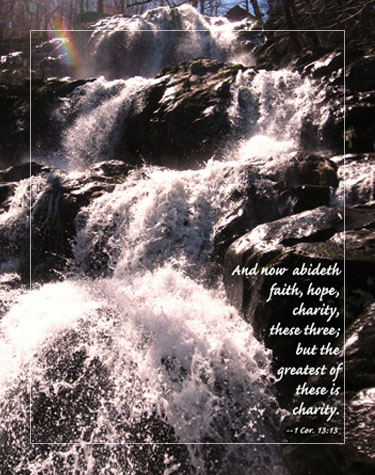
Cover Photo: Dark Hollow Falls Rainbow by Bob Kirchman.

Thursday, October 17, 2013

THYME Magazine: Looking to the Future

Citizen Journalism with a Better Flavor

THYMEO621
Volume VI, Issue XXI

Motivated by the Hope Unseen

"Give me one hundred men who fear nothing but sin and desire nothing but G-d, and I care not whether they be clergyman or laymen, they alone will shake the gates of Hell and set up the kingdom of Heaven upon the earth.” -- John Wesley

Consider for a minute the amount of energy expended worldwide to persecute people of Faith. Organizations like Voice of the Martyrs [1.] report that it is at an all time high. Christians and Jews seem to often find themselves in the cross hairs of world opinion. Why should this be? Could it be that those who want to set up earthly kingdoms or earthly Utopias know better than the Saints the true power of the Kingdom of G-d?

In his book Under the Influence [2.] Alvin Schmidt lays out a compelling case for the positive influence those who have pursued the Kingdom of G-d have had on the world. Far from being of "no earthly good," people of faith have revolutionized healthcare, care for orphans and the poor and generally improved the welfare of the places they have been carried to, in fulfillment of the admonition in Jeremiah 29:

"Thus saith the Lord of hosts, the G-d of Israel, unto all that are carried away captives, whom I have caused to be carried away from Jerusalem unto Babylon;

Build ye houses, and dwell in them; and plant gardens, and eat the fruit of them;

Take ye wives, and beget sons and daughters; and take wives for your sons, and give your daughters to husbands, that they may bear sons and daughters; that ye may be increased there, and not diminished.

And seek the peace of the city whither I have caused you to be carried away captives, and pray unto the Lord for it: for in the peace thereof shall ye have peace."

Generally the abuses so quickly cited as reasons for limiting the influence of the church occurred as kings and clerics misappropriated the language of faith in pursuit of earthly power. The National Socialists in Germany may have artfully spun the language of the church, but why then did they find men like Dietrich Bonhoeffer [3.] so dangerous? In earlier times men like Meno Simonsz [4.] stood in opposition to what they saw as the church succumbed to the culture around her.

Presenting a clear alternative to the prevailing paradigms of the culture, men and women of faith serve an unseen kingdom and in doing so influence the world. William Wilberforce eliminated the vile institution of slavery [5.] in England. George Müller changed the way society viewed orphans [6.] along with Charles Dickens [7.]. Florence Nightengale and Dorethea Dix [8.], inspired by faith, worked tirelessly to improve the human condition.

Which brings me back to the original question: Why should a society so diminish those institutions and people who have contributed so much? Perhaps it is time to take another look at the power and place of faith... especially the place it has in one's own life. To that end Billy Graham, one of America's most prominent spokespersons for faith, presents: My Hope America [click to view]. This series of programs, culminating in November of 2013, offers a foundation of hope to a nation who's moorings have been deeply shaken.

Saturday, August 10, 2013

Why Religious Literacy Matters

You Can't Understand Western Civilization Without It

IMG_0972
Leaves in a pool of water in Jarman's Gap.

This Survey [click to read] featured in Jewish World Review should give one cause to consider the implications of education as an entirely secular pursuit.

"You can't understand Western civilization unless you understand religion," she said. "How can you understand your cultural heritage in terms of art? How do you understand literary allusions in novels? Even a non-religious person needs religious literacy to understand he artifacts of our civilizations."

Indeed, I have written before about how much of what we value in our culture today has its roots firmly in faith that prompted men and women to live out their convictions and in the process they made society a better place.

How Christianity Changed the World

Schmidt
Originally published as:
Under the Influence,
Alvin J. Schmidt
Zondervan, 2001

Here is a book that really ought to be on your reading list. As we prepare to celebrate the wonder of Emmanuel -- "G-d With Us," it would be interesting to consider the historical influence of the Christian faith in out civilization. Obviously many modern writers consider it not all that great, or even destructive. They point to such events as the Crusades and the Spanish Inquisition and conclude that religion is not such a great influence on society. An atheist group in England is buying bus ads that say "why believe in G-d, Just be good for goodness' sake." Just in time for Christmas, no less, and using red and green lettering.

But such thinking ignores a vast body of history where men and women, inspired by their faith, abolished slavery, instituted humane treatment of the poor and mentally ill and generally lifted the situation of their fellow citizens. What good is "good for goodness sake" if good is not defined from a higher source. Indeed one can then make the conclusion that it is 'good' to kill six million members of another race. It happened in Twentieth Century Germany. Hitler may have appealed to Christianity in his speeches, but his actions go against the clearly understood teachings of the Faith. Study the life and death of Deitrich Bonhoffer and you will understand where the principles of his beliefs led one citizen to actively oppose the policies of Hitler.

It is a mistake to assume that Western Civilization is automatically 'Christian.' Schmidt looks back to the days of the Roman Empire, when Christians were the ones who rescued unwanted children from destruction and the Middle Ages, when Christians cared for the victims of plague that most simply shunned. Time and time again, Christianity is seen leading men and women to challenge the default direction of Western civilization.

We will read Dicken's 'A Christmas Carol' this coming Christmas season, but will we stop to think of how Charles Dickens was addressing social issues of his day. And what of William Wilberforce, the British parliamentarian who, moved by his faith, labored half a century to abolish slavery in the British possessions? When Dorethea Dix and Florence Nightengale improved healthcare methods, it was their faith that moved them.

Schmidt provides a great body of scholarly research to bring this forgotten history to light again. One point I take from his writing is that Christianity is at its best when it speaks into culture. It has been rendered less effective by its present 'mainstream' status [as when it is seen as a branch of the Republican Party]. It is all too easy to hijack the language of faith without embracing its life-changing path of discipleship.

Theodore Dalrymple writes in City Journal: "What the New Atheists are Missing." Himself a non-believer, he points to a time when a teacher's hypocrasy led him to question. Dalrymple does not, however, reject the realm of faith as a force in creating and ordering societies. He see's naturalistic explainations and philosophies quite insufficient for dealing with all of human existence. Richard Dawkins' assertions that religious education is tantamount to child abuse, for example seem to Dalrymple no more than the rebellious ranting of a child who's just learned that his parents are not perfect. All of us have experienced some sort of disillusionment in our youth. I remember a time when a nun of the 'Sisters of Mercy' punished me for some infraction I had not [at least in my recollection] committed. I too questioned a lot of things. The Cuban missle crisis fueled more unanswered anxiety as I careened into adolescence.

But something happened in my teenaged years that is etched firmly in my memory. It was a dark and stressful winter day when I decided to walk in the woods near Triadelphia Reservoir. Something spoke to me that afternoon that was more eloquent than the ranting of hormones and the perceived unfairness of life. The buds of the trees were growing fat. here was the hope of spring and new life. Clearly spring would come. The buds gave evidence of an event hoped for. They were indeed the substance of something yet unseen!

"For the invisible things of him from the creation of the world are clearly seen, being understood by the things that are made, even his eternal power and Godhead; so that they are without excuse:" -- Romans1:20 KJV

Holy writ makes the point that the order and beauty of the creation speaks eloquently of the creator. Thus Intelligent Design, though it merely points out the complex mechanisms of nature, leads one to seek the source of such wisdom. I look to that time in the trees as an affirmation of personal faith in a creator. Though at that point it was pretty detatched and intellectual at best.

"...for he that cometh to G-d must believe that he is, and that he is a rewarder of them that diligenly seek him." Hebrews 11:6b KJV

As a young adult I embraced faith in Christ as redeemer and rewarder. The journey of faith had begun with the fat buds years before though.Therefore I must conlude that those who consider the design of the universe dangerous information have good reason if they fear that others may follow the path I have walked. Dawkins would prefer me to credit space aliens with seeding life to this planet and thus push the hard questions of origin to another world. Darwinism, in its purest form, rejects the idea that this world is some sort of intentional creation. Of course this leads to the rejection of theism and ultimately the rejection of certain absolutes. The film 'Expelled' takes a good look at 'eugenics' and how it is supported by a darwinian world view. In the first half of the Twentieth Century certain proponents of eugenics sought to speed evolution along by eliminating the reproduction of certain undesirable types of persons. The results were forced sterilization of the mentally ill and the holecaust. Contrast that movement with Dorethea Dix and others who, motivated by Christian faith, improved conditions for the mentally ill.

Alvin Schmidt makes a good case in his book 'Under the Influence' that faith is a builder of society rather than a force to destroy it. Dalrymple the non-believer would concur. Thus the danger of Christian principles such as 'intelligent design' leading to dangerous conclusions is much inflated. One might even conclude that the free discussion of order and design,wherever it is found, is wholesome. Certainly there is no basis for its exclusion from the academy.The argument will no doubt be made: "what about the crusades, what about jihad, religion is dangerous?" Yes, it is certainly something that may be missused, but that must be countered with an honest look at how the so-called "good" science of evolution was the foundation of eugenics. Millions of people were killed in this misguided attempt to improve humanity. Ironically, such brilliant men as Albert Einstein met the criteria for elimination. We reduce the world to only naturalistic explainations at our own peril. The argument for open inquiry, with men and women of Faith seated at the table, stands.

New Maple

"When through the woods,and forest glades I wander,
and hear the birds sing sweetly in the trees;
when I look down,from lofty mountain grandeur,
and hear the brook and feel the gentle breeze"
-- "How Great Thou Art" Verse 2

Friday, October 22, 2010

THYME Magazine

Citizen Journalism with a Better Flavor

thyme0244
Volume II, Issue XLIV

Cover: Ellicott's Mills in miniature as created by Bob Kirchman in 1971/1972 at age 20. It was refurbished and corrected to reflect current research for the B&O Museum's 'Roads to Rails' exhibit last year.

Remembering our Roots

The 'other' Weekly News Magazine [click to read] presents: "How to Restore the American Dream." If the American Dream is merely about home ownership and material security, we're down for the count. In the late seventies the government sought to make home ownership available to all. In 2007 we got the bill for it.

But if we see the American dream as something more... those desires that drove people to our shores in the first place, we're ready for a renaissance.

The Pilgrims, the Anabaptists and Moravians were drawn to this land by the promise of freedom to worship and live without interference from hostile government interference. Indeed they preferred the risk and hardship it entailed to the relative safety of servitude.

By 1831, Alexis de Tocqueville observed an amazing young nation taking shape and wrote:

"I sought for the greatness of the United States in her commodious harbors, her ample rivers, her fertile fields, and boundless forests--and it was not there. I sought for it in her rich mines, her vast world commerce, her public school system, and in her institutions of higher learning--and it was not there. I looked for it in her democratic Congress and her matchless Constitution--and it was not there. Not until I went into the churches of America and heard her pulpits flame with righteousness did I understand the secret of her genius and power. America is great because America is good, and if America ever ceases to be good, America will cease to be great!"

Though many would seek to obfuscate this heritage, a serious study of history shows that our nation perservered and grew, often against impossible odds, as her founders labored and prayed, trusting in Divine Providence.

The Free Market Did NOT Cause the Great Depression

greatmyths-cvr

Great Myths of the Great Depression [Click to Read] by Lawrence W. Reed

"President Herbert Hoover is mistakenly presented in standard history texts as a laissez-faire president, but he signed into law so many costly and foolish bills that one of Franklin Roosevelt’s top aides later said that “practically the whole New Deal was extrapolated from programs that Hoover started.”

"Americans voted for Franlin Roosevelt in 1932, expecting him to adhere to the Democratic Party platform, which called for less government spending and regulation." -- Lawrence W. Reed

The really frightening thing about history is how it repeats itself.

broke

The Plan to Restore Our Trust, Truth and Treasure [click to read].

Required Reading:

Schmidt

In light of the President's recent assertion that 'America is not a Christian Nation' I would like to offer Alvin Schmidt's book Under the Influence, How Christianity Changed the World. There are many legitimate arguments to be made about how Faith and Government should function together but a look at the principles that our Nation was founded upon will show a clear Judeo-Christian influence.

"If no other consideration had convinced me of the value of the Christian life, the Christlike work which the Church of all denominations in America has done during the last 35 years for the elevation of the black man would have made me a Christian." -- Booker T. Washington in 'Up from Slavery' (1901)

Tuesday, September 28, 2010

Why Religious Literacy Matters

You Can't Understand Western Civilization Without It

IMG_0972
Leaves in a pool of water in Jarman's Gap.

This Survey [click to read] featured in Jewish World Review should give one cause to consider the implications of education as an entirely secular pursuit.

"You can't understand Western civilization unless you understand religion," she said. "How can you understand your cultural heritage in terms of art? How do you understand literary allusions in novels? Even a non-religious person needs religious literacy to understand he artifacts of our civilizations."

Indeed, I have written before about how much of what we value in our culture today has its roots firmly in faith that prompted men and women to live out their convictions and in the process they made society a better place.

How Christianity Changed the World

Schmidt
Originally published as:
Under the Influence,
Alvin J. Schmidt
Zondervan, 2001

Here is a book that really ought to be on your reading list. As we prepare to celebrate the wonder of Emmanuel -- "G-d With Us," it would be interesting to consider the historical influence of the Christian faith in out civilization. Obviously many modern writers consider it not all that great, or even destructive. They point to such events as the Crusades and the Spanish Inquisition and conclude that religion is not such a great influence on society. An atheist group in England is buying bus ads that say "why believe in G-d, Just be good for goodness' sake." Just in time for Christmas, no less, and using red and green lettering.

But such thinking ignores a vast body of history where men and women, inspired by their faith, abolished slavery, instituted humane treatment of the poor and mentally ill and generally lifted the situation of their fellow citizens. What good is "good for goodness sake" if good is not defined from a higher source. Indeed one can then make the conclusion that it is 'good' to kill six million members of another race. It happened in Twentieth Century Germany. Hitler may have appealed to Christianity in his speeches, but his actions go against the clearly understood teachings of the Faith. Study the life and death of Deitrich Bonhoffer and you will understand where the principles of his beliefs led one citizen to actively oppose the policies of Hitler.

It is a mistake to assume that Western Civilization is automatically 'Christian.' Schmidt looks back to the days of the Roman Empire, when Christians were the ones who rescued unwanted children from destruction and the Middle Ages, when Christians cared for the victims of plague that most simply shunned. Time and time again, Christianity is seen leading men and women to challenge the default direction of Western civilization.

We will read Dicken's 'A Christmas Carol' this coming Christmas season, but will we stop to think of how Charles Dickens was addressing social issues of his day. And what of William Wilberforce, the British parliamentarian who, moved by his faith, labored half a century to abolish slavery in the British possessions? When Dorethea Dix and Florence Nightengale improved healthcare methods, it was their faith that moved them.

Schmidt provides a great body of scholarly research to bring this forgotten history to light again. One point I take from his writing is that Christianity is at its best when it speaks into culture. It has been rendered less effective by its present 'mainstream' status [as when it is seen as a branch of the Republican Party]. It is all too easy to hijack the language of faith without embracing its life-changing path of discipleship.

Theodore Dalrymple writes in City Journal: "What the New Atheists are Missing." Himself a non-believer, he points to a time when a teacher's hypocrasy led him to question. Dalrymple does not, however, reject the realm of faith as a force in creating and ordering societies. He see's naturalistic explainations and philosophies quite insufficient for dealing with all of human existence. Richard Dawkins' assertions that religious education is tantamount to child abuse, for example seem to Dalrymple no more than the rebellious ranting of a child who's just learned that his parents are not perfect. All of us have experienced some sort of disillusionment in our youth. I remember a time when a nun of the 'Sisters of Mercy' punished me for some infraction I had not [at least in my recollection] committed. I too questioned a lot of things. The Cuban missle crisis fueled more unanswered anxiety as I careened into adolescence.

But something happened in my teenaged years that is etched firmly in my memory. It was a dark and stressful winter day when I decided to walk in the woods near Triadelphia Reservoir. Something spoke to me that afternoon that was more eloquent than the ranting of hormones and the perceived unfairness of life. The buds of the trees were growing fat. here was the hope of spring and new life. Clearly spring would come. The buds gave evidence of an event hoped for. They were indeed the substance of something yet unseen!

"For the invisible things of him from the creation of the world are clearly seen, being understood by the things that are made, even his eternal power and Godhead; so that they are without excuse:" -- Romans1:20 KJV

Holy writ makes the point that the order and beauty of the creation speaks eloquently of the creator. Thus Intelligent Design, though it merely points out the complex mechanisms of nature, leads one to seek the source of such wisdom. I look to that time in the trees as an affirmation of personal faith in a creator. Though at that point it was pretty detatched and intellectual at best.

"...for he that cometh to G-d must believe that he is, and that he is a rewarder of them that diligenly seek him." Hebrews 11:6b KJV

As a young adult I embraced faith in Christ as redeemer and rewarder. The journey of faith had begun with the fat buds years before though.Therefore I must conlude that those who consider the design of the universe dangerous information have good reason if they fear that others may follow the path I have walked. Dawkins would prefer me to credit space aliens with seeding life to this planet and thus push the hard questions of origin to another world. Darwinism, in its purest form, rejects the idea that this world is some sort of intentional creation. Of course this leads to the rejection of theism and ultimately the rejection of certain absolutes. The film 'Expelled' takes a good look at 'eugenics' and how it is supported by a darwinian world view. In the first half of the Twentieth Century certain proponents of eugenics sought to speed evolution along by eliminating the reproduction of certain undesirable types of persons. The results were forced sterilization of the mentally ill and the holecaust. Contrast that movement with Dorethea Dix and others who, motivated by Christian faith, improved conditions for the mentally ill.

Alvin Schmidt makes a good case in his book 'Under the Influence' that faith is a builder of society rather than a force to destroy it. Dalrymple the non-believer would concur. Thus the danger of Christian principles such as 'intelligent design' leading to dangerous conclusions is much inflated. One might even conclude that the free discussion of order and design,wherever it is found, is wholesome. Certainly there is no basis for its exclusion from the academy.The argument will no doubt be made: "what about the crusades, what about jihad, religion is dangerous?" Yes, it is certainly something that may be missused, but that must be countered with an honest look at how the so-called "good" science of evolution was the foundation of eugenics. Millions of people were killed in this misguided attempt to improve humanity. Ironically, such brilliant men as Albert Einstein met the criteria for elimination. We reduce the world to only naturalistic explainations at our own peril. The argument for open inquiry, with men and women of Faith seated at the table, stands.

New Maple

"When through the woods,and forest glades I wander,
and hear the birds sing sweetly in the trees;
when I look down,from lofty mountain grandeur,
and hear the brook and feel the gentle breeze"
-- "How Great Thou Art" Verse 2

Sunday, February 1, 2009

Atheist Explains Why Africa Needs G-d

This is Thought Provoking

Matthew Parris Explains Why in this Times Article [click to read] "Those who want Africa to walk tall amid 21st-century global competition must not kid themselves that providing the material means or even the knowhow that accompanies what we call development will make the change. A whole belief system must first be supplanted."

I have mentioned "Under the Influence: How Christianity Transformed Civilization" by Alvin J. Schmidt previously. Here is an interesting testimonial to Mr. Schmidts observations from an unlikely source.

Hat tips to Randy Alcorn

Monday, December 8, 2008

Under the Influence

How Christianity Changed the World

Schmidt
Originally published as:
Under the Influence,
Alvin J. Schmidt
Zondervan, 2001

Here is a book that really ought to be on your Christmas reading list. As we prepare to celebrate the wonder of Emmanuel -- "G-d With Us," it would be interesting to consider the historical influence of the Christian faith in out civilization. Obviously many modern writers consider it not all that great, or even destructive. They point to such events as the Crusades and the Spanish Inquisition and conclude that religion is not such a great influence on society. An atheist group in England is buying bus ads that say "why believe in G-d, Just be good for goodness' sake." Just in time for Christmas, no less, and using red and green lettering.

But such thinking ignores a vast body of history where men and women, inspired by their faith, abolished slavery, instituted humane treatment of the poor and mentally ill and generally lifted the situation of their fellow citizens. What good is "good for goodness sake" if good is not defined from a higher source. Indeed one can then make the conclusion that it is 'good' to kill six million members of another race. It happened in Twentieth Century Germany. Hitler may have appealed to Christianity in his speeches, but his actions go against the clearly understood teachings of the Faith. Study the life and death of Deitrich Bonhoffer and you will understand where the principles of his beliefs led one citizen to actively oppose the policies of Hitler.

It is a mistake to assume that Western Civilization is automatically 'Christian.' Schmidt looks back to the days of the Roman Empire, when Christians were the ones who rescued unwanted children from destruction and the Middle Ages, when Christians cared for the victims of plague that most simply shunned. Time and time again, Christianity is seen leading men and women to challenge the default direction of Western civilization.

We will read Dicken's 'A Christmas Carol' this season, but will we stop to think of how Charles Dickens was addressing social issues of his day. And what of William Wilberforce, the British parliamentarian who, moved by his faith, labored half a century to abolish slavery in the British possessions? When Dorethea Dix and Florence Nightengale improved healthcare methods, it was their faith that moved them.

Schmidt provides a great body of scholarly research to bring this forgotten history to light again. One point I take from his writing is that Christianity is at its best when it speaks into culture. It has been rendered less effective by its present 'mainstream' status [as when it is seen as a branch of the Republican Party]. It is all too easy to hijack the language of faith without embracing its life-changing path of discipleship.

Theodore Dalrymple writes in City Journal: "What the New Atheists are Missing." Himself a non-believer, he points to a time when a teacher's hypocrasy led him to question. Dalrymple does not, however, reject the realm of faith as a force in creating and ordering societies. He see's naturalistic explainations and philosophies quite insufficient for dealing with all of human existence. Richard Dawkins' assertions that religious education is tantamount to child abuse, for example seem to Dalrymple no more than the rebellious ranting of a child who's just learned that his parents are not perfect. All of us have experienced some sort of disillusionment in our youth. I remember a time when a nun of the 'Sisters of Mercy' punished me for some infraction I had not [at least in my recollection] committed. I too questioned a lot of things. The Cuban missle crisis fueled more unanswered anxiety as I careened into adolescence.

But something happened in my teenaged years that is etched firmly in my memory. It was a dark and stressful winter day when I decided to walk in the woods near Triadelphia Reservoir. Something spoke to me that afternoon that was more eloquent than the ranting of hormones and the perceived unfairness of life. The buds of the trees were growing fat. here was the hope of spring and new life. Clearly spring would come. The buds gave evidence of an event hoped for. They were indeed the substance of something yet unseen!

"For the invisible things of him from the creation of the world are clearly seen, being understood by the things that are made, even his eternal power and Godhead; so that they are without excuse:" -- Romans1:20 KJV

Holy writ makes the point that the order and beauty of the creation speaks eloquently of the creator. Thus Intelligent Design, though it merely points out the complex mechanisms of nature, leads one to seek the source of such wisdom. I look to that time in the trees as an affirmation of personal faith in a creator. Though at that point it was pretty detatched and intellectual at best.

"...for he that cometh to G-d must believe that he is, and that he is a rewarder of them that diligenly seek him." Hebrews 11:6b KJV

As a young adult I embraced faith in Christ as redeemer and rewarder. The journey of faith had begun with the fat buds years before though.Therefore I must conlude that those who consider the design of the universe dangerous information have good reason if they fear that others may follow the path I have walked. Dawkins would prefer me to credit space aliens with seeding life to this planet and thus push the hard questions of origin to another world. Darwinism, in its purest form, rejects the idea that this world is some sort of intentional creation. Of course this leads to the rejection of theism and ultimately the rejection of certain absolutes. The film 'Expelled' takes a good look at 'eugenics' and how it is supported by a darwinian world view. In the first half of the Twentieth Century certain proponents of eugenics sought to speed evolution along by eliminating the reproduction of certain undesirable types of persons. The results were forced sterilization of the mentally ill and the holecaust. Contrast that movement with Dorethea Dix and others who, motivated by Christian faith, improved conditions for the mentally ill.

Alvin Schmidt makes a good case in his book 'Under the Influence' that faith is a builder of society rather than a force to destroy it. Dalrymple the non-believer would concur. Thus the danger of Christian principles such as 'intelligent design' leading to dangerous conclusions is much inflated. One might even conclude that the free discussion of order and design,wherever it is found, is wholesome. Certainly there is no basis for its exclusion from the academy.The argument will no doubt be made: "what about the crusades, what about jihad, religion is dangerous?" Yes, it is certainly something that may be missused, but that must be countered with an honest look at how the so-called "good" science of evolution was the foundation of eugenics. Millions of people were killed in this misguided attempt to improve humanity. Ironically, such brilliant men as Albert Einstein met the criteria for elimination. We reduce the world to only naturalistic explainations at our own peril. The argument for open inquiry, with men and women of Faith seated at the table, stands.

New Maple

"When through the woods,and forest glades I wander,
and hear the birds sing sweetly in the trees;
when I look down,from lofty mountain grandeur,
and hear the brook and feel the gentle breeze"
-- "How Great Thou Art" Verse 2

Tuesday, December 2, 2008

Civilization Under Fire

Mumbai's Brutal Wake Up Call

This Piece by Melanie Phillips is a Brutally Honest Assessment of the war [yes, I said war] being waged against Western civilization right now. Guy Sorman Has this Report in City Journal. Steven Emerson Has This to Say.

Mark Steyn Offers this Analysis of the so-called 'analysis' being offered by the talking heads. Hopefully we will get the message sooner than later that appeasement doesn't work with this crowd. If 9/11 wasn't our generation's Pearl Harbor, Mumbai ought to be.

We are engaged in conflict with this enemy in the Middle East, our troops are securing the situation in Iraq. Still, the so-called 'Mainstream' Media who were so eager to report our casualties when it was going badly have No Desire to Report Our Success.

'We Have Met the Enemy and They are Us'

Pogo Possum's famous quote describes precisely the reaction of our news media and intellectuals. We can't say 'Islamic Terrorists' anymore but we are free to disparage Western civilization all we desire. Michael Medved's Ten Lies are standard fare on CNN and any college campus. Even Kathleen Parker is Buying Into this Myth. The Capitol Visitor's Center opened yesterday and the small reference it makes to the faith in our country's foundation is only thanks to a few clear voices who spoke up against such outright untruths as this: Our Nation's National Motto is 'E Pluribus Unum' according to the Center. It is actually 'In G-d We Trust,' but the curators needed to be reminded of that fact by concerned citizens before they would correct their display.

Alvin Schmidt's book Under the Influence paints a much different picture of Western Civilization. Much of what makes us able to abolish slavery and extend compassion is a direct result of faith in action in our public life. We need to remember our roots as we enter this battle.

Tuesday, April 22, 2008

An Inconvenient Observation

The Order of the Universe is Problematic for Some

I saw 'Expelled' this past weekend and it was a pretty powerful documentary. G-d is getting some pretty bad press these days from esteemed writers such as Richard Dawkins and Christopher Hitchens. The Intelligent Design movement, though it is not specifically theistic, is uniformly vilified in the academy. Why is an inquiry into the observable order of the universe so dangerous, especially when open inquiry is such a cherished part of scientific investigation? Perhaps such 'open inquiry' inevitably leads to the 'wrong' conclusions.

Theodore Dalrymple writes in City Journal: "What the New Atheists are Missing." Himself a non-believer, he points to a time when a teacher's hypocrasy led him to question. Dalrymple does not, however, reject the realm of faith as a force in creating and ordering societies. He see's naturalistic explainations and philosophies quite insufficient for dealing with all of human existence. Richard Dawkins' assertions that religious education is tantamount to child abuse, for example seem to Dalrymple no more than the rebellious ranting of a child who's just learned that his parents are not perfect. All of us have experienced some sort of disillusionment in our youth. I remember a time when a nun of the 'Sisters of Mercy' punished me for some infraction I had not [at least in my recollection] committed. I too questioned a lot of things. The Cuban missle crisis fueled more unanswered anxiety as I careened into adolescence.

But something happened in my teenaged years that is etched firmly in my memory. It was a dark and stressful winter day when I decided to walk in the woods near Triadelphia Reservoir. Something spoke to me that afternoon that was more eloquent than the ranting of hormones and the perceived unfairness of life. The buds of the trees were growing fat. here was the hope of spring and new life. Clearly spring would come. The buds gave evidence of an event hoped for. They were indeed the substance of something yet unseen!

"For the invisible things of him from the creation of the world are clearly seen, being understood by the things that are made, even his eternal power and Godhead; so that they are without excuse:" -- Romans1:20 KJV

Holy writ makes the point that the order and beauty of the creation speaks eloquently of the creator. Thus Intelligent Design, though it merely points out the complex mechanisms of nature, leads one to seek the source of such wisdom. I look to that time in the trees as an affirmation of personal faith in a creator. Though at that point it was pretty detatched and intellectual at best.

"...for he that cometh to G-d must believe that he is, and that he is a rewarder of them that diligenly seek him." Hebrews 11:6b KJV

As a young adult I embraced faith in Christ as redeemer and rewarder. The journey of faith had begun with the fat buds years before though.Therefore I must conlude that those who consider the design of the universe dangerous information have good reason if they fear that others may follow the path I have walked. Dawkins would prefer me to credit space aliens with seeding life to this planet and thus push the hard questions of origin to another world.

Darwinism, in its purest form, rejects the idea that this world is some sort of intentional creation. Of course this leads to the rejection of theism and ultimately the rejection of certain absolutes. 'Expelled' takes a good look at 'eugenics' and how it is supported by a darwinian world view. In the first half of the Twentieth Century certain proponents of eugenics sought to speed evolution along by eliminating the reproduction of certain undesirable types of persons. The results were forced sterilization of the mentally ill and the holecaust. Contrast that movement with Dorethea Dix and others who, motivated by Christian faith, improved conditions for the mentally ill.

Alvin Schmidt makes a good case in his book 'Under the Influence' that faith is a builder of society rather than a force to destroy it. Dalrymple the non-believer would concur. Thus the danger of Intelligent Design leading to dangerous conclusions is much inflated. One might even conclude that the free discussion of order and design,wherever it is found, is wholesome. Certainly there is no basis for its exclusion from the academy.

The argument will no doubt be made: "what about the crusades, what about jihad, religion is dangerous?" Yes, it is certainly something that may be missused, but that must be countered with an honest look at how the so-called "good" science of evolution was the foundation of eugenics. Millions of people were killed in this misguided attempt to improve humanity. Ironically, such brilliant men as Albert Einstein met the criteria for elimination. We reduce the world to only naturalistic explainations at our own peril. The argument for open inquiry stands.

New Maple

"When through the woods,and forest glades I wander,
and hear the birds sing sweetly in the trees;
when I look down,from lofty mountain grandeur,

and hear the brook and feel the gentle breeze"
-- "How Great Thou Art" Verse 2