
Showing posts with label Howard Zinn. Show all posts

Wednesday, September 10, 2014

THYME Magazine: Back to School Issue

Citizen Journalism with a Better Flavor

THYME0811
Volume VIII, Issue XI

 The Problem of Original Zinn

Last week THYME asked the question: Could it be that the modern activist narrative, perpetuated by writers like Howard Zinn, conveniently ignores the sin, violence and retribution that lies outside of 'Western' activity. His 776 page A People's History of the United States [click to read] is required reading on many college campuses. No doubt, his philosophy has influenced many an aspiring journalist in their own activism. But Zinn must be seen for the Marxist that he is, and his convenient 'omission' of important history needs to be corrected.The problem is that Zinn, not sin, has become the basis for the activism of men like Sharpton and Jackson, who for the media serve as icons of the Civil Rights Movement.

First of all, it must be noted that Zinn himself admits: “Once I was bar mitzvahed, and I had done my religious duty, and my family needn’t be ashamed of me anymore…. that was the end of my religiosity.” He further perpetuates the marginalization of Faith in his works. Bob Cheeks [click to read] writes: "Rhetorician Richard M. Weaver in his essay, Up From Liberalism, explained the spiritual discernment that gave birth to his intellectual epiphany: “Original sin is a parabolical expression of the immemorial tendency of man to do the wrong thing when he knows the right thing.” By acknowledging Original sin, Weaver, abandoned a youthful dalliance with what at that time (the 1930’s) was called liberalism. Unfortunately, historian/activist Howard Zinn had no such epiphany."

The problem is not so much that Zinn has a narrative,but that the academy has embraced Zinn's one-sided narrative as a base for understanding our culture. Daniel J. Flynn sums it up quite nicely: "Who is the most influential historian in America? Could it be Pulitzer Prize winners Arthur Schlesinger, Jr. or Joseph Ellis or David McCullough, whose scholarly works have reached a broad literary public? The answer is none of the above. The accolade belongs instead to the unreconstructed, anti-American Marxist Howard Zinn, whose cartoon anti-history of the United States is still selling 128,000 copies a year twenty years after its original publication. Many of those copies are assigned readings for courses in colleges and high schools taught by leftist disciples of their radical mentor."

That is the problem. Steeped in the narrative that the world was doing fine before the evil white oppressors arrived on the scene, Zinn ignores the sin that has plagued men of all colors and cultures since long ago. Raiding and retribution were seen in tribal cultures and are still seen today in the tragic breakdown of civil society in places like Rwanda. Somehow the only real 'evil' in Zinn's world is that of the Western 'Imperialist.' That is why history, like mapmaking, requires an honest telling. Even America's Romantic period Romanticised the "Noble Savage." Indeed a lot of bloody raiding and retribution was left out even then. Ironically the best anti-colonial emergence of all, the American Experiment, is lumped in with the great empires of Spain and Britian.

No doubt, this is possible because men like Zinn see America as simply a continuation of European Imperialism. What is missed is the bright hope that burned briefly in newly freed African nations who initially modeled themselves after our Constitutional government. I remember that time in the middle of the Twentieth Century where Africans in traditional garb met in gleaming new assembly halls to take their rule from their former colonizers. That seemed such a time of hope and promise. Later I was saddened to see the destruction of Uganda, once known as the 'Pearl of Africa,' by despotic leadership feeding off of the bad feelings and retribution culture of the old tribalism. Rwanda's bloody descent was a terrible playing out of the same scenario.

But the United States Constitution actually acknowledges quite clearly the weakness of man and his propensity to take advantage of his fellows. Thus it enumerates basic rights held by all and limits the restriction of those rights by the institutions of government. Within the framework of Constitution, slavery, long a part of human history, becomes problematic in a way that allows the work of a William Wilberforce to go forward. But, as Bob Cheeks writes: "Zinn’s ideals have a misanthropic ring to them. I don’t believe he loves humanity as he claims. I believe he worships the idea of a state that can transform Americans into that antiseptic android, the socialist’s “New Man.” Perhaps he is angry with a G-d who would allow pain and suffering in this world?"

That last thought of Cheeks, so well dramatized in the movie: G-d's Not Dead [click to read], appears to drive far too much of the narrative at the academy. That would explain the steady stream of socialist solutions coming out of that world and their antipathy for localized initiative outside of government oversight, as in the case of healthcare reform. It may be seen as well in the state's resistance to Faith-based solutions and the desire of the state to create 'compelling public interest' legislation to force businesses run by people of Faith (Hobby Lobby, Conestoga Wood Products) to provide coverage of abortion causing drugs or prohibiting them from refusing service to those who would force them, in providing such service, to violate their conscience (Elane Photography, Sweet Cakes by Melissa). Such is in keeping with the molding of the "antiseptic android," the "New Man." It can be no less than that.

Remembering September 11, 2001

Where Were You (When The World Stopped Turning)
Alan Jackson

Where were you when the world stopped turning on that September day?
Were you in the yard with your wife and children
Or working on some stage in L.A.?
Did you stand there in shock at the sight of that black smoke
Risin' against that blue sky?
Did you shout out in anger, in fear for your neighbor
Or did you just sit down and cry?

Did you weep for the children who lost their dear loved ones
And pray for the ones who don't know?
Did you rejoice for the people who walked from the rubble
And sob for the ones left below?
Did you burst out in pride for the red, white and blue
And the heroes who died just doin' what they do?
Did you look up to heaven for some kind of answer
And look at yourself and what really matters?

I'm just a singer of simple songs
I'm not a real political man
I watch CNN but I'm not sure I can tell
you the difference in Iraq and Iran
But I know Jesus and I talk to God
And I remember this from when I was young
Faith, hope and love are some good things He gave us
And the greatest is love

Where were you when the world stopped turning on that September day?
Were you teaching a class full of innocent children
Or driving down some cold interstate?
Did you feel guilty 'cause you're a survivor
In a crowded room did you feel alone?
Did you call up your mother and tell her you loved her?
Did you dust off that Bible at home?

Did you open your eyes, hope it never happened
Close your eyes and not go to sleep?
Did you notice the sunset the first time in ages
Or speak to some stranger on the street?
Did you lay down at night and think of tomorrow
Or go out and buy you a gun?
Did you turn off that violent old movie you're watchin'
And turn on "I Love Lucy" reruns?

Did you go to a church and hold hands with some strangers
Did you stand in line and give your own blood?
Did you just stay home and cling tight to your family
Thank God you had somebody to love?

I'm just a singer of simple songs
I'm not a real political man
I watch CNN but I'm not sure I can tell
you the difference in Iraq and Iran
But I know Jesus and I talk to G-d
And I remember this from when I was young
Faith, hope and love are some good things He gave us
And the greatest is love

Where were you when the world stopped turning that September day?


0911002
Lower Manhattan, New York, New York. Photo by Detective Greg Smedinger
 
0911007
Arlington, Virginia.
 
0911003
Shanksville, Pennsylvania.

The Southeast Reliability Project

gasline
"There are no simple solutions, only intelligent choices." -- Caterpillar Advertisement.

Intelligent Choices, that was the message of a series of advertisements by construction equipment giant Caterpillar in the 1960's. Of course Caterpillar had a vested interest in the construction industry moving forward, but the thought is a good one. Augusta County, Virginia now faces the need, in the case of Dominion Resources' 42 mile proposed pipeline route through the county, to make some intelligent choices.

"Pipelines tear up the land..." "Affordable Energy requires pipelines."
Those could be the conflicting sentiments in today's discussion, much like the opposing viewpoints highlighted in the Caterpillar advertisements. And they can guide us, as we consider the impact and opportunity of any project. A badly designed pipeline route will indeed affect us for years to come, but design is a beautiful process and through intelligent considerations we might indeed arrive at a very workable solution.

The first map of the proposed route simply cut across the expanse of George Washington National Forest without regard for terrain or sensitive natural areas. A second map corrected the route to reflect concern for sensitive areas in the National Forest, but cut a swath through the growing community of Stuarts Draft. The pipeline mappers now had created conflict with the county's comprehensive plan. Supervisor David Karaffa also pointed out the need to protect important underground aquifers in the Stuarts Draft area. Obviously more design is in order.

Pipelines are easiest to site in open country. After they are buried and the land is restored you can indeed farm right over them. They are problematic where there is heavy development. They require an open right of way where only roads may cross them and no structures may be placed over them. It might surprise you to know that a gas pipeline runs right through the Virginia Horse Center Complex outside of Lexington Virginia. At one point the center's designers considered covered walkways from stables to arenas and were stopped by the need to leave pipeline right of way uncovered.

Pipelines are least desirable where there is a dense community or in natural preservation areas. The 100' right of way MUST be maintained clear in order to perform necessary inspection and maintenance. Thus it is imperative that the route be sensitively threaded through the mountains by its designers. But that is certainly possible. Just North of Calf Mountain Shelter on the Appalachian Trail, one first crosses a very obvious swath cut for power line right of way. The electricity crackles in the lines overhead, supported by enormous towers... it is a bit eery... but walk a bit farther and you step into what appears to be a wildlife clearing just past Jarman's Gap. Wildflowers and butterflies abound.

You leave the trail and walk to the edge to take in the view a little better. Only then do you realize you are standing on a natural gas line right of way! You can see now that the cleared path extends on past the end of Buck's Elbow Mountain, far in the distance. I grew up with gas lines. In fact, as a boy I walked to my favorite lake, Triadelphia Reservoir, on the gas line right of way. The gas line actually ran right under the reservoir!

One resource I still have from my younger days is a copy of Ian McHarg's 1967 book: Design with Nature. It is a great guide to intelligently siting projects with sensitivity to their environment. McHarg used a series of semi-transparent overlays on which important natural features, historically important sites and existing communities are all colored in. The result of analyzing the composite of McHarg's overlays is the most environmentally responsible design. Such is the process we must insist be applied to the Southeast Reliability Project.

Samuel Truett Cathy: 1921-2014

samueltruett
Samuel Truett Cathy.

No goal is too high if we climb with care and confidence.”

Nearly every moment of every day we have the opportunity to give something to someone else – our time, our love, our resources. I have always found more joy in giving when I did not expect anything in return.”

“I’d like to be remembered as one who kept my priorities in the right order. We live in a changing world, but we need to be reminded that the important things have not changed, and the important things will not change if we keep our priorities in proper order.”

“You have to be very careful about what you say. More importantly, you have to be very careful about what you do. You never know how or when you influence people – especially children.”

“It is when we stop doing our best work that our enthusiasm for the job wanes. We must motivate ourselves to do our very best, and by our example lead others to do their best as well.”

“I believe no amount of business school training or work experience can teach what is ultimately a matter of personal character. Businesses are not dishonest or greedy, people are. Thus, a business, successful or not, is merely a reflection of the character of its leadership.”

Wednesday, September 3, 2014

THYME Magazine: Finding the C.U.R.E.

Citizen Journalism with a Better Flavor

THYME0810B
Volume VIII, Issue X

Finding the C.U.R.E.
Star Parker's Mission to Give People a Voice

As the wreckage of Watts smoldered in the wake of the riots of 1992, a young woman's dream lay shattered in the ruins. Star Parker had dreamed of creating an urban Christian magazine and that enterprise was now a casualty of the violence. As a teen she had had a troubled life, influenced by crime and drugs. She came to Los Angeles with a dream to become a dancer on Soul Train, but ended up as a single mother on welfare instead. Her life was forever changed when she gave it to Christ. She credits her G-d-given Faith for everything that happened after that.

Ms. Parker was motivated by her Faith to do more than simply cash her check and languish for the rest of her life on public assistance. She worked under the table and found a way to put herself through school, earning a degree in marketing. She launched her magazine, only to see her business destroyed in 1992. But Star Parker was only defeated temporarily. She continued her writing and her activism. Taking on the welfare system she had escaped, she wrote her autobiography, Pimps, Whores and Welfare Brats, published in 1997. Her second book, Uncle Sam's Plantation, was released in 2003.

Star Parker founded the Coalition on Urban Renewal and Education, or CURE, to: "provide a national voice of reason on issues of race and poverty in the media, inner city neighborhoods, and public policy." As a social policy consultant, Star Parker has given regular testimony before the United States Congress, and is a national expert on major television and radio shows across the country. She recently RAN for Congress but was unsuccessful. Star is a regular commentator on CNN, MSNBC, and FOX News. She has debated Jesse Jackson on BET; fought for school choice on Larry King Live; and defended welfare reform on the Oprah Winfrey Show.

Today Ms. Star regularly publishes compelling commentary on issues of the day. Many of them appear on the website of CURE [click to read] and provide a welcome contrast to the repetitive tomes of Jesse Jackson and Al Sharpton. Her story is amazing. Her writing is clear and lucid. She seems like a woman who has stepped out of the Harlem Renaissance and into our century! She is on a mission to inspire black pastors so that they might inspire their congregants.

So why don't we hear more about her? Her story of overcoming does not square well with the 'victim' narrative favored by so many contemporary activists. Also, her Christian Faith, the catalyst in her amazing life story, is problematic to modern Liberal narrative as well!

Could it be that the modern activist narrative, perpetuated by writers like Howard Zinn, conveniently ignores the sin, violence and retribution that lies outside of 'Western' activity. His 776 page A People's History of the United States [click to read] is required reading on many college campuses. No doubt, his philosophy has influenced many an aspiring journalist in their own activism. But Zinn must be seen for the Marxist that he is, and his convenient 'omission' of important history needs to be corrected.The problem is that Zinn, not sin, has become the basis for the activism of men like Sharpton and Jackson, who for the media serve as icons of the Civil Rights Movement.

First of all, it must be noted that Zinn himself admits: “Once I was bar mitzvahed, and I had done my religious duty, and my family needn’t be ashamed of me anymore…. that was the end of my religiosity.” He further perpetuates the marginalization of Faith in his works. Bob Cheeks [click to read] writes: "Rhetorician Richard M. Weaver in his essay, Up From Liberalism, explained the spiritual discernment that gave birth to his intellectual epiphany: “Original sin is a parabolical expression of the immemorial tendency of man to do the wrong thing when he knows the right thing.” By acknowledging Original sin, Weaver, abandoned a youthful dalliance with what at that time (the 1930’s) was called liberalism. Unfortunately, historian/activist Howard Zinn had no such epiphany."

The problem becomes most apparent when 'history' focuses on slavery in the Western world, conveniently forgetting its long-standing existence both ancient and primitive societies. Ignored is the fact that it was the Western world that created conditions for the dialogue and activism that largely ended the foul institution. Faith was the catalyst in the lives of men like John Newton and William Wilberforce. It was the catalyst for Martin Luther King's dream as well.

Indeed, Star Parker finds herself swimming upstream (as far as the academy is concerned) with her message of personal responsibility and empowerment. Her message and indeed her own life story serve to deconstruct the 'victim' narrative so essential to the perpetuation of the modern Liberal philosophy. Where they would focus on reforming 'corrupt' (as they see it) institutions, Parker seeks to reform the man! We would do well to remember that our great universities were founded on this principle, to bring the Gospel into practical practice in the hearts of individuals that make up our society. Star Parker is merely picking up their original mission in the work she does. Her message resonates with that of Martin Luther King's 1962 Speech, given at the Lincoln Memorial:

I am happy to join with you today in what will go down in history as the greatest demonstration for freedom in the history of our nation.

Five score years ago a great American in whose symbolic shadow we stand today signed the Emancipation Proclamation. This momentous decree came as a great beckoning light of hope to millions of Negro slaves who had been seared in the flames of withering injustice. It came as a joyous daybreak to end the long night of their captivity.

But one hundred years later the Negro is still not free. One hundred years later the life of the Negro is still sadly crippled by the manacles of segregation and the chains of discrimination.

One hundred years later the Negro lives on a lonely island of poverty in the midst of a vast ocean of material prosperity.

One hundred years later the Negro is still languishing in the comers of American society and finds himself in exile in his own land.

We all have come to this hallowed spot to remind America of the fierce urgency of now. Now is the time to rise from the dark and desolate valley of segregation to the sunlit path of racial justice. Now is the time to change racial injustice to the solid rock of brotherhood. Now is the time to make justice ring out for all of God's children.

There will be neither rest nor tranquility in America until the Negro is granted citizenship rights.

We must forever conduct our struggle on the high plane of dignity and discipline. We must not allow our creative protest to degenerate into physical violence. Again and again we must rise to the majestic heights of meeting physical force with soul force.

And the marvelous new militarism which has engulfed the Negro community must not lead us to a distrust of all white people, for many of our white brothers have evidenced by their presence here today that they have come to realize that their destiny is part of our destiny.

So even though we face the difficulties of today and tomorrow I still have a dream. It is a dream deeply rooted in the American dream.

I have a dream that one day this nation will rise up and live out the true meaning of its creed: 'We hold these truths to be self-evident; that all men are created equal."

I have a dream that one day on the red hills of Georgia the sons of former slaves and the sons of former slave owners will be able to sit together at the table of brotherhood.

I have a dream that one day even the state of Mississippi, a state sweltering with the heat of injustice, sweltering with the heat of oppression, will be transformed into an oasis of freedom and justice.

I have a dream that little children will one day live in a nation where they will not be judged by the color of their skin but by the content of their character.

I have a dream today.

I have a dream that one day down in Alabama, with its vicious racists, with its Governor having his lips dripping with the words of interposition and nullification, one day right there in Alabama little black boys and black girls will be able to join hands with little white boys and white girls as sisters and brothers.

I have a dream today.

I have a dream that one day every valley shall be exalted, every hill and mountain shall be made low, the rough places plains, and the crooked places will be made straight, and before the Lord will be revealed, and all flesh shall see it together.

This is our hope. This is the faith that I go back to the mount with. With this faith we will be able to hew out of the mountain of despair a stone of hope. With this faith we will be able to transform the genuine discords of our nation into a beautiful symphony of brotherhood. With this faith we will be able to work together, pray together; to struggle together, to go to jail together, to stand up for freedom forever, )mowing that we will be free one day.

And I say to you today my friends, let freedom ring. From the prodigious hilltops of New Hampshire, let freedom ring. From the mighty mountains of New York, let freedom ring. From the mighty Alleghenies of Pennsylvania!

Let freedom ring from the snow capped Rockies of Colorado!

Let freedom ring from the curvaceous slopes of California!

But not only there; let freedom ring from the Stone Mountain of Georgia!

Let freedom ring from Lookout Mountain in Tennessee!

Let freedom ring from every hill and molehill in Mississippi. From every mountainside, let freedom ring.

And when this happens, when we allow freedom to ring, when we let it ring from every village and hamlet, from every state and every city, we will be able to speed up that day when all of G-d's children, black men and white men, Jews and Gentiles, Protestants and Catholics, will be able to join hands and sing in the words of the old Negro spiritual, "Free at last! Free at last! Thank G-d almighty, we're free at last!"

The Divine Plan of Redemption

If my people, which are called by my name shall humble themselves, and pray, and seek my face, and turn from their wicked ways; then I will hear from Heaven, and will forgive their sin, and will heal their land." -- 2 Chronicles 7:14

The Great Depression of the 1930's in America...


What does redemption really look like? "The greater the struggle, the more glorious the triumph" -- Mr. Mendez.

"What this world needs is a little Wonder!" -- Mr Mendez

This beautiful short film has much to say about the mission of G-d's people in the world today. Do we grasp the wonder of Imago Dei in those around us? Do we seek to encourage and nurture it. The Butterfly Circus should be seen as a challenge to all of us in this regard.

Wednesday, July 30, 2014

THYME Magazine: Seeking Solutions

Citizen Journalism with a Better Flavor

THYME0805
Volume VIII, Issue V

An American Story

Dinesh D’Souza, In his film America, addresses the so-called 'historian,' Howard Zinn. Zinn is required reading on the university campuses but his 'history,' while it is quick to point out the very real sins of American history, is all to quick to omit the essential core of the American narrative, that of Redemption! This omission leads the uninformed consumer of Zinn to regard America as just the ultimate manifestation of conquering Colonialism, but the entire narrative tells a different story altogether. In the midst of human weakness, a nation crafted looking to G-d for guidance, was to be the stage for triumph over evil.

Slavery was indeed a vile evil. William Wilberforce fought to eliminate it in England, but the institution stubbornly remained in America until the middle of the Nineteenth Century. The seeds of its distruction, it must be noted, had already been planted in the Declaration of Inalienable Rights first drafted by the Patriots. The departure from John Locke's original "Life, Liberty and Property" was not accidental. It marks a moment of Divine inspiration. That inspiration would see its fruition only after the country's bloodiest war, fought within our own borders.

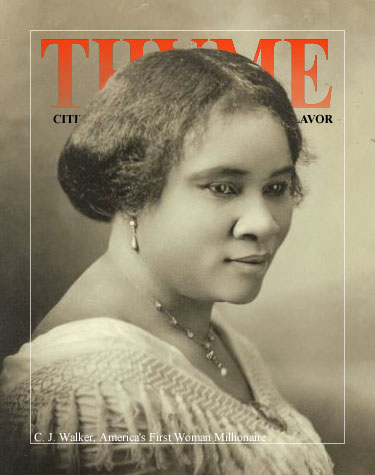
Zinn and his disciples omit the stories of triumph, such as that of C. J. Walker, because they do not bear out the oppressor/victim narrative at all. The sad truth is that many young people are not being told the wonderful stories that might inspire them. THYME would like to change that.

A Distinctly American Story

She was born Sarah Breedlove, on December 23, 1867, on a cotton plantation near Delta, Louisiana. She was the fifth child of Owen and Minerva, who had been slaves up to the Emancipation. She was orphaned at age seven and went to live with her sister, Louvinia, and her brother-in-law in Vicksburg, Mississippi. Sarah likely picked cotton and did other manual labor but when she was fourteen, she married Moses McWilliams. On June 6, 1885, their daughter A'Leila was born. Two years later, Sarah became a widow. She and A'Lelia moved to St. Louis, where Sarah's brothers were barbers. Working as a laundress, Sarah made enough money to send her daughter to the city school. She herself attended public night school whenever she was able to. It was in St. Louis that Sarah Breedlove met her second husband Charles J. Walker. He worked in advertising and would later become the promoter of her hair care business.

When Sarah Breedlove developed a scalp disorder that resulted in the loss of most of her hair, she experimented with home remedies and patent medicines in an effort to cure it. In 1905, she became a salesperson for Annie Turnbo Malone in Denver, who had developed a line of hair care products for African-American women. By 1907 she had developed her own line of products. Opening her first factory in Pittsburgh, Pennsylvania 1908, she also opened a beauty school to train her "Walker Agents," who instructed local operators in the best use of her products. She saw her mission as more than producing products. She saw her beauty care products as a means of elevating the status of Black women and became active in philanthropic work as well. The whole operation was later moved to Indianapolis, Indiana where the business continued to grow.

C. J. Walker them moved to Harlem in New York City. She and her daughter A'Lelia became an important part of the 'Harlem Renaissance.' She died on May 25, 1919. She was but 51 years old, yet her personal journey had taken her to such heights that she remains an inspiration to all who know her story.

Yarmouk
A child plays in the rubble of Yarmouk. Photo by Jonathan Messing.

Children in a World of Troubles

Yarmouk was home to the largest Palestinian refugee community in the country before the conflict began. 180,000 Palestinian civilians called it home. Now only 20,000 remain. Food and medical supplies are routinely denied entry and starvation is one of the three main causes of death. Recently, in the Jarabulus area, 22 people were killed and thrown into the streets to instill fear in the population. Some of them were children." -- Jonathan Messing

Massacre at Yarmouk [click to read]

I was informed last Friday that there were Unaccompanied Child Immigrants (UCI) at the Shenandoah Juvenile Detention Center in Verona. Like most others, I had read the newspapers and heard the news reports about these children, but now they were here in my district. I called the detention center and set up an appointment to meet some of these children.

I arrived at the Juvenile Detention Center Monday morning at 8 am. I had the opportunity to meet five illegal immigrant children, look into their welfare, and hear their stories. It was a heart-breaking experience." -- David Karaffa

Illegal Immigrant Children in Verona [click to read].

The Islamic State last week issued an ultimatum to the Christians in the town of Mosul, the second largest city in Iraq, ordering them to convert to Islam, pay a religious tax or face death. The statement by the leader of the Islamic State, Abu Bakr al-Baghdadi, warned that the Christians had until Saturday to “leave the borders of the Islamic Caliphate.” He added that, “After this date, there is nothing between us and them but the sword.” Messages warning Christians about the ultimatum were announced through loudspeakers on the city’s mosques. Church leaders advised the few families who wanted to negotiate with terrorist that they should also flee for their own safety. The exodus went on in Mosul throughout Friday, with all the Christians abandoning the town by the end of the day. “For the first time in the history of Iraq, Mosul is now empty of Christians,” said one man. "We have lived in this city and we have had a civilization for thousands of years - and suddenly some strangers came and expelled us from our homes," a woman in her 60s told media sources. “Hundreds were walking on foot,” said a bishop in the neighboring city of Tel Keif. He said many of them were bereft of all money or possessions - and that ISIS had robbed them of all of their belongings before setting off for refugee camps. (Israel National News/Reuters) Where is the outcry from the Christian world about what's happening to the Christians in Iraq? Where is the UN? Where are the evangelicals? Where are the Jews and the protesters who so quickly come against Israel!" -- JNN News