
Showing posts with label George Washington. Show all posts

Wednesday, February 18, 2015

THYME Magazine: Thoughts on Leadership

Citizen Journalism with a Better Flavor

THYME0907
Volume IX, Issue VII

The Challenge of Leadership

It was just over a week ago that Jordan's King Abdullah II, learning of the execution by terrorist group ISIS of one of his pilots, cut short a visit to the White House and returned to his own country to oversee the air attack on ISIS militants. The king, who is a trained pilot, was rumored to be manning one of the planes leading the attack. Though official sources denied it, the king does regularly participate in military operations and flies his own helicopter to remote parts of his kingdom. Many Americans lauded this quick and decisive response, especially in light of our own President's ambivalence. Certainly it was a breath of fresh air to see a leader take it to the terrorists rather than lecture us on the Crusades.

No doubt, America's tepid response begs the question of qualification when it comes to Commander-in-chief of the greatest military power in the world. Should we require a potential President to have military experience? It seems logical, but though it would have disqualified a number of inept Chief Executives, it would have also deprived us of the leadership of Ronald Reagan! Someone opined to me recently that Reagan was so effective because he had been a Governor. As Chief Executive of a state, he would have already learned to build teams and draw expertise from the members who in many cases would have a far better understanding of the issues than he did. The commenter said that Governors, upon becoming President, had the ability, not only to work with a team, but often brought some of their best people with them to Washington.

That said, it might be better to look for a deeper level of leadership qualification. Yes, military leadership is an important part of it, but there is more. Also, it is important to remember that the principle of civilian oversight is a deterrent to military coups. Thus it falls on the citizens and the media to make informed judgements on candidates. An educated electorate would never put a largely untested and unvetted Junior Senator's finger anywhere near the red button. Is it reasonable to expect some resume from a potential candidate so that we may know something of his policies, world and domestic?

King Abdullah showed the proper resolve in dealing with terrorists, but it is worth noting that this warrior-king is unelected. He is known to govern by playing various factions in his kingdom against one another. He is a vocal critic of Jordan's neighbor Israel and is indeed more complex than the noble knight that he has come to be seen as. Speech in the Hashemite Kingdom is closely regulated. It is a crime to speak out against the crown. The General Intelligence Department is highly feared. His kingdom has massive unemployment and as many as two thirds of the citizens are on the public dole.

To the West, another model of leadership is in play. A true representative government exists in neighboring Israel, where members of the Knesset are elected, as is the Prime Minister. Binyamin Netanyahu serves at the pleasure of the voters, and he has a pretty impressive resume. When our own President was running with the Choom Gang, PM Netanyahu was serving with IDF Special Forces. He is a student of the world he must lead his people in. His own advertisement for his reelection says volumes about the subject of leadership in a lighthearted way.

Meet the 'Bibi Sitter'


Leadership: "Taking care of the children."

In the ad, the prime minister mentions the other choice for "taking care of the children": Isaac "Buji" Herzog and Tzipi Livni, the leaders of the left-wing political alliance in Israel's upcoming elections.

Buji? Our children will have to take care of him!" says the father, according to a translation.

By the time we get home, we won't have a house left," the mother says.

He'll even give away the carpet," (the Hebrew word for carpet can also be translated 'territory', so there is a double entendre here) the father jokes.

When the parents return from their night out, they greet Netanyahu with a "shalom," which means "peace."

Not unconditionally," Bibi responds.

The polls in Israel seem to be moving in Bibi and Likud's direction. Meanwhile, PM Netanyahu's government has received pushback from the White House after the Israeli prime minister accepted an invitation from House speaker John Boehner to speak to Congress in March. What is illustrated well here is the true challenge of leadership... providing security for one's people and working to do so in a very dangerous world! The media, in turn, MUST move away from its simplistic victim/oppressor narrative and provide leadership as well.

The Challenge of Leadership
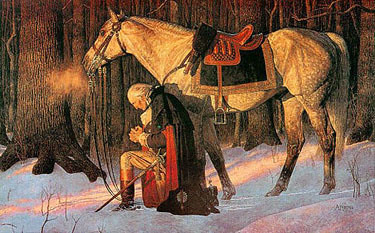
theprayer
"The Prayer at Valley Forge" by Arnold Friberg is one of the best known paintings of the American Revolution. It depicts George Washington at Valley Forge.

No doubt, George Washington knew the challenge of leadership well. He began his career without a full college degree, but at the age of sixteen he obtained his surveyer's certificate from The College of William and Mary. At an age when most modern young men are playing video games, he was out discovering and marking an actual country! He did do something akin to the actions of modern young men when he discreetly carved his initials into Rock Bridge County's natural wonder, Natural Bridge!

Washington is noted for his military career, but historian James Hodges, Ph.D.gives us some unique insight into the man's character:

At the Battle of Brandywine in September 1777, a particularly brutal battle with much carnage on both sides, a fox terrier got lost between the lines. The little dog was captured by the Americans, who saw inscribed in his collar: “Property of General Howe.” Washington made sure the little dog was fed, cleaned and treated well. Under a flag of truce, Alexander Hamilton delivered the dog to General Howe, who had suffered great mental anguish thinking his little terrier had been lost to him forever.

Washington had been passionately fond of horses from early boyhood, and owned his first horse at 17. His mother, Mary Ball Washington, was a skilled horsewoman who taught young George how to train horses using only the gentlest of methods, and to never resort to any cruelty. Washington learned that harsh training methods were counter-productive, because horses treated with respect are eager to please their riders." [1.]

At the second battle of Trenton, on January 2, 1777, it was clearly evident that Washington's great charger Nelson returned the affection of his rider. Though cannon shells were bursting around them, man and horse stood firm. To those men Washington led into battle, they stood together as a symbol of strength. A soldier writes: “As I crossed the bridge crowded with fellow soldiers, I brushed up against the boot of the man and flank of the horse. Both seemed to exude courage.”

After the great war was over, Washington indeed became President of the nation he had helped to create. His leadership skills would be tested in the days of the Newburgh Conspiracy, where he would avert a military coup. The young nation's coffers were empty. The Continental Army had not been fully paid, and an uprising was brewing. There was talk of taking up arms against the Congress. Washington went to his officers and appealed to them in an emotional address on March 15, 1783.

Cool heads prevailed and Congress voted on a plan to pay the men. Interestingly, Washington distrusted the notion of political parties. He never aligned with one himself, though those around him were crafting the foundation for the two party system we have today. Perhaps the man's own sayings tell us volumes about his life and its motivations: [2.]

It is impossible to rightly govern the world without G-d and Bible."

The propitious smiles of Heaven can never be expected on a nation that disregards the eternal rules of order and right which Heaven itself has ordained”

Make sure you are doing what G-d wants you to do---then do it with all your strength."

What students would learn in American schools above all is the religion of Jesus Christ.” "It is the duty of all Nations to acknowledge the providence of Almighty G-d, to obey his will, to be grateful for his benefits, and humbly to implore his protection and favors."

My mother was the most beautiful woman I ever saw. All I am I owe to my mother. I attribute my success in life to the moral, intellectual and physical education I received from her."

The General hopes and trusts that every officer and man will endeavor to live and act as becomes a Christian soldier defending the dearest rights and liberties of his country."

If to please the people, we offer what we ourselves disapprove, how can we afterwards defend our work? Let us raise a standard to which the wise and honest can repair. The rest is in the hands of G-d."

No people can be bound to acknowledge the Invisible Hand which conducts the affairs of men more than the people of the United States. Every step by which they have advanced to the character of an independent nation seems to have been distinguished by some token of providential agency"

I am sure that never was a people, who had more reason to acknowledge a Divine interposition in their affairs, than those of the United States; and I should be pained to believe that they have forgotten that agency, which was so often manifested during our Revolution, or that they failed to consider the omnipotence of that G-d who is alone able to protect them.”

Happiness and moral duty are inseparably connected.”

I earnestly pray that the Omnipotent Being who has not deserted the cause of America in the hour of its extremist hazard, will never yield so fair a heritage of freedom a prey to "Anarchy" or "Despotism"."

Stones of Remembrance
Remembering G-d's Mighty Works in Our Lives

AngusDei_web
Angus Dei (Lamb of G-d), by Kristina Elaine Greer. [1.]

One of the greatest challenges to our Faith is our forgetfulness. Pastor Seth Hankee preached our sermon one Sunday about how the people were instructed to remember the great things G-d had done for them. G-d separated the Jordan, as He had the Red Sea, for the people to walk across and gave them the following command:

And it came to pass, when all the people were clean passed over Jordan, that the Lord spake unto Joshua, saying, Take you twelve men out of the people, out of every tribe a man, And command ye them, saying, Take you hence out of the midst of Jordan, out of the place where the priests' feet stood firm, twelve stones, and ye shall carry them over with you, and leave them in the lodging place, where ye shall lodge this night.

Then Joshua called the twelve men, whom he had prepared of the children of Israel, out of every tribe a man: And Joshua said unto them, Pass over before the ark of the Lord your G-d into the midst of Jordan, and take you up every man of you a stone upon his shoulder, according unto the number of the tribes of the children of Israel: That this may be a sign among you, that when your children ask their fathers in time to come, saying, What mean ye by these stones?

Then ye shall answer them, That the waters of Jordan were cut off before the ark of the covenant of the Lord; when it passed over Jordan, the waters of Jordan were cut off: and these stones shall be for a memorial unto the children of Israel for ever. And the children of Israel did so as Joshua commanded, and took up twelve stones out of the midst of Jordan, as the Lord spake unto Joshua, according to the number of the tribes of the children of Israel, and carried them over with them unto the place where they lodged, and laid them down there.

And Joshua set up twelve stones in the midst of Jordan, in the place where the feet of the priests which bare the ark of the covenant stood: and they are there unto this day." -- Joshua 4:1-9

The Passover meal had already been instituted as testimony to G-d's redemption, so that a child would ask: "Why is this Night Different from all Other Nights?" The story in a meal gave illustration to the miracle that had carried the people out of Egypt.

For the Christian, remembering deliverance from sin is the greatest miracle. In preparation for Easter, the Church observes Lent, reminding us of the deliverance Jesus brought us by way of the cross: 

Ash Wednesday emphasizes two themes: our sinfulness before G-d and our human mortality. The service focuses on both themes, helping us to realize that both have been triumphed through the death and resurrection of Jesus Christ.

During some Ash Wednesday services, the minister will lightly rub the sign of the cross with ashes onto the foreheads of worshipers. The use of ashes as a sign of mortality and repentance has a long history in Jewish and Christian worship. Historically, ashes signified purification and sorrow for sins."-- —Adapted from The United Methodist Book of Worship

So it is very important to tell our stories of redemption, using reminders that will stir our minds to recall times when we were vividly aware of the Divine reaching out to touch our lives. Pastor Seth showed us a little children's book he had saved from his first house... on closer examination you could see the tire print on the page, a reminder of how when a car careened into his living room, it had narrowly missed hitting his wife and young child. Certainly G-d had protected his young family and that little book now told a much bigger story!

So now it is time to commit ourselves to the telling of the great stories, the ones that end in redemption and deliverance from our present condition. The Book of Judges follows the Book of Joshua and gives a sober warning: "And Joshua the son of Nun, the servant of the Lord, died, being an hundred and ten years old. And they buried him in the border of his inheritance in Timnathheres, in the mount of Ephraim, on the north side of the hill Gaash. And also all that generation were gathered unto their fathers: and there arose another generation after them, which knew not the Lord, nor yet the works which he had done for Israel." -- Judges 2:8-10

The importance of stories and their redemptive narrative cannot be emphasized enough. Passing the torch must always be a priority in every generation.

1. "I did this with a sheet of 8.5"x11" computer paper some ashes from my fireplace and canola oil. I mixed up some of the oil and ashes similar to how they are mixed on Ash Wednesday and painted them on the paper in a cross then sprinkled the rest of the dry ashes on top. I then found one of the music compositions for "Agnus Dei," Latin for Lamb of G-d, on www.hymnary.org [click to read] and cut out strictly the music overlaying it and changing the opacity over the picture of my ash cross. Then I added the Latin words meaning, "Lamb of G-d, who takes away the sins of the world, have mercy upon us, grant us peace." This piece is to remind us that we are sinners made up of dust, but G-d loved us so much, he took mercy on us sending His son as a sacrificial lamb, to take away our sins. If we believe and accept his sacrifice we are granted this eternal peace and life with Him. May the Lord bless you all and lead you closer to Him during this season of Lent, looking forward to the promise of Easter. Amen." -- Kristina Elaine Greer

Ash Wednesday and Lent
A Time For Reflection and Redirection

sunset
Sunset in the Blue Ridge Mountains.

Guest Post by M. K. Hand

You might notice people walking around with cross-shaped smudges on their foreheads. There is no "mystical" attribute assigned to this practice. The ashes are a physical reminder of our need for repentance, and a symbol of the dependency of humans on G-d's mercy through Jesus Christ.

Why ashes? The Bible speaks of man returning to dust and ashes (from whence he came), and Job smeared himself with dust and ashes as a symbol of atonement. Also, in the Old Testament, animals were sacrificed to G-d for atonement, and they were burnt to ashes. When Jesus came as a living sacrifice, the Law was no longer applicable, and animal sacrifices were no longer needed for atonement. Jesus was the final sacrifice...He ushered us into a time of Grace through Faith, once and for all.

Lent, the season leading up to Easter, is a time of increased attention to charity (love), prayer, and fasting for Christians. It is a special time to reflect, repent and rejoice. It prepares our hearts to fully take in and celebrate the sacrifice, atonement, and grace made possible by Jesus' crucifixion, and the restoration of our relationship, broken by our sin, with the Father. Many people fast, give up something meaningful to them, or turn away from a sin that has taken hold of their life; fasting is also a way to identify with the sacrifice made by Jesus at Calvary. May this time leading up to Easter be a time of reflection, repentance, and rejoicing for you!

Therefore also now, saith the Lord, turn ye even to me with all your heart, and with fasting, and with weeping, and with mourning: And rend your heart, and not your garments, and turn unto the Lord your G-d: for he is gracious and merciful, slow to anger, and of great kindness, and repenteth him of the evil." ~ Joel 2:12-13

Wednesday, July 9, 2014

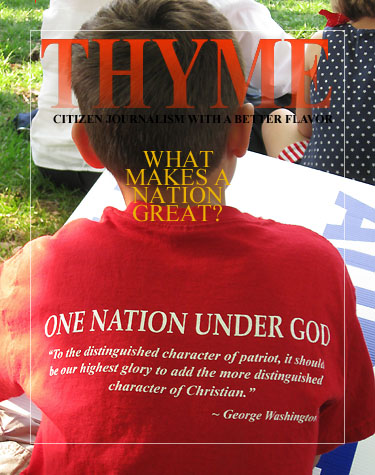
THYME Magazine: What Makes a Nation Great?

Citizen Journalism with a Better Flavor

THYME0802
Volume VIII, Issue II

What Makes a Nation Great?

The 'other' Weekly News Magazine [click to read] once asked: "What makes a school great?" THYME asks: "Why stop there, what makes a NATION great?" As we seek to teach our children the foundations of our Nation, we can agree with the 'other' magazine that it takes great teachers.

No doubt, some will insist that it is a simple matter of perfecting institutions. Some will venture so far as to address the character of man himself, but it is quite evident that those who crafted the original documents our nation is founded on saw a need for a hand greater than their own to guide them. Their own writings give us a clear indication that they did,  so here are some thoughts from our Founding Fathers:

John Adams and John Hancock:
We Recognize No Sovereign but God, and no King but Jesus! [April 18, 1775]

John Adams:
“ The general principles upon which the Fathers achieved independence were the general principals of Christianity… I will avow that I believed and now believe that those general principles of Christianity are as eternal and immutable as the existence and attributes of G-d.”
“[July 4th] ought to be commemorated as the day of deliverance by solemn acts of devotion to God Almighty.”
–John Adams in a letter written to Abigail on the day the Declaration was approved by Congress

"We have no government armed with power capable of contending with human passions unbridled by morality and religion. Avarice, ambition, revenge, or gallantry, would break the strongest cords of our Constitution as a whale goes through a net. Our Constitution was made only for a moral and religious people. It is wholly inadequate to the government of any other." --October 11, 1798

"I have examined all religions, as well as my narrow sphere, my straightened means, and my busy life, would allow; and the result is that the Bible is the best Book in the world. It contains more philosophy than all the libraries I have seen." December 25, 1813 letter to Thomas Jefferson

"Without Religion this World would be Something not fit to be mentioned in polite Company, I mean Hell." [John Adams to Thomas Jefferson, April 19, 1817]


Samuel Adams: 
He who made all men hath made the truths necessary to human happiness obvious to all… Our forefathers opened the Bible to all.” [ "American Independence," August 1, 1776. Speech delivered at the State House in Philadelphia]

“ Let divines and philosophers, statesmen and patriots, unite their endeavors to renovate the age by impressing the minds of men with the importance of educating their little boys and girls, inculcating in the minds of youth the fear and love of the Deity… and leading them in the study and practice of the exalted virtues of the Christian system.” [October 4, 1790]


John Quincy Adams:
“Why is it that, next to the birthday of the Savior of the world, your most joyous and most venerated festival returns on this day [the Fourth of July]?" “Is it not that, in the chain of human events, the birthday of the nation is indissolubly linked with the birthday of the Savior? That it forms a leading event in the progress of the Gospel dispensation? Is it not that the Declaration of Independence first organized the social compact on the foundation of the Redeemer's mission upon earth? That it laid the cornerstone of human government upon the first precepts of Christianity"?
--1837, at the age of 69, when he delivered a Fourth of July speech at Newburyport, Massachusetts.

“The Law given from Sinai [The Ten Commandments] was a civil and municipal as well as a moral and religious code.”
John Quincy Adams. Letters to his son. p. 61


Elias Boudinot:
“Be religiously careful in our choice of all public officers . . . and judge of the tree by its fruits.”

Charles Carroll - signer of the Declaration of Independence
" Without morals a republic cannot subsist any length of time; they therefore who are decrying the Christian religion, whose morality is so sublime and pure...are undermining the solid foundation of morals, the best security for the duration of free governments." [Source: To James McHenry on November 4, 1800.]

Benjamin Franklin:
“ G-d governs in the affairs of man. And if a sparrow cannot fall to the ground without his notice, is it probable that an empire can rise without His aid? We have been assured in the Sacred Writings that except the Lord build the house, they labor in vain that build it. I firmly believe this. I also believe that, without His concurring aid, we shall succeed in this political building no better than the builders of Babel” –Constitutional Convention of 1787 original manuscript of this speech

“In the beginning of the contest with Britain, when we were sensible of danger, we had daily prayers in this room for Divine protection. Our prayers, Sir, were heard, and they were graciously answered… do we imagine we no longer need His assistance?” [Constitutional Convention, Thursday June 28, 1787]

In Benjamin Franklin's 1749 plan of education for public schools in Pennsylvania, he insisted that schools teach "the excellency of the Christian religion above all others, ancient or modern."

In 1787 when Franklin helped found Benjamin Franklin University, it was dedicated as "a nursery of religion and learning, built on Christ, the Cornerstone."


Alexander Hamilton:
Hamilton began work with the Rev. James Bayard to form the Christian Constitutional Society to help spread over the world the two things which Hamilton said made America great:
(1) Christianity
(2) a Constitution formed under Christianity.
“The Christian Constitutional Society, its object is first: The support of the Christian religion. Second: The support of the United States.”

On July 12, 1804 at his death, Hamilton said, “I have a tender reliance on the mercy of the Almighty, through the merits of the Lord Jesus Christ. I am a sinner. I look to Him for mercy; pray for me.”

"For my own part, I sincerely esteem it [the Constitution] a system which without the finger of G-d, never could have been suggested and agreed upon by such a diversity of interests." [1787 after the Constitutional Convention]

"I have carefully examined the evidences of the Christian religion, and if I was sitting as a juror upon its authenticity I would unhesitatingly give my verdict in its favor. I can prove its truth as clearly as any proposition ever submitted to the mind of man."


John Hancock:
“In circumstances as dark as these, it becomes us, as Men and Christians, to reflect that whilst every prudent measure should be taken to ward off the impending judgments, …at the same time all confidence must be withheld from the means we use; and reposed only on that God rules in the armies of Heaven, and without His whole blessing, the best human counsels are but foolishness… Resolved; …Thursday the 11th of May…to humble themselves before God under the heavy judgments felt and feared, to confess the sins that have deserved them, to implore the Forgiveness of all our transgressions, and a spirit of repentance and reformation …and a Blessing on the … Union of the American Colonies in Defense of their Rights [for which hitherto we desire to thank Almighty God]…That the people of Great Britain and their rulers may have their eyes opened to discern the things that shall make for the peace of the nation…for the redress of America’s many grievances, the restoration of all her invaded liberties, and their security to the latest generations.
"A Day of Fasting, Humiliation and Prayer, with a total abstinence from labor and recreation. Proclamation on April 15, 1775"


Patrick Henry:
"Orator of the Revolution."

This is all the inheritance I can give my dear family. The religion of Christ can give them one which will make them rich indeed.”
—The Last Will and Testament of Patrick Henry

“It cannot be emphasized too clearly and too often that this nation was founded, not by religionists, but by Christians; not on religion, but on the gospel of Jesus Christ. For this very reason, peoples of other faiths have been afforded asylum, prosperity, and freedom of worship here.” [May 1765 Speech to the House of Burgesses]

“The Bible is worth all other books which have ever been printed.”


John Jay:
“ Providence has given to our people the choice of their rulers, and it is the duty, as well as the privilege and interest of our Christian nation to select and prefer Christians for their rulers.” Source: October 12, 1816. The Correspondence and Public Papers of John Jay, Henry P. Johnston, ed., (New York: Burt Franklin, 1970), Vol. IV, p. 393.

“Whether our religion permits Christians to vote for infidel rulers is a question which merits more consideration than it seems yet to have generally received either from the clergy or the laity. It appears to me that what the prophet said to Jehoshaphat about his attachment to Ahab ["Shouldest thou help the ung-dly and love them that hate the Lord?" 2 Chronicles 19:2] affords a salutary lesson.” [The Correspondence and Public Papers of John Jay, 1794-1826, Henry P. Johnston, editor (New York: G.P. Putnam's Sons, 1893), Vol. IV, p.365]


Thomas Jefferson:
“ The doctrines of Jesus are simple, and tend to all the happiness of man.”

“Of all the systems of morality, ancient or modern which have come under my observation, none appears to me so pure as that of Jesus.”

"I am a real Christian, that is to say, a disciple of the doctrines of Jesus."

“God who gave us life gave us liberty. And can the liberties of a nation be thought secure when we have removed their only firm basis, a conviction in the minds of the people that these liberties are a gift from God? That they are not to be violated but with His wrath? Indeed I tremble for my country when I reflect that God is just, and that His justice cannot sleep forever.” (excerpts are inscribed on the walls of the Jefferson Memorial in the nations capital) [Source: Merrill . D. Peterson, ed., Jefferson Writings, (New York: Literary Classics of the United States, Inc., 1984), Vol. IV, p. 289. From Jefferson’s Notes on the State of Virginia, Query XVIII, 1781.]


Samuel Johnston:
“It is apprehended that Jews, Mahometans (Muslims), pagans, etc., may be elected to high offices under the government of the United States. Those who are Mahometans, or any others who are not professors of the Christian religion, can never be elected to the office of President or other high office, [unless] first the people of America lay aside the Christian religion altogether, it may happen. Should this unfortunately take place, the people will choose such men as think as they do themselves.
[Elliot’s Debates, Vol. IV, pp 198-199, Governor Samuel Johnston, July 30, 1788 at the North Carolina Ratifying Convention]


James Madison:
“ We’ve staked our future on our ability to follow the Ten Commandments with all of our heart.”

“We have staked the whole future of American civilization, not upon the power of government, far from it. We’ve staked the future of all our political institutions upon our capacity…to sustain ourselves according to the Ten Commandments of G-d.” [1778 to the General Assembly of the State of Virginia]

• I have sometimes thought there could not be a stronger testimony in favor of religion or against temporal enjoyments, even the most rational and manly, than for men who occupy the most honorable and gainful departments and [who] are rising in reputation and wealth, publicly to declare the unsatisfactoriness [of temportal enjoyments] by becoming fervent advocates in the cause of Christ; and I wish you may give in your evidence in this way.
Letter by Madison to William Bradford (September 25, 1773)


• In 1812, President Madison signed a federal bill which economically aided the Bible Society of Philadelphia in its goal of the mass distribution of the Bible
.
“ An Act for the relief of the Bible Society of Philadelphia” Approved February 2, 1813 by Congress

“It is the mutual duty of all to practice Christian forbearance, love, and charity toward each other.”

• A watchful eye must be kept on ourselves lest, while we are building ideal monuments of renown and bliss here, we neglect to have our names enrolled in the Annals of Heaven. [Letter by Madison to William Bradford [urging him to make sure of his own salvation] November 9, 1772]

At the Constitutional Convention of 1787, James Madison proposed the plan to divide the central government into three branches. He discovered this model of government from the Perfect Governor, as he read Isaiah 33:22;
“For the LORD is our judge, the LORD is our lawgiver,
the LORD is our king;
He will save us.”
[Baron Charles Montesquieu, wrote in 1748; “Nor is there liberty if the power of judging is not separated from legislative power and from executive power. If it [the power of judging] were joined to legislative power, the power over life and liberty of the citizens would be arbitrary, for the judge would be the legislature if it were joined to the executive power, the judge could have the force of an oppressor. All would be lost if the same … body of principal men … exercised these three powers." Madison claimed Isaiah 33:22 as the source of division of power in government
See also: pp.241-242 in Teaching and Learning America’s Christian History: The Principle approach by Rosalie Slater]


James McHenry – Signer of the Constitution:
Public utility pleads most forcibly for the general distribution of the Holy Scriptures. The doctrine they preach, the obligations they impose, the punishment they threaten, the rewards they promise, the stamp and image of divinity they bear, which produces a conviction of their truths, can alone secure to society, order and peace, and to our courts of justice and constitutions of government, purity, stability and usefulness. In vain, without the Bible, we increase penal laws and draw entrenchments around our institutions. Bibles are strong entrenchments. Where they abound, men cannot pursue wicked courses, and at the same time enjoy quiet conscience.

Jedediah Morse:
"To the kindly influence of Christianity we owe that degree of civil freedom, and political and social happiness which mankind now enjoys. . . . Whenever the pillars of Christianity shall be overthrown, our present republican forms of government, and all blessings which flow from them, must fall with them."

John Peter Gabriel Muhlenberg:
In a sermon delivered to his Virginia congregation on Jan. 21, 1776, he preached from Ecclesiastes 3.

Arriving at verse 8, which declares that there is a time of war and a time of peace, Muhlenberg noted that this surely was not the time of peace; this was the time of war. Concluding with a prayer, and while standing in full view of the congregation, he removed his clerical robes to reveal that beneath them he was wearing the uniform of an officer in the Continental army! He marched to the back of the church; ordered the drum to beat for recruits and over three hundred men joined him, becoming the Eighth Virginia Brigade. John Peter Muhlenberg finished the Revolution as a Major-General, having been at Valley Forge and having participated in the battles of Brandywine, Germantown, Monmouth, Stonypoint, and Yorktown.

Thomas Paine:
“ It has been the error of the schools to teach astronomy, and all the other sciences, and subjects of natural philosophy, as accomplishments only; whereas they should be taught theologically, or with reference to the Being who is the author of them: for all the principles of science are of divine origin. Man cannot make, or invent, or contrive principles: he can only discover them; and he ought to look through the discovery to the Author.”
“ The evil that has resulted from the error of the schools, in teaching natural philosophy as an accomplishment only, has been that of generating in the pupils a species of atheism. Instead of looking through the works of creation to the Creator himself, they stop short, and employ the knowledge they acquire to create doubts of his existence. They labour with studied ingenuity to ascribe every thing they behold to innate properties of matter, and jump over all the rest by saying, that matter is eternal.” “The Existence of God--1810”


Benjamin Rush:
• “I lament that we waste so much time and money in punishing crimes and take so little pains to prevent them…we neglect the only means of establishing and perpetuating our republican forms of government; that is, the universal education of our youth in the principles of Christianity by means of the Bible; for this Divine Book, above all others, constitutes the soul of republicanism.” “By withholding the knowledge of [the Scriptures] from children, we deprive ourselves of the best means of awakening moral sensibility in their minds.” [Letter written (1790’s) in Defense of the Bible in all schools in America]
• “Christianity is the only true and perfect religion.”
• “If moral precepts alone could have reformed mankind, the mission of the Son of God into our world would have been unnecessary.”

"Let the children who are sent to those schools be taught to read and write and above all, let both sexes be carefully instructed in the principles and obligations of the Christian religion. This is the most essential part of education”
Letters of Benjamin Rush, "To the citizens of Philadelphia: A Plan for Free Schools", March 28, 1787


Justice Joseph Story:
“ I verily believe Christianity necessary to the support of civil society. One of the beautiful boasts of our municipal jurisprudence is that Christianity is a part of the Common Law. . . There never has been a period in which the Common Law did not recognize Christianity as lying its foundations.”
[Commentaries on the Constitution of the United States p. 593]
“ Infidels and pagans were banished from the halls of justice as unworthy of credit.” [Life and letters of Joseph Story, Vol. II 1851, pp. 8-9.]
“ At the time of the adoption of the constitution, and of the amendment to it, now under consideration [i.e., the First Amendment], the general, if not the universal sentiment in America was, that Christianity ought to receive encouragement from the state, so far as was not incompatible with the private rights of conscience, and the freedom of religious worship.”
[Commentaries on the Constitution of the United States p. 593]


Noah Webster:
“ The duties of men are summarily comprised in the Ten Commandments, consisting of two tables; one comprehending the duties which we owe immediately to G-d-the other, the duties we owe to our fellow men.”

“In my view, the Christian religion is the most important and one of the first things in which all children, under a free government ought to be instructed...No truth is more evident to my mind than that the Christian religion must be the basis of any government intended to secure the rights and privileges of a free people.”
[Source: 1828, in the preface to his American Dictionary of the English Language]

Let it be impressed on your mind that G-d commands you to choose for rulers just men who will rule in the fear of God [Exodus 18:21]. . . . If the citizens neglect their duty and place unprincipled men in office, the government will soon be corrupted . . . If our government fails to secure public prosperity and happiness, it must be because the citizens neglect the Divine commands, and elect bad men to make and administer the laws. [Noah Webster, The History of the United States (New Haven: Durrie and Peck, 1832), pp. 336-337, 49]

“All the miseries and evils which men suffer from vice, crime, ambition, injustice, oppression, slavery and war, proceed from their despising or neglecting the precepts contained in the Bible.” [Noah Webster. History. p. 339]

“The Bible was America’s basic textbook
in all fields.” [Noah Webster. Our Christian Heritage p.5]

“Education is useless without the Bible” [Noah Webster. Our Christian Heritage p.5 ]


George Washington:
Farewell Address: The name of American, which belongs to you, in your national capacity, must always exalt the just pride of Patriotism, more than any appellation derived from local discriminations. With slight shades of difference, you have the same religion" ...and later: "...reason and experience both forbid us to expect, that national morality can prevail in exclusion of religious principle..."


“ It is impossible to rightly govern the world without G-d and Bible.”

“What students would learn in American schools above all is the religion of Jesus Christ.” [speech to the Delaware Indian Chiefs May 12, 1779]

"To the distinguished character of patriot, it should be our highest glory to add the more distinguished character of Christian" [May 2, 1778, at Valley Forge]

During his inauguration, Washington took the oath as prescribed by the Constitution but added several religious components to that official ceremony. Before taking his oath of office, he summoned a Bible on which to take the oath, added the words “So help me G-d!” to the end of the oath, then leaned over and kissed the Bible.

Nelly Custis-Lewis (Washington’s adopted daughter):
Is it necessary that any one should [ask], “Did General Washington avow himself to be a believer in Christianity?" As well may we question his patriotism, his heroic devotion to his country. His mottos were, "Deeds, not Words"; and, "For G-d and my Country."

“ O Most Glorious G-d, in Jesus Christ, my merciful and loving Father; I acknowledge and confess my guilt in the weak and imperfect performance of the duties of this day. I have called on Thee for pardon and forgiveness of my sins, but so coldly and carelessly that my prayers are become my sin, and they stand in need of pardon.”
“ I have sinned against heaven and before Thee in thought, word, and deed. I have contemned Thy majesty and holy laws. I have likewise sinned by omitting what I ought to have done and committing what I ought not. I have rebelled against the light, despising Thy mercies and judgment, and broken my vows and promise. I have neglected the better things. My iniquities are multiplied and my sins are very great. I confess them, O Lord, with shame and sorrow, detestation and loathing and desire to be vile in my own eyes as I have rendered myself vile in Thine. I humbly beseech Thee to be merciful to me in the free pardon of my sins for the sake of Thy dear Son and only Savior Jesus Christ who came to call not the righteous, but sinners to repentance. Thou gavest Thy Son to die for me.”
[George Washington; from a 24 page authentic handwritten manuscript book dated April 21-23, 1752
William J. Johnson George Washington, the Christian (New York: The Abingdon Press, New York & Cincinnati, 1919), pp. 24-35.]

"Although guided by our excellent Constitution in the discharge of official duties, and actuated, through the whole course of my public life, solely by a wish to promote the best interests of our country; yet, without the beneficial interposition of the Supreme Ruler of the Universe, we could not have reached the distinguished situation which we have attained with such unprecedented rapidity. To HIM, therefore, should we bow with gratitude and reverence, and endeavor to merit a continuance of HIS special favors". [1797 letter to John Adams]


James Wilson:
Signer of the Declaration of Independence and the Constitution
Supreme Court Justice appointed by George Washington
Spoke 168 times during the Constitutional Convention

"Christianity is part of the common law"
[Sources: James Wilson, Course of Lectures [vol 3, p.122]; and quoted in Updegraph v. The Commonwealth, 11 Serg, & R. 393, 403 (1824).]


Source: Quotes of the Founding Fathers.

bars
Photo by Nick Page.

School Starting Age: The Evidence
by David Whitebread

Earlier this month the "Too Much, Too Soon" campaign made headlines with a letter calling for a change to the start age for formal learning in schools. Here, one of the signatories, Cambridge researcher David Whitebread, from the Faculty of Education, explains why children may need more time to develop before their formal education begins in earnest.

"In the interests of children’s academic achievements and their emotional well-being, the UK government should take this evidence seriously" -- David Whitebread

In England children now start formal schooling, and the formal teaching of literacy and numeracy at the age of four. A recent letter signed by around 130 early childhood education experts, including myself, published in the Daily Telegraph (11 Sept 2013) advocated an extension of informal, play-based pre-school provision and a delay to the start of formal ‘schooling’ in England from the current effective start until the age of seven (in line with a number of other European countries who currently have higher levels of academic achievement and child well-being).

This is a brief review of the relevant research evidence [1.] which overwhelmingly supports a later start to formal education. This evidence relates to the contribution of playful experiences [2.] to children’s development as learners, and the consequences of starting formal learning at the age of four to five years of age

There are several strands of evidence which all point towards the importance of play in young children’s development, and the value of an extended period of playful learning before the start of formal schooling. These arise from anthropological, psychological, neuroscientific and educational studies. Anthropological studies of children’s play in extant hunter-gatherer societies, and evolutionary psychology studies of play in the young of other mammalian species, have identified play as an adaptation which evolved in early human social groups. It enabled humans to become powerful learners and problem-solvers. Neuroscientific studies have shown that playful activity leads to synaptic growth, particularly in the frontal cortex, the part of the brain responsible for all the uniquely human higher mental functions.

In my own area of experimental and developmental psychology, studies have also consistently demonstrated the superior learning and motivation arising from playful, as opposed to instructional, approaches to learning in children. Pretence play supports children’s early development of symbolic representational skills, including those of literacy, more powerfully than direct instruction. Physical, constructional and social play supports children in developing their skills of intellectual and emotional ‘self-regulation’, skills which have been shown to be crucial in early learning and development. Perhaps most worrying, a number of studies have documented the loss of play opportunities for children over the second half of the 20th century and demonstrated a clear link with increased indicators of stress and mental health problems.

Within educational research, a number of longitudinal studies have demonstrated superior academic, motivational and well-being outcomes for children who had attended child-initiated, play-based pre-school programmes. One particular study of 3,000 children across England, funded by the Department for Education themselves, showed that an extended period of high quality, play-based pre-school education was of particular advantage to children from disadvantaged households.

Studies have compared groups of children in New Zealand who started formal literacy lessons at ages 5 and 7. Their results show that the early introduction of formal learning approaches to literacy does not improve children’s reading development, and may be damaging. By the age of 11 there was no difference in reading ability level between the two groups, but the children who started at 5 developed less positive attitudes to reading, and showed poorer text comprehension than those children who had started later. In a separate study of reading achievement in 15 year olds across 55 countries, researchers showed that there was no significant association between reading achievement and school entry age.

This body of evidence raises important and serious questions concerning the direction of travel of early childhood education policy currently in England. In the interests of children’s academic achievements and their emotional well-being, the UK government should take this evidence seriously.

This work is licensed under a Creative Commons License. [1.] The original article appears Here [click to read].

Saturday, October 19, 2013

A Reading from 'The Crossing' by Jack Levin

Overwhelming Obstacles Faced Washington's Men

crossing
Washington Crossing the Delaware, 1851. Oil-on-canvas painting by Emanuel Gottlieb Leutze. The painting commemorates General George Washington's crossing of the Delaware River on the night of December 25–26, 1776, during the American Revolutionary War, the first move in a surprise attack against the Hessian forces at Trenton, New Jersey.

Last night, Dr. Mark Levin challenged the gloom in the Conservative community with a reading from his father's book: The Crossing [click to read] Beginning with Washington's humble acceptance of his commission to command the Continental Army, Jack Levin then goes on to detail the string of setbacks and overwhelming odds against which Washington and his soldiers struggled.

Bootless men tied rags around their feet and still their blood stained the snow. Crossing a river full of ice flows, they went on to become a part of history!

I was in the studio listening intently to the reading, challenged by the faith and courage that Dr. Levin and his father so vividly brought to life. Faith and Courage! We need those stunning Virtues now more than ever.

If Washington felt unworthy for the task, my own unworthiness is greater. Yet, these are the times that call for such as us to keep up the good fight. Washington sought help from the Divine, and His Grace and Mercy are "New every morning!" -- Lamentations 3:23 They are available to us!

"And let us not be weary in well doing: for in due season we shall reap, if we faint not." -- Galations 6:9

Thursday, June 28, 2012

THYME Magazine

Citizen Journalism with a Better Flavor

thyme0306
Volume IV, Issue XXVI

America's Revolution... A Model to Emulate
"I consider it an indispensable duty to close this last solemn act of my official life by commending the interests of our dearest country to the protection of Almighty G-d and those who have the superintendence of them into His Holy keeping." -- George Washington

"If my people...shall humble themselves, and pray, and seek my face...then shall I hear from heaven, and will forgive their sin, and will heal their land." -- II Chronicles 7:14

The 'other' Weekly News Magazine [click to read] features the cover headline: 'The Revolution that Wasn't.' Today's revolutionaries would do well to remember at least a very basic history of revolutions.

The French Revolution (1789-1799) created chaos. The Bolshevik Revolution in 1917 led to another dark tyranny.

Rare in history is the casting off of tyranny successfully accomplished and followed by the creation of a system of government that allows for the peaceful transfer of power... through the ballot box.

It is well known that George Washington inspired his men through the difficult days of Valley Forge and the Battle of Trenton... the nation's future very much in the balance. Perhaps not so well known is that Washington had to put down mutinies by Continental soldiers after the war... unpaid by a bankrupt Congress.

Our nation's survival of those days was miraculous. The creation of her Constitutional government was no less miraculous. Today, Federal judges invoking the Commerce Clause participate in an equally miraculous continuation of that same experiment.

Their Freedom is Not Our Freedom

These Observations [click to read] by Diana West in Jewish World Review give clarity to what 'they' want. Universalists believe all peoples prefer freedom to its absence, which is probably true. But they also believe all peoples define "freedom" in the same way. Is that true?

Celebrate Arab democracy? [click to read] by Caroline B. Glick in Jewish World Review.

No summary will do this damning article justice.

Wisdom2
True wisdom. ht/Joy

The Revolution that Wasn't

This week the "other" weekly news magazine laments the "revolution" in Egypt, saying: "the generals are still in charge." I hope, for the sake of Coptic Christians and other miniorities, that some stable heads are in charge. One of our Constitution's unique characteristics is that it limits government and affirms the rights of the individual citizen as G-d given. When Jefferson penned the Declaration of Independence, he wrote:

"We hold these truths to be self-evident, that all men are created equal, that they are endowed by their Creator with certain unalienable Rights, that among these are Life, Liberty and the pursuit of Happiness.--That to secure these rights, Governments are instituted among Men, deriving their just powers from the consent of the governed, --That whenever any Form of Government becomes destructive of these ends, it is the Right of the People to alter or to abolish it, and to institute new Government, laying its foundation on such principles and organizing its powers in such form, as to them shall seem most likely to effect their Safety and Happiness. Prudence, indeed, will dictate that Governments long established should not be changed for light and transient causes; and accordingly all experience hath shewn, that mankind are more disposed to suffer, while evils are sufferable, than to right themselves by abolishing the forms to which they are accustomed. But when a long train of abuses and usurpations, pursuing invariably the same Object evinces a design to reduce them under absolute Despotism, it is their right, it is their duty, to throw off such Government, and to provide new Guards for their future security." -- American Declaration of Independence

In 1789, the Bill of Rights further asserted: "Congress shall make no law respecting an establishment of religion, or prohibiting the free exercise thereof; or abridging the freedom of speech, or of the press; or the right of the people peaceably to assemble, and to petition the Government for a redress of grievances."

Carefully making the case that human rights com from G-d, the founders codified limits on the state in keeping with that belief.

AJeffersonQt
ht/Joy.

THYME Interactive [click to read] brings you even more of our famous Nanny State Updates and other  news you need in this crucial election year.

Deists and Atheists? [click to read]. Dr. Roger Shultz discusses the Founding Fathers from a historical perspective. A special Independence Day presentation.

vom

Thursday, April 12, 2012

THYME Magazine

Citizen Journalism with a Better Flavor

thyme0415
Volume IV, Issue XV

The World's Most Distinctive Club

Eight men from Virginia shaped the world we live in. The 'other' weekly news magazine this week calls the fraternity of Presidents: "the most exclusive club in the world." Virginia is sometimes referred to as the "Mother of Presidents" because eight U.S. Presidents come from the state.

George Washington led the fight that preceded our founding. He was President of the Continental Congress and led the Continental Army. When Congress failed to pay the Continental Army, Washington rode out to intervene, saving the young nation. He was the first President of the young United States. John Adams of Massachussetts followed as the second President. Then three other Virginians followed.

Thomas Jefferson, who drafted the Virginia Statute of Religious Freedom and the Declaration of Independence was our third President. He bought the Louisiana Purchase from France and more than doubled the size of the country for 15 million dollars. Napoleon Bonaparte badly needed the money. The Mississippi River would open up a whole new world. Jefferson also asserted America's right to the seas by standing up to the Barbary Pirates.

James Madison, our fourth President, is known as the Father of our Constitution. He was President during the War of 1812 when Washington City was burned by the British.

James Monroe was next in line. He had been sent by Jefferson to France to negotiate the Louisiana Purchase. His Monroe Doctrine told European powers to stay out of South America.

William Henry Harrison was our ninth President. He had fought in the War of 1812. He has the dubious distinction of having been killed by his inaugural address. Contracting pneumonia after giving the speech on a very cold day, Harrison died a month after taking office. His was the shortest term of office of any American President.

John Tyler, his Vice-president succeeded him, becoming the tenth President of the United States. He was referred to as "His Accidency" because of this. He was the first President to be married while in office.

Zachary Taylor, of Orange County, Virginia, became our twelfth President. A career soldier who had fought in the Mexican War, President Taylor died after sixteen months in office.

Woodrow Wilson, born right here in Staunton, Virginia, became our 28th President. He was President during World War I and aferwards worked to establish the League of Nations. A leader of the Progressive Movement, Wilson pursued an agenda that included the Federal Reserve Act, Federal Trade Commission Act, the Clayton Antitrust Act, the Federal Farm Loan Act and an income tax. Interestingly enough, Wilson's early career took place far from Virginia. He was President of Princeton University and then Governor of New Jersey before running for President in 1912.

oped2112chu

Raising Five Kids Isn't Work, Staffer Says

Obama staffer Hilary Rosen has hit a nerve when she says that Ann Romney hasn't 'worked.' In Rosen's eyes, taking care of five children is not 'work' of importance. My Mother raised five of us and once rolled her eyes when Barbara Walters admitted she didn't know where to buy Gatoraid! Mom had worked in the engineering department of the Martin Company. After she married Dad, she would take her slide rule to the A&P Grocery Store and do her own 'unit pricing' before the stores instituted it. She would illustrate Zeno's Paradox by continually dividing the last piece of the last piece of pie.

This was one of Mom's best lectures. She'd cut the pie into eight pieces instead of the flawless seven she usually did. Then she'd keep dividing until the pie filling refused to cooperate with the lesson. Her kitchen was a place full of learning and wonder.

We raised our young daughter with a program called Joy School in her preschool years. Mom would have loved it. Richard and Linda Eyre, a couple in Utah invented it. [1.] I'm sure Ann Romney availed herself of resources like this.

The administration distanced themselves from Rosen's remark, but the remark was an honest window into the thinking of those who are running the country right now.

"Of course they had to disown Hilary Rosen. She was egregiously honest. She told people exactly what she genuinely believed. She has no understanding of; and no respect for a woman who could do anything with her life and considers raising her children the highest possible calling. Hillary Rosen considers this a waste of time and talent. It makes her a perfect representative of the anti-traditional left. The only thing she did wrong, in the reptilian eyes of David Axelrod, was publically admitting it." -- Red State

In fact, Red State wonders about The Administration's Record [click to read] on paying female employees.

On March 15, 2012, THYME Wrote:

"But looking at Proverbs 31, we run the risk of cheapening the true value of a person if we reduce her to simply a wage earner, albeit a powerful one. A while ago I asked a young artist to help me in the studio. I told her: "I'm not going to pay you what you're worth, I'll pay you what the job is worth. If I had to pay you what you are worth I couldn't afford you." That distinction comes to mind as we ruminate on the value of our wives and daughters to our family and society. Every now and then someone will try to assign a number value to the service of a women who takes care of her home and family (not working outside the home). It is always in six figures and that calculation makes a great point. There are many great people who's influence far exceeds their monitary earnings and society is the richer for it."

Lynn Has This to Say [click to read] as a homeschooling Mother who raised and educated her own children:

"So some parents don't think it "takes a village" to raise our children ... we take the responsibility of doing it ourselves. Not every stay-at-home mom is rich ... we sacrifice, scrimp, and do without to create a family atmosphere. Barack Obama's "female gap" advantage may have just taken a blow. Why can't liberals MYOB?" -- Lynn Mitchell

My suspicion is that the administration is well aware of what an asset Mrs. Romney is to her husband and her family. Otherwise, why would they bother to attack her?

16303803305723521838

Wednesday, March 30, 2011

Robert E. Lee's Artist Father-in-law

George Washington Parke Custis' Arlington House

IMG_2699 The columns of Arlington House.

George Washington Parke Custis was the Father-in-law of Robert E. Lee. He built Arlington House as a tribute to his step-grandfather George Washington. The hallway features frescoes above the doorways that Custis painted of hunt scenes.

IMG_2828Hounds pursue a rabbit.

Friday, February 4, 2011

THYME Magazine

Citizen Journalism with a Better Flavor

thyme0306
Volume III, Issue VI

America's Revolution... A Model to Emulate

"I consider it an indispensable duty to close this last solemn act of my official life by commending the interests of our dearest country to the protection of Almighty God and those who have the superintendence of them into His Holy keeping." -- George Washington

"If my people...shall humble themselves, and pray, and seek my face...then shall I hear from heaven, and will forgive their sin, and will heal their land." -- II Chronicles 7:14

The 'other' Weekly News Magazine [click to read] features the cover headline: 'Revolution.' Today's revolutionaries would do well to remember at least a very basic history of revolutions.

The French Revolution (1789-1799) created chaos. The Bolshevik Revolution in 1917 led to another dark tyranny.

Rare in history is the casting off of tyranny successfully accomplished and followed by the creation of a system of government that allows for the peaceful transfer of power... through the ballot box.

It is well known that George Washington inspired his men through the difficult days of Valley Forge and the Battle of Trenton... the nation's future very much in the balance. Perhaps not so well known is that Washington had to put down mutinies by Continental soldiers after the war... unpaid by a bankrupt Congress.

Our nation's survival of those days was miraculous. The creation of her Constitutional government was no less miraculous. Today, Federal judges invoking the Commerce Clause participate in an equally miraculous continuation of that same experiment.

Their Freedom is Not Our Freedom

These Observations [click to read] by Diana West in Jewish World Review give clarity to what 'they' want. Universalists believe all peoples prefer freedom to its absence, which is probably true. But they also believe all peoples define "freedom" in the same way. Is that true?

Celebrate Arab democracy? [click to read] by Caroline B. Glick in Jewish World Review.

No summary will do this damning article justice.

Friday, July 9, 2010

Prelude to Restoring Honor I

The National Cathedral

George Washington
Light from the windows above...

George Washington
...frames a statue of George Washington.

National Cathedral
Stained glass and stone.

Tuesday, March 9, 2010

History Maker III

The James River and Kanawha Canal

James River and Kanawha Canal
In 1785 the James River and Kanawha Canal was begun. George Washington personally surveyed its location. Here is an illustration from Harper's Weekly of the canal.

Not only was the Potomac being developed as a route to the West. In Richmond a similar project, the James River and Kanawha Canal was begun. The original plan was to build a waterway all the way to the Ohio River. An impressive tunnel would have been built through the mountains.

But flooding, financial troubles and the coming of the Railroad ended the effort. In 1851 the canal was only half finished and the railroads were expanding in all directions faster than the canal could be dug. After the Civil War some of the canal right of way was used for the Richmond and Allegheny Railroad, later incorporated into the C&O system.

Richmond
Shokhoe Bottom in Richmond.

Richmond
Today the business of the Commonwealth is carried on in a hotel atrium featuring a floor map of the canal and turning basin...

Richmond
...while stones from the old locks and turning basin provide a resting place on a sunny day.

Richmond
The James Center stands on the site of the old turning basin.

Richmond
Atrium in the James Center.

History Maker II

He Was Father to this Country in Many Ways

IMG_8786
Statue of George Washington in the Virginia State Capitol.

Most of us who studied American History when it was... American History know of the Winter at Valley Forge, the crossing of the Delaware and the Battle of Trenton. We know that George Washington was our first President. 'Dangerous' Home Schoolers [1.] even know that he was a man who trusted in G-d and prayed.

Still, there is much to learn about this man. Without his forsight there might not have been a United States of America as we know it. We might have never made it past our own Revolution.

In 1783 Washington gave up his command of the Continental Army and returned to private life. He did not enjoy his retirement for long. Revolutionary soldiers, hearing rumors that they would be dismissed without being paid, surrounded Independence Hall in Philidelphia with fixed bayonetts. No doubt, the members of the Continental Congress were in danger of being killed or taken hostage by angry soldiers.

Washington gathered troops and rushed to Philadelphia as our government slipped away to exile in Princeton, New Jersey. Washington met personally with the mutinous officers, pleading with them not to "sully the glory" they have earned. He successfully stops a military coup in its tracks. A colonel writes him, suggesting that Washington crown himself king, supported by “the universal esteem and veneration of an army.” Washington found the idea repugnant. His noble impulse shaped the nature of American leadership for the centuries to come. [2.]

But Washington did even more to shape our Nation. He wrote: "No well informed mind need be told, that the flanks and rear of the United territory are possessed by other powers, and formitable ones too -- nor how necessary it is to apply the cement of interest to bind all parts of it together... open wide door, and make a smooth way for the produce of that country to pass to our markets..." In 1784 he persuaded the Virginia and Maryland assemblies to pass bills establishing a company to improve the Potomac for shipping.

Just West of Washington DC the Great Falls of the Potomac roar impressively. Of course they stood in the way of Westward travel. The Potowmack Canal was built out of Washington's vision.

In 1785 the Mount Vernon Compact was drawn up to provide for free navigation of the Potomac River and the Chesapeake Bay. Interstate commerce again prompted talks in Annapolis,Maryland the following year.

A conference was scheduled for 1787 in Philadelphia to amend the Articles of Confederation to allow free commerce between the states. That conference resulted in the drafting of the United States Constitution.

More on George Washington [click to read].

IMG_8734
The Great Falls of the Potomac.

patowmack002
Plan and profile of the Potowmack Canal.

locks4and5
Locks 4 and 5, illustration in Great Falls Visitor's Center.

IMG_8745
Ruins of lock on Potowmack Canal.

IMG_8746
Another lock on the canal.

IMG_8747
Stonework detail of a lock.

History Maker III [click to read]. The James River and Kanawha Canal.

Wednesday, December 24, 2008

The Treasure of Our Heritage

Our Ancestors Faced Amazing Difficulties with Amazing Courage

It may seem strange to tell a Civil War story at Christmas, but I suppose the greatest gift we have been given by our parents is the wealth of our ancestors' life experiences. Such reservoirs will refresh us as we face many a difficult day. It was Christmas of 1776 when George Washington took his men across the Delaware. In many people's minds the revolution was all but lost. Washington's army was ragged and undersupplied. The odds were against any hope of succeeding. Still these men crossed the river, won the battle and the tide turned. The rest is, well, history.

Most of us have some amazing stories that come from our own ancestors. They are, I am convinced, signposts for our own journey. We need to tell them, especially at holidays.

My Great Grandfather Tolbert Saunders Dalton was born in Robertson County, Tennessee, close to Nashville. He was seventeen When the War between the States started. He joined the 49th Regiment of Tennessee Volunteers and had a long and distinguished career as a soldier. He saw many battles, some of them quite fierce, and the sight and sound of men dying around him led him to preach the Gospel. By the light of many a campfire, my Great Grandfather shared the simple message of redemption in Christ.

He served under General Nathan B. Forrest and saw action in some of the battles for control of the Mississippi. When Union troops advanced on Memphis, preparing to attack at dawn the next day, General Forrest was outnumbered ten to one. He did not have the artillery to protect the city, but he did have at his disposal a fair number of farm wagons and many willing workers like young Dalton. All night long, the boys hollowed out the ends of tree trunks and blacked them to look like cannon. Then each ‘cannon’ was positioned on a set of wagon wheels. The faux cannon were positioned for maximum effect along the banks of the river and then General Forrest demanded surrender! In a dangerous bluff Forrest’s 300 men captured 3,000 would-be attackers.

Tolbert Dalton was later assigned to spy duty. He once carried a message to General Forrest through enemy lines by pretending to be a deaf and dumb farm boy. Seeing an unexpected checkpoint, he quickly stuffed the message in his mouth and made signs to the soldiers. He was quick-minded enough to sign for clarification when one of the soldiers said “go ahead.”

Wounded in action, Dalton spent several months out of action and then joined the Seventh Kentucky Volunteers. In one battle the flag was shot down and young Tolbert rose to replant it in the breastworks. When it was shot down again, Dalton rallied the troops by standing to hold the flag in place. Enemy fire ripped his shirt but miraculously he was unscathed. His courage under fire earned him the rank of Major. The experience affirmed G-d’s calling in the young soldier’s heart.When the war was over, Dalton went to Medical School and became a doctor but the needs of mens’ souls called him to the work that had begun around the campfires of his regiment. Preaching became Dalton’s sole vocation and he eventually settled in the town of Stanley in Page County, Virginia. One of my most treasured possessions is a copy of Wilmore’s New Analytical Reference Bible that my Grandfather once used.