Wednesday, February 26, 2014

THYME Magazine: A Case for Vision VII

Citizen Journalism with a Better Flavor

THYME0709
Volume VII, Issue X

A Case for Vision VII
© 2014 The Kirchman Studio.

Our nation is in need of an I. K. Brunel's vision today.  Our situation is no less dire than that of Bristol in the Nineteenth Century and we need to find direction, both in spirit and economically, if we are to emerge successfully. [1.] Looking at what is happening in North Dakota it is imperative that we find similar opportunity for people in every state of the union. Where shall we look for a vision of the future? Certainly not to an administration that sees massive unemployment and underemployment as a good thing! Many of us have seen our hopes and dreams take a serious hit from the policies of this administration. The marketplace has less resources available to support the creative endeavors we are now supposedly 'free' to pursue. Just ask anyone actually selling fine art these days. People need to be making money in order to spend it! If you are looking to the National Endowment for the Arts to fund your work, guess what? Diminishing tax revenues means less money to fund 'public' art. In fact, the government will be hard pressed to meet obligations such as Social Security and Medicare.

The current administration has no intention of encouraging the true creative sector in this country. In fact, it is becoming quite clear that they WANT us discouraged. Our discouragement is essential for them to implement their 'fundamental change' to the country we live in. That is why we must not succumb. I would like to, in the spirit of Theodor Herzl's Aultneuland, give you reason for hope and reason to stay in the fight as well! Herzl was a man with a vision. In Altneuland he was spot-on in describing the nation that was born, or reborn, if you will in the creation of modern day Israel. When Herzl wrote his novel the land was securely in the hands of the Ottoman Empire. In 1917 England's foreign secretary Arthur Balfour wrote a declaration stating that this land should indeed be given as a homeland to the people who had inhabited it since ancient times. World War I saw the end of the empire and British control. It wasn't until 1947 that Israel was truly 'reborn' in the wake of that terrible war.

So, it is essential for us in our time to keep the vision alive that created our own republic. We need to teach our young people, instructing them in the Faith and values that are the true foundation of America's remarkable story. Just like Bristol, England in the Nineteenth Century, we need to look beyond our immediate boundaries and see new possibilities. I believe that ultimately the unseen hand of creativity and human ingenuity can prevail. Will we live to see new wonders? I believe in G-d. I believe in inspiration, and I believe in Imago Dei... the knowledge that in creation G-d did indeed give mankind a small spark of His own creative energy. When Samuel Morse telegraphed: "What hath G-d wrought?" he was correct in his attribution even as he worked with his own hands to make the device. Now we need to be open to the same sort of inspiration. There are things we can make again (or for the first time)!

Consider the more recent story of R. G. LeTourneau, who's company had been awarded a contract to build a machine to lift airplanes by the government during the great war. No one had ever built such a machine before, and the engineers were stumped. Wednesday evening rolled around and LeTourneau announced to his stunned team that he was going to a prayer meeting. "But, sir,... We've got a deadline on this thing!" The great industrialist replied: "But I have a deadline with G-d." LeTourneau went to the prayer meeting. He sang praises and poured out his heart in earnest prayer. He said that walking back to his office from the prayer meeting, he 'saw' the design he was seeking for the machine clearly in his head! What if a modern-day Brunel were indeed to create new dorways for American commerce, as American ingenuity continues to finds new sources for energy to power that commerce. Just think, new geothermal resources powering new frontiers in American inventiveness.

I, for one, refuse to believe that the age of inspiration is past. I do believe that it is essential that we return to the roots of Faith and freedom that have given birth to the American experiment and sustained it. It is not enough to be brilliant in business if we squander the return it gives us in a false sense of entitlement: "For unto whomsoever much is given, of him shall be much required." -- Luke 12:8 So, come with me, in the spirit of Aultneuland, to an America not too far in the distant future. Let us visit a land where a greater vision prevails than simply profit or personal reward. In my youth we once rode the train into Philadelphia from Baltimore. At the time, when you entered into Pennsylvania from Delaware, you were greeted by a large sign that read: "What Chester Makes Makes Chester." The city of Chester was at the time a center of manufacturing and it indeed saw itself in terms of its contributions to the world.

Would that we would see ourselves as contributors to the world once more! If Herzl were to step into his beloved Zion today, he would be amazed to see the center of advanced technology she has become. He would wonder at technologies being developed there that might one day give sight to the blind! Though he forsaw them, the modern cities such as Tel Aviv would still astound him! He would see the amazing works of irrigation that have made Israel the garden state of the world. The flowers we had at our wedding in 1980 came in boxes that proudly proclaimed that they were grown in Israel. Abraham the Patriarch was given the promise in Genesis 22:18: "And in thy seed shall all the nations of the earth be blessed; because thou hast obeyed my voice." What wonderful contributions might we as a people make to the world if we will ourselves heed the voice of the One who created creativity itself?

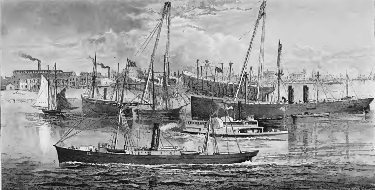
chesterport2
The waterfront of Chester, Pennsylvania in 1875.

Wednesday, February 19, 2014

THYME Magazine: A Case for Vision VI

Citizen Journalism with a Better Flavor

THYME0709a
Volume VII, Issue IX

A Case for Vision VI
© 2014 The Kirchman Studio.

When William Wilberforce had ended the slave trade in the British Empire, he had thrown the city of Bristol into economic depression. The port there was heavily devoted to that wretched business and suffered heavily when it was brought to a sudden halt. The unintended consequence had been a rise in children condemned to a life of poverty. Ending the vile business of enslaving Africa's children had resulting in England's society spurning the needs of her own. Men like Charles Dickens and George Müller had seen the wretched street urchins most people despised as jewels to be polished. Müller, relying solely on Divine provision, built five large houses for Orphans at Ashley Downs in Bristol, England. He trained the girls to be nurses, teachers, clerical workers and domestics. He apprenticed all the boys in various trades. He was excoriated for training these unwanted children "above their station." He ignored the critics.

What is often forgotten in the telling of this story is the means by which G-d provided. In 1831, 24 year old Isambard Kingdom Brunel was awarded a contract to bridge the Avon Gorge. It was the dream of a prosperous wine merchant who provided the initial funding. The completed bridge would become the symbol of the city, but lack of funding dogged the project. It took thirty years to complete it. For years only the towers stood completed. In 1833 Brunel began work on the Great Western Railway, which would become the instrument of Bristol's economic revitalization. The nicknames: "Great Way Round" and "G-d's Wonderful Railway" seem to describe well Brunel's great work. Brunel's vision extended beyond the shores of England. He envisioned the creation of a highway of commerce all the way to the Americas! Harnessing the power of steam, he built the great ships to make hs vision a reality. Muller's prayer for provision found answer in the accomplishment of Brunel's vision!

America today is in sore want of leadership like that of Brunel. When a White House spokesman spins the tale that a shrinking employment is a good thing he is delusional. One needs only to look at those countries where this low employment is actually the case to see the madness of such thinking. Visiting Santa Cruz, Bolivia, I am struck with the contrasts. Indeed you can go into the Hipermaxi (a store that resembles a Super Wal Mart) and buy a wide variety of products. Within the inner rings of the great city there are indeed a variety market based businesses. You can stop in at the Hotel Cortez and enjoy a scrumptious buffet (in the company of the city's drug dealers); But travel a few rings out, and the world changes. Here there is little commerce, save a few small markets and ladies selling food on the street. You've just traveled from where the income is measured in thousands of Bolivianos to where it is measured in Hundreds. The plan is laid out for large avenues, but the paving abruptly ends. There is no water and sewer, only an open canal of sorts down the avenue. The smell is overpowering at times.

Turning off of a roughly poured concrete avenue, one finds oneself on a street of mud. It takes some skillful driving to avoid being mired. Here one sees the result of limited resources in a Socialist state. The reason we are here is because years ago, an RN from Charlottesville, Virginia saw the lack of care in government hospitals and started her own. We are working on a house for her head nurse. The compound where we are working is in the outer rings of the city. There is electricity (wire is fairly cheap to string), but the compound had to be provided with its own clean well and septic system. There is a water plant in Santa Cruz, its architecture suggests that it was been constructed in the late 'sixties and its perimiter is heavily guarded by men in riot gear. The plant only appears to provide service within the inner rings. Wherever we go in the city, we follow the good travel advice to avoid the water. We use a lot of hand sanitizer. In spite of all precautions, I still become violently ill. Such is the state of a part of the world 'freed' from meaningful commerce! If one thinks the world will be cleaner for the elimination of industry, one only needs to look at parts of the world where there is little and take heed. Land around the city is often cleared by burning it off, resulting in an acrid smoke that hangs over the area. The best cure for Marxist/Socialist Gaian thinkers in the developed world might just be for them to live in the outer rings of the society their philosophies have actually created. Sadly, such societies tend to create their own elite, safely within the rings closest to the Hipermaxi. That is where the Elite Socialists of our own country tend to gather. There is a market, of sorts, that exists because THEY have money and wants, but the resources for caring for the vast population are stretched woefully thin. Doctors in state hospitals are paid by the government, but drugs are expensive and patients must pay for them. A poor family may obtain surgery for their child but the poor child will have no pain medication.

My RN friend initially gathered donated medications and equipment to send to the state childrens' hospital. She was shocked to find that hospital staff were charging patients for it anyway. Those with money in such a society avoid the government hospitals like the plague, and seek care at private institutions. My friend was able to purchase a hospital from one such practice and turned it into Mission of Hope Bolivia, which provides compassionate care to Santa Cruz's poorest. Outside of Santa Cruz, one sees the true plight of 'minorities' when they are not a voting block to be bought. People of Inca ancestory often live in the deepest poverty and my friend has started another clinic in the city of Sucre especially to care for them. On Sunday, we visit a small church in the outermost part of the city. I am struck by the beauty of the worship offered by the poorest of the poor. Here in the midst of such a bleak landscape, the ministry of the Gospel creates an oasis of hope.

Much closer to the United States, one has only to look at Cuba and Haiti to see the results of the 'freedom' created by lack of industry. Haiti's mountainsides have been stripped of vegetation by people living on the edge of subsistence. Michael Moore may think Cuba has the best healthcare system in the world, but I would have to ask him why it is that children there are going blind for lack of simple basic nutriition? Next week THYME will look at the promise and potential of America and suggest a vision for her renewal and her future. We will look at the amazing technological advances and robust agriculture of a small nation the size of New Jersey. Taking our cue from Wayne Grudem and Barry Asmus In their book The Poverty of Nations [click to read], we will paint a vision for an American Civilization revitalized by the principles they have laid out for us. (to be Continued).

IMG_8012
It feels a bit like a Super Walmart, but it has a personality that is uniquely Bolivian.

IMG_7926
A dancer moves with the music to add visual richness to worship. The church is in Santa Cruz's poorest neighborhood.

See more at Bob's Bolivia Journal [click to read].

Wednesday, February 12, 2014

THYME Magazine: A Case for Vision V

Citizen Journalism with a Better Flavor

THYME0708
Volume VII,Issue VIII

A Case for Vision V

In their book: The Poverty of Nations [click to read], Wayne Grudem and Barry Asmus describe what they call: "The amazing process of creating value that did not exist before." Using the example of a woman in a poor country who takes three dollars' worth of material and sews it into a shirt which she sells for thirteen dollars, the authors point out that she has created a new product of value. She has made that cloth ten dollars more valuable than when she bought it. She has also contributed ten dollars of value to the total value of everything her nation will produce that year, the GDP of that nation. In Zambia, at a place called Grippis Farm, people are learning to sew. They begin with plastic snack bags as they build their skills to the point where they can work with the actual valuable fabric. In fact, Grippis Farm, which receives support from people in American churches, is putting into practice what The Poverty of Nations preaches.

Grippis Farm provides education for the young people of the community. It supports sustainable advances in agriculture as well as incubating the fledgling sewing business. Angus Buchan, who fled Zambia for South Africa buring its previous period of political unrest, has created a similar community of opportunity of opportunity at Shalom Ministries. Asmus and Grudem point to examples in history of nations that have become prosperous by producing more goods and services. England during the Industrial Revolution invented machinery for efficiently weaving cotton thread, thus revolutionizing the clothing industry. "The principle product of the new technology that we know as the Industrial Revolution was cheap, washable cotton, and along with it mass-produced soap made of vegetable oils. For the first time, the common man could wear underwear, once known as body linen because that was the washable fabric that the well-to-do wore next to their skin... Personal hygiene changed drastically, so that commoners of the late Nineteenth and early Twentieth Century often lived cleaner than kings and queens of a century earlier.

By producing immense amounts of cotton and then other desirable products (such as high quality steel and machinery), England became the world's wealthiest nation. Income per person in England doubled between 1780 and 1860, then between 1860 and 1990 it multiplied another six times!" -- David S. Landes, The Wealth and Poverty of Nations, (New York, W. W. Norton, 1999), 154, 190-94. [1.] The authors go on to cite post World War II Japan and modern China as having become similar productive societies. The Congressional Office of Management and Budget has just released projections showing massive shrinking of America's employment resulting from the so-called "Affordable Care Act's" implementation. [2.] That is on top of an already documented decline that began around 2007. Employment percentages often hide the fact that many employable people have given up and are no longer counted. Employment as a percentage of actual population in the United States has reached a new and dismal all-time low.

A White House spokesman's decree that: "now more Americans are no longer tied to a full-time job and are free to pursue their dreams." rings hollow. Most creative ventures in following dreams, after all, began as night and weekend enterprises begun by people in regular jobs. My own venture into enterprenuership began over thirty years ago. I was frustrated in a position where my creativity was dismissed and their was no prospect of growth in career stature or compensation. My best designs often ended up on the cutting room floor, so to speak, as the man I worked for desired quick and dirty... and made that fact very clear. He was a good man, but saw no need for vision when what worked twenty years ago would, he surmised, serve quite adequately. I began with my little studio in a spare bedroom. I would pick up my assignments before and after work, and often missed lunch to meet with clients. I would do the actual work in the evening. My little daughter was a baby and often I would share a tender moment with my beautiful wife at the 2:00am feeding!

I gave my employer a month's notice. I thought he would like for me to train my replacement. No one ever showed up to shadow me; Instead, I remember the afternoon I was taken to a very nice lunch by my bosses who proceeded to tell me that I would most certainly fail at my new venture. I should stay where I was! That I "failed" for thirty years at it I do wear as a badge of honor. I have had a handful of brilliant young people share with me in the process of learning the art of visualization. That has been the greatest honor I have received in the process. I once won a PIVA award for one of my brochure designs for a major development company and they misspelled my name! I think of the young people like my last assistant who mostly taught themselves while in my company, and I feel that having somehow enabled their greatness to shine is my most fulfilling reward! These are the honors that gather no dust sitting on your sideboard.

So, we must ask ourselves: "What are we bequeathing to these brilliant young souls?" My nephew works in Baltimore at the sugar refinery. He sent me an article not long ago talking about how they were tearing down the Sparrow's Point Steel Mill and selling the demolished machinery for scrap value. Management saw the need to create one last bit of profit by making men who had lovingly maintained these machines and used them to make a living now tear them apart and sort them into scrap bins! One man saw some sander disks and though they were industrial quality, they would fit on his home sander. He asked his immediate supervisor if he could have them. When his supervisor agreed he threw them in the open bed of his pickup only to be fired by a higher-up manager later that day for stealing company property! The man did not steal the disks, he asked first. Most of us will read this and see the higher law that should govern, but the manager only saw what should have been added to the gross tonnage of scrap 'misdirected' to an employee's vehicle.[3.]

If one looks at the percentage of growth in private employment compared to government employment, the picture is bleak.[4.] Government does not produce, it can only tax and procure. Furthermore, look at communities that have been "freed from work" and subsist on government programs. Are they hotbeds of entrepreneurship (other than the drug trade)? A friend of mine shared with me a video about an inner city ministry in Brooklyn, New York. They did home visits and you see disturbing footage inside a dirty, roach infested apartment. A young child still plays but an older sibling stares vacantly from a couch. There are no dreams here to be pursued! Generations have known nothing but government dependency. Is this the vision our leaders have for our great nation?[5.] More and more Americans are on food stamps now. But here, amid the bleakness, one finally sees the hope. While most states have lackluster private employment growth or outright decline, South Dakota stands out like a bright beacon. Though the current administration has done everything to stifle domestic energy production on public lands and the Keystone Pipeline, PRIVATE lands have never been busier. The Dakotas and parts of Texas as well have become boom economies. You can go there and sign on with an oil company and soon be making a six-figure salary. Workers are so desired that you can make seventeen dollars an hour at Wal Mart! The point is that in this one sector of the country there are workers creating value that wasn't there before... and they are being rewarded for it.

Wednesday, February 5, 2014

THYME Magazine: A Case for Vision IV

Citizen Journalism with a Better Flavor

THYME0707
Volume VII, Issue VII

A Case for Vision IV

A recent buzz on social media was one to the effect that Hobby Lobby was planning to close stores in response to the Obamacare insurance contraceptive/abortificant mandate. The rumor was not new. The company is actively fighting this regulatory infringement upon its right of conscience. Founder and CEO David Green was quick to respond to the news piece in which he is reported to have announced the downsizing [1.]. Actually Mr. Green said that the company had plans to build 30 or more new stores this year. Doing the news involves checking facts and we found Mr. Green's actual statement in a report issued in conjunction with receiving an award from a major university this past April [2]. The reasons for the award actually spoke volumes about the life and vision of David Green. From the news articles it would appear that Mr. Green was quietly doing what CEOs all do, just running his company to make a profit, when all of a sudden he became the object of Federal regulation. The fact of the matter is that David Green's work itself springs from, and is dedicated to, a higher vision.

Dr. Henry Smith, President of Indiana Wesleyan University said in conferring the honor: "I am excited to announce that Dr. David Green, founder and CEO of Hobby Lobby Creative Centers, has accepted our invitation to the Society of World Changers as our 2013 inductee. David Green is a business leader, an entrepreneur, a philanthropist, an author, a patron of scholarship and culture but above everything else, he is a servant of Christ like any one of us, a saved sinner dependent upon the grace of God and the guidance of the Holy Spirit. He attributes any success he has had to his trust in G-d, and acknowledges that G-d has used that success as a platform to minister to the world. IWU recognized David Green and his achievements previously through the conferral of an honorary doctorate in 1999."[3.]

FORBES notes: "There are very few members of The Forbes 400 who bring religion to work. Most notable are Chick-fil-A's Truett Cathy and Forever 21's Jin Sook and Do Won Chang, born-again Christians who keep Bibles in their office and print John 3:16 on the bottom of each shopping bag. More typical is Warren Buffett, who admits to being agnostic. Green joined Buffett’s Giving Pledge in 2010: His public letter doing so quotes 2 Corinthians ('Each of you should give what you have decided in your heart to give, not reluctantly or under compulsion, for God loves a cheerful giver'). And that's about all that Buffett and Green have in common philanthropically." Green has a vision to change the world and it plays itself out in the way he conducts his business. He does not see any part of his life as outside of G-d's oversight: "You can't have a belief system on Sunday and not live it the other six days."[4.]

Green is the son of a preacher who's small congregations in Oklahoma barely supported their family. He wore hand-me-down clothes and ate many a meatless meal with his siblings. His five siblings all became pastors (or pastors' wives). Green took "the road less travelled," struggling through school and eventually becoming a stock boy in a general store. FORBES says of him: "Green spent most of his time sweeping floors and unloading boxes for 60 cents an hour, but he fell in love with the romantic idea of buying something for 10 cents and selling it for 20." He served in the Air Force Reserve, and was working as a manager at TG andY stores when he borrowed $600.00 to buy some picture frame making equipment. He and his wife Barbara and another manager literally started the business working on his kitchen table. Their first product was miniature picture frames which they began selling in 1970. In 1972 they opened their first 300 square foot retail location.

Green credits the bead buying craze of the hippies for growing his business to the point that he was able to quit his day job and open a larger store in 1975. Barbara was not thrilled. Those days he was doing about $100,000 in sales and TG andY was doing two billion. Today Hobby Lobby makes well over three billion dollars annually. He speaks candidly of the businesses' struggles and near failure. In 1985 the business was overleveraged and struggling under the weight of bad inventory decisions. Green says of that time: "It was a pride problem, and I had to get rid of it. It's sort of like God says to me, because I was arrogant, 'I'm going to let you have it by yourself.'" Green prayed, worked hard, cut costs and negotiated with his creditors. In the end his perserverance paid off and the company not only survived, but thrived.

Hobby Lobby stores close on Sundays to allow staff time to worship and enjoy time with family. He starts employees well above minimum wage and sees the company's profitability as a gift from G-d. He has given much to further the work of the Gospel and Christian education. Green says: "I want to know that I have affected people for eternity. I believe I am. I believe once someone knows Christ as their personal savior, I've affected eternity. I matter 10 billion years from now." Dr. Henry Smith says of him: "We thank God for David Green's example precisely for that reason: because he sees his wealth as God's possession rather than allowing himself to be possessed by it; because he judges himself by the standards of Heaven and not of earth; and because he recognizes that his own efforts are in vain unless he trusts and depends upon the Holy Spirit." [5.]

A Vision For Work and the World

"Let thy work appear unto thy servants, and thy glory unto their children. And let the beauty of the Lord our God be upon us: and establish thou the work of our hands upon us; yea, the work of our hands establish thou it." -- Psalm 90:16-17

I am reading The Poverty of Nations, A Sustainable Solution [click to read] by Wayne Grudem and Barry Asmus. It examines the reasons successful nations are successful and how successful nations can forget the roots of their success and fall into decline. Like Alvin Schmidt's Under the Influence [click to read], the book does not hide the influence of Biblical principles in advancing the state of humanity. As many in the academy and the media today criticize free markets, Grudem and Asmus point out that the flaws are not necessarily a flaw in free markets, but in human morality. If a people have no moral barrier to it, markets will indeed deliver drugs, slaves and a host of evils, but that is not necessarily a fault of a free market. Indeed the attempts of government to control such evils will inevitably cost far more than imagined and have far less effect on curtailing the evils than proponents of such action desire. Thus the authors show how the Rule of Law, Respect for Property and Good Leadership are all essential for national prosperity... these things being rooted in values presented in the Bible.

Markets, influenced by morality, are actually quite fertile for creativity. When the slave trade was ended in England by William Wilberforce, the initial result was the economic decline of the port of Bristol. Creativity responded to the need as Isambard Kingdom Brunel built the Great Western Railway and steamships to link Bristol to America. The heart of George Müller ministered to Bristol's cast off children, but it was possible largely due to the creativity that linked Bristol to the economic pulse of the world. In fact, Grudem and Asmus point out that a wonderful coming together of talents and resources occurs in markets that requires no huge agency of oversight. In a simple little story called I Pencil, the beauty of this phenomenon is wonderfully illustrated.


I Pencil.

"No single person on the earth could make a pencil without the help of countless others."

Read, Leonard E., "I, Pencil: My Family Tree as told to Leonard E. Read." [click to read] 1999. Library of Economics and Liberty. 5 February 2014.

Wednesday, January 29, 2014

THYME Magazine: A Case for Vision III

Citizen Journalism with a Better Flavor

THYME0706
Volume VII, Issue VI

A Case for Vision III

You may nave noticed that THYME has departed lately from being a simple parody of the 'other' weekly news magazine. The reason is twofold. First of all. it becomes a bit sophomoronic to parody a magazine that asks on its cover: "Can Anyone Stop Hillary?" I can name about six or seven great candidates without thinking about it. The media won't rush to report them but they are out there. If they want to reduce it to Clinton vs Christie this early in the game, so be it. The Alternative Citizen Media will continue to present a plethora of far more interesting people. In an age of Alternative Media perhaps we can make the game exciting again. We at THYME will do our best! Second, the times demand a more serious approach. We are confronted today by very real problems. If we can draw from history and the voice of experience, we must do so. The political class and the media seem intent on silencing certain voices in the debate. It is those very voices, may I suggest, that we need most to listen to. The country today seems intent on allowing itself to crumble. Noble virtues are denigrated while the vague goal of 'self actualization' has become the subject of ardent pursuit. Relativism is the rule and 'tolerance' the supreme virtue. Clearly we are a nation in distress. Looking back into history, can we find evidence that we as a people have faced similar peril? If so, what lessons might we learn to help us in the struggle for America today? Consider the condition of the nation in the turbulent time following the Revolution.

As the Eighteenth Century drew to a close there were almost a million new settlers to the West of the Blue Ridge Mountains. In 1803, France sold the Louisiana Purchase to the young nation and Thomas Jefferson, essentially doubling the size of the United States. Lewis and Clark's reports of this vast land would only serve to further fuel the drive for Westward expansion. While the future looked bright for the country, the future of the Christian Faith seemed to be one of slowly diminishing light. Church attendance was dropping off. New ideas from Europe challenged the narrative of Faith and it looked like the influence of Faith would fade, even as the New World filled itself. An Episcopal preacher in the Carolinas said: "How many thousands . . . never saw, much less read, or ever heard a Chapter of the Bible! How many Ten thousands who never were baptized or heard a Sermon! And thrice Ten thousand, who never heard of the Name of Christ, save in Curses . . . ! Lamentable! Lamentable is the situation of these people." Though the land was rich in promise, the spiritual condition of her people was quite impoverished. Immorality and vice abounded as settlement continued. Though no national media paraded it, the dark side of human nature reigned in many remote places. In the wilds of Kentucky, in what would become Logan County, there was a place called Rogues' Harbor. The Digital History of North Carolina describes it as follows: "Here many refugees from almost all parts of the Union fled to escape justice or punishment. . . . It was a desperate state of society. Murderers, horse-thieves, highway robbers, and counterfeiters fled there, until they combined and actually formed a majority." -North Carolina Digital History

But something happened in the very fabric of our nation about that time that would shape our future and chart our course well into the Centuries to follow. There was still much immorality and vice to be found, but in 1799 a Prebyterian minister wrote: "We have heard from different parts the glad tidings of the outpourings of the Spirit, and of times of refreshing from the presence of the Lord. . . . From the East, from the West, and from the South, have these joyful tidings reached our ears." The Second Great Awakening came to life as men like James McGready brought the message of Hope and Redemption to the frontier. McGready did not fear to enter places like Rogues' Harbor to speak of: "Heaven and its glories, Hell and its torments." In 1796, McGready was Pastoring three churches in Southwestern Kentucky. In what can only be attributed to a mighty move of the Spirit of G-d, hundreds of people at a time were finding a new and refreshed Faith across the frontier in camp meetings and revivals. In the South and the West. Barton W. Stone was the Presbyterian Pastor of the Cane Ridge and Concord churches, northeast of Lexington, Kentucky. Stone observed McGready's work in Logan County and laid plans for a similar meeting for August 1801 at Cane Ridge. Over 10,000 people attended that meeting. Some estimates put the crowd as high as 25,000. The flames of revival were spreading, leaping now into Tennessee!

Stone observed that Presbyterians, Baptists and Methodists were all joined together at this great meeting, singing the same songs and experiencing the same Spirit! "The rough, violent, irreligious frontier, which many felt threatened to undo the morals of the new nation, was being tamed by the Lamb of God." In the East, a similar manifestation of the Spirit of G-d was taking place. Though many prayed for revival, the rise of Universalists, Unitarians and Deists in the region had denied the basic teachings of Christianity and dulled the impact of Faith. Jonathan Edward's Grandson Timothy Dwight observed of the period during and after the Revolution as follows: "The profanation of the Sabbath . . . profaneness of language, drunkenness, gambling, and lewdness, were exceedingly increased; and, what is less commonly remarked, but is not less mischievous, than any of them, a light, vain method of thinking, concerning sacred things, a cold, contemptuous indifference toward every moral and religious subject." But the fires of Revival were stirring in the East. Though this movement was quieter in some respects, it's deep roots would manifest themselves in cultural reform. The abolitionist movement, for example, would come out of this renewed mind. Pastor Alvan Hyde wrote: ". . . A marvelous work was begun, and it bore the most decisive marks of being God’s work. So great was the excitement, though not yet known abroad, that into whatever section of the town I now went, the people in that immediate neighborhood, would leave their worldly employments, at any hour of the day, and soon fill a large room. . . . All our religious meetings were very much thronged, and yet were never noisy or irregular. . . . They were characterized with a stillness and solemnity, which, l believe, have rarely been witnessed. . . . To the praise of sovereign grace, l may add, that the work continued, with great regularity and little abatement, nearly eighteen months."

"And Jesus went about all the cities and villages, teaching in their synagogues, and preaching the gospel of the kingdom, and healing every sickness and every disease among the people. But when he saw the multitudes, he was moved with compassion on them, because they fainted, and were scattered abroad, as sheep having no shepherd. Then saith he unto his disciples, The harvest truly is plenteous, but the labourers are few; Pray ye therefore the Lord of the harvest, that he will send forth labourers into his harvest." -- Matthew 9:35-38 

As thousands embraced Faith, this Scripture became a reality for the American churches. The Baptists ordained lay ministers to meet the needs of the growing church in the young nation. The Methodists created the institution of the Circuit Rider. Young ministers would literally cover a 'circuit' of churches, riding on horseback from community to community. They were mostly young and single, and had to be in pretty good health. They would be out on the circuit for weeks at a time, perhaps returning to the same community every five weeks or so. They would often come upon a family new to the frontier bringing in the harvest or doing chores and join in as a means of building relationships for the spread of the Gospel. Often the young minister would find a warm welcome and spend the night with the family. He would return on a regular basis and hold services. A congregation might begin to form and build a temporary meeting place, often a 'brush arbor,' which was a simple pole structure covered with brush. Today there are many litle churches that have placed a more permanent building in place of the brush arbor. They may still bear the name of the family that provided the land and materials for the first congregation.

Indeed the seeds had been planted for a movement of G-d that would minister to the nation through a terrible Civil War and well into a Century where America would be thrust into the world's great conflicts. Revival came to the colleges, beginning in Virginia's Hampton Sidney College and even occurring at places like Yale. Men like Charles Finney and D. L. Moody would continue to preach the Gospel, adapting their methods to minister to the nation that grew in the Nineteenth Century, but the message remained the same. Eventually America would become a great sender of missionaries into the world. The Gospel would go forth to touch millions and in doing so would bring hope and purpose in many places around the globe.

In one of my childhood books is the story of a Methodist Pastor who arrives at a new parsonage and with his children plants a tree. The tradition of that Faith is that ministers will move on to new pastorates, so the man is planting a tree that he himself will never sit in the shade of. It is clearly an act of kindness intended to bless a family like his that will follow... in the far distant future. I love that story because it is a planting of hope and belief that looks beyond the here and now. It is a remnant of that far-looking faith that once long ago stood face to face with America's endless frontier.

Thursday, January 23, 2014

Mary's Rock Tunnel on Skyline Drive

Shenandoah National Park's Only Tunnel in the Snow

MarysRockSepia
The tunnel, constructed in 1932, passes through 3514' tall Mary's Rock. It is 610 feet long and was engineered to avoid making an unsightly road cut.

Tuesday, January 21, 2014

THYME Magazine: A Case for Vision II

Citizen Journalism with a Better Flavor

THYME0705a
Volume VII, Issue V

"Sing, O barren, thou that didst not bear; break forth into singing, and cry aloud, thou that didst not travail with child: for more are the children of the desolate than the children of the married wife, saith the Lord.

Enlarge the place of thy tent, and let them stretch forth the curtains of thine habitations: spare not, lengthen thy cords, and strengthen thy stakes;

For thou shalt break forth on the right hand and on the left; and thy seed shall inherit the Gentiles, and make the desolate cities to be inhabited.

Fear not; for thou shalt not be ashamed: neither be thou confounded; for thou shalt not be put to shame: for thou shalt forget the shame of thy youth, and shalt not remember the reproach of thy widowhood any more.

For thy Maker is thine husband; the Lord of hosts is his name; and thy Redeemer the Holy One of Israel; The God of the whole earth shall he be called." -- Isaiah 54:1-5

A Case for Vision II

For three hundred years following the Reformation, many church leaders neglected the command of Christ to reach the nations. Towards the end of the Eighteenth Century, a newly ordained Baptist leader in England spoke to challenge this misapplication of the doctrine of election. "Young man, sit down! You are an enthusiast. When God pleases to convert the heathen, he'll do it without consulting you or me," said an older minister. The young man's name was William Carey. He was a cobbler by trade, but his calling would take him far beyond the walls of his little cobbler's shop. Carey's vision, you see, was as wide as the map of the world that he hung on his shop's wall. Gathering some like-minded friends, he began to pray for the fulfillment of his vision.

Carey admired the work of the Moravians [click to read], who at one point were one of the foremost sending congregations, planting churches around the world. They even founded churches among America's Cherokee Nation. Dismayed by his own denomination's lack of zeal for such work, he penned An Enquiry Into The Obligations Of Christians To Use Means For The Conversion Of The Heathens. Seeing the Great Commission as applying to the church of his day, he said: "Multitudes sit at ease and give themselves no concern about the far greater part of their fellow sinners, who to this day, are lost in ignorance and idolatry."

In 1792, Carey organized a missionary society and called for his fellow believers to: "Expect great things from God; attempt great things for God!" Few men today would have the patience and tenacity of Carey who said: "I can plod, I can persevere to any definite pursuit." Carey offered to become the first missionary of his society to the great subcontinent of India, offering to go if his friends back home would "hold the ropes." After a fourteen month journey and many personal tragedies, Carey labored on for seven years before he saw his first convert, Krishna Pal. Two months later he published his first Bengali New Testament. He and his colleagues would go on to publish translations of the entire Bible in Bengali, Oriya, Marathi, Hindi, Assamese, and Sanskrit, as well as hundreds of lesser used dialects.

Carey was instrumental in significant social reform in India. His work and advocacy resulted in the abolition of infanticide, widow burning (sati), and assisted suicide. Thus did a man's love for his Saviour result in the affirmation of Imago Dei in a whole new part of the world. When William Carey died, he had served the people of  India for 41 years!

When Isaiah wrote the book that bears his name, Israel had forgotten the G-d given mission to be a light to the nations. Losing sight of this important purpose, the people sank into idolatry and pleasure-seeking. Every generation faces the very real danger of missing the great calling. Ours is no exception. Pastor Bruce Hankee related the story of Carey to his congregation, challenging us to program our lives for G-d's purpose through an understanding of Isaiah 54:1-5. He challenged us to enlarge our capacity for G-d's purpose, as Carey did. Ephesians 3:19 exhorts us: "And to know the love of Christ, which passeth knowledge, that ye might be filled with all the fulness of God." Indeed this is a great reason to expand our tent, that we might contain more of the love of G-d for our fellows! In lengthening our cords, we are expanding our influence. Just as a cobbler in the middle of England became a major pioneer in world missions, we too can have a greater influence if we will persevere in the pursuit of a great vision.

Wednesday, January 15, 2014

THYME Magazine: A Case for Vision

Citizen Journalism with a Better Flavor

THYME0704
Volume VII, Issue IV

A Case for Vision

The day was growing long as the evening light outside was fading away. I was installing the model our studio had built of a major resort in the welcome center. At 1" = 500' the physical model showed ski slopes, golf courses and a wonderful water park on a most amazing mountain location. The staff had quietly slipped in and out to look at the artistic rendition of the resort's majesty and many had expressed their admiration. I was hurrying to place the identifying numbers for the map key when I first noticed that I had an audience. Two teenagers had come in to look at the model up close. Their parents were already headed in to the indoor pool area but even the wonders of a world-class resort couldn't stop youth from being intrigued by a statement of vision.

One of the girls gazed at the model with what appeared to be skills of observation beyond her years. There was no need for the admonition: "Don't touch anything!" In fact, I would have considered it an insult. Both sisters displayed incredible respect for the work taking place before them. Though the first girl was quite conversant in literature (how many kids can use the words 'Utopian' and 'Distopian' in their conversation); Homeschoolers? Perhaps, but I didn't ask. Tolkien, Lewis and Rowling were better topics for conversation. The girls had clearly been raised to treasure literature and thought. That they lingered when a really fun moment awaited them through the next doorway spoke volumes to me. Young people (and I have been priviledged to work with the best in our studio) want to see vision and deserve to be shown our best efforts at it.

Most of my life has been spent in the field of visualization. It has involved constructing hundreds of little models of proposed projects, the drawing and painting of innumerable renderings and as the economy recently crumbled, some really interesting publishing projects. Vision is as essential to the soul as food is to the body, so, as S. Truitt Cathy says: "Make it good!" It is in our blood. It is a part of our history.

Michigan at the turn of the Century was poised to become a center of vision and innovation. My own ancestors fled Bavaria in 1870 as Otto von Bismark 'unified' Germany. They came to the American Northwest to settle in that cold land, finding employment on the growing railroad. The men set out first, seeking their fortunes, and saved their money to bring their ladies to the New World. When Oma arrived, she quickly decided she didn't like the boys working on Sunday, so they found work in Bay City's growing sawmill industry. Eventually Bay City would become known for pre-manufactured houses as Aladdin Homes and Lewis Homes would enter the market that Sears Roebuck is most famous for. The companies grew well into the Twentieth Century, but faltered during America's Great Depression.

Ironically it was during this same Depression, South of Bay City in Detroit, that Henry Ford's assembly line was creating an American version of the 'Industrial Revolution.' For a good portion of the Twentieth Century, Detroit was the automobile production center of the world. Across the 'glove,' in Benton Harbor, the Heath Company [click to read] began manufacturing a 'build it yourself' airplane kit. Expanding into consumer electronics, Heath offered a whole range of kits for enthusiasts who wanted to build their own radios and electronic devices. Heathkit became a legend as scores of people assembled and enjoyed these products. My father and I must have assembled dozens of them in my youth. My two brothers went on to become NASA engineers!

As Detroit diminished and Asian and European auto makers grew, one of my uncles worked for John Portman creating the great towers of Detroit's Renaissance Center. Today those gleaming towers preside over a city in decline. As Japanese and Korean companies remade the assembly line, Detroit's 'Big Three' were hobbled by antiquated methodology and union work rules. They had operated without fear of competition for so long that they came too late to the world of robotics and subcompact cars.

Great minds like that of Lee Iococca might have remade her, but Detroit was stubborn about resisting change and forgot about the deep well of her inventive past. It was not so much that they were 'stuck in the past' but that they were 'stuck in their own Century!' Had they looked to the past, they might have seen the transformation wrought in previous times by men like I. K. Brunel [click to read]. If some day we find ourselves gliding rapidly between cities in pneumatic tube transit systems, we will do well to remember that Brunel was there first. He used a pneumatic tube and piston to propel trains on one of his innovative railways in the Nineteenth Century!

The time was growing late. I asked my young observers a loaded question: "Why are there no books on how to teach your baby to walk?" They looked at me with a serious rumination I had often seen in the countenance of my studio assistant when I'd pose such a problem. "You don't need them!" one of the girls thoughtfully answered. She went on to explain that babies naturally want to stand and reach out to their full potential. "Why do we lose that?" I pondered. "Does it get 'taught out of us' as we move on to more formal instruction?"

And yet, it can be rekindled! It can be nurtured! As a boy I spent hours in the woods observing the wonders of the natural world. In 1964 the New York Worlds Fair inspired me to draw impossible built environments. Men walked on the Moon. My grandfather designed and built his own machinery for his mill. My grandmother was a great painter and designer. My mother loved mathematics and designing sweater patterns. My father wrote the procedures for testing spacecraft in the 1960's. Once Mom took me to visit a friend of hers who sculpted in white marble. Her friend encouraged me to work in Ivory Soap!

I do not consider my childhood to be all that out of the ordinary. This world is FULL of beautiful creative souls, most of whom LOVE to share their vision with young people. If it IS at all out of the ordinary, then I believe we are to blame for not allowing our children to come alongside and be infected by our brightest and best. History offers us even more. Consider the Wright Brothers [click to read]. Too often we've turned history class into: "What's Wrong with America" and neglected the stories of inspiration and greatness. That is not to say we should ignore the dark parts, but we must never create a picture of hopelessness and despair. There is too much evidence to the contrary!

My wife is an educator of young children. She once shared with me some research about early childhood development that focused on infants in an orphanage in Tehran. The staff was spread so thin that the children were merely fed and changed. There was no time to hold and cuddle the infants. Far too many of these precious souls never rose to crawl. They never pulled upright to walk. They simply died. The study affirmed the importance of nurture in young lives, and begs us to ask: "As we push our children to conformity and 'productivity,' do we unwittingly cease to nourish some essential part of the soul?" Could Vision be the essential food for human aspiration?

As much of the media has been all too ready to report the demise of the American experiment, THYME looks at these fine young people and looks to offer them far more. We'd like to present a vision that is rooted in history and faith, that dares them to dream big dreams. The world needs them to do so, We can offer them no less!

Wednesday, January 8, 2014

THYME Magazine Epiphany Edition II

Citizen Journalism with a Better Flavor

THYME0703
Volume VII, Issue III

Faith's Foundations in Christ's Unity
By Donna Lou Shickel - © 2013 Donna Lou Shickel Publishing Co. Distribute freely with permission

If you’ve been with us here at A Place of Grace recently, you’ve heard the series on the deliberate and systematic attacks against our nation’s Christian Judeo values and freedoms. You’ve heard about the horrific goals they’ve stated and accomplished because they believe the Christian/Judeo faith and traditional values hold back progress, not to mention their own rise to totalitarian power. You’ve heard here about the successful influence by socialist and communist sympathizers in our own country in the attack on human life, education, the modern feminist movement and against our free market system. So what could any of us as Christians possibly have in common with these haters of human dignity and freedom? Is it even possible that any believer could be in mutual agreement with them on anything? Well, there is, and you may be surprised.

Welcome to A Place of Grace, I’m your host, Donna Lou. Through all my research, I was most horrified to see that without exception, these leaders have first and foremost sought to destroy not a human institution, but a Divine one – the historic Church - the most powerful voice standing against socialist/communist now called progressive efforts. Look back at the tactics used to malign and subvert our American institutions, and the re-writing of our Christian-Judeo history and Founding Fathers. Think about the repeated magnification of our countries’ failures and all the stories of those who HAVE abused her benevolence. And with what purpose? To present the problem as freedom, and the solution as government control and oppression. And the same tactics continue to be used in an attempt to destroy the historic Church from her beginning; fueling fear-based divisions, inciting blame, vilifying all members for the failures of a few, basically re-writing history. And too often, enemies of the Church have been quite successful in turning people against the very idea of Christianity, and toward intimidating other churches to water-down or eradicate basic controversial teachings. And divided, we fall.

I mentioned before that thousands of communist sympathizers were recruited by individuals like Bella Dodd to infiltrate seminaries, to destroy the Church in the US and Europe. Not to say that the Church hasn’t always had her Judases helping the devil’s cause from the inside, from the time of Christ - Those who would use God, rather than allow Him to live through them. But don’t you wonder why an anti-Catholic view would be the one area some of us might be in agreement with the likes of Marx, Stalin, Darwin, Frederick Nietzche, Margaret Sanger, Hitler, Mao, John Dewey, not to mention Empererors Nero, Dometian, oh don’t forget Napoleon, and now the secular media, and many of our own countries progressive leaders in government and in other churches? I thought here at Advent, where we are to make straight our crooked ways, it would be good to set straight maybe the most controversial teaching of the Catholic Church – Who does the Bible say Mary is? And who Mary is and is not according to Catholic teaching. It’s hard to ignore Mary at Christmas (or Epiphany for that matter).

 Many of you know I was raised Catholic, educated in Catholic grade school and high school, minus the middle school education during the cultural revolution of the late sixties, which was chaos, teachers taking us out of school to protest, passing marijuana around, during the “make love not war” era, a statement coined by known communist, Herbert Marcuse. A time when the Catholic Church was ridiculed as the lone voice against abortion and departure from virtue, but stood firm, despite many of her own members being swayed by science and media who convinced people that “it wasn’t a real baby” until months after conception and “you bishops are just oppressing natural behavior”. But the Church stood on the faith of the Apostles which carried forth precepts of the ancient Hebrew blood Covenant God entered into with Abraham which included Abraham’s seed, don’t mess with the seed. And because God became flesh in the Person of Jesus in the womb of the Virgin Mary, the fully Divine Son’s human life began at the moment of conception.

God sanctified human life and we therefore have no right to destroy or tamper with that life or it’s seed which God has created through the sacred union between a husband and wife. Contrary to popular teaching, the nuns were very clear in teaching us that Christ alone is our one, true Mediator, and that you worship Mary or ANY person other than God, family, friend, pastor, pets, if you don’t love God more than these, you do so at the expense of your own soul. I never saw them beat anybody, though I was deserving, but they sure beat that into us, and all other teachings the Catholic Catechisms actually teach. It never crossed my mind that anyone would even think we worshiped Mary until I moved to the peaceful, God-fearing Shenandoah Valley. I learned to stop telling people of my Catholic background, because instead of wanting to talk about Jesus, people seemed to be fixated on Mary and purgatory. I told my Dad once it was like going to a doctor’s convention, and the heart specialists demanding that the endocrinologists explain why they were focused on the thyroid gland. “Why do you worship the thyroid? It’s the heart that gives you life!” But I was never a good Catholic anyway.

I was taught to love God with all my heart, soul, mind and strength and to become a fisher of men, but carnal me had other fish to fry. And when I came back to my senses in my early twenties, I came back to the faith only nominally, then married and moved here, to the Valley. And I did what I hate having done to me. I distanced myself from the Church because it was controversial. Even though I knew that MOST accusations were errant, I cared more about belonging and being accepted. And when you’re making friends with people who were raised to believe that the Catholic Church is the antichrist, but you both are just as passionate about the Word of God, and standing against Satan, well you just focus on what you have in common and hope for the best. Plus, I found precious few people who wanted to hear or bother to look up what the Catholic Church actually teaches, and to their credit, it’s the only Church who has set in stone what is believed, taught and why, citing all of Sacred Scripture, and refuses to change it.

The Catechism I was taught then is the exact same today, used in many non-denominational Christian schools to teach the faith, even here in the Valley, and most of it was complete in early Christianity. The Pope has no authority to change the teachings of Christ and the Apostles, that’s why they seem so rigid in our culture. They only reassert the Sacred Truths to a particular culture when needed for clarification and renewal. But I didn’t like being grilled and interrogated and even blamed for the Crusades, which if you check history, were only begun after 400 years of turning the other cheek to Muslim attacks against the Holy Lands and the Christians, Jews and other Muslims who were making their pilgrimages to the Holy Lands. The call to the Crusades included building monasteries along the routes for all religions to have safe shelter and food on their pilgrimages where they once were being killed or captured as slaves. You’d be surprised to learn that the common myths believed about the Crusades originated, again, by communists and others who hate Christianity. And to learn the only religion calling for forced conversions were the Muslims.

Let’s take a whole show for the Crusades one day, shall we? But back to my litany upon moving here: - “No, we don’t worship Mary and dead saints, we worship God alone, we venerate the saints in Heaven and on earth whom the Scriptures say pray and intercede for us, and there’s no such thing as dead saints, if you’re a saint, you never taste death.” “No, the Pope is not above the Scriptures, He’s a servant TO the Scriptures and to the flock. No, we don’t believe you can pray someone out of purgatory on their way to hell, when you die, you’ve chosen your own destination. No, we don’t believe you can work your way to Heaven, only the redeeming sacrifice of Christ unlocks eternal life for us. “But you wear crucifixes because you think Jesus never got off the cross!” “No, we got the memo on that one too.” I thought people should be relieved to hear this, or at least check out the facts themselves, but again, when you’re raised and taught to stay away from Catholics lest you too become deceived, well I was weak. And that bothered me, being someone who would otherwise get between bullies and victims and defend and take hits for people being maligned. But I would soon become engaged in Bible study with my many good Protestant and Evangelical friends who overlooked my Catholic background, and eventually accepted the invitation to enter my new Church’s three year license to ministry program. And it was by this time that I found it necessary to thoroughly investigate every debated teaching of the Catholic Church.

Now the original Protestant Reformers defended the teaching on Mary’s perpetual virginity, also not to elevate her, but based on what it says about God, Scriptures, AND about the glory Jesus shares with His beloved, John 17 and throughout the New Testament. It wasn’t until centuries later, with near complete detachment from the early Church customs rooted in Old Testament Judaism, that accusations of Catholics worshiping Mary began, at which time the Pope issued a decree to re-state what the Church and the Protestant reformers believed from the beginning. Yes, I yearn for unity, but not at all costs. I have no intentions of proselytizing or in defending any idolaters or wolves in sheep’s clothing, I just want us to honestly consider these things and encourage good Christians to do your own research. I’m sure you trust the authorities who taught you as they trusted theirs, but do your own research. I can attest that nothing will make you as popular as being a disgruntled, ex-Catholic poster child in a crowd of Protestants, but what a shallow honor! And nothing can lose you friends faster than defending or defining Catholic teaching if you’re a well-Catechized Catholic who’s consecrated your life to Christ. But the devil’s had his day. After having spent half of my life in each Church, all I can see is that we need each other, and we have to begin somewhere to dialogue.

In the meantime, we all need to get grounded in our own faith and leave it to others to profess theirs lest we bear false witness and destroy our own Covenant family with God. I understand the objections and the risk, but I also see the openly stated, hell-bent deliberate effort by Communists who hate us all and want to divide and destroy EVERY Church. Did you know that dehumanizing Jews and Catholics was the very tactic Stalin and Hitler used to slaughter millions? They spread mockery and lies that the existence of these people threatened the lives of their other citizens so that by the time the killing began they would support it or at least look the other way, like we’re doing with the ongoing massacre of thousands of Catholics today in the Middle East and elsewhere. The same thing happened in Rwanda two decades ago. The power-hungry government spread propaganda of fear and hatred, calling the Tutsi people “cockroaches”, that led Hutu neighbors to take up government issued machetes to kill nearly a million of their own brethren! And a few weeks ago, I think I heard the straw that broke this camel’s back.

On a Sunday morning radio show, someone was making vulgar jokes about nuns. Nuns! Women who consecrate their lives to Christ, some who are right now being imprisoned, stripped, raped and paraded through public streets in the Middle East, along with the priests who are being beheaded and their churches and thousands of parishioners bombed, butchered or shot! And when one bishop or priest is killed, another takes his place because they gave a sacred oath before God to shepherd Jesus’ flock with their very lives when all other missions have pulled out. Those nuns who taught me would get up to pray at three in the morning to pray for a wretch like me before spending the day giving us an excellent education. Not that I cared then, but when I heard these jokes, I said, “Enough. Open season on nuns and anyone else we’d like to dehumanize is over. This has to stop. What other group of people can you openly mock and slur in such a way but the Catholics, and still call yourself Christian? What race, creed, color – what religion can you do that to and get away with it in our society today? Yet we preach Grace and Mercy for all?

In Matthew chapter 10, Jesus promised His true disciples they would be accused of being the devil. And it wouldn’t be the atheists calling a group of believers the anti-christ, they don’t believe in Christ or the devil. No, it would be other members of the same religious community. Jesus said they will flog you from their synagogues, where the early Christians would assemble. Fellow believers will accuse you of being Beelzebub and drunkards from their very place of worship. Are other assemblies openly accusing your church what Jesus promised? What prophesy are we fulfilling here? So if Catholics are idolaters and actually worshiping Mary, why would you choose someone who said to God, “Be it done unto me according to your Word”? Why choose as your false idol someone whom God’s messenger said, “The Lord is with you” and “with God all things are possible”? A mother who points to her son, Jesus and says, “Do whatever He tells you?” Why a mother who endures mockery, is accused of being the mother of Beelzebub, but doesn’t distance herself from Him but rather stands and gives her ascent at the Cross for her own salvation and for the world’s, rather than saying no and demanding this brutal execution stop as Peter once did?

Because this humble woman, the first Christian, knew that this brutal execution was actually the willing Sacrifice that would save mankind from eternal death, and for cooperating in His Salvific Act, she would be set afire with the Holy Spirit anew at Pentecost. This is a curious idol, indeed, mostly because Jesus went through Mary to come to us. I could say, “I love Mary Magdelene, I love Rahab the prostitute, and you’d say, “Oh yea.” But “I love Mary?” Oh, that means I worship her. In the Catechism of the Catholic Church, number 487, it states “What the Catholic faith believes about Mary is based on what it believes about Christ, and what it teaches about Mary illumines in turn its faith in Christ.” Likewise, it would say a lot about a God Who would impregnate a young girl and then distance himself from her out of fear others would worship her, and say more about the causes you and I might have given Him to treat us in the same manner. What does it say if Jesus treated Mary with any iota of disrespect, that’s not sinless by Mosaic law. And why would anyone defend the sanctity of human life when God only used Mary as an object?

Yes, what you believe about Mary directly impacts what you believe about our Lord. His Word states, when both women are filled with the Holy Spirit, Elizabeth calls her “Mother of my Lord,” and in the Holy Spirit Mary states, “All generations will call me blessed,” but we don’t call her anything but “a willing vessel”, if that? Is that what you call your mother? So let’s look to what the Israelites would understand from Scripture about the Woman, beginning in Genesis 3 when God said to the serpent who deceived Adam and Eve, verse 15 I will put enmity between you and the woman, and between your offspring and hers. Enmity to the Jews meant complete separation, division, nothing in common, in fact enmity meant warfare. The mother of the seed who is Christ would by God’s own Word and redeeming Grace, have no connection whatsoever with the devil.

Revelation 12:13 says that when the devil was thrown from Heaven down to earth, he persecuted the woman who gave birth to the male child. And when he couldn’t touch her, verse 17 says that he was enraged with the woman, and went off to make war with the rest of her children. And really, how could the woman from whom the God-man, Jesus, would draw his flesh and blood from and in whose womb would have created a sinless human body, mind and soul, have in her own being the stain of sin? How could the flesh and blood that would redeem the world be drawn from a sinful woman? Mary was indeed saved by the same Grace that saves us all, as she praises God her Savior in the Magnificat in Luke chapter 2. The once for all sacrifice was applied to Mary by God’s design, otherwise Jesus would have carried the stain of original sin. Or, as some argue, that Jesus wasn’t fully human but was incubated within but separately from Mary’s being. That’s a problem, again, not because of what it says about Mary, but what it says about Christ.

First, if Jesus was not fully human, not truly born of a woman and as it says in Hebrews 4:15, like us in every way except for sin, then He’s not the true mediator for mankind and He’s not like us, not the first-born of God and of man, He’s simply God in a human-like shell and God didn’t really want to be that intimately connected with His Covenant people by becoming fully human through Christ with us after all! So therefore, you can’t really trust and relate to Jesus, you have to lean on created people or things. That’s the spirit of anti-christ. 1st John Chapter 4, 2 "By this you know the Spirit of God: every spirit that confesses that Jesus Christ has come in the flesh is from God, and every spirit that does not confess Jesus is not from God. And this is the spirit of the antichrist!"

 No one denied the historicity of Jesus’ existence, just His full-divinity or humanity, because without both, you don’t have one true mediator, and you don’t have to make a decision to give Him your whole life. You can just toss around His teachings in the Church of the Good People. But consider the parallels between the Tree of Life in Genesis, on Calvary, and in Revelation, and that in calling Mary “the woman”, Jesus was not being rude. Because when the Angel Gabriel appeared to Mary, he didn’t speak on his own behalf. These were God’s Words in Luke 1 verse 28 as God’s Messenger, and the original text is “Hail, Full of Grace.” God Himself gave a royal greeting to Mary. Hail as a greeting is only used in the Gospels or historically as a royal greeting, remember “Hail, King of the Jews.” And “Full of Grace”, the title Mary was literally greeted which is translated from complete with grace, is only used elsewhere in John one verse 14 which says of Jesus, He was full of Grace. Mary’s a creature, but Grace, as we know, is the life of God living inside of us.

 All that Mary is is by God’s doing, and her leading in God’s Word gives us hope and a beautiful example, not an object of worship but a “great sign” as Revelation 12 says, that points to ALL THE MORE reason to worship God! But as we read in Luke chapter one beginning in verse 29But she was much perplexed by his words and pondered what sort of greeting this might be. 30The angel said to her, ‘Do not be afraid, Mary, for you have found favour with God. 31And now, you will conceive in your womb and bear a son, and you will name him Jesus. 32He will be great, and will be called the Son of the Most High, and the Lord God will give to him the throne of his ancestor David. 33He will reign over the house of Jacob for ever, and of his kingdom there will be no end.’ Now, we might miss the significance that the throne of David would have for a devout Old Testament Jewish girl. But Mary wouldn’t have. According to Scriptural genealogy, historical manuscripts and archeological evidence, Mary was the late-life miracle child of Anna and Joachim, and according to Mosaic Law, was the child that opened the womb, referred to as “first born”, whether there were more children or not. God commanded in Exodus 13, the Festival of Unleavened Bread, don’t miss that, The LORD said to Moses: "Consecrate to me all the firstborn; whatever is the first to open the womb among the Israelites, of human beings and animals, is mine." Firstborn in the Bible doesn’t imply there are second born, just as the word “until” in Biblical language didn’t imply mean the cessation of an event would now commence. Psalm 110 quoted in Acts 2 says, The LORD says to my Lord: "Sit at My right hand until I make Your enemies a footstool for Your feet.", - it doesn’t mean at which point, Jesus you can’t sit here anymore. And in Deuteronomy 34, it says no one knew the location of Moses’ grave “until this present day.” Earlier translations of Matthew 1:25 give a better sense of Mary’s case: "He had no relations with her at any time before she bore a son" or "He had not known her when she bore a son".

The Gospel writers intentionally call to mind Old Testament prefigurements and prophesies to show that Jesus is the Messiah. In 2nd Samuel, David’s wife Michal laughs at and despises David for bringing the Ark of Old into Jerusalem dressed not as a royal king, but in an ephod. 2 Samuel 6:23 says that because Michal despised David, and David rebukes Michal, there was enmity, that “Michal the daughter of Saul had no child until the day of her death. It was understood that because of this enmity, David had no relations with her and gave her no child “until the day of her death.” This is one of literally countless parallels throughout Scripture to validate it’s Divine origin. The ephod was the same garment as Adam, Aaron and other priests wore as did Jesus when He washes His disciples feet, renewing the Old Testament ordination rite with His Apostles. David wasn’t just humbly dressed, he was dressed as a priest of God, leaping and dancing for joy for six steps, sacrificing on every seventh step, and the parallels between David and the Ark of Old and Mary are numerous: David arose and made haste to the hill country of Judea, same written of Mary; David says of the Ark, "who am I that my Lord should come to me?"

Elizabeth, filled with the Holy Spirit says of Mary, who am I that the mother of my Lord should come to me, David leaped for joy, Elizabeth says the baby leaped in my womb for joy, the infant John the Baptist who was six months ahead of Jesus, David leaped for joy six steps ahead of the Ark, David offers a prayer, Mary echoes the same prayer in the Magnificat; David and the Ark remained for 3 months at the house of Obed Edom, Mary remained with Elizabeth three months. No Jewish reader would have missed these parallels OR the same patterns and prefigurements occurring where the Ark led the people and the seven trumpets in the Old Testament and the Old Ark seen with the new, THE woman, and the trumpets, and patterns of seven in Revelation. We can argue about linguistics, and translations, like the original Greek texts calling Jesus THE son of Mary, not A son of Mary as was in other cases as with James and John. But far more fundamental than translations of terms are the themes Jewish Christians understood from Sacred Scripture regarding Mary as the New Eve, the Ark of the New Covenant and the New Davidic Kingdom’s Queen Mother.

 In the Old Davidic Kingdom, the Queen mother sat at her son’s right hand interceding for the people, no power on her own, but she took the people’s petitions and brought them to her son who highly revered her, Solomon even bowed before Bathsheba. So why wasn’t the king’s wife the queen? Because the Bride was so numerous. The King Jesus, having some as his bride who would also be his blood sisters or brothers and then be consummated to them in the Wedding Feast would be to the Jews, Catholics and reformers an absolute abomination of God’s Laws, beyond consideration. And what we might miss about virgins in Old Testament, or in the parable Jesus told of ten virgins, was that these were more than biological virgins. That went without saying for unmarried Jewish women, or they were stoned to death. So these would have been sort of like Jewish nuns, consecrated wholly to God for life, and when they came of child-bearing age, would either have permission to remain serving as handmaids of the Lord in His Temple, or to be married to an older, righteous man who was perhaps widowed if they had no other male in the family to provide for them.

 When Mary asked the Angel Gabriel in Luke 1 verse 34‘How can this be, since I am a virgin?” it wasn’t because she hadn’t had the talk yet. Mary was asking, how could she bear a child since as a first-born, consecrated virgin, she would never know a man in the carnal sense. And if she is the prophesied woman of Genesis, with whom God placed complete enmity between the devil, she could have no such communion with a man born in sin. We have understandable confusion when the New Testament mentions Jesus’ brothers and sisters, but close relatives were brothers and sisters by Jewish terminology, and early Church scholars and historians make many mentions that Joseph was widowed with either his children, or his brothers. But more didn’t need to be stated about this because under Mosaic law, whomever impregnated a woman was to be her spouse until his death. Joseph was clearly told that the child in her womb was of the Holy Spirit, who of course could not die. A Jewish scholar once said that “For Mary to have relations with a mere man after supposedly carrying the Divine Son of God in her tabernacle would have been like using the Ark of the Old Covenant as a wine cooler after God left its presence.” And if “Blessed is the fruit of (Mary’s) womb” as the Word states, wouldn’t those accused of idolizing a creature like Mary also idolize the flesh and blood of anyone sharing the same flesh and blood of Jesus? Wouldn’t they know undisputedly the names of these brothers and sisters, and have shrines to them?

Does God have step-sons? And where are the bones and relics of Mary? The term that the Angel used to tell Mary how she would conceive, was only used one other place in Scripture. Luke 1:35, the Holy Spirit will come upon you and the power of the Most High will Overshadow" you, the word for overshadow was "episkiasei" – only used in Exodus 40:34 – 48, to describe the Ark of Old when Almighty God came upon it and dwelled, or tabernacled with His people! It’s the same term the early Christians used to describe what happens in the renewal of the New Covenant Sabbath Worship! And the term for Shakina glory was a feminine noun, which then made no sense. The Ark of Old led the way in its holiness in scattering enemies and leading God’s people through the Jordan River and to their promised land. It contained the priestly rod of Aaron, the Law on stone tablets, and the Manna which gave life to the Isralites.

 Now the New Ark carries the Way and the Truth on a heart of flesh and the Bread of Life Who Himself enters the Jordan River opening the Heavens and the Way for His people to be One with The Father. Do you see the Glory of God we miss, along with the hope we share together, when we’re more inclined to separate and divide rather than give ourselves to our Lord and His prayer that we be One? Today’s program is sponsored by listeners from the Protestant, Evangelical, Pentecostal, Anabaptist and Catholic faith who agree, we want and need revival, and it can’t come until we see, we need each other and a return to common, mutual love and respect for each other. Will you stand with us? Get in touch with me here at A Place of Grace at donnalou.com, or by writing to Donna Lou, PO Box 400, Churchville, VA 24421.

I’ll do whatever I can to help. Let the world one day tell the story, that God brought revival to the Shenandoah Valley of Virginia, who led the restoration of the entire nation! Because they chose to love, and allowed God to turn their swords into plowshares, and their spears into pruning hooks. Let it be said that God heard from Heaven, and healed our land, because in the Shenandoah Valley, where there was repentance, there was renewal and there was God so there was love that could not be stopped! Why not us, beloved? Why can’t it begin here? We’ve heard the problems, what else could be the solution? Who else is with us? Who will commit to a new beginning, in mutual love and respect? I’m sure you have other questions too, and I’ll do my best to answer them, donnalou@donnalou.com. Until then, “Glory to God in the highest, and on earth peace to men of good will” (Lk 2:14).

Wednesday, January 1, 2014

THYME Magazine Epiphany Edition I

Citizen Journalism with a Better Flavor

thyme0702a
Volume VII, Issue II

Epiphany, Another Forgotten Season

Celebrated by the Western Church on January 6th, Epiphany celebrates the revelation of Christ to the Nations, as pictured by the visitation of the Magi. Portrayed as three Eastern kings astride camels, they follow the Christmas star to worship the newborn King. Here is a profound telling of truth that is often lost in its cultural wrappings. If ever there was a celebration needed for today, it is Epiphany!

The biblical identification for these pilgrims is Magi. The Magi are an interesting group in temselves, originating in a hereditary priesthood of the Medes (the ancestors of modern day Kurds). They were installed as religious leaders and policy advisors to the Persian court by Darius and here they actually make their first appearance in Holy Writ. Daniel, carried into exile from the fallen kingdom of Judea, is assigned to this group when he surpasses the rest of them in his service to the king. Daniel correctly fortold the return of the exiles seventy years in the future.

Though he served a secular king and kingdom, Daniel never lost his connection to G-d and Jerusalem. His quarters had a window facing Jerusalem and he was 'busted' for praying when the king decreed that all his citizens bow only to him. Daniel's deliverance from this decree's punishment, by a Divine intervention, is an often told story by people of Faith. What must be conjectured, however, is the influence this man of Faith might have had on his fellow wizards.

Daniel never returned to Jerusalem, though he never forgot her. He grew old and died as a stranger in a strange land. Though he walked the halls of power in Persia, his citizenship remained in the Land of Promise. His book ends with descriptions of things far into the future, and is silent about the later life of Daniel himself. One might safely assume that he remained in the company of the Magi and continued to serve the Persian court.

A young spiritually minded person would have sought out men like Daniel as mentors. Thus it is highly likely that the hope of the coming King was wrapped into the fabric of Daniel's life and work in such a way that his apprentices would preserve it. Many years later it propelled some of them on a long and perilous journey to find that King. There is no Scriptural reference saying there were only three. That may be an assumption based on the mention of three specific gifts they brought; Gold Frankincense and Myrr.

And what did they find? A Child and his mother, ordinary in their appearance perhaps, but marked by Heavenly purpose! Picture the scene, if you will, of mighty clerics, who direct the affairs of empire by their counsel bowing before a woman and an infant!

Epiphany compells us to wrap our minds and hearts around ancient truth and promise. Epiphany compells us to fight the myopia of contemporary culture and look for the Hand of the Divine! Epiphany compells us to awaken from our slumber and if we hear the voice of G-d, to LISTEN! Epiphany is that discovery so wonderful it is a sin to conceal it. It is a truth that carries a blessing for ALL who will hear it and heed it.

So, as the world around us marks the beginning of a new year and marks down the merchandise of Christmas past, it is really time to continue unwrapping the wonder of G-d's redemptive relationship with His children. Old truths must be pondered, but the promise we find there demands action. The voice of G-d must be answered. History, you see, is not some endless cycle. It leads us on a journey to find a specific destination. The voice of the Divine speaks of far more than some warm feeling of self-actualization. It calls us to participate in the ushering in of a Greater Kingdom!

C. S. Lewis captured the hope and the message so well in this thought from "The Lion, the Witch and the Wardrobe:"

"When Adam’s flesh and Adam’s bone,

Sit at Cair Paravel in throne,

The evil time will be over and done."

Spoken to four rather ordinary children, the extaordinary hope of Aslan's rule creates a feeling of thrilled anticipation. Does the knowledge of the unfulfilled prophecies of G-d's Eternal Kingdom create in us today that feeling as well?

Epiphany's Meaning for Today

Around the world, the hope of Christ's Eternal Kingdom fires the passion of Christians in diverse and difficult situations. Coptic Christians in Egypt share this hope with hidden house church groups in China and North Korea. In Nigeria the faithful watch their churches destroyed, knowing that an Eternal Jerusalem awaits them.

Twelve men hiding in an upper room were propelled outward one Pentecost long ago to share that hope. These reluctant witnesses found themselves empowered by the Holy Spirit as they went. At first glance, history seems to tell us that the church eventually divided into many factions... today many at the tips of these branches hold tight to their distinctives, but miss the branching and rooting of a great tree. Today there are many distinctive groups within Christianity, but has the essential message survived? Next week we will take a good look at how essential truth has indeed flowed like the lifeblood of this great tree.

Friday, December 27, 2013

Unpacking The Twelve Days of Christmas

You Will Never Look at this Song the Same Way Again

THYME0701
"Partridge."

I always assumed the song: "The Twelve Days of Christmas" to be a simple frivolous song of celebration. Not so!, this song is instructive in basic truths of the Christian Faith! Here is the explanation by Father Edward Dowling:

“The Twelve Days of Christmas” celebrates the official Christmas season which starts liturgically on Christmas Day and ends twelve days later on the Feast of the Epiphany. “My true love” refers to God, “me” is the individual Catholic. The “twelve lords a leaping” are the twelve basic beliefs of the Catholic Church as outlined in the Apostles Creed. The “eleven pipers piping” are the eleven Apostles who remained faithful after the treachery of Judas. The “ten ladies dancing” are the Ten Commandments. The “nine drummers drumming” are the nine choirs of angels which in those days of class distinction were thought important. The “eight maids a milking” are the Eight Beatitudes. The “seven swans a swimming” are the Seven Sacraments. The “six geese a laying” are the Six Commandments of the Church or the six days of creation. The “five golden rings” are the first five books of the Old Testament called the Torah which are generally considered the most sacred and important of all the Old Testament. The “four calling birds” are the Four Gospels. The “three French hens” are the Three Persons in God or the three gifts of the Wise Men. The “two turtle doves” represent the two natures in Jesus: human and divine or the two Testaments, Old and New. The “partridge” is the piece de resistance, Jesus himself, and the “pear tree” is the Cross."

Here is More Historical Background [click to read] from Father Dowling. h/t Kristina Riley

Thursday, December 26, 2013

Pie Jesu By Forte on "America's Got Talent"

A Lesson in IMAGO DEI, by John Stonestreet


This group just met two weeks before this audition!

Beauty, Truth and Operatic Boy Bands... [click to read]

"In his book, “Simply Christian,” N.T. Wright speaks about the various “voices” that point to something greater and better than the stuff of everyday life. Among these are beauty and truth.

Beauty, both natural and man-made, he writes, is “sometimes so powerful that it evokes our deepest feelings of awe, wonder, gratitude, and reverence.” It both “calls us out of ourselves” and “appeals to feelings deep within us.”

This kind of transcendence lifts people beyond the distracting noise and sensationalist drivel of popular culture, which almost by definition is superficial, intended to grab our attention long enough to part us from our money.

Forte’s audition has gone viral. And it’s a powerful reminder that there is an alternative to the superficial. The fact that the lyrics sung came from the Church’s liturgy remind us that so much of the West’s enduring beauty was inspired by, and created in service to, Christian truth. And this story should remind us that, in the end – despite the layers of distraction, lies, and confusion – this is still God’s world and every person is made in His image.

The link between Christianity and beauty is so indisputable that, instead of denying it, skeptics and critics will often simply downplay or deny the importance of beauty altogether. But as Wright put it, this is a voice that cannot be silenced. You're likely to hear it in the most unexpected places—for instance, talent competitions on network television." -- John Stonestreet

THYME Magazine, Esther of the Year

Citizen Journalism with a Better Flavor

THYME0701
Volume VII, Issue I 

Sgt. Mayan Yogev, Esther of the Year

"She (Sgt. Yogev) never hesitates. There were dire situations in which she had to give on-the-field care to a victim with a gun shot wound to the head or perform a tracheotomy on 12-year-old girl in critical condition." -- Yoav Zitun ht/Phillip Pasmanick [1.]

Just another day in the life of 20 year old Mayan Yogev. Don't be fooled by her youth and beauty, Sgt. Yogev is probably the busiest first responder in her Golan Heights patrol. Hundreds of Syrians in this troubled border area have been the recipients of Yogev's good care. Like a modern-day Florence Nightingale, she lights the lamp of compassionate care for her patients without regard for their citizenship.

"During the last months she has seen things that your average paramedic sees in a decade," says one of her commanders.Indeed the parallel to Nightingale's service during the Crimean War seems fitting. Here is a person who has tirelessly performed her duties with dedication and courage. Yoav Zitun [click to read] has much good to say about this remarkable woman!

Her brother Yitach says of her: "We weren't surprised, she has a strong character which allows her to deal not just with painful sights but also with difficult challenges without reservation or fear.

When she returns home she goes out and has a good time, she speaks of how much she believes in what she is doing, no questions asked. She tells us how she meets people in dire need of help, and does not embellish stories as heroic. Even as a high school student, she knew she wanted to have a meaningful period in the IDF, offering help and saving lives."

Her Father says of her: "it was always important for her to make a contribution and help other people. Her work over the last few months fills me with pride."

Her IDF colleagues have much to say in praise of her as well. Known for her courage and willingness to head into any forward area to render medical care, Yogev is a valued and respected member of their team. Those of us who pray for the Peace of Jerusalem look forward to the day when scores of Syrians and Israelis will simply remember her as their angel, their "lady with a lamp," in a difficult distant past.

Santa Filomena
by Henry Wadsworth Longfellow

Whene'er a noble deed is wrought, 
Whene'er is spoken a noble thought, 
Our hearts, in glad surprise, 
To higher levels rise.

The tidal wave of deeper souls 
Into our inmost being rolls, 
And lifts us unawares 
Out of all meaner cares.

Honour to those whose words or deeds 
Thus help us in our daily needs, 
And by their overflow 
Raise us from what is low!

Thus thought I, as by night I read 
Of the great army of the dead, 
The trenches cold and damp, 
The starved and frozen camp, -

The wounded from the battle-plain, 
In dreary hospitals of pain, 
The cheerless corridors, 
The cold and stony floors.

Lo! in that house of misery 
A lady with a lamp I see 
Pass through the glimmering gloom, 
And flit from room to room.

And slow, as in a dream of bliss, 
The speechless sufferer turns to kiss 
Her shadow, as it falls 
Upon the darkening walls.

As if a door in heaven should be 
Opened and then closed suddenly, 
The vision came and went, 
The light shone and was spent.

On England's annals, through the long 
Hereafter of her speech and song, 
That light its rays shall cast 
From portals of the past.

A Lady with a Lamp shall stand 
In the great history of the land, 
A noble type of good, 
Heroic womanhood.

Nor even shall be wanting here 
The palm, the lily, and the spear, 
The symbols that of yore 
Saint Filomena bore.