Showing posts with label African American History. Show all posts

Saturday, March 7, 2015

THYME Magazine: Jonathan Myrick Daniels

Citizen Journalism with a Better Flavor

THYME0910a
Volume IX, Issue IXb

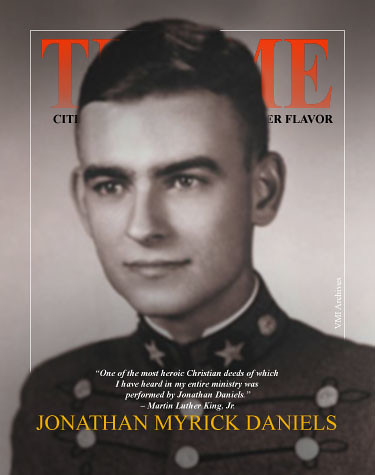
Jonathan Myrick Daniels

I can’t imagine that I have anything to give of any significance…” -- Jonathan Daniels

Graduating from Virginia Military Institute in 1961, Jonathan Myrick Daniels went on to study at the Episcopal Divinity School in Cambridge, Massachusetts. Daniels, who hailed from Keene, New Hampshire, probably never imagined that he would be remembered for one brave deed. In 1965, however, Daniels heard Dr. Martin Luther King plead for more clergy of all races and creeds to become involved in the struggle for civil rights. Daniels traveled to Alabama where he initially became involved in voter registration efforts.

He and 29 other people were arrested when they peacefully picketed whites-only businesses in the small town of Fort Deposit, Alabama. They were incarcerated in the Haynesville, Alabama Jail. Upon his release in August of 1965 Jonathan Daniels and Catholic priest Richard Morrisroe accompanied two black teenagers, Joyce Bailey and Ruby Sales, into Varner's Cash Store to buy a cold drink. Though the store served non-whites, Tom Coleman, a construction worker and part-time deputy sheriff, was at the store. He was looking for a confrontation. Coleman raised his shotgun and fired at the group. Daniels was shot and killed instantly as he pushed sixteen year old Ruby Sales to the ground in order to protect her. He saved her life. Father Morrisroe was seriously wounded.

His parents, Dr. Phillip Daniels and Connie Daniels, raised Jonathan and his sister Emily in an atmosphere of Faith and service to others. Their son struggled with his own identity and his own calling. He surprised his family by attending VMI, where he was elected Valedictorian and graduated at the head of his class. He initially went to graduate school at Harvard to study literature but then followed his calling to divinity school. He said that the Holy Spirit of G-d was the driving force in the direction of his life.

The young woman who's life he saved, Ruby Sales, eventually went into the ministry herself, founding an urban ministry dedicated to Daniels' memory.

Mr. Smith Goes to Washington
The Stories in the Story

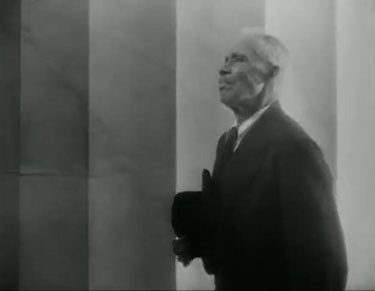
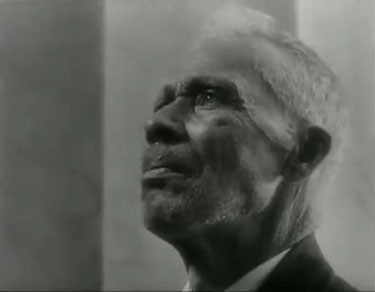
The Movie, Mr. Smith Goes to Washington [click to view], was made by Frank Capra in 1939. Capra's film contains some interesting snapshots of how the common man, operating in concert with the principles laid down by our founders, can truly change the course of history as he works to preserve freedom. Early in the story, a "lost" Mr. Smith finds himself in the Lincoln Memorial. Here he sees what must be an immigrant grandfather teaching his grandson the meaning of the great inscriptions that define freedom. Then the gentleman pictured below walks into the great edifice and deliberately removes his hat in reverence for the principles enshrined there.

mrsmith002
Jimmy Stewart enters the Memorial...

mrsmith003
...and sees this gentleman remove his hat, in reverence for...
mrsmith0011
...the freedom that was hard won through a time of great sacrifice.
smith006
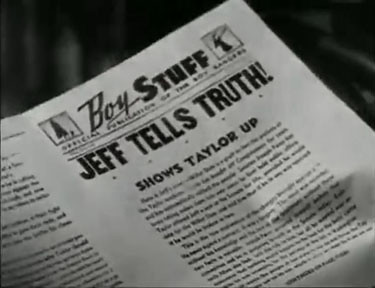
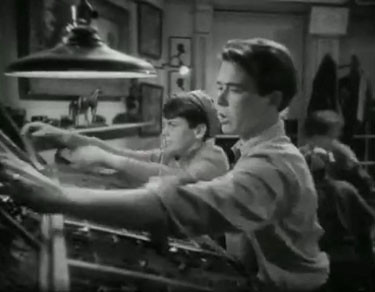
The little four page paper of Jeff's father has become 'Boy Stuff' and a wonderful group of boys put it together.
smith007
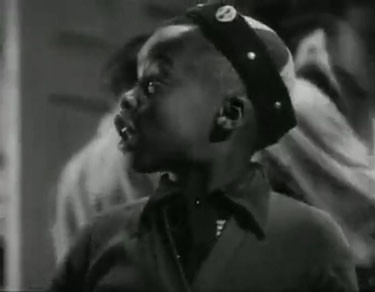
"Bring on the paper!" this young man shouts as they print a special edition to vindicate Jeff as the Taylor Machine attempts to control the big papers.
boystuff
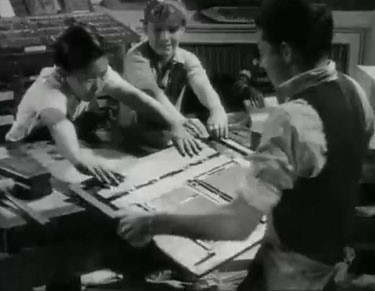
Here they pull page proofs.

smith008
"Jeff Tells Truth!"

It would be a little over two decades before Dr. Martin Luther King would stand at that SAME Memorial to share his "I Have a Dream Speech," but it is clear from the stills above, that Capra is in on the dream. To an America mired in a reality of apartheid, he presents the great truth of IMAGO DEI, through the three characters alongside Smith in the Memorial. The staff of 'Boy Stuff' also presents a group where the dream lives. Though some students of the film have trouble with the "pigeons and the porters" in the scene where Smith arrives in Washington, one must remember that the film was made in the 1930's and also that the porters leave the politicians "holding the pigeons."

In the end, Capra makes a film that is entertaining as it gives us glimpses of that "bright shining city on a hill." Though Capra's Senate Chamber is a movie set, the truth he depicts there is something every American needs to see for themselves.

The Prime Minister's Speech

We presented Binyamin Netanyahu's Speech [click to read] without comment earlier in the week. That was by design as we feel the speech was most appropriate, delivered with respect and dignity and like the preceding story of Jefferson Smith, it laid out important truth clearly. Mr. Netanyahu does not need a lengthy defense. His critics, by their own wailing and gnashing of teeth, merely proclaim their own missplaced priorities.

A country that has no qualms about destabilizing the Middle-east, holds innocent Americans like Saeed Abedini [1.] for years without due process in foul prisons and is rushing to obtain weapons of mass destruction must be subjected to the sort of honest analysis presented by the Prime Minister. To do less is reckless! Those who want to wail about perceived insult need to ask themselves if that insult is indeed worse than the injury of an Iranian bomb destroying a city in Israel or America?
Saturday, January 24, 2015

THYME Magazine: The Power of Inspiration III

Citizen Journalism with a Better Flavor

THYME0903A
Volume IX, Issue IIIa

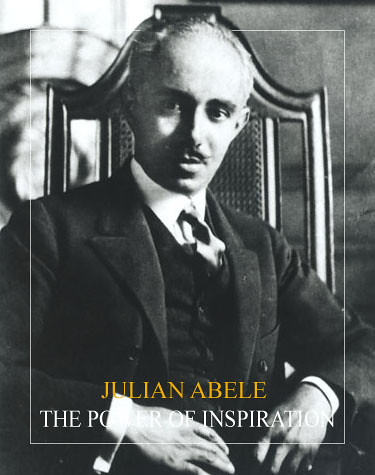
Julian Abele, Architect

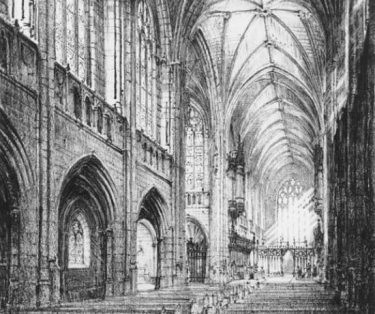
The great architects of the Beaux Arts tradition relied heavily on the power of their own drawing ability to visualize their unfolding design process. Julian Albele (1881-1950) was a master of this craft. His surviving drawings of what many consider to be the most beautiful building in the state of North Carolina would be impressive for their archival record alone. Abele  is a man who deserves to be studied further for his accomplishments; for his is one of the great stories of America.

Albele was born in 1881, the youngest of eight children in a Philadelphia family. He showed great abilities in mathematics as a child and attended the Quaker-run Institute for Colored Youth, which later became Cheyney University. He completed a two-year architectural drawing course at the Pennsylvania Museum School of Industrial Art, earning the nickname: "Willing and Able." Julian Abele was the first African American student to enroll in the Department of Architecture at the University of Pennsylvania, and became the department's first black graduate in 1902. His studio partner was Louis Magaziner, the only Jewish student in the department, who was of Hungarian descent. The two became lifelong friends.

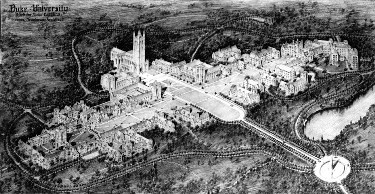
In 1906, Abele joined the firm of Horace Trumbauer as assistant to chief designer Frank Seeburger. In 1909 Seeburger left the firm and Abele became the chief designer in his place. He was the second highest paid employee in the firm. During the years of the Great Depression and the World War, commissions were few and far between. but in Durham, North Carolina, the Julian S. Carr and Washington Duke family fortunes would fund the Duke Endowment. A great gothic campus would be build, designed by Julian Albele, in a commission won by the Philadelphia firm.

In the segregated South, the impeccably dressed francophile, Albele, was once reportedly denied lodging by a Durham hotel. In those days attribution was scarcely given to team members so the Trumbaurer firm name was credited as the architect of record. It wasn't until late in the Twentieth Century that proper attribution was accorded Albele and a portrait of the architect was displayed at the university. His legacy is an incredible one. The chapel he designed is considered by many one of the most beautiful buildings in the region!

Abele_Drawing_Tower1
Julian Abele's rendering for the tower of Duke University Chapel in Durham, North Carolina.

Abele_001
Julian Abele's rendering for the interior of the Duke University Chapel.

Albele_002
Julian Abele's rendering of the Duke University Campus.

Saturday, December 6, 2014

THYME Magazine: Mia Love, Distinctly American

Citizen Journalism with a Better Flavor

THYME0824a
Volume VIII, Issue XXIIIa

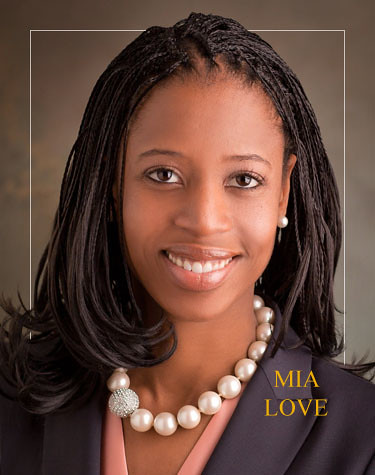
Mia Love, Distinctly American

She was born in Brooklyn, New York, the daughter of Haitian immigrants Jean Maxine Bourdeau and his wife Marie who had fled the country in 1973. Ludmya Bourdeau (Mia) came into the world December 6, 1975. Her father had been threatened by dictator François “Papa Doc” Duvalier's secret police. Jean came to the country by himself and was joined by his wife a few months later. Immigration law at the time allowed them to apply for citizenship if they had a child born in this country. Mia says: “My parents have always told me I was a miracle and our family’s ticket to America.”

When she was five, the family moved to Norwalk Connecticut. Marie worked as a nurse and Jean worked as a janitor, a bus driver and other assorted jobs. She grew up in a pretty rough neighborhood. She recalls that friends from her Catholic school were not allowed by their parents to come to her home for her birthday party. After high school, Mia attended the University of Hartford. A fine arts major, she was probably not looking forward to a career in politics. The theater appealed to her more.

After college, Mia became a flight attendant. Her sister Cynthia had joined the Latter Day Saints and Mia's investigation of the Church led her to do so as well. Jason Love, an LDS missionary on assignment to Connecticut, took an interest in this amazing young woman. Though young men on mission are admonished not to think about romance, the two found each other when Mia later moved to Salt Lake City. They were married, and here the story might have ended with Mia Love, mother of three, but for the bugs.

When she and her husband moved to a new neighborhood at the North end of Utah Lake, they found that the lake's midge flies were a real problem. She became a champion for the cause of getting the neighborhood sprayed for bugs! When the Supreme Court considered removing the phrase: "Under G-d" from the Pledge of Allegiance, she became active in public affairs again. in 2003 she was elected to the Saratoga Springs City Council. In 2009 she ran for mayor. She got sixty percent of the vote.

Running for Congress in Utah's Fourth District, Love again made history in this past election. She's the first black Republican Congresswoman, but there is more to her story. She has attained these milestones for Americans of Haitian ancestry in the United States as well. Love says of her earlier success: "I wasn’t elected in Saratoga Springs because of my race or my gender or my heels. I was elected by the people there because I had a plan and a vision to get us financially stable. Think about people like Martin Luther King. Imagine if he decided to fit into this mold that society told him to fit into. Imagine if he just listened to the government when they told him he was a second-class citizen.” Mia Love has already defied any effort to "mold" her. She will be a breath of fresh air when she takes her seat in Congress.

Boeing's Space Launch System


"Going to Mars is hard, but can you imagine the things that we're going to learn along the way?" -- Paisley Matthews, Boeing Program Integration Manager

Wednesday, July 30, 2014

THYME Magazine: Seeking Solutions

Citizen Journalism with a Better Flavor

THYME0805
Volume VIII, Issue V

An American Story

Dinesh D’Souza, In his film America, addresses the so-called 'historian,' Howard Zinn. Zinn is required reading on the university campuses but his 'history,' while it is quick to point out the very real sins of American history, is all to quick to omit the essential core of the American narrative, that of Redemption! This omission leads the uninformed consumer of Zinn to regard America as just the ultimate manifestation of conquering Colonialism, but the entire narrative tells a different story altogether. In the midst of human weakness, a nation crafted looking to G-d for guidance, was to be the stage for triumph over evil.

Slavery was indeed a vile evil. William Wilberforce fought to eliminate it in England, but the institution stubbornly remained in America until the middle of the Nineteenth Century. The seeds of its distruction, it must be noted, had already been planted in the Declaration of Inalienable Rights first drafted by the Patriots. The departure from John Locke's original "Life, Liberty and Property" was not accidental. It marks a moment of Divine inspiration. That inspiration would see its fruition only after the country's bloodiest war, fought within our own borders.

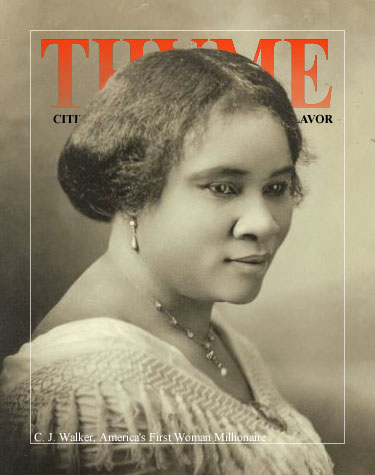
Zinn and his disciples omit the stories of triumph, such as that of C. J. Walker, because they do not bear out the oppressor/victim narrative at all. The sad truth is that many young people are not being told the wonderful stories that might inspire them. THYME would like to change that.

A Distinctly American Story

She was born Sarah Breedlove, on December 23, 1867, on a cotton plantation near Delta, Louisiana. She was the fifth child of Owen and Minerva, who had been slaves up to the Emancipation. She was orphaned at age seven and went to live with her sister, Louvinia, and her brother-in-law in Vicksburg, Mississippi. Sarah likely picked cotton and did other manual labor but when she was fourteen, she married Moses McWilliams. On June 6, 1885, their daughter A'Leila was born. Two years later, Sarah became a widow. She and A'Lelia moved to St. Louis, where Sarah's brothers were barbers. Working as a laundress, Sarah made enough money to send her daughter to the city school. She herself attended public night school whenever she was able to. It was in St. Louis that Sarah Breedlove met her second husband Charles J. Walker. He worked in advertising and would later become the promoter of her hair care business.

When Sarah Breedlove developed a scalp disorder that resulted in the loss of most of her hair, she experimented with home remedies and patent medicines in an effort to cure it. In 1905, she became a salesperson for Annie Turnbo Malone in Denver, who had developed a line of hair care products for African-American women. By 1907 she had developed her own line of products. Opening her first factory in Pittsburgh, Pennsylvania 1908, she also opened a beauty school to train her "Walker Agents," who instructed local operators in the best use of her products. She saw her mission as more than producing products. She saw her beauty care products as a means of elevating the status of Black women and became active in philanthropic work as well. The whole operation was later moved to Indianapolis, Indiana where the business continued to grow.

C. J. Walker them moved to Harlem in New York City. She and her daughter A'Lelia became an important part of the 'Harlem Renaissance.' She died on May 25, 1919. She was but 51 years old, yet her personal journey had taken her to such heights that she remains an inspiration to all who know her story.

Yarmouk
A child plays in the rubble of Yarmouk. Photo by Jonathan Messing.

Children in a World of Troubles

Yarmouk was home to the largest Palestinian refugee community in the country before the conflict began. 180,000 Palestinian civilians called it home. Now only 20,000 remain. Food and medical supplies are routinely denied entry and starvation is one of the three main causes of death. Recently, in the Jarabulus area, 22 people were killed and thrown into the streets to instill fear in the population. Some of them were children." -- Jonathan Messing

Massacre at Yarmouk [click to read]

I was informed last Friday that there were Unaccompanied Child Immigrants (UCI) at the Shenandoah Juvenile Detention Center in Verona. Like most others, I had read the newspapers and heard the news reports about these children, but now they were here in my district. I called the detention center and set up an appointment to meet some of these children.

I arrived at the Juvenile Detention Center Monday morning at 8 am. I had the opportunity to meet five illegal immigrant children, look into their welfare, and hear their stories. It was a heart-breaking experience." -- David Karaffa

Illegal Immigrant Children in Verona [click to read].

The Islamic State last week issued an ultimatum to the Christians in the town of Mosul, the second largest city in Iraq, ordering them to convert to Islam, pay a religious tax or face death. The statement by the leader of the Islamic State, Abu Bakr al-Baghdadi, warned that the Christians had until Saturday to “leave the borders of the Islamic Caliphate.” He added that, “After this date, there is nothing between us and them but the sword.” Messages warning Christians about the ultimatum were announced through loudspeakers on the city’s mosques. Church leaders advised the few families who wanted to negotiate with terrorist that they should also flee for their own safety. The exodus went on in Mosul throughout Friday, with all the Christians abandoning the town by the end of the day. “For the first time in the history of Iraq, Mosul is now empty of Christians,” said one man. "We have lived in this city and we have had a civilization for thousands of years - and suddenly some strangers came and expelled us from our homes," a woman in her 60s told media sources. “Hundreds were walking on foot,” said a bishop in the neighboring city of Tel Keif. He said many of them were bereft of all money or possessions - and that ISIS had robbed them of all of their belongings before setting off for refugee camps. (Israel National News/Reuters) Where is the outcry from the Christian world about what's happening to the Christians in Iraq? Where is the UN? Where are the evangelicals? Where are the Jews and the protesters who so quickly come against Israel!" -- JNN News

Wednesday, July 2, 2014

THYME Magazine: Independence Day Issue

Citizen Journalism with a Better Flavor

july22014
Volume VIII, Issue I

Reverend Richard's Prayer
From Homer Hickam's Book: 'Sky of Stone'

I was reading Homer Hickam's book: Sky of Stone when this passage riveted me with its profound wisdom, succinctly stated. Hickam describes a 4th of July celebration in Coalwood where the Reverend gave this invocation: [1.]

"Dear Lord, we are gathered here to celebrate not just the independence of our great land, but also the document on which it stands. There is much to admire in that document but what we best remember is this: We hold these truths to be self-evident; that all men are created equal; that they are endowed by their Creator with certain inalienable rights; that among these are life, liberty, and the pursuit of happiness.

To prepare for this invocation today, I have pondered long and hard these words. Most of you know that I rarely go anywhere without my Bible. It is an old Bible. It belonged to my grandfather. What you don't know is that inside this book, I have always kept a copy of the Declaration of Independence. It also belonged to my grandfather. He believed it to be as Holy as his Bible.

When I was a boy, somebody once asked me if my grandfather had been a slave. I couldn't imagine that could be true so I went to him and asked him: Grandfather, were you a slave? He said, Child, a man called me that but I was never a slave and you know why? Because I could read. My mama, she taught me when that man wasn't looking, just as her mama taught her.

When he became officially a free man, my grandfather purchased this Bible and a copy of the Declaration of Independence. He kept them both until the day he died. He left them to me.

I have come to understand my grandfather was right. No man or woman can be a slave if they can read. Especially if they can read the Bible and the American Declaration of Independence.

But that means there are still slaves in this land. There are slaves who do not know that they have inalienable rights given to them by God, and that they also have, by the grace of the Lord, life, liberty, and the right to pursue their happiness and the happiness of their families.

They are slaves to their own ignorance. Ignorance is the ultimate slave owner.

So on this 4th of July, I pray a special prayer.I pray for the day when the tyranny of ignorance will be banished all across this great land and every man, woman, and child can read and understand what they read.

I pray for that day.I pray every day for that day."

The good Reverend had planted in me a renewed vision of the mission before us. That is the mission of educating ourselves and our children.

Capitol
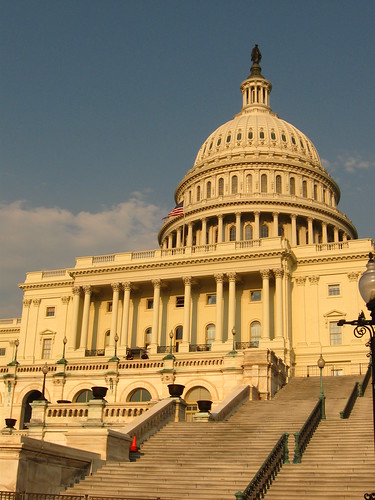
The U.S. Capitol.

A Victory for Religious Freedom

The Supreme Court ruled Monday that certain "closely held" for-profit businesses can cite religious objections in order to opt out of a requirement in the so-called "Affordable Care Act" to provide free contraceptive coverage for their employees. Justice Samuel Alito wrote in the majority opinion of the 5-4 decision that the contraceptive mandate was unlawful. The big winners, besides Amendment One, are Hobby Lobby and Conestoga Wood Products. Obamacare exemptions have already been negotiated for a number of religious institutions.

Although White House Press Secretary Josh Earnest said Monday afternoon that the decision: "jeopardizes the health of women who are employed by these companies," it is clear that all that is decided by this ruling is that companies run by people of Faith don't have to pay for abortificants. It does not stop employees from obtaining them on their own. There was a fair amount of "discussion" about the "problems" this legislation could cause, like a company run by Jehovah's Witnesses might not want to pay for blood transfusions. Mrs. Clinton said she found the ruling: "Deeply disturbing!"

Most of the scenarios presented fail to acknowledge the long tradition of religious tolerance this country has practiced. Horse drawn buggies with reflective triangles operate safely on modern highways to accommodate the needs of the Amish and Old Order Mennonites. Religious accommodation is actually something we as a people are quite good at.

Mr. Earnest and Mrs. Clinton would do well to address the very real plight of thousands of women who's health is truly jeopardized because they can no longer receive life-saving cancer treatments or heart procedures. The reason, loss of coverage as a result of implementation of the so-called: "Affordable Care Act!"

A growing culture of respect for life in the womb is taking place in America today. Clearly those of us who see the sanctity of unborn lives will see this as a victory for an even more fundamental right... that of life itself!

Wednesday, February 23, 2011

The Incredible Journey of Henry 'Box' Brown

For Him, Thinking Outside the Box Meant Getting in One

'Henry
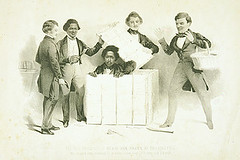
Henry 'Box' Brown

He was born a slave in Louisa County Virginia in 1815. On March 29, 1849 Henry 'Box' Brown literally mailed himself to freedom, no mean feat for the two-hundred pound 5' 8" man, who had a carpenter build him a special wooden shipping container.

Mr. Brown was a worker in one of Richmond's tobacco factories but when his family was sold and taken away to North Carolina he grieved their loss and eventually knew that he wanted to seek his freedom. He sought out an agent of the Underground Railroad who arranged contacts for him in the city of Philadelphia [Pennsylvania was a free state]. Brown devised his unique escape and had a carpenter build the box. Care was taken to provide inconspicuous air holes and the box was clearly labled "This Side Up With Care."

Cleverly disguised as a shipment of dry goods, Brown was transported by wagon to the RF&P Railroad for a trip to the Potomac. A ferry took him accross the river to continue his journey by train to Philadelphia. The box was handled roughly and was placed upside down a few times but Brown was able to remain silent and avoid detection. The journey lasted 26 hours.

He arrived at the doorstep of James Miller McKim, a Philadelphia abolitionist, who had agreed to receive the shipment. He greeted the men who uncrated him, saying "How do you do gentlemen," then sang a hymn that he had chosen to celebrate his freedom.

Mr. Brown became a popular speaker and when the Fugitive Slave Law was passed in 1850 he went to Britian. In 1875 he returned to the U.S. and continued as a popular speaker and entertainer.

Monday, May 31, 2010

Dr. Vivien Theodore Thomas

Breaking Barriers in Surgery and Opportunity

vivienthomas
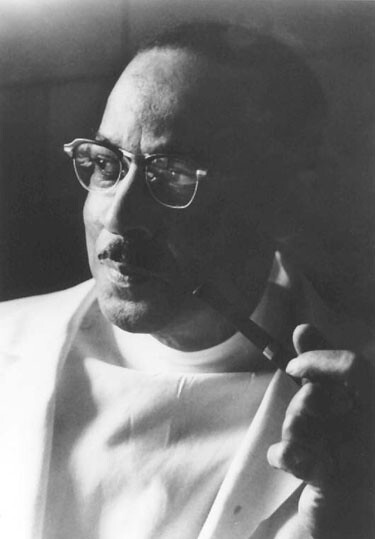
Dr. Thomas pioneered lifesaving surgical techniques.

Dr. Vivien Theodore Thomas was born on August 29, 1910 in New Iberia, Louisiana. He was the grandson of slaves but completed high school in Nashville Tennessee. He dreamed of continuing his education and becoming a doctor but the Great Depression in 1929 dashed his hopes for higher education.

Thomas had found a job at Fisk University as a carpenter for their maintenance department. He worked through the Summer of 1929 but was laid off in October of that year following the stock market crash. This put his educational plans on hold and eventually he found work as a laboratory assistant with Dr. Alfred Blalock at Vanderbilt University.

The original job description was caring for the dogs being used for surgical experiments. Thomas fed the animals and cleaned their cages. Dr. Blalock took notice of the young Thomas, discovering that he possessed keen hand-eye coordination, a sharp intellect and the ability to think on his feet to solve problems. No doubt, Thomas' carpentry skills and training came in to play here.

Blalock began using Thomas as a technical assistant, having him perform much of the actual work in developing new surgical techniques. Through the 1930's Blalock pushed on into new frontiers in vascular and cardiac surgery. Thomas did essential work in perfecting the surgical procedures. This pioneer work made Blalock one of the leading surgeons of his time.

In 1940 Blalock was offered the position of Chief of Surgery at Johns Hopkins in Baltimore. He requested that Thomas be hired with him. Their 34 year partnership would continue to push the barriers in surgical technique. Their work would eventually lead to learning how to correct the heart defects that caused blue baby syndrome, Their work on crush syndrome led to understanding that would save the lives of thousands of soldiers in World War II.

Baltimore society was even more segregated than Nashville and Johns Hopkins only hired African Americans in their houskeeping department. Thomas was put on the payroll as a janitor but worked alongside Blalock in surgery. He turned a few heads walking the halls in his labcoat. Here many wonder that Blalock so valued Thomas professionally but allowed him to be distanced socially. Both men, it must be remembered, where men raised in the old Southern society. The separation was highly codified in a city like Baltimore [I still have a map of the city from my youth that matter-of-fact labels the white and colored swimming pools in Druid Hill Park]. The recognition of merit over race and the mens' friendship was enough to remove the most insurmountable of barriers.

Blalock didn't object to Thomas initially being 'assigned' to housekeeping but by 1946 he had negotiated his status as the highest paid lab assistant at Hopkins.

Watching Thomas perform an intricate surgical procedure, Blalock remarked "That looks like something the Lord made." Thomas was able to perform complex surgeries with such efficiency of motion that the students said that he made them look effortless. When a young surgeon in training moved in too close to observe, he might unknowingly step into a spot next to Blalock, who would tersely remind him: "Only Vivian is to stand there!"

In 1976 Johns Hopkins presented Thomas with an honorary doctorate and appointed him an instructor of surgery, acknowledging the work he had already been performing for decades.

Monday, May 24, 2010

'The Apprentice'

Benjamin Banneker's Amazing Accomplishments

Banneker
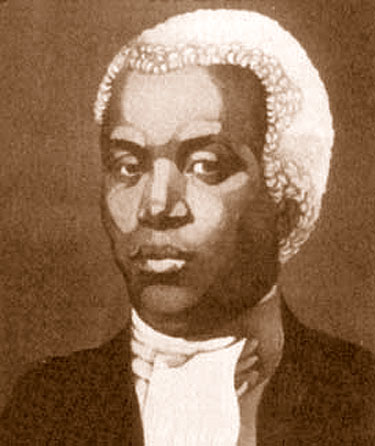
Benjamin Banneker was a renaissance man.

"You're Fired"

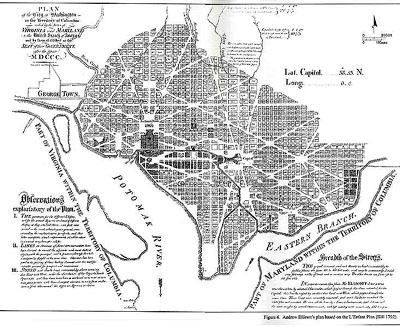
The story of Benjamin Banneker is forever intertwined with the planning of our nation's capital city. In 1791 Banneker was in the employment of Andrew Ellicott, who was charged with the task of laying out the monumental city plan concieved by French architect Pierre Charles de L'Enfant, who had been hired to design a capital suitable for the new republic.

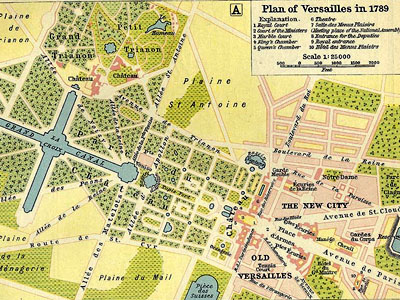
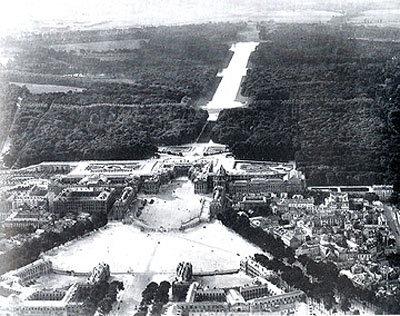
L'Enfant based his design on the best traditions of Baroque landscape design and his creation resembled the hunting gardens of Louis XIV's massive palace at Versailles. L'Enfant proved to be very difficult to work with... America's first 'rock star' architect, you might say. George Washington fired him.

Here the traditional story says that L'Enfant rolled up his drawings and left the young country in a huff, taking his designs with him. Ellicott turned to Banneker, who had prepared the actual surveys, and Banneker is said to have redrawn the plans from memory!

Though many modern historians doubt that Banneker recreated the plans from memory, the man's documented accomplishments would be in keeping with those of a man capable of such a feat.

Versaillesplan
The hunting gardens of Versailles...

versaillesabove
...inspiration for our nation's capital?

A simple farmer most of his life, Banneker had the good fortune to know the Quaker settlers of Ellicott's Mills in Maryland. The Society of Friends believed in providing basic education to all people and young Banneker certainly received a solid basic education.

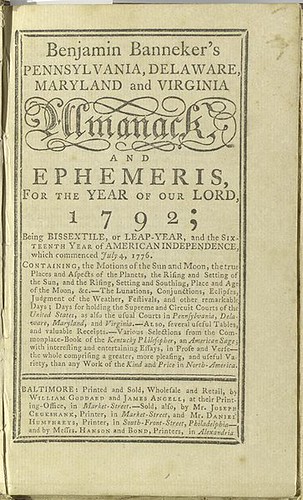
Banneker became a student of astronomy and published an almanac. He corresponded with President Thomas Jefferson on the issue of the status of his fellow African Americans. His letter to Jefferson is well crafted, invoking reason as well as compassion. It appears that Banneker took up the craft of surveying in his fifties, looking to a time when he might be physically too old to farm.

Banneker is said to have observed the workings of a clock and then carved his own working clock mechanism from scrap wood. He published his almanac until 1802.

"Banneker lived for four years after his almanacs discontinued. He published a treatise on bees, did a mathematical study on the cycle of the seventeen-year locust, and became a pamphleteer for the anti-slavery movement. He continued scientific studies by night and walked his land by day. He also continued to keep his garden. He hosted many distinguished scientists and artists of his day, and his visitors commented on his intelligence and on his knowledge of everything of importance that was happening in the country. As always, he remained precise and reflective in his conversations with others. His last walk (with a friend) came on October 9, 1806, he complained of being ill and went home to rest on his couch. He died later that day." [1.]

363px-BannekerAlmanac
Banneker's Almanac.

Ellicott_Banneker
The Ellicott/Banneker map of Washington.

washington
The city today.

laneyadvrt

Monday, March 31, 2008

The Incredible Journey of Henry 'Box' Brown

For One Man, Thinking Outside the Box Meant Getting into One

'Henry
Henry 'Box' Brown

He was born a slave in Louisa County Virginia in 1815. On March 29, 1849 Henry 'Box' Brown literally mailed himself to freedom, no mean feat for the two-hundred pound 5' 8" man, who had a carpenter build him a special wooden shipping container.

Mr. Brown was a worker in one of Richmond's tobacco factories but when his family was sold and taken away to North Carolina he grieved their loss and eventually knew that he wanted to seek his freedom. He sought out an agent of the Underground Railroad who arranged contacts for him in the city of Philadelphia [Pennsylvania was a free state]. Brown devised his unique escape and had a carpenter build the box. Care was taken to provide inconspicuous air holes and the box was clearly labled "This Side Up With Care."

Cleverly disguised as a shipment of dry goods, Brown was transported by wagon to the RF&P Railroad for a trip to the Potomac. A ferry took him accross the river to continue his journey by train to Philadelphia. The box was handled roughly and was placed upside down a few times but Brown was able to remain silent and avoid detection. The journey lasted 26 hours.

He arrived at the doorstep of James Miller McKim, a Philadelphia abolitionist, who had agreed to receive the shipment. He greeted the men who uncrated him, saying "How do you do gentlemen," then sang a hymn that he had chosen to celebrate his freedom.

Mr. Brown became a popular speaker and when the Fugitive Slave Law was passed in 1850 he went to Britian. In 1875 he returned to the U.S. and continued as a popular speaker and entertainer.