Showing posts with label Thomas Jefferson. Show all posts

Wednesday, November 20, 2013

Virginia's Jack Jouett Rode Through the Night

His Warning Saved Jefferson and Virginia's Officials

Jack_jouett_silhouette
This silhouette of Jack Jouett by his son Matthew is the only known image of the Revolutionary War hero.

On the night of June 3, 1781, Jack Jouett learned of an impending surprise attack on Charlottesville by British Lieutenant-Colonel Banastre Tarleton's "Whitecoat" Regiment. Jouett was at Cuckoo Tavern in Louisa County, bedded down on the tavern's lawn according to some accounts. When he learned of the advancing Tarlton, he quickly mounted his horse and rapidly traveled along back roads and old trails to warn Thomas Jefferson and the Virginia Legislature at Monticello.

Legend has it that in his urgency to get to Charlottesville, Jouett was permenantly scarred by the branches he rode through. He rested briefly at Lousia Courthouse before proceeding on to Monticello. Arriving around four in the morning, he hastily awoke Jefferson and his guests, who enjoyed breakfast before they fled while Jefferson checked periodically with his telescope for signs of Tarlton, Monticello literally sitting on its own "little mountain."

The government of Virginia evacuated to Staunton, across the Blue Ridge Mountains, where the legislature reconvened and elected Thomas Nelson to be Virginia's next governor as Jefferson's term had officially expired. Henry Wadsworth Longfellow immortalized Paul Revere, but it wasn't until 1909 that a similar tribute was published by Charlottesville's newspaper:

"Hearken good people: awhile abide
And hear of stout Jack Jouett's ride;
How he rushed his steed, nor stopped nor stayed
Till he warned the people of Tarleton's raid.

The moment his warning note was rehearsed
The State Assembly was quickly dispersed.
In their haste to escape, they did not stop
Until they had crossed the mountain top.
And upon the other side come down.
To resume their sessions in Staunton Town.

His parting steed he spurred,
In haste to carry the warning
To that greatest statesman of any age,
The Immortal Monticello Sage.

Here goes to thee, Jack Jouett!
Lord keep thy memory green;
You made the greatest ride, sir,
That ever yet was seen."

--Charlottesville Daily Progress, October 26, 1909

Friday, September 27, 2013

Thomas Jefferson's 'Other' House

Poplar Grove was His Place of Retreat from Public Life

IMG_3634
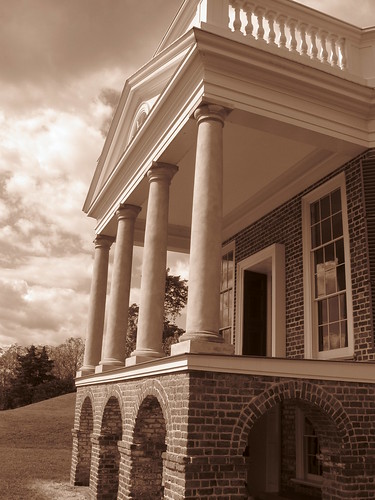
While he was President, Thomas Jefferson designed and built this "other home" near Lynchburg as a "retreat for rest and writing."

Thursday, June 28, 2012

THYME Magazine

Citizen Journalism with a Better Flavor
thyme0306
Volume IV, Issue XXVI

America's Revolution... A Model to Emulate
"I consider it an indispensable duty to close this last solemn act of my official life by commending the interests of our dearest country to the protection of Almighty G-d and those who have the superintendence of them into His Holy keeping." -- George Washington

"If my people...shall humble themselves, and pray, and seek my face...then shall I hear from heaven, and will forgive their sin, and will heal their land." -- II Chronicles 7:14

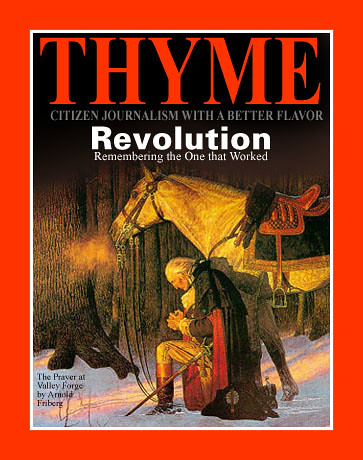
The 'other' Weekly News Magazine [click to read] features the cover headline: 'The Revolution that Wasn't.' Today's revolutionaries would do well to remember at least a very basic history of revolutions.

The French Revolution (1789-1799) created chaos. The Bolshevik Revolution in 1917 led to another dark tyranny.

Rare in history is the casting off of tyranny successfully accomplished and followed by the creation of a system of government that allows for the peaceful transfer of power... through the ballot box.

It is well known that George Washington inspired his men through the difficult days of Valley Forge and the Battle of Trenton... the nation's future very much in the balance. Perhaps not so well known is that Washington had to put down mutinies by Continental soldiers after the war... unpaid by a bankrupt Congress.

Our nation's survival of those days was miraculous. The creation of her Constitutional government was no less miraculous. Today, Federal judges invoking the Commerce Clause participate in an equally miraculous continuation of that same experiment.

Their Freedom is Not Our Freedom

These Observations [click to read] by Diana West in Jewish World Review give clarity to what 'they' want. Universalists believe all peoples prefer freedom to its absence, which is probably true. But they also believe all peoples define "freedom" in the same way. Is that true?

Celebrate Arab democracy? [click to read] by Caroline B. Glick in Jewish World Review.

No summary will do this damning article justice.

Wisdom2
True wisdom. ht/Joy

The Revolution that Wasn't

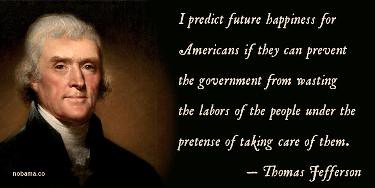
This week the "other" weekly news magazine laments the "revolution" in Egypt, saying: "the generals are still in charge." I hope, for the sake of Coptic Christians and other miniorities, that some stable heads are in charge. One of our Constitution's unique characteristics is that it limits government and affirms the rights of the individual citizen as G-d given. When Jefferson penned the Declaration of Independence, he wrote:

"We hold these truths to be self-evident, that all men are created equal, that they are endowed by their Creator with certain unalienable Rights, that among these are Life, Liberty and the pursuit of Happiness.--That to secure these rights, Governments are instituted among Men, deriving their just powers from the consent of the governed, --That whenever any Form of Government becomes destructive of these ends, it is the Right of the People to alter or to abolish it, and to institute new Government, laying its foundation on such principles and organizing its powers in such form, as to them shall seem most likely to effect their Safety and Happiness. Prudence, indeed, will dictate that Governments long established should not be changed for light and transient causes; and accordingly all experience hath shewn, that mankind are more disposed to suffer, while evils are sufferable, than to right themselves by abolishing the forms to which they are accustomed. But when a long train of abuses and usurpations, pursuing invariably the same Object evinces a design to reduce them under absolute Despotism, it is their right, it is their duty, to throw off such Government, and to provide new Guards for their future security." -- American Declaration of Independence

In 1789, the Bill of Rights further asserted: "Congress shall make no law respecting an establishment of religion, or prohibiting the free exercise thereof; or abridging the freedom of speech, or of the press; or the right of the people peaceably to assemble, and to petition the Government for a redress of grievances."

Carefully making the case that human rights com from G-d, the founders codified limits on the state in keeping with that belief.

AJeffersonQt
ht/Joy.

THYME Interactive [click to read] brings you even more of our famous Nanny State Updates and other  news you need in this crucial election year.

Deists and Atheists? [click to read]. Dr. Roger Shultz discusses the Founding Fathers from a historical perspective. A special Independence Day presentation.

vom

Thursday, April 12, 2012

THYME Magazine

Citizen Journalism with a Better Flavor

thyme0415
Volume IV, Issue XV

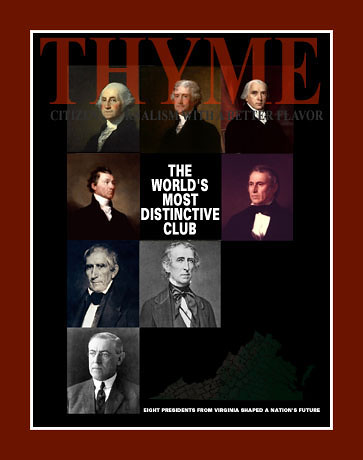
The World's Most Distinctive Club

Eight men from Virginia shaped the world we live in. The 'other' weekly news magazine this week calls the fraternity of Presidents: "the most exclusive club in the world." Virginia is sometimes referred to as the "Mother of Presidents" because eight U.S. Presidents come from the state.

George Washington led the fight that preceded our founding. He was President of the Continental Congress and led the Continental Army. When Congress failed to pay the Continental Army, Washington rode out to intervene, saving the young nation. He was the first President of the young United States. John Adams of Massachussetts followed as the second President. Then three other Virginians followed.

Thomas Jefferson, who drafted the Virginia Statute of Religious Freedom and the Declaration of Independence was our third President. He bought the Louisiana Purchase from France and more than doubled the size of the country for 15 million dollars. Napoleon Bonaparte badly needed the money. The Mississippi River would open up a whole new world. Jefferson also asserted America's right to the seas by standing up to the Barbary Pirates.

James Madison, our fourth President, is known as the Father of our Constitution. He was President during the War of 1812 when Washington City was burned by the British.

James Monroe was next in line. He had been sent by Jefferson to France to negotiate the Louisiana Purchase. His Monroe Doctrine told European powers to stay out of South America.

William Henry Harrison was our ninth President. He had fought in the War of 1812. He has the dubious distinction of having been killed by his inaugural address. Contracting pneumonia after giving the speech on a very cold day, Harrison died a month after taking office. His was the shortest term of office of any American President.

John Tyler, his Vice-president succeeded him, becoming the tenth President of the United States. He was referred to as "His Accidency" because of this. He was the first President to be married while in office.

Zachary Taylor, of Orange County, Virginia, became our twelfth President. A career soldier who had fought in the Mexican War, President Taylor died after sixteen months in office.

Woodrow Wilson, born right here in Staunton, Virginia, became our 28th President. He was President during World War I and aferwards worked to establish the League of Nations. A leader of the Progressive Movement, Wilson pursued an agenda that included the Federal Reserve Act, Federal Trade Commission Act, the Clayton Antitrust Act, the Federal Farm Loan Act and an income tax. Interestingly enough, Wilson's early career took place far from Virginia. He was President of Princeton University and then Governor of New Jersey before running for President in 1912.

oped2112chu

Raising Five Kids Isn't Work, Staffer Says

Obama staffer Hilary Rosen has hit a nerve when she says that Ann Romney hasn't 'worked.' In Rosen's eyes, taking care of five children is not 'work' of importance. My Mother raised five of us and once rolled her eyes when Barbara Walters admitted she didn't know where to buy Gatoraid! Mom had worked in the engineering department of the Martin Company. After she married Dad, she would take her slide rule to the A&P Grocery Store and do her own 'unit pricing' before the stores instituted it. She would illustrate Zeno's Paradox by continually dividing the last piece of the last piece of pie.

This was one of Mom's best lectures. She'd cut the pie into eight pieces instead of the flawless seven she usually did. Then she'd keep dividing until the pie filling refused to cooperate with the lesson. Her kitchen was a place full of learning and wonder.

We raised our young daughter with a program called Joy School in her preschool years. Mom would have loved it. Richard and Linda Eyre, a couple in Utah invented it. [1.] I'm sure Ann Romney availed herself of resources like this.

The administration distanced themselves from Rosen's remark, but the remark was an honest window into the thinking of those who are running the country right now.

"Of course they had to disown Hilary Rosen. She was egregiously honest. She told people exactly what she genuinely believed. She has no understanding of; and no respect for a woman who could do anything with her life and considers raising her children the highest possible calling. Hillary Rosen considers this a waste of time and talent. It makes her a perfect representative of the anti-traditional left. The only thing she did wrong, in the reptilian eyes of David Axelrod, was publically admitting it." -- Red State

In fact, Red State wonders about The Administration's Record [click to read] on paying female employees.

On March 15, 2012, THYME Wrote:

"But looking at Proverbs 31, we run the risk of cheapening the true value of a person if we reduce her to simply a wage earner, albeit a powerful one. A while ago I asked a young artist to help me in the studio. I told her: "I'm not going to pay you what you're worth, I'll pay you what the job is worth. If I had to pay you what you are worth I couldn't afford you." That distinction comes to mind as we ruminate on the value of our wives and daughters to our family and society. Every now and then someone will try to assign a number value to the service of a women who takes care of her home and family (not working outside the home). It is always in six figures and that calculation makes a great point. There are many great people who's influence far exceeds their monitary earnings and society is the richer for it."

Lynn Has This to Say [click to read] as a homeschooling Mother who raised and educated her own children:

"So some parents don't think it "takes a village" to raise our children ... we take the responsibility of doing it ourselves. Not every stay-at-home mom is rich ... we sacrifice, scrimp, and do without to create a family atmosphere. Barack Obama's "female gap" advantage may have just taken a blow. Why can't liberals MYOB?" -- Lynn Mitchell

My suspicion is that the administration is well aware of what an asset Mrs. Romney is to her husband and her family. Otherwise, why would they bother to attack her?


16303803305723521838

Tuesday, February 8, 2011

In the Shadows of Monticello

Thomas Jefferson's Home is Part of His Story

monticello
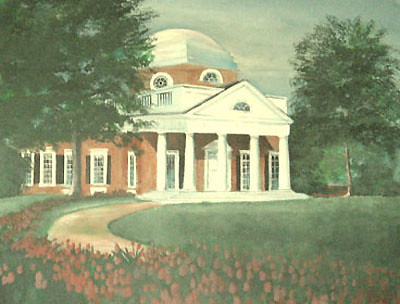
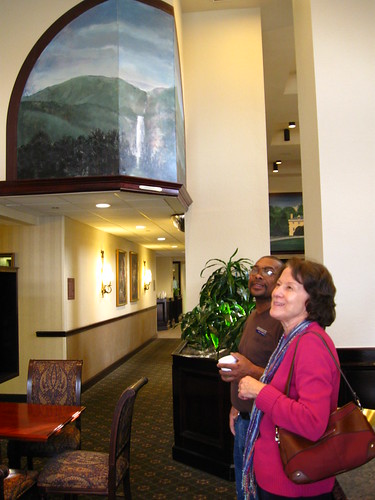
Monticello, as painted in the Hampton Inn murals by Bob Kirchman and Russ Fisher. The enigmatic dome replaced an earlier full upper story as Jefferson restyled the house.

Myron Magnet has written a series of written portraits of our founding fathers that are significant in that they paint them neither as demigods or demons, but as actual men. That is what they were, ordinary mortals who found themselves at a crossroads of history.

Our founders were men with human weakness and human passion. Thomas Jefferson [click to read] as revealed by Magnet in City Journal is no exception.

Most instructive is Magnet's study of the beliefs and principles that guided Jefferson. Ideals and realities in conflict, to be sure. Jefferson's final great work was to be his University of Virginia... architecturally a study in the pure classical forms. He laid out his 'Academical Village' to reflect an order and vision for an educated Virginia population. The first students would prove to be another lesson in human nature. Still Jefferson began this institution with great optimism. This experiment in the Enlightenment idea of mankind's perfectibility was the crowning achievement of his 'retirement' years.

"But as an intellectual enterprise, the university proved less satisfactory to its creator when it opened the year before he died. The students turned out to be not so much an aristocracy of virtue and talent as a gang of rowdy young men with a taste for drink, gambling, breaking windows, firing guns into the air, and thrashing professors who tried to stop them. The horrified Jefferson came down from his mountain to Charlottesville to reprimand them. Flanked by his dear friends and fellow trustees, James Madison and James Monroe, the frail 82-year-old patriarch drew himself up to his full six foot two, began to speak, and burst into tears." -- Myron Magnet.

Monticello
My rendering of the Monticello Visitor's Center. designed by Ayers Saint Gross. The rendering by The Kirchman Studio was used for promotion and development purposes. We are pleased to have had a small part in this great project.

Monday, January 17, 2011

Journey to Historic Charlottesville

It All Began at the Augusta Health Blood Bank...

...I was at Virginia Blood Services on the Trima machine, which collects platelets needed for the treatment of illness. One has a lot of time to think and converse during the procedure, and the Phlebotomists at Augusta do their best to make donation a great experience. Little did they know they were about to exceed their own expectations!

When I asked if they knew of an inexpensive getaway for a weekend with my wife, they started putting their heads together. We take care of my wife's elderly parents, so with a relief caregiver volunteering to come in, we didn't want to waste the weekend. Still, it has been tough for all of us associated with the building industry. There was no way we could afford a getaway.

"How much can you afford to spend?" she asked as the machine whirred a return. It was clear from my answer that financial resources were extremely thin. "Let me call my brother." she said.

Visions of a weekend in someone's hunting cabin came to mind. My wife would not find that all that romantic. Still, I needed ideas and was pretty desperate. "By the way, you don't need any artwork for your hotel?" I heard her ask. My ears perked up, I love the barter angle.

Then I heard her say my name in obvious answer to the question "Who is it?" "Oh, you know him!" she exclaimed.

Turns out her brother manages the Hampton Inn in Charlottesville where I worked in partnership with Russ Fisher to paint the lobby murals fifteen years ago! Now I have a complimentary suite! I can feel a twinkle in the eye of the Divine, who I suspect is quite a romantic.

IMG_2210
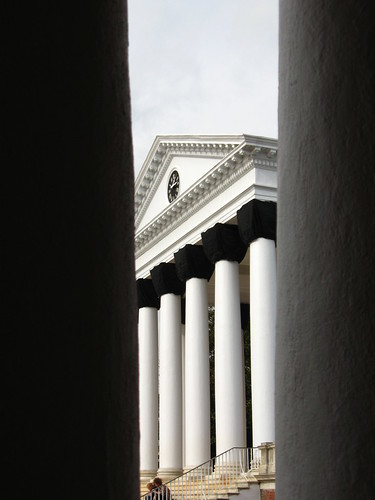
The Rotunda is a familiar image...

The inspiration for the Hampton Inn murals must rightfully be traced back to the photographs of Rufus W. Holsinger, who chronicled Charlottesville around the turn of the Century. Holsinger's images were reproduced on the walls of the University Cafeteria, which my Grandmother considered one of the few places to eat in Charlottesville. Monticello, the Rotunda and all of the familiar landmarks were there for the patrons to enjoy as they dined.

When Lisa Johnson of Plan Pro II first suggested the murals, the University Cafeteria was no more. It seemed like Charlottesville needed some sort of visual connection to its history and the lobby of her newest downtown hotel would be the ideal location.

openlawn
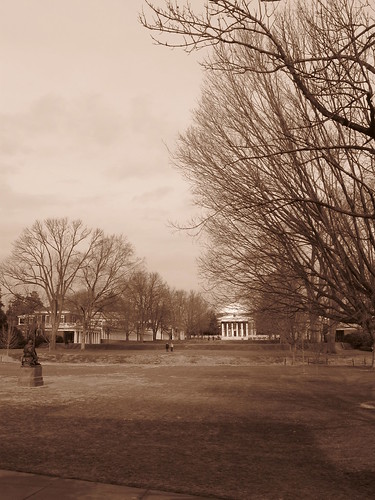
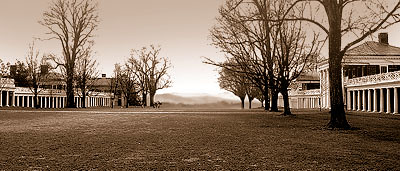
...but what is lost is the vista Jefferson intended for it to overlook. Photos and rendering overlay by Bob Kirchman.

We checked in and walked around the lobby. Then a most amazing thing happened. Not only is the Divine a romantic, He is an encourager! The Desk manager discovered that I had designed and painted the murals and she began to introduce me to the staff. My wife and I felt like celebrities as we were introduced to a host of people from housekeeping and maintenance.

It was clear that these wonderful souls, who went to work by these murals every day, loved them. Perhaps they loved the unique identity they created for the hotel, perhaps they just loved the connection with their community, but the fact is that their lives were somehow enriched by a work G-d had allowed me to do. I am thankful for that.

IMG_2167
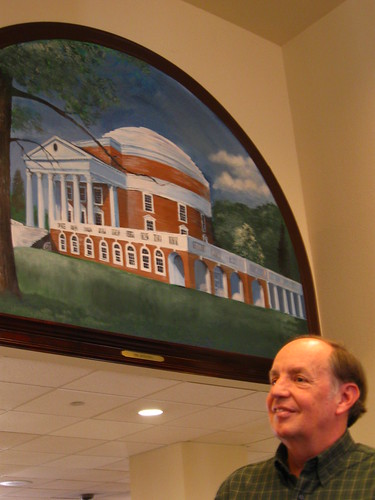
Here I am with the Rotunda painting.

IMG_2171
Crabtree falls is above us as we take a 'tour' of the murals with the hotel staff.

You can see all of the Hampton Inn Murals [click to view] here.

IMG_2189
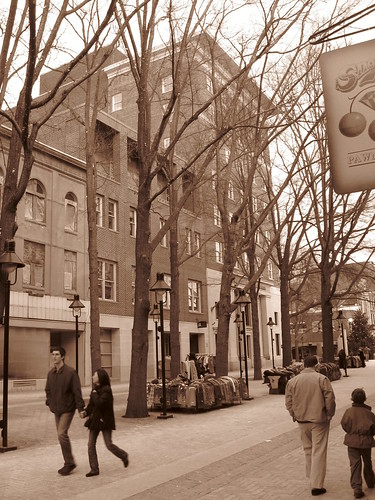
Charlottesville's Downtown Mall...

IMG_2188
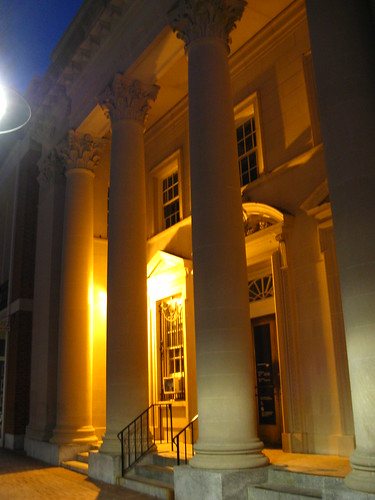
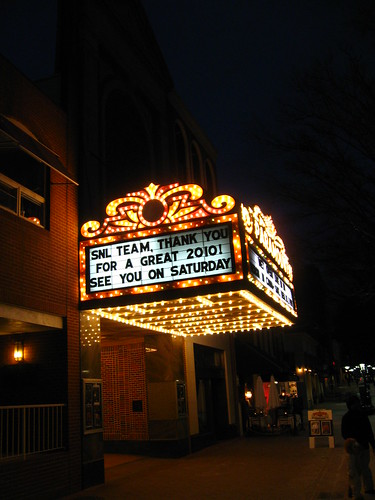
...features the restored Paramount Theatre,...

IMG_2190
...and a multitude of didning experiences.

IMG_2172
In the 1970's Charlottesville created the Mall from its Main Street...

IMG_2183
...which initially created a decline as businesses left the street. Today a vibrant new culture of commerce has returned. The Mall is a popular place.

IMG_2187
Moonlight over the Mall.

We enjoyed a pleasant walk along Charlottesville's Downtown Mall that evening. My wife took some books into a used book store and returned with some cash! She was obviously pleased with her side of the sale. Sunday morning we visited Trinity Presbyterian church for worship and were encouraged with a message on how G-d is close to us in our times of grief and suffering.

The text was the story of how Lazarus was raised from the dead. Our Lord knew he was going to raise Lazarus and yet he wept. He wept along with Lazarus' sisters Martha and Mary. He made their grief one with his own. Life can be hard and confusing, but G-d is not finished with the story. Still, He would comfort us and share our sorrows. It was a message I needed to hear and a further confirmation that this weekend was a gift from Heaven.

We walked around Jefferson's Academic Village and enjoyed his architecture. We drove out of town through Crozet and enjoyed the last light of evening at Mint Spring Park, grateful for the gift of unexpected blessings.

IMG_2203
The columns of the Rotunda are draped in black in rememberance of Yeardley Love and Morgan Harrington.

IMG_2213
Pavilion X has been restored to the colors Jefferson originally used to suggest classical stone architecture.

IMG_2214
The Middle Lake at Mint Springs.

Monday, May 24, 2010

'The Apprentice'

Benjamin Banneker's Amazing Accomplishments

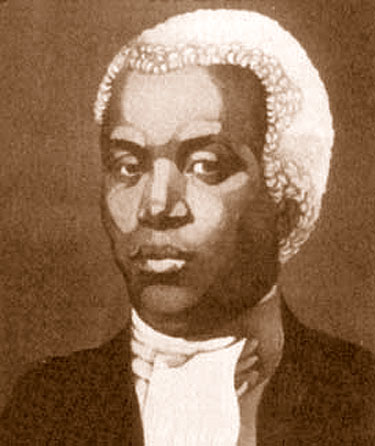
Banneker
Benjamin Banneker was a renaissance man.

"You're Fired"

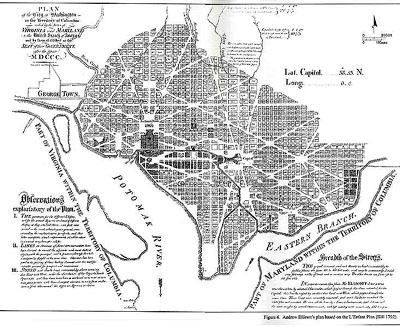
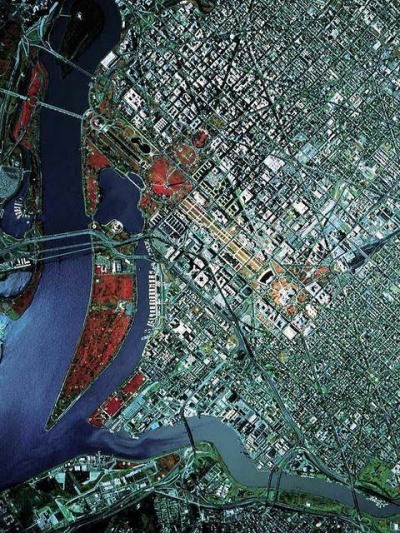
The story of Benjamin Banneker is forever intertwined with the planning of our nation's capital city. In 1791 Banneker was in the employment of Andrew Ellicott, who was charged with the task of laying out the monumental city plan concieved by French architect Pierre Charles de L'Enfant, who had been hired to design a capital suitable for the new republic.

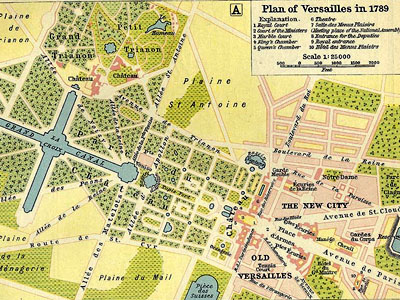
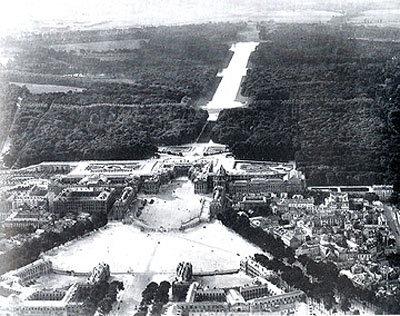
L'Enfant based his design on the best traditions of Baroque landscape design and his creation resembled the hunting gardens of Louis XIV's massive palace at Versailles. L'Enfant proved to be very difficult to work with... America's first 'rock star' architect, you might say. George Washington fired him.

Here the traditional story says that L'Enfant rolled up his drawings and left the young country in a huff, taking his designs with him. Ellicott turned to Banneker, who had prepared the actual surveys, and Banneker is said to have redrawn the plans from memory!

Though many modern historians doubt that Banneker recreated the plans from memory, the man's documented accomplishments would be in keeping with those of a man capable of such a feat.

Versaillesplan
The hunting gardens of Versailles...

versaillesabove
...inspiration for our nation's capital?

A simple farmer most of his life, Banneker had the good fortune to know the Quaker settlers of Ellicott's Mills in Maryland. The Society of Friends believed in providing basic education to all people and young Banneker certainly received a solid basic education.

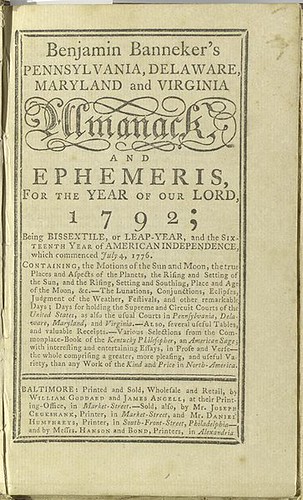
Banneker became a student of astronomy and published an almanac. He corresponded with President Thomas Jefferson on the issue of the status of his fellow African Americans. His letter to Jefferson is well crafted, invoking reason as well as compassion. It appears that Banneker took up the craft of surveying in his fifties, looking to a time when he might be physically too old to farm.

Banneker is said to have observed the workings of a clock and then carved his own working clock mechanism from scrap wood. He published his almanac until 1802.

"Banneker lived for four years after his almanacs discontinued. He published a treatise on bees, did a mathematical study on the cycle of the seventeen-year locust, and became a pamphleteer for the anti-slavery movement. He continued scientific studies by night and walked his land by day. He also continued to keep his garden. He hosted many distinguished scientists and artists of his day, and his visitors commented on his intelligence and on his knowledge of everything of importance that was happening in the country. As always, he remained precise and reflective in his conversations with others. His last walk (with a friend) came on October 9, 1806, he complained of being ill and went home to rest on his couch. He died later that day." [1.]

363px-BannekerAlmanac
Banneker's Almanac.

Ellicott_Banneker
The Ellicott/Banneker map of Washington.

washington
The city today.

laneyadvrt

Thursday, March 4, 2010

Quote of the Decade...

Government Efficiency is Eliminating the Position

"When I was studying for a Master's in Urban Administration, I caused a bit of an uproar. I said the goal of a public administrator is to find a way to eliminate their own job. A great administrator would be seeking a permanent fix to a problem, not managing the problem well." -- Phil Lynch

Phil was writing about the Post Office [click to read] but here's a truth too big to leave with just the United States Postal System. What if we did actually succeed in eliminating the need for public welfare programs [or at least reduce them to a true last resort safety net]?

Impossible, you say, but look to the Nineteenth Century when there was little care given to many who were truely needy and consider the work of men like George Mueller who founded five orphanages during the period. Much of what we consider basic humanitarian care has its roots in faith-based solutions. Compassionate care for the mentally ill under Dorothea Dix likewise as far better than State run Eugenics under Dejarnette. Why did we think the government could do these things better?
Or put the problem on the lowest shelf. The City of New York spends vast sums of money cleaning the subways. The transit system needs to save money so what happens if Citizens start to develop an 'ownership' mentality and carry out their own trash? If we have the same attitude toward our own community we will save its resources. I love Phil's logic. What if we can achieve just about anything without the government running it. Go ahead, I DARE you Washington, reduce the corporate tax rate and see what I'm talking about!

In the early days of Israel's existence there was no king. The kingdom was administered by Judges, sort of a citizen governing board. The book of Samuel talks about how the people wanted a king like every other nation around them. They are warned that a king will require a lot of upkeep [taxes will rise] and will require the conscription of more people than are now needed. By the time of Solomon the people are groaning under a large tax burden as the king embarks on large building projects and sends off to Egypt for ever more horses. Eventually the kingdom is split, the reason being a tax rebellion! If you don't believe me, read the books of Kings and Chronicles for yourself!

Even the figure head monarchy of Britian requires a large sum of public money for its maintenance to this day. I love the queen but what does she really do? Eliminating a position is harder than it would seem.

Thomas Jefferson and his fellow Patriots started well, eliminating the position of monarch but the fact that we have even been talking about 'Ted Kennedy's Seat' tells you it's time to get back to basics on this one. The Tea Parties are a healthy step in the right direction.

So, what about the Post Office. Let them eliminate Saturday delivery. There are private companies who will happily pick up the slack on essential deliveries. UPS and Fedex seem to have taken a fair amount of market share here anyway. In the spirit of Stamps.com, it seems some postal sales could be privatized as well. Stamps.com already gives you a discount for NOT going to the Post Office.

Pavilion X Restoration

Jeffersonian Architecture as Jefferson Saw It

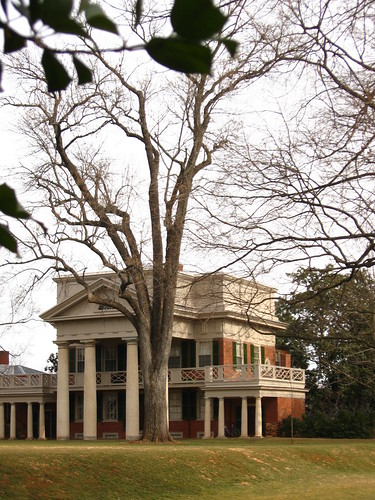
Pavilion X
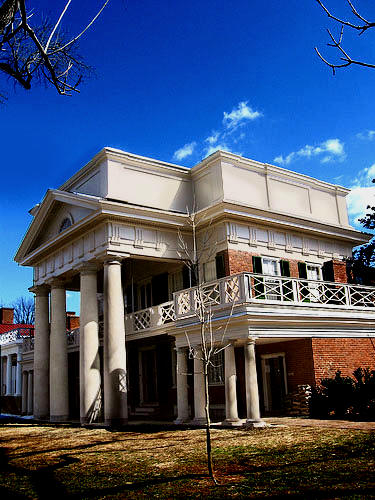
Pavilion X on the Lawn, restored to match Jefferson's original concept.

White columned brick houses, serpentine walls and lots of boxwoods. That is what comes to mind when Virginia architecture is mentioned, but the restoration of Pavilion X at the University of Virginia reminds us that Jefferson was not so much interested in creating a regional architecture as providing his students with the best models of classical form to be examples as they went on to create the architecture of the young republic.

The sand colored trim brings out the reproduction of a Roman facade, which would have been stone.

Friday, October 2, 2009

Jefferson's Houses: Farmington

One of the Finest Examples of His Residential Design

Farmington
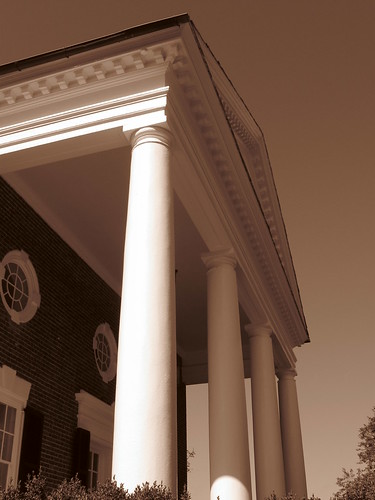
Farmington's columns.

Farmington

Farmington

Farmington

Farmington

Lebanon Cedar at Farmington
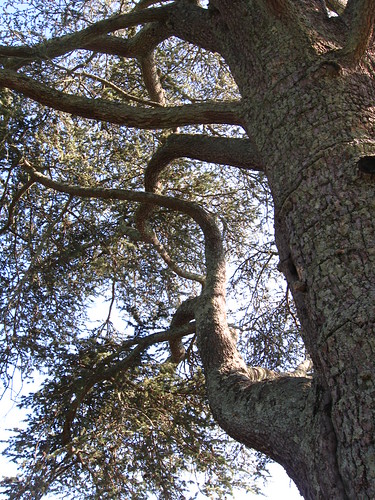
A Lebanon Cedar grows in front of the house.

Our Third President Was a Prolific Architect

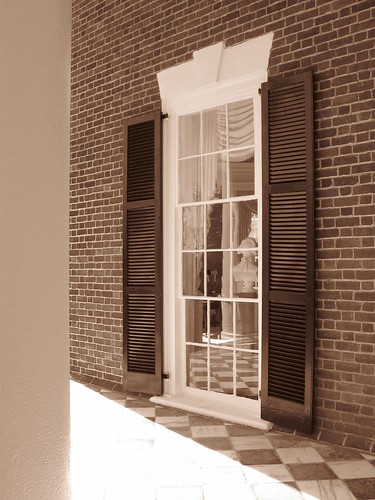
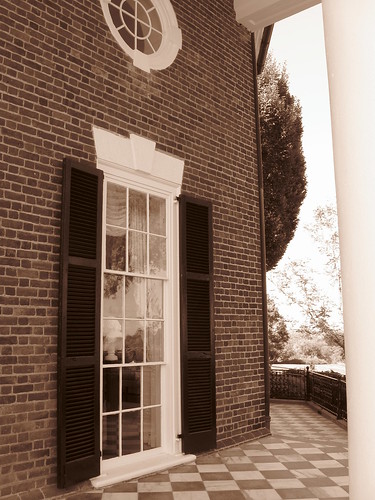
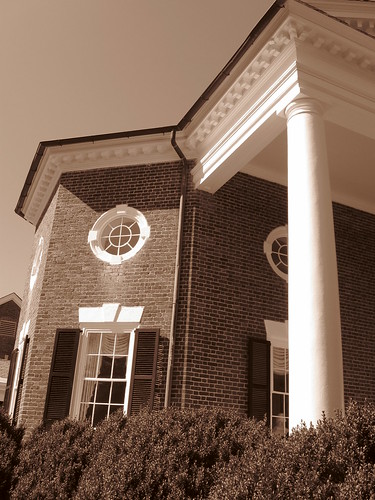
Monticello, the University of Virginia and Poplar Forest are all well known landmarks. Thomas Jefferson designed them all. Albemarle County boasts some lesser known works by Jefferson such as Farmington, who's octagonal addition was designed by Jefferson in 1803. It is now part of the Farmington Country Club just outside of Charlottesville. I wonder how old the Lebanon Cedar in front of the house is?

Saturday, January 10, 2009

Jefferson's Library

It Became the First Collection of A University

Rotunda
Thomas Jefferson's books became the original library of the University of Virginia and were housed in this reproduction of the Parthenon designed by Jefferson himself. 1914 Photo by Rufus W. Holsinger.

The Rotunda was always a wonder to me. Here in the rolling hills of Virginia sits a nice brick interpretation of the Parthenon set in a Palladian vision of the ideal village. Here is an Interesting Article about Jefferson's Library by Michael Knox Beran discussing the book: The Road to Monticello: The Life and Mind of Thomas Jefferson, by Kevin J. Hayes (Oxford, 738 pp., $34.95)

Jefferson's ideal of many such self-governing small communities is described well by Beran and his vision is worth serious study in our age.