Showing posts with label Hymns Project. Show all posts

Wednesday, December 31, 2014

THYME Magazine: Recognizing True Greatness

Citizen Journalism with a Better Flavor

THME0501
Volume VIII, Issue XXVII

Recognizing True Greatness
G-d's Not Dead

What do you do when your faith is challenged? A recent film asks that question as it follows a college student's unexpected 'testing' when his philosophy professor demends that all of the students write "G-d is Dead" on a piece of paper, sign it, and hand it in at the beginning of the first class, or face a failing grade. For most, it is a simple exercise of class compliance, but for freshman Josh Wheaton it is a demand that he deny the very foundations of who he is. Josh nervously refuses to comply, raising the ire of professor Radisson, who counters Wheaton's refusal with a daunting assignment; he must prove G-d's existence by presenting well-researched, intellectual arguments and evidence. He must go head to head with Radisson in a series of classroom debates. If he cannot convince his classmates of G-d's existence, he fails the course.

The movie G-d's Not Dead opened in just under 800 theaters, yet it sold out in many locations and outperformed films with far larger exposure. Directed by Harold Cronk, the film dramatizes what is unfortunately an all too commonly seen antipathy to faith in the modern academic community. But consider this; the universities that the radicals of the 1960's became tenured in during the years that followed owe their beginnings to people of faith who sought to bring truth and order, rooted in faith, to the Americas. Great schools like Dartmouth and William and Mary sought to bring the invigorating element of Faith to the populace of the New World, both Native and European. That initial mission is now reflected only in the aforementioned schools' mascots and Dartmouth's remaining scholarships for people of Native American ancestry.

“G-d’s Not Dead didn’t have a massive marketing budget, a liberal A-list star above the title or even the same number of screens most mainstream movies receive. The film is still on pace to snare the fourth spot in the weekend’s box office chart in a very competitive frame. LA Times: ”The religious drama ‘G-d’s Not Dead’ surprises at box office. The film, which opened on just 780 screens nationwide, took in more than $2.8 million Friday. It’s likely to be the No. 3 movie for the weekend, behind the bigger-budget, wider-released “Divergent” and “Muppets Most Wanted.” - Breitbart

The need to consider the greatness of G-d and His story are nothing new. This is reflected in the hymns of old and the wonder that they still inspire!
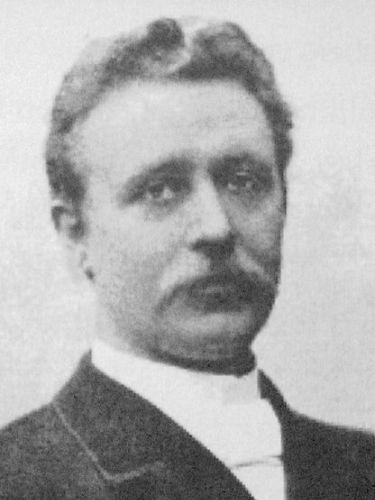
416px-Carl_Boberg
Carl Boberg.

He was 26 years old. The year was 1885. Carl Boberg, a Swedish minister,  wrote a poem entitled, “O Store Gud”. Boberg’s poem was published in 1886. The title, “O Store Gud,” translated into English is “O Great G-d,” translated into English, it reads like this:

When I the world consider
Which Thou has made by Thine almighty Word
And how the webb of life Thy wisdom guideth
And all creation feedeth at Thy board.
Refrain:
Then doth my soul burst forth in song of praise
Oh, great G-d
Oh, great G-d.


Stuart K. Hine, who wrote the hymn "How Great Thou Art" that we recognize today, was an English missionary to Poland in the 1920s. Climbing through the Carpathian Mountains, his entourage was faced with a gathering storm. Inspired by "O Store Gud," he penned the first verse of the hymn we know today. The storm was so severe that the party could not travel further. Reaching a little village, they were given shelter by the local schoolmaster.

Traveling on into Romania and into Bukovina, Hine wandered forest glades with the young people in his company. Thus was born the second verse. The conversion of many people living in the Carpathian Mountains inspired the third verse and the fourth, speaking of Christ's triumphant return to Earth, was written when Hine returned to England.
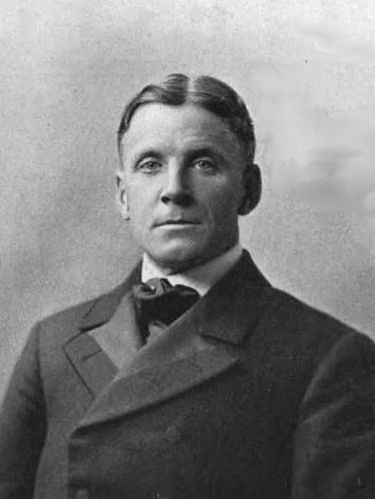
Babcock_001
Maltbie Davenport Babcock.

 Born in Syracuse, New York in 1858, Maltbie Davenport Babcock was the Pastor of a church in Lockport, New York. He often took long walks along the Niagra Escarpment, where he enjoyed the sweeping views of Lake Ontario. He would say to his wife Katherine: "I am going out to see the Father's World." Indeed, his walks with G-d in the beauty of Upstate New York inspired him to write the poem that became the great hymn. My beautiful wife was born in Syracuse, New York, though her Oklahoma accent, acquired in her childhood, makes that a well kept secret! She often hears me express a sentiment similar to Babcock's as I head for the Blue Ridge Mountains for the "Sunday Afternoon Walk."

Both hymns begin with an awe of G-d revealed in observation of nature. They build to an understanding of Christ's redemptive Love and rise to an expression of the triumphant Messiah establishing his rule and order on this Earth.

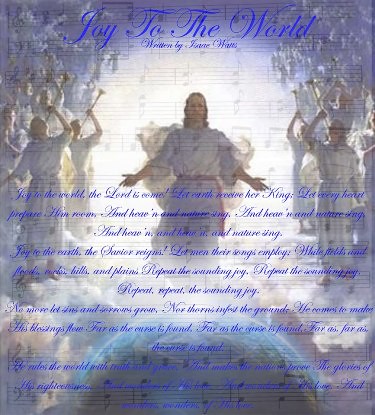
I have always loved the hymns these men wrote. The Hymns Project [click to read] was inspired by them. My friend and Colleague, Kristina Elaine Riley Greer actually deserves the credit for first developing graphic expression for great hymns. Her work on Henry Alford's Come Ye Thankful People, Come [click to read] and Joy to the World [click to read] deserve recognition in their own right. The Hymns Project was an attempt to build a visual representation of the rich musical tradition began by Carl Boberg, Stuart K. Hine and Maltbie Davenport Babcock.

IMG_0206
The Hymns Project.


The Testimony of Nature
Evening Light Plays Across the Folds of the Great Valley

valley
Photo by Kristina Elaine Riley Greer.

The heavens declare the glory of G-d; and the firmament sheweth his handywork.

Day unto day uttereth speech, and night unto night sheweth knowledge.

There is no speech nor language, where their voice is not heard.

Their line is gone out through all the earth, and their words to the end of the world. In them hath he set a tabernacle for the sun,

Which is as a bridegroom coming out of his chamber, and rejoiceth as a strong man to run a race.

His going forth is from the end of the heaven, and his circuit unto the ends of it: and there is nothing hid from the heat thereof.

The law of the Lord is perfect, converting the soul: the testimony of the Lord is sure, making wise the simple.

The statutes of the Lord are right, rejoicing the heart: the commandment of the Lord is pure, enlightening the eyes.

The fear of the Lord is clean, enduring for ever: the judgments of the Lord are true and righteous altogether.

More to be desired are they than gold, yea, than much fine gold: sweeter also than honey and the honeycomb.

Moreover by them is thy servant warned: and in keeping of them there is great reward.

Who can understand his errors? cleanse thou me from secret faults.

Keep back thy servant also from presumptuous sins; let them not have dominion over me: then shall I be upright, and I shall be innocent from the great transgression.

Let the words of my mouth, and the meditation of my heart, be acceptable in thy sight, O Lord, my strength, and my redeemer. -- Psalm 19
Wednesday, April 2, 2014

THYME Magazine: Recognizing True Greatness

Citizen Journalism with a Better Flavor

THME0501
Volume VII, Issue XV

Recognizing True Greatness
G-d's Not Dead

What do you do when your faith is challenged? A new film asks that question as it follows a college student's unexpected 'testing' when his philosophy professor demends that all of the students write "G-d is Dead" on a piece of paper, sign it, and hand it in at the beginning of the first class, or face a failing grade. For most, it is a simple exercise of class compliance, but for freshman Josh Wheaton it is a demand that he deny the very foundations of who he is. Josh nervously refuses to comply, raising the ire of professor Radisson, who counters Wheaton's refusal with a daunting assignment; he must prove G-d's existence by presenting well-researched, intellectual arguments and evidence. He must go head to head with Radisson in a series of classroom debates. If he cannot convince his classmates of G-d's existence, he fails the course.

The movie G-d's Not Dead opened last week in just under 800 theaters, yet it sold out in many locations and outperformed films with far larger exposure. Directed by Harold Cronk, the film dramatizes what is unfortunately an all too commonly seen antipathy to faith in the modern academic community. But consider this; the universities that the radicals of the 1960's became tenured in during the years that followed owe their beginnings to people of faith who sought to bring truth and order, rooted in faith, to the Americas. Great schools like Dartmouth and William and Mary sought to bring the invigorating element of Faith to the populace of the New World, both Native and European. That initial mission is now reflected only in the aforementioned schools' mascots and Dartmouth's remaining scholarships for people of Native American ancestry.

“G-d’s Not Dead didn’t have a massive marketing budget, a liberal A-list star above the title or even the same number of screens most mainstream movies receive. The film is still on pace to snare the fourth spot in the weekend’s box office chart in a very competitive frame. LA Times: ”The religious drama ‘G-d’s Not Dead’ surprises at box office. The film, which opened on just 780 screens nationwide, took in more than $2.8 million Friday. It’s likely to be the No. 3 movie for the weekend, behind the bigger-budget, wider-released “Divergent” and “Muppets Most Wanted.” - Breitbart

The need to consider the greatness of G-d and His story are nothing new. This is reflected in the hymns of old and the wonder that they still inspire!

416px-Carl_Boberg
Carl Boberg.

He was 26 years old. The year was 1885. Carl Boberg, a Swedish minister,  wrote a poem entitled, “O Store Gud”. Boberg’s poem was published in 1886. The title, “O Store Gud,” translated into English is “O Great G-d,” translated into English, it reads like this:

When I the world consider
Which Thou has made by Thine almighty Word
And how the webb of life Thy wisdom guideth
And all creation feedeth at Thy board.
Refrain:
Then doth my soul burst forth in song of praise
Oh, great G-d
Oh, great G-d.


Stuart K. Hine, who wrote the hymn "How Great Thou Art" that we recognize today, was an English missionary to Poland in the 1920s. Climbing through the Carpathian Mountains, his entourage was faced with a gathering storm. Inspired by "O Store Gud," he penned the first verse of the hymn we know today. The storm was so severe that the party could not travel further. Reaching a little village, they were given shelter by the local schoolmaster.

Traveling on into Romania and into Bukovina, Hine wandered forest glades with the young people in his company. Thus was born the second verse. The conversion of many people living in the Carpathian Mountains inspired the third verse and the fourth, speaking of Christ's triumphant return to Earth, was written when Hine returned to England.

Babcock_001
Maltbie Davenport Babcock.

 Born in Syracuse, New York in 1858, Maltbie Davenport Babcock was the Pastor of a church in Lockport, New York. He often took long walks along the Niagra Escarpment, where he enjoyed the sweeping views of Lake Ontario. He would say to his wife Katherine: "I am going out to see the Father's World." Indeed, his walks with G-d in the beauty of Upstate New York inspired him to write the poem that became the great hymn. My beautiful wife was born in Syracuse, New York, though her Oklahoma accent, acquired in her childhood, makes that a well kept secret! She often hears me express a sentiment similar to Babcock's as I head for the Blue Ridge Mountains for the "Sunday Afternoon Walk."

Both hymns begin with an awe of G-d revealed in observation of nature. They build to an understanding of Christ's redemptive Love and rise to an expression of the triumphant Messiah establishing his rule and order on this Earth.

I have always loved the hymns these men wrote. The Hymns Project [click to read] was inspired by them. My friend and Colleague, Kristina Elaine Riley actually deserves the credit for first developing graphic expression for great hymns. Her work on Henry Alford's Come Ye Thankful People, Come [click to read] and Joy to the World [click to read] deserve recognition in their own right. The Hymns Project was an attempt to build a visual representation of the rich musical tradition began by Carl Boberg, Stuart K. Hine and Maltbie Davenport Babcock.

IMG_0206
The Hymns Project.


Planning on Seeing the Movie Noah?

Here are some thoughts from my friend Pastor Chuck Balsamo. Many are criticizing the Biblical inaccuracy of the film and forgetting that this is a project by non-believers. Pastor Balsamo points out that any time people outside of the household of Faith delve into Biblical themes, the possibility exists for there to develop a great dialogue. To those who are ready to pounce on the film's weaknesses, he writes:

"Why focus on how much you hate this movie, and miss a huge opportunity to start up real discussions with real people about who G-d really is?

Some people live on a soap box, ranting about the things they hate. Who knows, maybe they’re doing good in some bizarre way… like shoving back the tide of evil or something.

But, I think there is a better way. That is, to seize the better opportunity!"

The Noah Movie – Are You Missing The Real Opportunity? [click to read]

Saturday, December 29, 2012

THYME Magazine

Citizen Journalism with a Better Flavor

THME0501
Volume V, Issue I

416px-Carl_Boberg
Carl Boberg.

He was 26 years old. The year was 1885. Carl Boberg, a Swedish minister,  wrote a poem entitled, “O Store Gud”. Boberg’s poem was published in 1886. The title, “O Store Gud,” translated into English is “O Great G-d,” translated into English, it reads like this:

When I the world consider
Which Thou has made by Thine almighty Word
And how the webb of life Thy wisdom guideth
And all creation feedeth at Thy board.
Refrain:
Then doth my soul burst forth in song of praise
Oh, great G-d
Oh, great G-d.


Stuart K. Hine, who wrote the hymn "How Great Thou Art" that we recognize today, was an English missionary to Poland in the 1920s. Climbing through the Carpathian Mountains, his entourage was faced with a gathering storm. Inspired by "O Store Gud," he penned the first verse of the hymn we know today. The storm was so severe that the party could not travel further. Reaching a little village, they were given shelter by the local schoolmaster.

Traveling on into Romania and into Bukovina, Hine wandered forest glades with the young people in his company. Thus was born the second verse. The conversion of many people living in the Carpathian Mountains inspired the third verse and the fourth, speaking of Christ's triumphant return to Earth, was written when Hine returned to England.

Babcock_001
Maltbie Davenport Babcock.

 Born in Syracuse, New York in 1858, Maltbie Davenport Babcock was the Pastor of a church in Lockport, New York. He often took long walks along the Niagra Escarpment, where he enjoyed the sweeping views of Lake Ontario. He would say to his wife Katherine: "I am going out to see the Father's World." Indeed, his walks with G-d in the beauty of Upstate New York inspired him to write the poem that became the great hymn. My beautiful wife was born in Syracuse, New York, though her Oklahoma accent, acquired in her childhood, makes that a well kept secret! She often hears me express a sentiment similar to Babcock's as I head for the Blue Ridge Mountains for the "Sunday Afternoon Walk."

Both hymns begin with an awe of G-d revealed in observation of nature. They build to an understanding of Christ's redemptive Love and rise to an expression of the triumphant Messiah establishing his rule and order on this Earth.

I have always loved the hymns these men wrote. The Hymns Project [click to read] was inspired by them. My friend and Colleague, Kristina Elaine Riley actually deserves the credit for first developing graphic expression for great hymns. Her work on Henry Alford's Come Ye Thankful People, Come [click to read] and Joy to the World [click to read] deserve recognition in their own right. The Hymns Project was an attempt to build a visual representation of the rich musical tradition began by Carl Boberg, Stuart K. Hine and Maltbie Davenport Babcock.

IMG_0206
The Hymns Project.

Monday, November 26, 2012

The Story of 'Joy to the World'

A Beloved Hymn Written in Celebration of Advent

adventjoy2
Graphic by Kristina Elaine Greer, who writes: "I overlaid the entire picture from photos I took of the music in the most recent United Methodist Hymnal. I simply clipped out the music part and compiled them together then cut and pasted them to the template and changed the opacity."

A Short History of 'Joy to the World'
by Kristina Elaine Greer

Most people think of the wonderful hymn, “Joy to the World,” as Christmas Hymn proclaiming the joy of Christ’s birth, but there is a different history behind this marvelous song. The original words to “Joy to the World” by English hymn writer Isaac Watts were based on Psalm 98 in the Bible. According to Wikipedia “the song was first published in 1719 in Watts' collection; The Psalms of David: Imitated in the language of the New Testament, and applied to the Christian state and worship.” Isaac Watts originally wrote the words of "Joy to the World" as a hymn glorifying Christ's triumphant return stated in the book of revelation, instead of as a song celebrating the birth of Jesus Christ. This song was meant more for Advent than Christmas and in some hymnals today you will find it in the holiday concordance of the hymnal under Advent instead of Christmas (which is correct). Interestingly, we only sing the second half of Watts' lyrics when we sing this beloved hymn. The music of this song was adapted and arranged to Watts' lyrics by Lowell Mason in 1839. The melody is said to have been from an older melody, which was then believed to have originated from Handel, partially because of the theme of the refrain (And heaven and nature sing...). This appears in the beloved orchestra opening and accompaniment of the “Comfort ye” from Handel's Messiah, the first four notes match the beginning of the choruses “Lift up your heads” and “Glory to G-d” from the same oratorio. Handel, however, did not compose the entire tune. In fact “Antioch” is the generally used name of the tune. As of the late 20th century, “Joy to the World” was the most-published Christmas hymn in North America. Today we still enjoy it during the holiday seasons of Advent and Christmas time no matter the history it reminds us to be joyful that we have a Savior, who came to earth as a baby, lived among us, died for us, was raised again victorious, and is our Lord who will come again in glorious acclamation. G-d bless you all during the Advent, Christmas, and Epiphany seasons!

Saturday, November 17, 2012

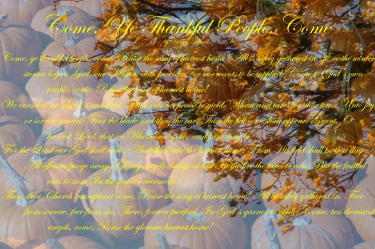
Come, Ye Thankful People, Come

Harvest Hymn Written in 1844 by Henry Alford

hymn2
“Come, Ye Thankful People, Come” is a harvest hymn written in 1844 by Henry Alford. It is often sung to the tune “St. George's Windsor” by George Job Elvey. So I created this in light of Thanksgiving to remind us of what we should really be thankful for. Two of my photos are overlayed with the text of the hymn added." -- Laney Riley Photo Graphic by Laney Riley

View Larger Image [click to view].

Thursday, November 15, 2012

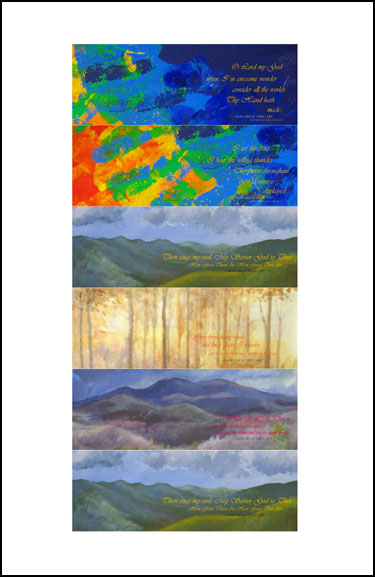
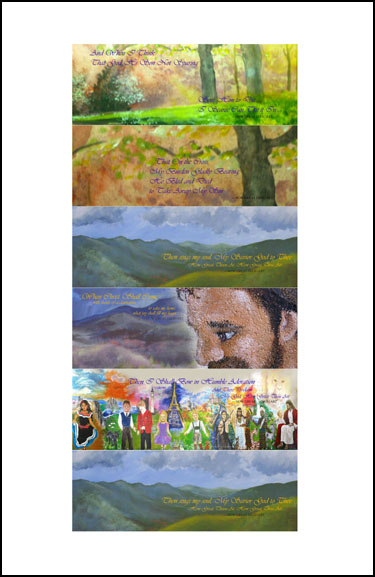
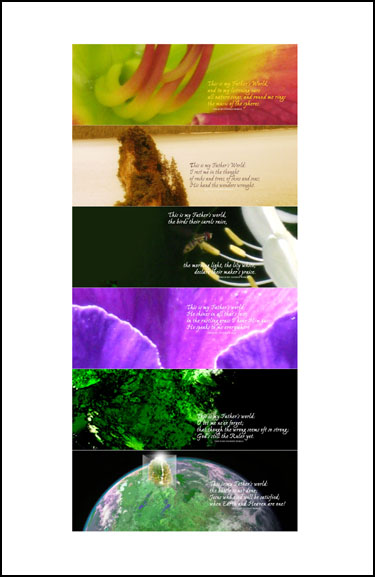
The Hymns Project Framed Prints

"How Great Thou Art" and "This is My Father's World"

web001

web002

web003
The Hymns Project: "How Great Thou Art" and "This is My Father's World," set of three framed 11" x 17" images. Paintings by B. Riley, Kristina Elaine Riley and Bob Kirchman, Photography by Bob Kirchman and NASA image manipulation and rendering overlay by Bob Kirchman.

The set of images is now available through The Kirchman Studio [click to read].