Showing posts with label Roads to Rails. Show all posts

Saturday, November 22, 2014

THYME Magazine: The Vision of Charles Carroll

Citizen Journalism with a Better Flavor

THYME0821A
Volume VIII, Issue XXIa

The Vision of Charles Carroll

July 4, 1828 the last surviving signer of the Declaration of Independence took part in an important ceremony as he turned the first spade of earth at the symbolic laying of the first stone of the Baltimore and Ohio Railroad. Fifty-two years after he put his name to the document that began our nation, Charles Carroll of Carrollton participated in an event that looked to her future. Indeed, inspired by the Ellicott Brothers [click to read], Carroll had already diversified agriculture on his large estate in Howard County, Maryland. He had helped build flour mills and limestone mills that in turn helped to create a more sustainable agriculture. The Quaker Ellicotts had migrated to this "picturesque wilderness" from Bucks County, Pennsylvania and partnered with Carroll, a Catholic, to move the region away from single crop plantations and enrich the soil with ground limestone, a practice that continues to this day. Now the ninety year old patriot was breaking ground for the prototype railroad. It was not exactly like the modern rails on cross ties we are familiar with, but rather iron straps laid on top of two continuous granite "curbs." The first motive power was horsepower. Horses actually pulled the carriages along the rails. A wind powered wicker car was even experimented with before the famous "Tom Thumb" steam engine gave challenge to a horse drawn train carriage in the now legendary race. [2.]

I consider this among the most important acts of my life, second only to my signing the Declaration of Independence, if even it be second to that.” Carroll said of the moment. The stone, laid in a field outside Baltimore, was also a time capsule, into which were placed a copy of the company's charter, newspapers of the day and a scroll bearing the words: "This Stone is deposited in commemoration of the commencement of the Baltimore and Ohio Railroad. A work of deep and vital interest to the American people. Its accomplishment will confer the most important benefits upon this nation, by facilitating its commerce, diffusing and extending its social intercourse, and perpetuating the happy Union of these, Confederated States. The first general meeting of the citizens of Baltimore to confer upon the adoption of proper measures for undertaking this magnificent work, was on the second day of' February 1827…” [1.]

The railroad would eventually do all of these things as a vast nation would be joined together by her steel rails. The Nineteenth Century would see her span from sea to sea to become a country her founders could scarcely have imagined!

Charles Carroll had been born in September 1737 in Annapolis. He attended Jesuit colleges in Maryland and France, before going on to study law in Paris and London. In 1765 he returned to Howard County and took charge of the Carroll family's vast estate there. Catholics in Maryland before independence were not allowed to participate in politics, practice law or vote, but Carroll became influential as a writer of tracts against taxation without representation under the pseudonym "First Citizen." In 1776 he was appointed to the Continental Congress. Although he was not present for the vote for independence, he was one of the first signers. He added the distinct identifier: "of Carrollton" to distinguish himself from a number of relatives having the same name. After independence was won, Carroll became a Maryland State Senator in 1777 and eventually became a United States Senator representing that state.

In 1800 he left political service and was instrumental in building canals and the establishment of the Baltimore and Ohio Railroad Company. His farm in Howard County became a model of improvements in agriculture. He died in Baltimore in 1835 at the age of 95.
Wednesday, February 23, 2011

'But Smooth the Road...'

Recognizing Transportation's Role in Virginia's Vitality

"But smooth the road once, and make easy the way for them, and then see what an influx of articles will be poured upon us; how amazingly our exports will be encreased by them, and how amply we shall be compensated for any trouble and expence we may encounter to effect it." -- George Washington in a letter to Virginia Governor Benjamin Harrison, October 10, 1784

_N4O3090
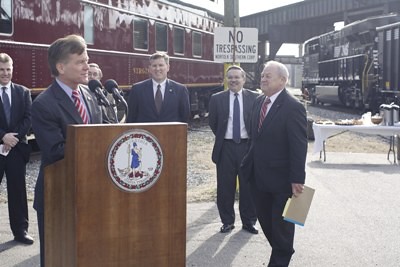
Governor Bob McDonnell announced that Norfolk Southern Railway Company is acquiring 1,500 new railcars from Chicago-based FreightCar America, Inc . The high-capacity coal cars will be manufactured at FreightCar America’s facility in Roanoke beginning in May of 2011. The order totals more than $100 million.

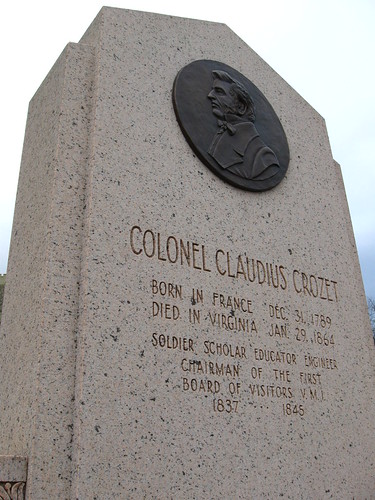
In the early days of our history, men like George Washington saw the need for a strong transportation system. Washington served as a director of the Chesapeake and Ohio Canal Company. Later the railroads would create the smooth road West that Washington saw as so essential. Claudius Crozet would later pioneer the construction of railroads through Virginia's mountainous regions. The region's prosperity in the decades that followed owes much to the forward thinking of such leaders.

Modern Virginia Governors do well to be equally committed to 'smooth the road' for Virginia's commerce. Governor Bob McDonnell, through a number of initiatives, is showing that the current administration shares in the vision of men like Washington and Crozet.

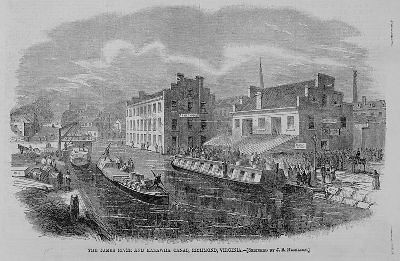
James River and Kanawha Canal
James River and Kanawah Canal.

Mount Vernon, October 10, 1784.

Dear Sir:

Upon my return from the western Country a few days ago, I had the pleasure to receive your favor of the 17th. ulto. It has always been my intention to pay my respects to you before the chance of another early and hard winter should make a warm fireside too comfortable to be relinquished. And I shall feel an additional pleasure in offering this tribute of friendship and respect to you, by having the company of the Marqs. de la Fayette, when he shall have revisited this place from his Eastern tour; now every day to be expected.

I shall take the liberty now, my dear sir, to suggest a matter, which would (if I am not too shortsighted a politician) mark your administration as an important era in the Annals of this Country, if it should be recommended by you, and adopted by the Assembly.

It has been long my decided opinion that the shortest, easiest, and least expensive communication with the invaluable and extensive Country back of us, would be by one, or both of the rivers of this State which have their sources in the Apalachian mountains. Nor am I singular in this opinion. Evans, in his Map and Analysis of the middle Colonies which (considering the early period at which they were given to the public) are done with amazing exactness. And Hutchins since, in his topographical description of the Western Country, (a good part of which is from actual surveys), are decidedly of the same sentiments;
as indeed are all others who have had opportunities, and have been at the pains to investigate and consider the subject.

But that this may not now stand as mere matter of opinion or assertion, unsupported by facts (such at least as the best maps now extant, compared with the oral testimony, which my opportunities in the course of the war have enabled me to obtain); I shall give you the different routs and distances from Detroit, by which all the trade of the North Western parts of the United territory, must pass; unless the Spaniards, contrary to their present policy, should engage part of it; or the British should attempt to force nature by carrying the trade of the upper Lakes by the river Outawaies into Canada, which I scarcely think they will or could effect. Taking Detroit then (which is putting ourselves in as unfavourable a point of view as we can be well placed, because it is upon the line of the British territory) as a point by which, as I have already observed, all that part of the trade must come, it appears from the statement enclosed, that the tide waters of this State are nearer to it by 168 miles than that of the river St. Lawrence; or than that of the Hudson at Albany by 176 miles.

Maryland stands upon similar ground with Virginia. Pennsylvania altho’ the Susquehanna is an unfriendly water, much impeded it is said with rocks and rapids, and nowhere communicating with those which lead to her capital; has it in contemplation to open a communication between Toby’s Creek (which empties into the Alleghany river, 95 miles above
Fort Pitt) and the west branch of Susquehanna; and to cut a canal between the waters of the latter, and the Schuylkill; the expence of which is easier to be conceived than estimated or described by me. A people however, who are possessed of the spirit of commerce, who see, and who will pursue their advantages, may achieve almost anything. In the mean time, under the uncertainty of these undertakings, they are smoothing the roads and paving the ways for the trade of that western World. That New York will do the same so soon as the British Garrisons are removed, which are at present, insurmountable obstacles in their way, no person who knows the temper, genius, and policy of those people as well as I do, can harbour the smallest doubt.

Thus much with respect to rival States; let me now take a short view of our own; and being aware of the objections which are in the way, I will enumerate, in order to contrast them with the advantages.

The first and principal one is, the unfortunate Jealousy, which ever has and it is to be feared ever will prevail, lest one part of the State should obtain an advantage over the other part (as if the benefits of trade were not diffusive and beneficial to all); then follow a train of difficulties viz: that our people are already heavily taxed; that we have no money; that the advantages of this trade are remote that the mostdirect rout for it is thro’ other States, over whom we have no controul; that the routs over which we have controul, are as distant as either of those which lead to Philadelphia, Albany or Montreal; That a sufficient spirit of commerce does not pervade the citizens of this commonwealth; that we are in fact doing for others, what they ought to do for themselves.

Without going into the investigation of a question, which has employed the pens of able politicians, namely, whether trade with Foreigners is an advantage or disadvantage to a country. This State as a part of the confederated States (all of whom have the spirit of it very strongly working within them) must adopt it, or submit to the evils arising therefrom without receiving its benefits; common policy therefore points clearly and strongly, to the propriety of our enjoying all the advantages which nature and our local situation afford us; and evinces clearly that unless this spirit could be totally eradicated in other States, as well as in this, and every man made to become either a cultivator of the Land, or a manufacturer of such articles as are prompted by necessity, such stimulas should be employed as will force this spirit; by shewing to our Countrymen the superior advantages we possess beyond others; and the importance of being upon a footing with our Neighbours.

If this is fair reasoning, it ought to follow as a consequence, that we should do our part towards opening the communication with the fur and peltry trade of the Lakes; and for the produce of the Country which lies within; and which will, so soon as matters are settled with the Indians, and the terms on which Congress means to dispose of the Land, and found to be favourable, are announced, settle faster than any other ever did, or any one would imagine. This then when considered in an interested point of view, is alone sufficient to excite our endeavours; but in my opinion, there is a political consideration for so doing, which is of still greater importance.

I need not remark to you Sir, that the flanks and rear of the United States are possessed by other powers, and formidable ones too; nor how necessary it is to apply the cement of interest, to bind all parts of the Union together by indissoluble bonds, especially that part of it, which lies immediately west of us, with the middle States. For, what ties, let me ask, shou’d we have upon those people? How entirely unconnected with them shall we be, and what troubles may we not apprehend, if the Spaniards on their right, and Gt. Britain on their left, instead of throwing stumbling blocks in their way as they now do, should hold out lures for their trade and alliance. What, when they get strength, which will be sooner than most people conceive (from the emigration of foreigners who will have no particular predilection towards us, as well as from the removal of our own citizens) will be the consequence of their having formed close connexions with both, or either of those powers in a commercial way?
It needs not, in my opinion, the gift of prophecy to foretell.

The Western settlers, (I speak now from my own observation) stand as it were upon a pivot; the touch of a feather, would turn them any way. They have look’d down the Mississippi, until the Spaniards (very impoliticly I think, for themselves) threw difficulties in their way; and they looked that way for no other reason, than because they could glide gently down the stream; without considering perhaps, the fatigues of the voyage back again, and the time necessary to perform it in; and because they have no other means of coming to us but by a long Land transportation and unimproved roads. These causes have hitherto checked the industry of the present settlers; for except the demand for provisions, occasioned by the increase of population, and a little flour which the necessities of Spaniards compel them to buy, they have no incitements to labour. But smooth the road once, and make easy the way for them, and then see what an influx of articles will be poured upon us; how amazingly our exports will be encreased by them, and how amply we shall be compensated for any trouble and expence we may encounter to effect it.

A combination of circumstances makes the present conjuncture more favourable for Virginia, than for any other State in the Union, to fix these matters. The jealous and untoward disposition of the Spaniards on one hand, and the private views of some individuals, coinciding with the general policy of the Court of Great Britain, on the other, to retain as long as possible the Posts of Detroit, Niagara, and Oswega &c. (which, tho’ done under the letter of the Treaty, is certainly an infraction of the spirit of it, and injurious to the Union) may be improved to the greatest advantage by this State; if she would open the avenues to the trade of that Country, and embrace the present moment to establish it. It only wants a beginning; the Western
Inhabitants wou’d do their part towards its execution. weak as they are, they would meet us at least half way, rather than be driven into the arms of, or be made dependant upon foreigners; which would, eventually, either bring on a separation of them from us, or a war between the United States and one or the other of those powers, most probably with the Spaniards.

The preliminary steps to the attainment of this great object, would be attended with very little expence, and might, at the same time that it served to attract the attention of the Western Country, and to convince the wavering Inhabitants thereof of our disposition to connect ourselves with them, and to facilitate their commerce with us, would be a mean of removing those jealousies which otherwise might take place among ourselves.

These, in my opinion are; to appoint Commissioners, who from their situation, integrity and abilities, can be under no suspicion of prejudice or predilection to one part more than to another. Let these Commissioners make an actual survey of James river and Potomack from tide-water to their respective sources. Note with great accuracy the kind of navigation, and the obstructions in it; the difficulty and expence attending the removal of these obstructions; the distances from place to place thro’ the whole extent; and the nearest and best Portages between these waters and the Streams capable of improvement which run into the Ohio; traverse these in like manner to their junction with the Ohio, and with equal accuracy. The navigation of this river (i.e., the Ohio) being well known, they will have less to do in the examination of it; but nevertheless, let the courses and distances of it be taken to the mouth of the Muskingum, and up that river (notwithstanding it is in the ceded lands) to the carrying place with Cayahoga; down the Cayahoga to Lake Erie, and thence to Detroit. Let them do the same with big Bever creek, although part of it is in the State of Pennsylvania; and with the Scioto also. In a word, let the Waters East and West of the Ohio, which invite our notice by their proximity, and the ease with which Land transportation may be had between them and the Lakes on one side, and the rivers Potomac and James on the other, be explored, accurately delineated, and a correct and connected Map of the whole be presented to the public. These things being done, I shall be mistaken if prejudice does not yield to facts; jealousy to candour, and finally, that reason and nature thus aided, will dictate what is right and proper to be done.

In the mean while, if it should be thought that the lapse of time which is necessary to effect this work, may be attended with injurious consequences, could not there be a sum of money granted towards opening the best, or if it should be deemed more eligible, two of the nearest communications, one to the Northward and another to the Southward, with the settlements to the westward? And an act be passed (if there should not appear a manifest disposition in the Assembly to make it a public undertaking) to incorporate, and encourage private
Adventurers if any should associate and sollicit the same, for the purpose of extending the navigation of Potomac or James river? And, in the former case, to request the concurrence of Maryland in the measure. It will appear from my statement of the different routs (and as far as my means of information have extended, I have done it with the utmost candour), that all the produce of the settlements about Fort Pitt can be brought to Alexandria by the Yohoghancy in 304 Miles; whereof only 31 is land transportation: And by the Monongahela and Cheat river in 300 miles; 20 only of which are land carriage. Whereas the common road from Fort Pitt to Philadelphia is 320 miles, all Land transportation; or 476 miles, if the Ohio, Toby’s Creek, Susquehanna and Schuylkill are made use of for this purpose: how much of this is by land, I know not; but from the nature of the Country it must be very considerable. How much the interests and feelings of people thus circumstanced would be engaged to promote it, requires no illustration.

For my own part, I think it highly probable, that upon the strictest scrutiny (if the Falls of the Great Kanhawa can be made navigable, or a short portage be had there), it will be found of equal importance and convenience to improve the navigation of both the James and Potomac. The latter I am fully persuaded, affords the nearest communication with the Lakes; but James river may be more convenient for all the settlers below the mouth of the Gt. Kanhawa, and for some distance perhaps above, and west of it: for I have no expectation that any part of the trade above the falls of the Ohio will go down that river and the Mississippi, much less that the returns will ever come up them; unless our want of foresight and good management is the
occasion of it. Or upon trial, if it should be found that these rivers, from the beforementioned Falls, will admit the descent of Sea vessels; in which case, and the navigation of the former’s becoming free, it is probable that both vessels and the cargoes will be carried to foreign markets and sold; but the returns for them will never in the natural course of things, ascend the long and rapid current of that river; which with the Ohio to the Falls, in their meanderings, is little if any short of 2000 miles. Upon the whole, the object, in my estimation is of vast commercial and political importance: in these lights I think posterity will consider it, and regret (if our conduct should give them cause) that the present favourable moment to secure so great a blessing for them, was neglected.

One thing more remains, which I had like to have forgot, and that is the supposed difficulty of obtaining a passage tho’ the State of Pennsylvania. How an application to its Legislature would be relished, in the first instance, I will not undertake to decide; but of one thing I am almost certain, such an application would place that body in a very delicate situation. There is in the State of Pennsylvania at least 100,000 souls west of the Laurel hill, who are groaning under the inconveniences of a long land transportation; they are wishing, indeed they are looking for the improvement and extension of inland navigation; and if this cannot be made easy for them, to Philada (at any rate it must be lengthy), they will seek a mart elsewhere; the consequence of which would be, that the State, tho’ contrary to the policy and interests of its Sea-ports, must submit to the loss of so much of its trade, or hazard not only the trade but the loss of the Settlement also; for an opposition on the part of Government to the extension of water transportation, so consonant with the essential interests of a large body of people, or any extraordinary impositions upon the exports or imports to, or from another State, would ultimately bring on a separation between its Eastern and Western Settlements; towards which, there is not wanting a disposition at this moment in that part of it, which is beyond the mountains. I consider Rumsey’s discovery for working Boats against stream, by mechanical powers (principally) as not only a very fortunate invention for these States in general, but as one of those circumstances which have combined to render the present epocha favourable above all others for fixing, if we are disposed to avail ourselves of them, a large portion of the trade of the Western Country in the bosom of this State irrevocably.

Lengthy as this letter is, I intended to have written a fuller and more digested one, upon this important subject, but have met with so many interruptions since my return home, as almost to have precluded my writing at all. What I now give is crude; but if you are in sentiment with me, I have said enough; if there is not an accordance of opinion I have said too much and all I pray in the latter case is, that you will do me the justice to believe my motives are pure, however erroneous my judgment may be on this matter, and that I am with the most perfect esteem etc.

IMG_2572
Claudius Crozet first pushed the railroad through Rockfish Gap in the Blue Ridge Mountains. His Monument may be seen today on the grounds of the Virginia Military Institute.

Thursday, February 3, 2011

Infrastructure as Investment

The Economic Impact of Improved Tansportation

Vienna
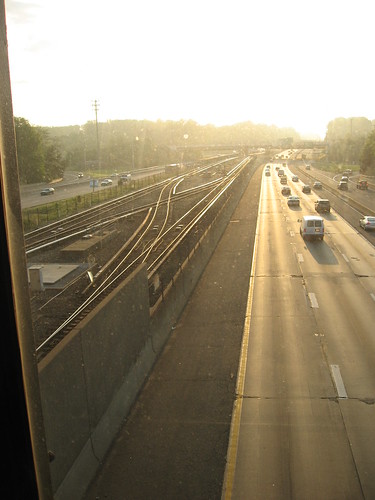
Interstate 66 in Vienna.

The Impact of 16 Infrastructure Projects
on the Commonwealth of Virginia Economy


This Report [click to read] by Stephen S. Fuller, Ph.D, makes the case. Virginia’s economy would expand by $4.1 billion and support 56,798 additional jobs if 16 infrastructure mega-projects being considered by the Virginia Department of Transportation (VDOT) are completed. The research conducted by Dr. Fuller, a George Mason University Professor in the School of Public Policy and Director of the Center for Regional Analysis, supports the Governor's proposed highway improvements as a long-term investment in Virginia's future.

Wednesday, December 8, 2010

Putting America Back to Work

Our Future Should be Built on Our Past Success

Valley Railroad Bridge
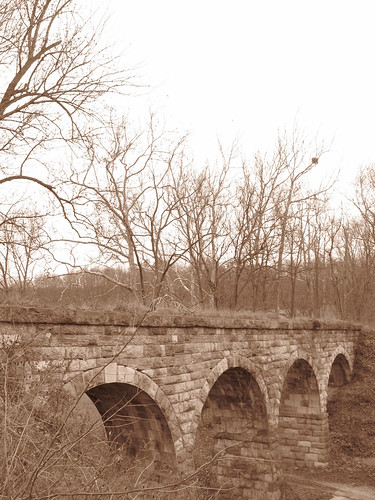
The Valley Railroad was once a branch of the B&O that ran all the way to Rockbridge County.

Mcormick's Mill
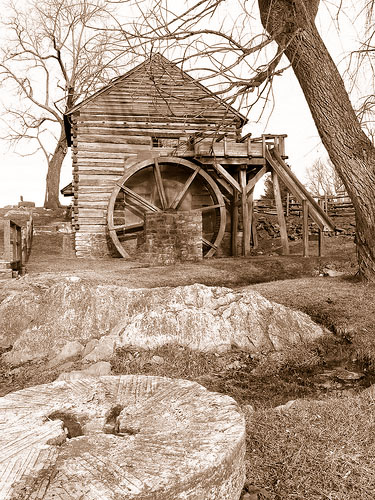
Agriculture was revolutionized by Cyrus McCormick, who built his first reaper at his Father's mill in Augusta County. The operation moved to Chicago to become the International Harvester Corporation.

Fishersille Mike shares this piece: Hard Choices All Around [click to read]. The bottom line is that it is time to start making things again. He references This Article by William Gross [click to read].

"The global economy is suffering from a lack of aggregate demand. With insufficient demand, nations compete furiously for their share of the diminishing growth pie.

In the U.S. and Euroland, many policies only temporarily bolster consumption while failing to address the fundamental problem of developed economies: Job growth is moving inexorably to developing economies because they are more competitive.

Unless developed economies learn to compete the old-fashioned way – by making more goods and making them better – the smart money will continue to move offshore to Asia, Brazil and their developing economy counterparts, both in asset and in currency space."

Drive past the once flourishing DuPont plant in Waynesboro and this will soon start to sink in. Once this complex employed thousands. Today a few hundred workers make Lycra. To qoute Billy Joel: "We're all in Allentown now."

Well we’re living here in Allentown
And they’re closing all the factories down
Out in Bethlehem they’re killing time
Filling out forms

Standing in line

Well our fathers fought the Second World War
Spent their weekends on the Jersey Shore
Met our mothers at the USO
Asked them to dance
Danced with them slow

And we're living here in Allentown.
But the restlessness was handed down
And it's getting very hard to stay.

Well we're waiting here in Allentown
For the Pennsylvania we never found
For the promises our teachers gave
If we worked hard
If we behaved.

So the graduations hang on the wall
But they never really helped us at all
No they never taught us what was real
Iron or coke,
Chromium steel.

– Billy Joel, 1982

But 'living in Allentown' is not an option. The decline of the American economy cannot support our large urbanized population.

"The constructive way is to stop making paper and start making things. Replace subprimes, and yes, Treasury bonds with American cars, steel, iPads, airplanes, corn – whatever the world wants that we can make better and/or cheaper. Learn how to compete again. Investments in infrastructure and 21st century education and research, as opposed to 20th century education are mandatory, as is a withdrawal from resource-draining foreign wars. It will be a tough way back, but it can be done with sacrifice and appropriate public policies that encourage innovation, education and national reconstruction, as opposed to Wall Street finance and Main Street consumption."

Some of the developments that make American plants less competitive are not bad. American mills in the Nineteenth Century employed children, often in dangerous environments. A system that has made life better for the workers is not a bad thing. High corporate tax rates, unsustainable pension plans and redundant Federal oversight that discourages production are very bad things.

We needn't reclaim all manufacturing. We need to find opportunities to excell as new technologies develop and master their development. New processes and craftmanship should fill our vacant plants and find market share enriching customers around the world.

Producing our own energy is essential. Increased nuclear capacity must be developed along with our own oil, gas and coal resources. Controlling energy costs is essential to our future productivity.

Localized production, small and home businesses and artisan farms are part of the answer too. Less centalization of such things as food production is good and renders us less susceptable to worldwide economic chaos.

The 1904 Saint Louis World's Fair and American Superiority

This Article by Guy Sorman in City Journal caught my eye. In 1904 the robust American economy was recognized as a world leader, but Sorman quotes a study showing the American economy coming into its own by 1820! He goes on to point out how egalitarian American ideals actually created the first mass market. Joseph Schumpeter's “creative destruction” is also mentioned as a reason for economic prosperity as the new constantly replaces the old and the market reallocates resources accordingly.

That translates into new innovative technology and methods. Eventually we'll be driving hydrogen cars and seeing advances in healthcare delivery. Government mandates won't accomplish this, changing economies, innovation and market demand will.

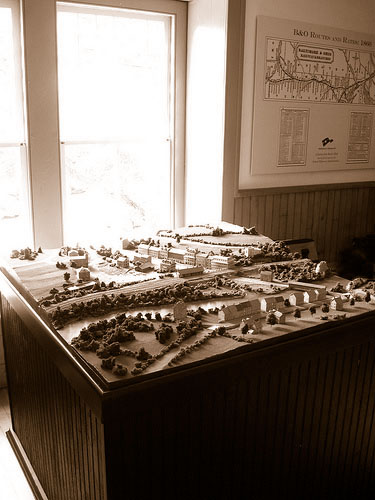
I once did a reconstruction of the Nineteenth Century town of Ellicott's Mills, first terminus of the Baltimore and Ohio Railroad outside of Baltimore. The Ellicott Brothers had migrated from Bucks County, Pennsylvania and settled on the banks of the Patapsco River. There they convinced Charles Carroll [the signer of the Declaration of Independence] to diversify his plantation agriculture. They intruduced wheat, flour mills, limestone mining and many other innovations and that is a model of what happened throughout the young Republic.

Our real cultural diversity as a 'Nation of Nations' fuels discovery and innovation. In spite of the professed loathing of so many world rulers for our Nation, the best and brightest still want to come here.

Model
Ellicott's Mills is typical of many American communities in the Nineteenth Century. Model by Mr. Kirchman.

Sorman points out that the U.S. economy and its spirit of enterprise still set the pace for the rest of the world. We must not invoke change that diminishes that.

The First Terminus of the B&O Railroad

B&O Station
B&O Station.

Patapsco Hotel
Patapsco Hotel.

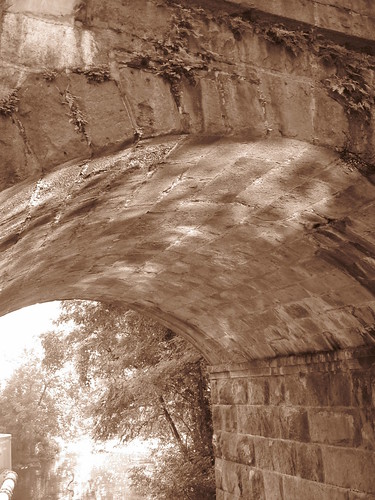
Bridge
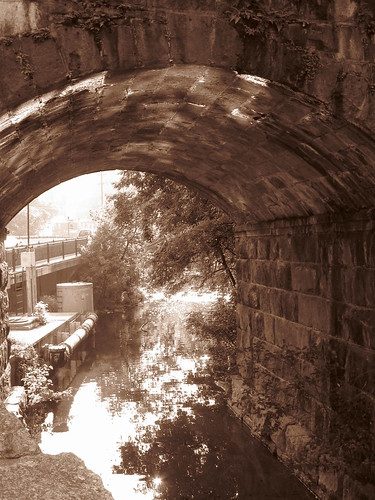
Arch of the old railroad bridge.

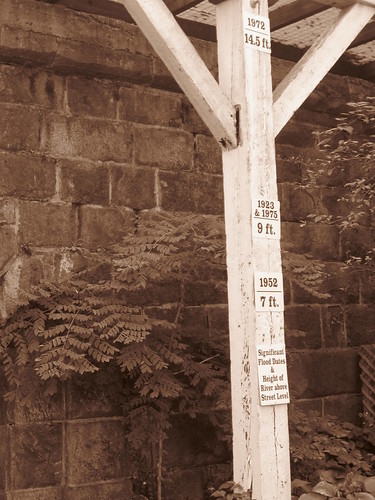
Floods
Floods of the Twentieth Century.

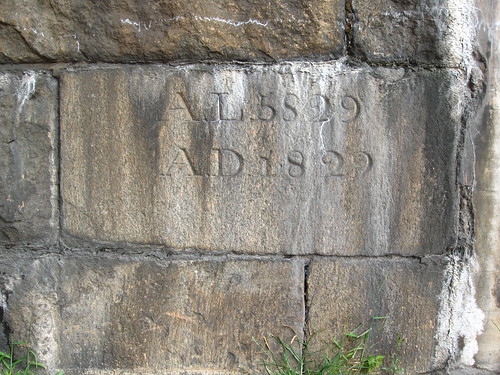
Bridge Cornerstone
Cornerstone of the railroad bridge...

Bridge
...still carrying Chessie System trains today.


Wednesday, October 27, 2010

Riding Railroading's Romantic Beginnings

Wind Power on the Baltimore and Ohio Railroad

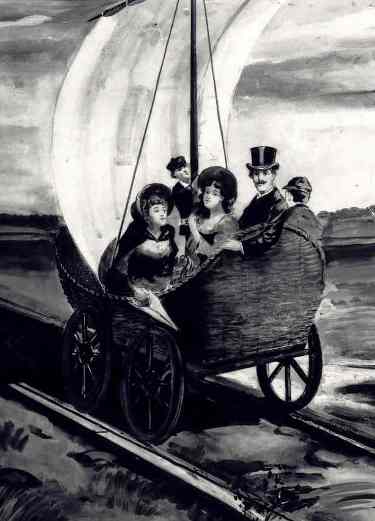
Sailcar Outing
AEolus sails down the Baltimore and Ohio tracks. From the Collections of the B&O Railroad Museum, used with permission.

A recent CSX Transportation radio spot invites canines in cars to "ride the wind, doggies!" It is a reference to the open roads created by CSX trains taking freight off the highways and a doggie's desire to ride in a car with his head sticking out of the open window. Railroading's early days briefly offered another opportunity to "ride the wind" as a unique experiment in motive power took place on America's first operating rail line.

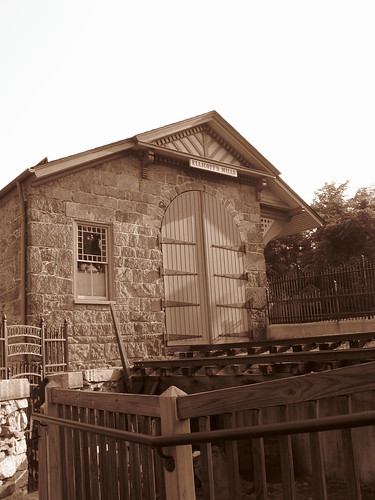
In the early days of the Baltimore and Ohio Railroad, the motive power was provided by horses. The carriages were pulled along the tracks by fine animals selected for this purpose. The building that housed stables and a blacksmith shop in Ellicott's Mills still stands. But horsepower would soon become a standard instead of a literal fact. Peter Cooper's small locomotive with its upright boiler would define the future of railroading. Still, there was a brief period in railroad history where passengers could literally ride the wind.

Evan Thomas of Baltimore constructed an experimental wicker car with a sail which he named the "AEolus." When there was enough wind blowing in direction to make it functional it was operated on the tracks between Baltimore and Ellicott's Mills.

The Russian Ambassador, Baron de Krudner came to observe the operationof the experimental car and actually handled the sail on the trip. He was presented by the President of the railroad with a model of the car. This led to an exchange of American engineers who helped construct Russia's rail system.

The demonstration of Cooper's steam locomotive set the direction for railroad operation. The Fourth Annual Report of the B&O Railroad in 1830 states:

"Experience with regard to the celerity of the conveyance of passengers during the preceeding four months on the first 13 miles of the Baltimore and Ohio Railroad, is of the most cheerful and convincing character. The practicability of maintaining a speed of 10 miles per hour with horses has been exhibited. With proper relays,this rate of traveling may be continued through any length of railway, the ascent and descents of which shall not exceed about 30 feet per mile.

Within the last few months, the improvements to locomotive steam engines have been such as to insure their general use on all railways of suitable gradation, and where fuel is cheap." [1.]

Wood and coal would fuel the first boilers. Riding the train could be a dirty experience as smoke and cinders wreaked havoc on the wardrobes of female travellers. Clean coal was used and promoted by the New York Central in this little rhyme:

Says Phoebe Snow
about to go
upon a trip to Buffalo
"My gown stays white
from morn till night
Upon the Road of Anthracite"

The modern railroad saw the use of diesel and electric power. Welded rails and modern track alignment would finally create the illusion of a smooth and effortless glide down the tracks.

21st Century railroads would like to harness the energy of wind farms to power their catenaries [the overhead wires providing power to locomotives], but even now, as during the Nineteenth Century, the winds remain as fickle as they are romantic.

1. The early motive power of the Baltimore and Ohio railroad By Joseph Snowden Bell, p. 5.

Monday, October 25, 2010

Life's Railway to Heaven

By M.E. Abbey--Words, and Charlie D. Tillman--Music

Rock Tunnel
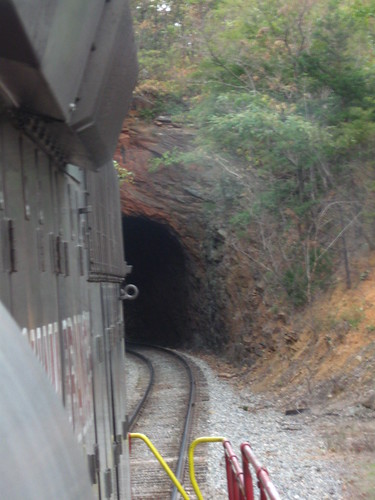
Buckingham Branch RR GP40 BB6 entering Claudius Crozet's Rock Tunnel in the Blue Ridge Mountains.

Life is like a mountain railroad, with an engineer that's brave;
We must make the run successful, from the cradle to the grave;
Watch the curves, the fills, the tunnels; never falter, never quail;
Keep your hand upon the throttle, and your eye upon the rail.

Bless'd Savior, Thou wilt guide us,
Till we reach that blissful shore;
Where the angels wait to join us
In Thy praise forevermore.

You will roll up grades of trial; you will cross the bridge of strife;
See that Christ is your Conductor on this lightning train of life;
Always mindful of obstruction, do your duty, never fail;
Keep your hand upon the throttle, and your eye upon the rail.

Bless'd Savior, Thou wilt guide us,
Till we reach that blissful shore;
Where the angels wait to join us
In Thy praise forevermore.

You will often find obstructions; look for storms of wind and rain;
On a fill, or curve, or trestle, they will almost ditch your train;
Put your trust alone in Jesus; never falter, never fail;
Keep your hand upon the throttle, and your eye upon the rail.

Bless'd Savior, Thou wilt guide us,
Till we reach that blissful shore;
Where the angels wait to join us
In Thy praise forevermore.

As you roll across the trestle, spanning Jordan's swelling tide,
You behold the Union Depot into which your train will glide;
There you'll meet the Superintendent, God the Father, God the Son,
With the hearty, joyous, plaudit, "Weary pilgrim, welcome home!"

Bless'd Savior, Thou wilt guide us,
Till we reach that blissful shore;
Where the angels wait to join us
In Thy praise forevermore.

This old spiritual has been relegated to a funeral hymn by many music directors. It would seem to me that it is more of a message for us to consider on the main line of life.

Christmas at Union Station
Union Station in Washington DC.

Wednesday, October 20, 2010

A Ride Through History on the BBRR

Buckingham Branch Railroad Follows Historic Path

Original Blue Ridge Tunnel
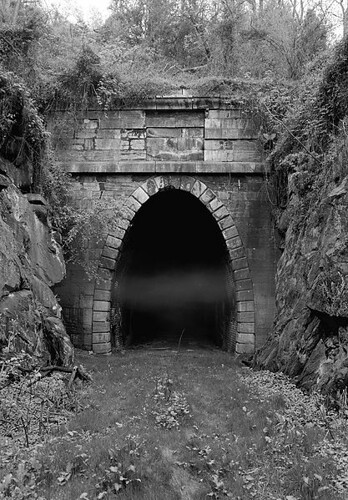
Claudius Crozet's Original Blue Ridge Tunnel. Library of Congress Image.

The Virginia Central Railroad was a major feat of engineering in its day as Claudius Crozet built a series of four tunnels under the Blue Ridge Mountains in 1856. Today the crews that operate the Buckingham Branch Railroad carry on the tradition.

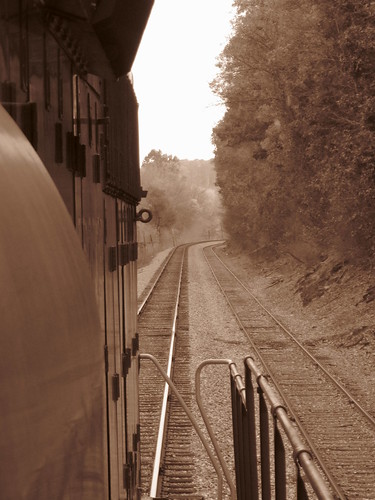
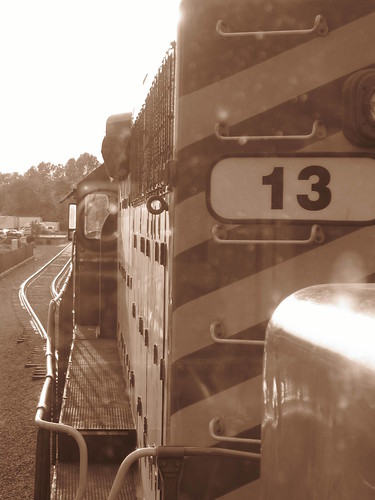
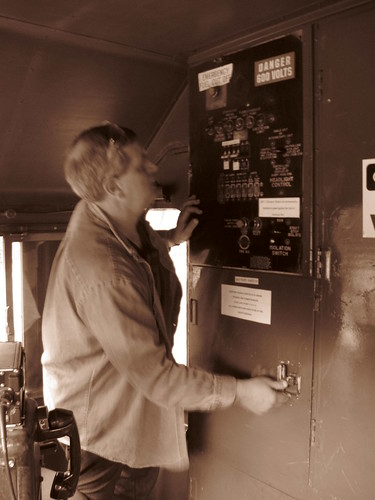
We're riding on BB6, a GP40 diesel-electric locomotive, out of The Flats. Our crew, Don and Zane, are making the run across the mountain to Charlottesville. A number of businesses along the track depend on the railroad for bulk shipments.

We roll through Staunton and make our way to Transit Mix Concrete to deliver a car. Although much of a railroad's operation is computerized, the process of making up trains and taking them apart is still a mixture of chess game, choreography and hard work on the part of the train crew.

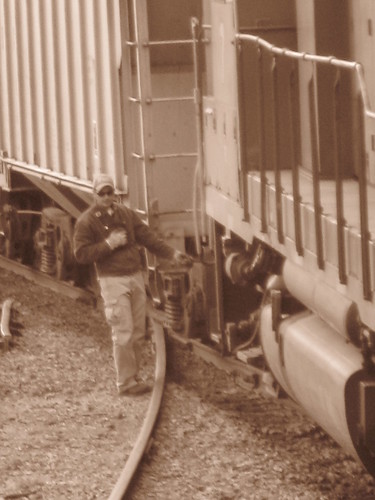
Switches must be unlocked and thrown, hand brakes set and unset and safety measures attended to. It looks like fun on a balmy october day as Zane moves about performing these tasks, but you have to imagine what it is like when he's doing the same job in last Winter's big snow or driving rain. A railroad man's job was tough in the Nineteenth Century and this part of it hasn't changed.

It takes a bit of leverage to throw a switch on a good day, so think of what it must be like when snow is piling up around you. We back into the first siding. It has tight curves that make for slow going. We've left most of our cars on the main line and are pushing the cement car into place. Then we need to return and couple up those we've left. We pull forward and back the entire train onto the Transit Mix siding to clear the track for a Westbound CSX train. The switch must be opened for the main line and locked before the track is considered clear.

Then you wait. Safe operation depends on constant communication and a permitting system to ensure that no Eastbound train tries to share a track with a Westbound. There are work trains to be accounted for too. A long line of empty coal cars passes. When the track is cleared we begin again. Our next stop is Augusta Coop. We will be bringing them another car from Charlottesville, so we drop one car for them on their siding. We'll put it in the fertilizer pit area later when we return.

Now we make our way out to Fishersville. We roll through Waynesboro and Basic City. We start climbing the mountain and enter the almost mile-long Blue Ridge Tunnel. This is a parallel tunnel to Crozet's original Blue Ridge Tunnel that was built in 1942 for larger wartime rail cars. We emerge at Afton and head down seven miles of descending grade that will take us to the town of Crozet.

The train moves through a series of tight curves where the track follows the original route, You can imagine what it must have been like to cut that grade through the stone by hand. We move through this section under 25 miles per hour. The Rock tunnel is next. Here is an uncased tunnel that was built by Crozet. It looks about the same as it did in the Nineteenth Century.

We pass through open cuts where the Greenwood tunnel and another tunnel have been bypassed. Then its on through Crozet. We pass the now defunct Westvaco wood lot in Ivy. "This would be a great place for a business," Don says. "Good luck on that, this is Albemarle County," I reply. When I lived in Crozet, some of my neighbors worked for Westvaco. There were the Morton's Frozen Foods plant and Acme Visible Records plant in the town itself. Both are shuttered now as well.

We enter Charlottesville where the train must crawl through town at 10 miles per hour and cannot blow her horn at grade crossings. I muse to Don about UVA students who cross streets [and railroad tracks] without looking: "What do you do about them," I ask. "You have to be ready to stop" is his answer. You are allowed to sound the horn in an emergency.

We switch cars in the Charlottesville yard by the fading evening light. There is a little preschool by the entrance to the yards and it gives me great pleasure to sit in a locomotive cab and wave to the kids. The teachers hold up some of the little guys to get a better look. I wave some more as we pass the school several times. I remember in my youth the Maryland and Pennsylvania Railroad had a track near our house. I liked to watch that train.

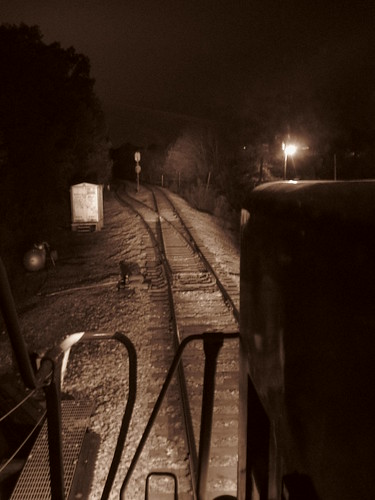
It is dark as we crawl back out of Charlottesville. Don spots a grey fox sitting on the track near the University of Virginia. He runs off and we spot a hole near the track. Later I spot an owl flying overhead as we run through Albemarle County. Deer are everywhere.

We return to Brand, just East of Staunton, where we shuffle around the other car we've picked up for Augusta Coop and push it into their siding. It's around 9:30pm when we return to the flats. There is paperwork to do for the crew. I pick up Don's bag of required operating manuals -- it is heavy. I'm grateful to have seen a part of the culture that built this country and to have shared it with the men who still live it.

Staunton
BB6 Leaves the flats and heads through Staunton.

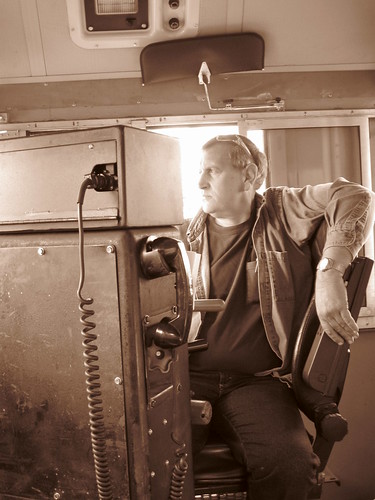
Don driving BB6
Don driving BB6.

Augusta Coop
Augusta Coop.

BB6
Rolling through Brand, heading East.

BB13
BB13.

Charlottesville
In the Charlottesville Yard.

Powering up BB7
Powering up BB7 for the return trip.

Blue Ridge Tunnel
Inside the Blue Ridge Tunnel.

Brand Siding
Back at Brand.

More Photos [click to view].

Tuesday, November 10, 2009

The B&O Railroad in the Valley

The Valley Railroad

Valley Railroad Bridge
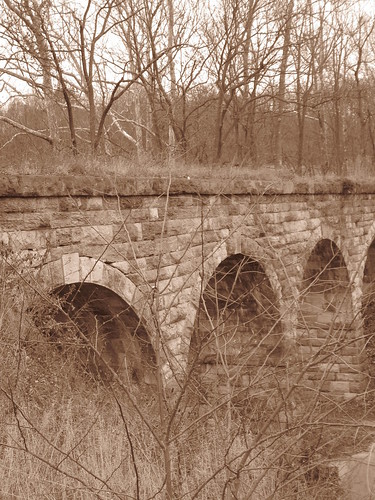
Valley Railroad bridge built around 1884.

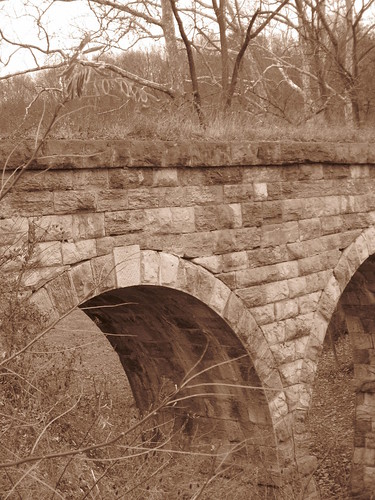
Driving South from Staunton on interstate 81 one cannot miss the beautiful old railroad bridge spanning Folly Creek just south of the interchange with route 262. It was built around 1884 as part of a line that extended down the Valley from Harper's Ferry to Lexington.

The Valley Railroad was chartered February 23, 1866 but was an idea held since the mid-1800's by the Baltimore and Ohio Railroad to tap into the rich agriculture of the Virginia Valley as well as the coalfields to the West. Iron and Maganese were to be found as well and by 1883 construction reached as far as Lexington.

Construction would continue toward Salem but the final stretch of track was never laid. Economic crisis and competition from parallel lines would eventually bring construction to a halt but the line itself was operated as part of the B&O system for many years. It was not abandoned until 1942.

Valley Railroad Bridge
A rough faced granite ashlar stone...

Valley Railroad Bridge
...with a smooth face ashlar in the soffits of the arches.

Saturday, September 5, 2009

A Journey on the National Road

America's First 'Federal' Highway Project

The National Road passes under the Baltimore and Ohio Railroad.
This is our model of mid Nineteenth Century Ellicott's Mills.

Long before Route 66 and the Lincoln Highway, in our country's younger days there was the National Road. Here's a Photographic Journey [click to read] down the National Road by Christopher Busta-Peck.

Wednesday, August 26, 2009

Roads to Rails

Our Model in the B&O Museum, Ellicott City

Roads to Rails
The Roads to Rails display.

Roads to Rails
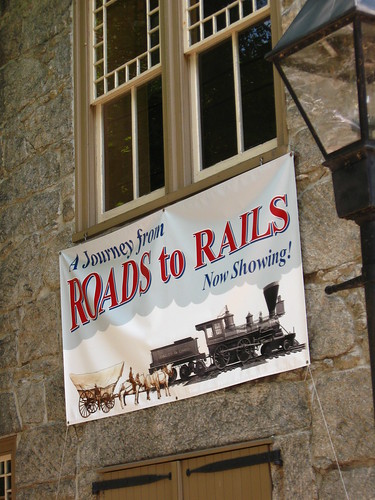
Banner for 'Roads to Rails' on the old station.

One of the highlights of the Summer has been preparing the model of Nineteenth Century Ellicott's Mills for display in 'Roads to Rails.' Today I was at the museum adding the old stables. Did you know that the first railroad horsepower was... literally horsepower! Prior to the introduction of the upright boiler steam engines cars were pulled by teams of horses.