The Mayor Who Made a DifferenceAn Article for the June 1996 Deep Cove Crier
by Reverend Ed Hird, Rector,
St. Simon’s Anglican Church, Used with his permission.So often, Toronto functions as the city that other Canadians feel the most ambivalent about. The proverbial expression "Can anything good come out of Nazareth?" readily comes to my mind as I think of Toronto. And yet ironically, the nickname "Toronto The Good" points to a side of Toronto that has largely been forgotten in the Canadian amnesia about our own heritage and roots. I was talking recently to Phyllis Beck, the Deep Cove Crier Seniors Columnist, about Toronto roots, only to discover that her daughter-in-law, Barbara Hall, is the current Mayor of Toronto. I commented to Phyllis about the recent discovery that my Great-great-grandfather, Thomas Allen, was a senior Alderman in Toronto during a period of 19 years. When I was in Toronto a few months back, getting a first-hand glimpse of the "Toronto Blessing", I kept driving back and forth past Allen Road. My ignorance about this road named after my Torontonian ancestor reminded me afresh of our Canadian forgetfulness about some of our own heros.
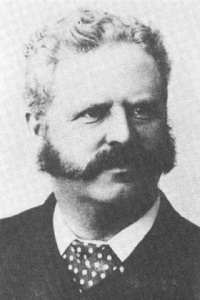 William H. Howland
One such hero was
Mayor William Howland of Toronto, a public servant who was so dedicated to helping the disadvantaged that he gave away most of his wealth. Son of the Honorable W.P. Howland, the first Lieutenant-Governor of Ontario, William was possessed with a bubbly enthusiasm and phenomenal capacity for hard work. By the age he was 25, William was president, vice-president, or a director of more than a dozen companies in the fields of insurance and finance, electrical services, and paint manufacturing. When he became president of the Queen City Fire Insurance Company in 1871, he was the youngest insurance company president in Canada. As well, Howland was President of three influential organizations: the Toronto Board of Trade, the Dominion Board of Trade, and the Manufacturer’s Association of Ontario. Out of his love for his country, he served as Chairman of the Canada First movement, personally financing its weekly newspaper "The Nation".
At age 32, Howland was led to Christ by his priest, Dr. W.S. Rainsford of St. James Anglican Cathedral. His life-changing experience gave him a new passion for helping the poor. He became involved helping with the Hillcrest Convalescent Hospital, the YMCA, the Haven Home for Unwed Mothers, the Prisoner’s Aid Association, the Central Prison Mission School, and the Toronto General Hospital. Night after night, Howland visited the slums, going from house-to-house, and reaching out to the poor, the sick, and the alcoholic. He also purchased 50 acres to start an Industrial School in order to steer youth away from the life of crime. Other initiatives were his building an alternative school for drop-outs, and a Home for the Aged and Homeless Poor. When he began to teach an interdenominational bible study for 100 young men, his new priest J.P. Lewis objected to Howland’s involvement with non-Anglicans. Out of this rejection, he began the interdenominational Toronto Mission Union, which operated seniors’ homes, convalescent homes, and Toronto’s first-ever home nursing service.
Because of his great compassion for the poor, he was elected as Mayor of Toronto in 1885, with a strong mandate to clean up the city. Howland signaled his arrival in the mayor’s office by installing a twelve-foot banner on the wall, reading, "Except the Lord Build the City, the Watchman Wakes but in Vain". Despite fierce opposition, Howland was so successful, that Toronto became nicknamed "Toronto the Good". As champion of the poor, Howland and his Alliance friend, Rev. John Salmon, would tramp the lanes and alleys, feeding the poor, praying over the sick, and comforting the sad. With a population of just 104,000, Toronto had over 800 licensed and unlicensed saloons. Over half of all criminal offenses recorded in 1885 were related to drunkenness.
Howland is described in Desmond Morton’s book "Mayor Howland: the Citizen’s Candidate" as the first reform mayor in Toronto’s history. Due to bureaucratic corruption, municipal garbage collection was all but non-existent. Even City Hall’s own garbage was rarely picked up. Rotting garbage fouled the alleyways, yards, and streets, giving Toronto a reputation for flies, stench, and disease. With no general sewage system, Toronto lived on the verge of a typhoid epidemic. Children swam in the same Toronto harbour area into which raw sewage was flowing from the ditches. Toronto’s fresh water supply was sucked through leaking and rotting wooden pipes, half buried in the sewage and sludge of the Toronto harbour.
Howland believed that we didn’t usually need more laws; we just needed to enforce the ones that already existed. He shocked the city bureaucrats by enforcing the already existing bylaw which forbid the depositing of garbage within the city limits. After he threatened to send the city commissioner to jail for breaking this bylaw, garbage miraculously began to be collected! Howland also worked hard in the construction of a trunk sewer system, to redirect the sewage away from the Toronto Harbour. He had such a dramatic impact in reducing the crime rate that other mayors began visiting Toronto, hoping to imitate Howland’s miracle.
During his re-election campaign in 1887, all the taxi cabs were paid off by Howland’s opponent so that they would refuse to take Howland’s supporters to the polling stations. Women however (2,000 widows and single women with property) had just been given the vote. So they held up their long Victorian dresses, and trucked through the snow to give Howland the moral reformer a second term. When Howland was re-elected by a landslide, over 3,000 of his supporters at the YMCA hall spontaneously burst into singing "Praise God From Whom All Blessings Flow.".
After he unexpectedly stepped down as Mayor after two terms, Howland became the founding President of the Christian Alliance (which later took the name C&MA: Christian and Missionary Alliance). The unique interdenominational nature of the early C&MA allowed Howland to be its president, while still remaining an Anglican. When he died unexpectedly at age 49, his funeral involved Anglican, Alliance, and Presbyterian clergy. With more than a thousand mourners on foot from all social classes, it was the largest funeral procession that had ever been held in Toronto. A poem published in the Toronto Globe said of Howland: "And not Toronto mourns alone; All Canada his fame had heard; His name is dear, a household word, And far and wide, his worth was known". May William H. Howland continue to be a living symbol of the difference that just one Canadian can make.
Reverend Ed Hird, Rector,
St. Simon’s Anglican Church
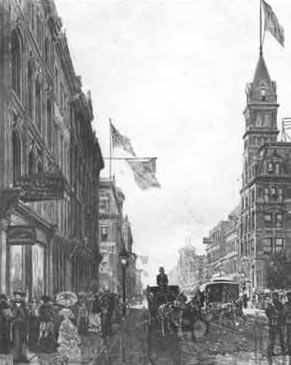 Toronto in the late Nineteenth Century.