Showing posts with label Citizen Educators. Show all posts

Wednesday, October 28, 2015

THYME Magazine: The Bridge Builder's Tale XXVII

Citizen Journalism with a Better Flavor

Chapterpagelh3

On a long flight, after periods of crisis and many hours of fatigue, mind and body may become disunited until at times they seem completely different elements, as though the body were only a home with which the mind has been associated but by no means bound. Consciousness grows independent of the ordinary senses. You see without assistance from the eyes, over distances beyond the visual horizon. There are moments when existence appears independent even of the mind. The importance of physical desire and immediate surroundings is submerged in the apprehension of universal values.” – Charles Linbergh

The aircraft was cleared for landing at Baltimore's BWI Airport. An ambulance met the Greenes and whisked them to Johns Hopkins. Kris' daughter had passed the hours watching the Disney 'Princesses' movies on the plane. Now she wore Pat's robe like a royal one as she was hurried off to Baltimore. Though the administration had tried to put institutions like Johns Hopkins Hospital under government control, the administrators of that institution had skillfully avoided it. Kris carried a sizeable amount of Alaska Petrodollars, handed to her by Rupert, in order to ensure her treatment under the "Private Option."

Zimmerman planned to remain on the plane and quietly slip out when they were no longer needed. Unfortunately he had parted with his Petrodollars before they might possibly have come in handy. This was no small airport where Zimmerman-friendly staff ignored the bounty on his head. This was Baltimore Washington International -- thirty minutes from the nation's capital! Some officious little weasel of a security official ran the obligatory check on the plane's tail number. He was not satisfied with the Calgary registration and started cross-checking the recorded flight plans. Obtaining a warrant, he and a small detail of security stormed the plane on the tarmac. Zimmerman's crews were required to be expert marksmen... and women, but Zimmerman ordered them to surrender. No one should have to die when Rupert's surrender would end any need for force. Besides, Zimmerman knew the lower 48 depended on the fruits of his labor for their economic survival. Negotiation just might work.

Zimmerman was taken into custody and the plane seized by the IRS. A tax charge had been fabricated by the administration in the hopes of just such a moment as this. While Rupert was incarcerated, Kris' daughter responded wonderfully to her treatments. Elizabeth O'malley provided them and the plane crew with commercial tickets home on Alaska Air. Alaska Air even 'loaned' the BSB a temporary replacement for 'BSB One.' Elizabeth's mercy flights continued even as her father languished in a US Federal Prison.

Elizabeth O'Malley pressed the Alaskan Autonomous Republic to pursue diplomatic measures to secure Rupert's release. Zimmerman took advantage of the time to write her lengthy letters in which he mused on how quickly a great culture like the United States could be reduced to the state she was in now, unaware of her heroic past, anxious for an uncertain future, she had sold herself out all too quickly to the rhetoric of "Hope and Change." Indeed there had been change, but now things had become all the more hopeless! A great nation that had rolled up her sleeves and faced obstacles with Faith and Tenacity was now reduced to the status of victims who blamed others for their lack of progress. Liberalism had moved from advancing mankind's condition to warring against the noble instincts of man... and man was being reduced in the process.

Pastor Greene was concerned about this too. An interesting round of correspondence between Elizabeth, Greene and Zimmerman ensued where the three thinkers opined as to how best address the problem. Zimmerman valued Greene's insight, as both men had a low tolerance for most of the bull-crap that passed as 'modern thought.' Elizabeth, who saw most of the world's suffering as a direct result of bad political choices, wondered at the revolving door of revolution, where the people overturned their rulers, identifying those in power as oppressors, only to establish regimes that were even more oppressive than the ones that they'd replaced. The great universities had been established to bring Christianity to the wilderness, but now they spurned their beginnings and promoted this endless cycle of violence. [1.]

A year went by. Kris' daughter grew strong and became the darling of the Big Diomede community. Elizabeth became the acting president of the BSB organization in her father's absence, presiding over the reconstruction of the Eastbound span's 'blind hump' into a more gradual ascent and descent. The president of the trucker's association gave her a plaque, but the burly presenter's sincere bear-hug represented more accurately the drivers' deep sentiments!

churchrebuild
"Eschewing the notion of high and noble ideals for humanity to aspire to, modern thinkers sought to recreate institutions rather than enlighten the heart. Their notion that 'man was basically good' and that the institutions were the problem did not resonate with a man like Zimmerman, who needed no-one to remind him of the dark places of his own heart." Greenstone Replacement, St. Francis' Church, Staunton, Virginia.
Photo by Bob Kirchman 

rebuildrepublic
Thomas Jefferson's Rotunda, Clad in Scaffolding for Reconstruction.
Photo by Bob Kirchman
Capitolreconst
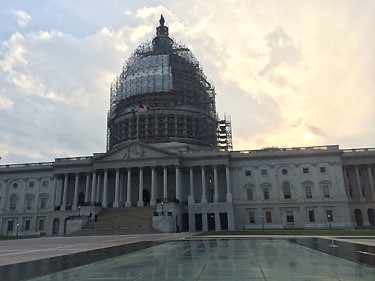
Capitol Dome in Scaffolding. Photo by R. S. Kirchman

Previous Chapter | Next Chapter
[click to read ]

Copyright © 2019, The Kirchman Studio, all rights reserved

Wednesday, October 22, 2014

THYME Magazine: "Elites and Intellectuals"

Citizen Journalism with a Better Flavor

FAITH2
Volume VIII, Issue XVII

The Vacuum at the Top

There was a time when the "elite" truly seemed to be better than most people. For example, Leonardo da Vinci was an architect, cartographer, engineer, painter, sculptor, writer and legendary inventor among other things. Socrates was a superb stonecutter, soldier, politician and philosopher. Galileo studied medicine, mathematics, physics and has been referred to as "the father of modern science." For much of human history even the lesser "elites" from noble families had a tremendous advantage over the average man in a time when an education was hard to come by and their wealth and position in society provided them with opportunities to acquire skills that the general populace couldn't." writes John Hawkins. In an article entitled: Elites Are No Longer Elite [click to read], Hawkins explores the reason this is so. Essentially, Hawkins says that there are no more Renaissance men and women, as people tend to become highly proficient in one area of expertise while remaining woefully ignorant of the world outside of their area of expertise. That was not always so.

There was a time when brilliant people like Claudius Crozet and Isambard Kingdom Brunel needed to know a broader range of knowledge in order to do the works they were able to accomplish. They needed to know more than engineering tables. They needed to understand commerce and markets. These men built railroads, but their work ultimately built communities as they provided avenues of commerce and prosperity. Crozet and Brunel seem far closer in stature to da Vinci than their modern counterparts. Hawkins continues: "Today, in a world where there is a nearly infinite supply of news sources, there are far fewer shared activities than there used to be; college educations are commonplace and people can become extraordinarily wealthy based on a terribly narrow skillset." Indeed, my own experience often included such exercises as drawing for architects who couldn't draw and sometimes in the presentation process, creating design for designers who couldn't. Indeed, I was sometimes amazed that by simply stepping back and taking in a larger picture, the resulting contribution to a work would be better than imagined.

The Académie des Beaux-Arts taught through the process of drawing. The advent of computer drafting led to a whole era of designers who's drawings, though they guided the mouse, where essentially drawn by someone else! The art once deemed so essential to design remains as a brief portion of the course, but it is no longer something a designer immerses oneself in every moment. One feels at times, watching the process, as if the designer is connecting lines and templates. The window manufacturer provides the cuts which are pasted into the drawing on screen. To be sure, the computer has opened up new vistas for the exploration of complex forms, but the buildings we live our everyday lives in do not require complex forms. Before the Second World War, in the early Twentieth Century, there existed a beautiful Classicism that made small houses noble. There was a sense of scale and proportion. There was a sense of shadow and texture. I learned much copying the styles of the renderers of those days.

On a far larger scale, Hawkins observes that our leaders often emerge having shown little or no expertise beyond their small sphere. Virginia boasts an 'elite' Senator who's 'expertise' consists of making a fortune by buying cell phone licenses. His good fortune in acquiring wealth is his credential. He does not know what it is like to struggle for years, paying your employee but not yourself to build a business. That might not be such an issue but for his stated derision of those who do: ""you’re going to see a coalition that has just about completely taken over the Republican Party in this state and if they have their way, it’s going to take over state government. It’s made up of the Christian Coalition, it’s made up of the right to lifers, it’s made up of the NRA, it’s made up of the homeschoolers, it’s made up of a whole coalition of people that have all sorts of different views that I think most of us in this room would find threatening to what it means to be an American." -- Mark Warner [1.]

There was a time when Beauty, Truth, Virtue and Nobleness were seen to spring from a Divine origin. The problem with Senator Warner's statement is that he summarily dismisses a whole group of people who embrace that. The Right to Life springs from the concept of IMAGO DEI, that belief that mankind is created in the Image of G-d. The Second Amendment acknowledges the belief that government serves the people and that power remains with the people. The ability to engage in self-defense is simply an expression of that greater principle. Homeschoolers simply acknowledge that the parent is the first one responsible for training up a child. They extend that responsibility in providing instruction in a broader body of knowledge than early language. Here Hawkins swerves into a greater truth. Modern relativism has rendered obsolete the concept that there is an ultimate source of Wisdom and Truth. The Academy, believing this, no longer teaches it.

Until recent times the Divine underpinning was foundational to learning. By its very nature it invited exploration of a broader world. Design had its inspiration in nature. Flawed human nature was continually challenged by a Divine benchmark. Relativism states that "all truths are equally valid," resulting in a diminished sense of the need to pursue absolute truth. Indeed, there is NO need to pursue absolute truth, for it doesn't exist in their thinking. This immediately serves to narrow one's experience. The celebration of 'Diversity' does NOT serve to broaden because it rails against the notion that there is an absolute. One steps up to the human experience like a consumer of a buffet, sampling interesting dishes but learning nothing about the creation of a meal! Indeed, Hawkins notes that one phenomenon inherent in this mindset is that now we have people who are famous simply for being famous. They need not present a resume of accomplishment. Hawkins cites the example of our President, who was elected despite the conspicuous absence of a resume of accomplishment.

As his election was sealed and his inauguration began, news anchors remarked: "We know VERY LITTLE about him!" A colleague of mine lamented the general lack of investigative journalism in our day, remarking that they must not have the resources for it. NO!, all you needed to do was READ HIS BOOK and you would come away with a strong sense of his Anticolonialist Socialist sentiments. But such is the Modern Age, that we can style the blank canvas of a Presidential candidate to be whatever we want him to be. Because many in our day are unfamiliar with true accomplishment, we fail to look for it!

That is why this publication has recently presented a series of stories of great accomplishment. Neil Armstrong and President Kennedy show us something of it. They showed us how to lift our eyes to the horizon. Kennedy, though a flawed man like most of us, did heroic things in the Pacific War and wrote a book called Profiles in Courage. I read it in Middle School... not as an assignment, mind you, but because it sat on Dad's voluminous bookshelves. Those people assigned to find counterfeit money do not spend a lot of time studying counterfeit money. Instead, they study real money in GREAT DETAIL. By doing so they develop a sense for what the true currency looks like. Even when presented with a very skillful counterfeit they can "feel" it. That is why THYME Magazine has become, if you will, Profiles in Faith! Indeed, there is a real vacuum of true stories of accomplishment that, if we knew them, would inspire us to set our vision higher.

Da Vinci was in fact the illegitimate son of a peasant woman. Nobles in Eighteenth Century England were often useless "idle rich," yet there is a greater nobility that is recurring in the human experience. The First Earl of Mansfield, William Murray, might never have understood fully the depravity of slavery without the presence of his great-niece, Dido Elizabeth Belle in his life! She was an illegitimate child of a slave but because of her father's love, she was accorded the status of a noblewoman. Like Esther of old, she became in a way a representative for the humanity of her people. George Gist was derided by his neighbors, but he created a language for his people. Such is the true nobility that a free society is able to nurture in its people. America has been such an incubator for human brilliance for over two centuries! Those who would cast her aside in the pursuit of their Socialist solutions would do well to reconsider!

The Magician's Twin
C. S. Lewis and the Case Against Scientism


C. S. Lewis explores the modern tendency to elevate science to the status of religion.

Wednesday, March 5, 2014

THYME Magazine: A Case for Vision VIII

Citizen Journalism with a Better Flavor

Thyme0711
Volume VII, Issue XI

A Case for Vision VIII
© 2014 The Kirchman Studio.

What model best advances a society? What will propel us to new frontiers in creativity and to meet the needs of humankind most effectively? Again, history provides examples to learn from. We know intuitively that the American Revolution didn't happen in a vacuum. We know that John Locke's writings provided a model for Jefferson, but like any great work there is more to its creation than first meets the eye. If one takes a magnifying glass and looks closely, what might we learn? Before Bristol could revitalize itself, before the good of eliminating slavery could be accomplished that would necessitate Bristol's revitalization, there was profound societal change that would usher it in. In their book The Poverty of Nations [click to read] Wayne Grudem and Barry Asmus present the story behind the story, as it were. In 1688 England experienced its Glorious Revolution, where leaders of Parliament asked William of Orange to invade England and take the throne from James II. With an army of fifteen thousand Dutch soldiers, William overthrew James II who did not even resist his removal. The Glorious Revolution had the effect of limiting the king's power while vesting the power to govern in Parliament. Here we have a representative body assume real power and a firm check against absolute monarchy. The result was a greater pluralism in representation and what Daron Acemoglu and James A. Robinson hail as: "the world's first set of inclusive political institutions" in their book: Why Nations Fail. [1.]

William of Orange had been schooled in the thought of the Reformation. That Revolution, though many think of it as 'merely' spiritual, actually caused a paradigm shift in the culture as men and women were encouraged to pursue relationship with the Divine through each one's reading of the Scripture. The result was that personal literacy was encouraged, education flourished and everyone in the society was now able to work with new ideas. Jewish culture already encouraged such individual study and those cities in Europe who encouraged their Jewish communities rather than surpress them enjoyed the fruits of inventiveness and industry as well. Conversely, those who's cultures maintained the creative sector in the hands of a powerful few often surpressed this wonderful culture of creativity. The pograms of Czarist Russia and the Inquisition of Spain ultimately had the effect of squelching the healthy freedom of inquiry and exchange of ideas that propelled Post-reformation Northern Europe forward. Religious Freedom was a necessary byproduct of Reformation. It did come into being in at least limited form in some countries of Northern Europe. The desire for Religious Freedom spurred a number of diverse Faith communities to come to the new world. New England's Pilgrims and Maryland's Catholics sought it. The Anabaptists and the Presbyterians who crossed Virginia's Blue Ridge did as well. [2.]

The advancement of human freedoms seen in the Eighteenth Century might well be seen in the light of the quest for Religious Freedom. The First Amendment of our Constitution, if you read it in its entirety (not just, as some do, for the 'Establishment' clause), places Religious Freedom as a basic right and prohibits government from infringing upon it. It is a 'Negative Liberty' to be sure, but an essential one. The First Amendment also protects thought and speech from government 'oversight.' That is why the recent selective enforcement actions of the Internal Revenue Service are so unconstitutional. In surpressing Conservative and Religious speech they have become an agency of the government to trample on a hard-won expression of a basic human right! [3.]

"Let thy work appear unto thy servants, and thy glory unto their children. And let the beauty of the Lord our G-d be upon us: and establish thou the work of our hands upon us; yea, the work of our hands establish thou it." -- Psalm 94:16, 17

In 1776, more than a hundred years after the Glorious Revolution, Adam Smith wrote in An Inquiry into the Nature and Causes of the Wealth of Nations: "That security, which the laws of Great Britian give to every man that he shall enjoy the fruits of his own labor, is alone sufficient to make any country flourish. The natural effort of every individual to better his own condition, when suffered to exert itself with freedom and security, is so powerful a principle, that it alone, and without any assistance, not only is capable of carrying on the society of wealth and prosperity but of surmounting a hundred impertinent obstructions with which the folly of human laws too often encumbers its operations; though the effect of these obstructions is always more or less either to encroach upon its freedom or to diminish its security. In Great Britain industry is perfectly secure; and though it is far from being perfectly free, it is as free or freer than in any other part of Europe."  [4.] The Eighteenth Century saw the results of mankind loosed from the bonds of serfdom where he toiled under the oversight of a Lord for protection and also loosed from the constraints of the 'Divine Right of Kings,' also a supposed provider of protection. The grim reality was that such 'protection' included the obligation to fight in the king's wars, be they righteous or capricious. Meno Simonsz had resisted this policy and he and his followers endured much persecution for it. [5.]

The American Experiment owes much to the migration of persecuted Religious people to her shores. The Pilgrims landed in Massachussetts and proceeded to build their community. At first they held all things in the commons, no doubt seeing it necesary to be unified in carving out a new life in the frontier, but after a disasterous start this changed. William Bradford assigned each family their own plot of ground and since everyone 'owned' his productivity; productivity soared. The starvation and lackluster participation of some citizens in the common agriculture was changed as each man pushed his own farm to thrive. [6.] The new model, seen in the Jamestown colony as well, placed the armory in the commons but placed industry in private hands. Now a man had incentive to learn better methods, since he and his family would literally reap the benefits. This was not so much 'rugged individualism' as modern writers often surmise, but a cooperation of free individuals each pursuing their own industry, but coming together to protect themselves from common threats and coming together to bring in their bountiful harvests. Next to the armory, in the center of the commons, was the church. Faith was even more essential than dry powder for the security of the community.

When the Moravians setled in the Piedmont of North Carolina to peacefully farm, they built the town of Bethabara. At the center of Bethabara was the Gemeinhaus, where the Moravians met for worship. There was a bell that was rung several times a day to remind the faithful to pray. Bethabara was never attacked by Native Americans and in fact developed good relationships with the surrounding tribes. They later learned that hostile factions in those tribes had indeed organized a number of attacks on Bethabara in its earlier days. Sneaking up on the little community they had assumed they had been scouted out when they heard the ringing of the village bell and they rapidly reatreated! The Moravians, in fact, long enjoyed good relations with nations like the Cherokee, since single Moravians lived as a longhouse people, much as the Native Americans. There was, in fact, a large Moravian Cherokee settlement in the pre-removal era. Sadly, they were massacred in the buildup to the Cherokee Removal. The Moravians became for a time a major force in world evangelism, living the promise of the Gospel among people around the globe. [7.]

Acemoglu and Robinson note that some institutions produce great freedom and advancement while others do not. They seem to argue that institutions can be perfected but are at a loss as to how this actually happens. In the Nineteen-sixties nations around the world seemed poised to participate in the American Experiment. Colonialism was coming to an end. In African nations freed from colonialism. Beautiful African delegates in traditional robes met in gleaming new assembly halls as they proudly presided over an entire Continent emerging from Colonialism. The U. S. Constitution was frequently used as a model as these nations set a new course. National Geographic photos and articles from the period paint the picture of a bright future emerging. But as Uganda, once the 'Pearl of Africa' sank into horrible despotism; tribalism intermixed with 'anticolonial' Marxist politics resulting in the wholesale slaughter of millions; much of Africa descended into a new Post-Colonial period of darkness. Hutus and Tutsis warred in a costly conflict that destroyed their society. What happened? The models were good. But something was lacking in the foundation. Acemoglu and Robinson have no explaination as to why some institutions succeed and other, similar institutions fail. Asmus and Gruden present a compelling case that the whole model includes soundness in the culture, a soundness rooted in faith. (to be continued)

MASS00001

MASS00002

MASS00003
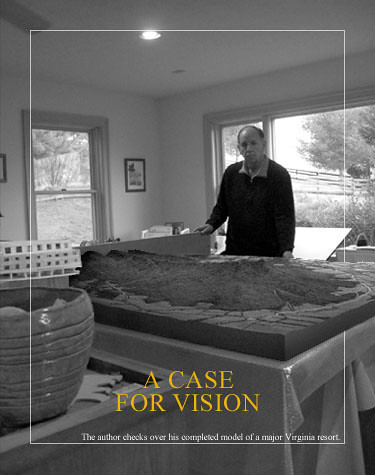
Scale model of Massanutten Resort by the Kirchman Studio.

Wednesday, February 26, 2014

THYME Magazine: A Case for Vision VII

Citizen Journalism with a Better Flavor

THYME0709
Volume VII, Issue X

A Case for Vision VII
© 2014 The Kirchman Studio.

Our nation is in need of an I. K. Brunel's vision today.  Our situation is no less dire than that of Bristol in the Nineteenth Century and we need to find direction, both in spirit and economically, if we are to emerge successfully. [1.] Looking at what is happening in North Dakota it is imperative that we find similar opportunity for people in every state of the union. Where shall we look for a vision of the future? Certainly not to an administration that sees massive unemployment and underemployment as a good thing! Many of us have seen our hopes and dreams take a serious hit from the policies of this administration. The marketplace has less resources available to support the creative endeavors we are now supposedly 'free' to pursue. Just ask anyone actually selling fine art these days. People need to be making money in order to spend it! If you are looking to the National Endowment for the Arts to fund your work, guess what? Diminishing tax revenues means less money to fund 'public' art. In fact, the government will be hard pressed to meet obligations such as Social Security and Medicare.

The current administration has no intention of encouraging the true creative sector in this country. In fact, it is becoming quite clear that they WANT us discouraged. Our discouragement is essential for them to implement their 'fundamental change' to the country we live in. That is why we must not succumb. I would like to, in the spirit of Theodor Herzl's Aultneuland, give you reason for hope and reason to stay in the fight as well! Herzl was a man with a vision. In Altneuland he was spot-on in describing the nation that was born, or reborn, if you will in the creation of modern day Israel. When Herzl wrote his novel the land was securely in the hands of the Ottoman Empire. In 1917 England's foreign secretary Arthur Balfour wrote a declaration stating that this land should indeed be given as a homeland to the people who had inhabited it since ancient times. World War I saw the end of the empire and British control. It wasn't until 1947 that Israel was truly 'reborn' in the wake of that terrible war.

So, it is essential for us in our time to keep the vision alive that created our own republic. We need to teach our young people, instructing them in the Faith and values that are the true foundation of America's remarkable story. Just like Bristol, England in the Nineteenth Century, we need to look beyond our immediate boundaries and see new possibilities. I believe that ultimately the unseen hand of creativity and human ingenuity can prevail. Will we live to see new wonders? I believe in G-d. I believe in inspiration, and I believe in Imago Dei... the knowledge that in creation G-d did indeed give mankind a small spark of His own creative energy. When Samuel Morse telegraphed: "What hath G-d wrought?" he was correct in his attribution even as he worked with his own hands to make the device. Now we need to be open to the same sort of inspiration. There are things we can make again (or for the first time)!

Consider the more recent story of R. G. LeTourneau, who's company had been awarded a contract to build a machine to lift airplanes by the government during the great war. No one had ever built such a machine before, and the engineers were stumped. Wednesday evening rolled around and LeTourneau announced to his stunned team that he was going to a prayer meeting. "But, sir,... We've got a deadline on this thing!" The great industrialist replied: "But I have a deadline with G-d." LeTourneau went to the prayer meeting. He sang praises and poured out his heart in earnest prayer. He said that walking back to his office from the prayer meeting, he 'saw' the design he was seeking for the machine clearly in his head! What if a modern-day Brunel were indeed to create new dorways for American commerce, as American ingenuity continues to finds new sources for energy to power that commerce. Just think, new geothermal resources powering new frontiers in American inventiveness.

I, for one, refuse to believe that the age of inspiration is past. I do believe that it is essential that we return to the roots of Faith and freedom that have given birth to the American experiment and sustained it. It is not enough to be brilliant in business if we squander the return it gives us in a false sense of entitlement: "For unto whomsoever much is given, of him shall be much required." -- Luke 12:8 So, come with me, in the spirit of Aultneuland, to an America not too far in the distant future. Let us visit a land where a greater vision prevails than simply profit or personal reward. In my youth we once rode the train into Philadelphia from Baltimore. At the time, when you entered into Pennsylvania from Delaware, you were greeted by a large sign that read: "What Chester Makes Makes Chester." The city of Chester was at the time a center of manufacturing and it indeed saw itself in terms of its contributions to the world.

Would that we would see ourselves as contributors to the world once more! If Herzl were to step into his beloved Zion today, he would be amazed to see the center of advanced technology she has become. He would wonder at technologies being developed there that might one day give sight to the blind! Though he forsaw them, the modern cities such as Tel Aviv would still astound him! He would see the amazing works of irrigation that have made Israel the garden state of the world. The flowers we had at our wedding in 1980 came in boxes that proudly proclaimed that they were grown in Israel. Abraham the Patriarch was given the promise in Genesis 22:18: "And in thy seed shall all the nations of the earth be blessed; because thou hast obeyed my voice." What wonderful contributions might we as a people make to the world if we will ourselves heed the voice of the One who created creativity itself?

chesterport2
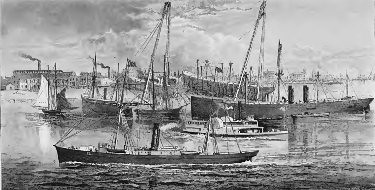
The waterfront of Chester, Pennsylvania in 1875.

Wednesday, February 12, 2014

THYME Magazine: A Case for Vision V

Citizen Journalism with a Better Flavor

THYME0708
Volume VII,Issue VIII

A Case for Vision V

In their book: The Poverty of Nations [click to read], Wayne Grudem and Barry Asmus describe what they call: "The amazing process of creating value that did not exist before." Using the example of a woman in a poor country who takes three dollars' worth of material and sews it into a shirt which she sells for thirteen dollars, the authors point out that she has created a new product of value. She has made that cloth ten dollars more valuable than when she bought it. She has also contributed ten dollars of value to the total value of everything her nation will produce that year, the GDP of that nation. In Zambia, at a place called Grippis Farm, people are learning to sew. They begin with plastic snack bags as they build their skills to the point where they can work with the actual valuable fabric. In fact, Grippis Farm, which receives support from people in American churches, is putting into practice what The Poverty of Nations preaches.

Grippis Farm provides education for the young people of the community. It supports sustainable advances in agriculture as well as incubating the fledgling sewing business. Angus Buchan, who fled Zambia for South Africa buring its previous period of political unrest, has created a similar community of opportunity of opportunity at Shalom Ministries. Asmus and Grudem point to examples in history of nations that have become prosperous by producing more goods and services. England during the Industrial Revolution invented machinery for efficiently weaving cotton thread, thus revolutionizing the clothing industry. "The principle product of the new technology that we know as the Industrial Revolution was cheap, washable cotton, and along with it mass-produced soap made of vegetable oils. For the first time, the common man could wear underwear, once known as body linen because that was the washable fabric that the well-to-do wore next to their skin... Personal hygiene changed drastically, so that commoners of the late Nineteenth and early Twentieth Century often lived cleaner than kings and queens of a century earlier.

By producing immense amounts of cotton and then other desirable products (such as high quality steel and machinery), England became the world's wealthiest nation. Income per person in England doubled between 1780 and 1860, then between 1860 and 1990 it multiplied another six times!" -- David S. Landes, The Wealth and Poverty of Nations, (New York, W. W. Norton, 1999), 154, 190-94. [1.] The authors go on to cite post World War II Japan and modern China as having become similar productive societies. The Congressional Office of Management and Budget has just released projections showing massive shrinking of America's employment resulting from the so-called "Affordable Care Act's" implementation. [2.] That is on top of an already documented decline that began around 2007. Employment percentages often hide the fact that many employable people have given up and are no longer counted. Employment as a percentage of actual population in the United States has reached a new and dismal all-time low.

A White House spokesman's decree that: "now more Americans are no longer tied to a full-time job and are free to pursue their dreams." rings hollow. Most creative ventures in following dreams, after all, began as night and weekend enterprises begun by people in regular jobs. My own venture into enterprenuership began over thirty years ago. I was frustrated in a position where my creativity was dismissed and their was no prospect of growth in career stature or compensation. My best designs often ended up on the cutting room floor, so to speak, as the man I worked for desired quick and dirty... and made that fact very clear. He was a good man, but saw no need for vision when what worked twenty years ago would, he surmised, serve quite adequately. I began with my little studio in a spare bedroom. I would pick up my assignments before and after work, and often missed lunch to meet with clients. I would do the actual work in the evening. My little daughter was a baby and often I would share a tender moment with my beautiful wife at the 2:00am feeding!

I gave my employer a month's notice. I thought he would like for me to train my replacement. No one ever showed up to shadow me; Instead, I remember the afternoon I was taken to a very nice lunch by my bosses who proceeded to tell me that I would most certainly fail at my new venture. I should stay where I was! That I "failed" for thirty years at it I do wear as a badge of honor. I have had a handful of brilliant young people share with me in the process of learning the art of visualization. That has been the greatest honor I have received in the process. I once won a PIVA award for one of my brochure designs for a major development company and they misspelled my name! I think of the young people like my last assistant who mostly taught themselves while in my company, and I feel that having somehow enabled their greatness to shine is my most fulfilling reward! These are the honors that gather no dust sitting on your sideboard.

So, we must ask ourselves: "What are we bequeathing to these brilliant young souls?" My nephew works in Baltimore at the sugar refinery. He sent me an article not long ago talking about how they were tearing down the Sparrow's Point Steel Mill and selling the demolished machinery for scrap value. Management saw the need to create one last bit of profit by making men who had lovingly maintained these machines and used them to make a living now tear them apart and sort them into scrap bins! One man saw some sander disks and though they were industrial quality, they would fit on his home sander. He asked his immediate supervisor if he could have them. When his supervisor agreed he threw them in the open bed of his pickup only to be fired by a higher-up manager later that day for stealing company property! The man did not steal the disks, he asked first. Most of us will read this and see the higher law that should govern, but the manager only saw what should have been added to the gross tonnage of scrap 'misdirected' to an employee's vehicle.[3.]

If one looks at the percentage of growth in private employment compared to government employment, the picture is bleak.[4.] Government does not produce, it can only tax and procure. Furthermore, look at communities that have been "freed from work" and subsist on government programs. Are they hotbeds of entrepreneurship (other than the drug trade)? A friend of mine shared with me a video about an inner city ministry in Brooklyn, New York. They did home visits and you see disturbing footage inside a dirty, roach infested apartment. A young child still plays but an older sibling stares vacantly from a couch. There are no dreams here to be pursued! Generations have known nothing but government dependency. Is this the vision our leaders have for our great nation?[5.] More and more Americans are on food stamps now. But here, amid the bleakness, one finally sees the hope. While most states have lackluster private employment growth or outright decline, South Dakota stands out like a bright beacon. Though the current administration has done everything to stifle domestic energy production on public lands and the Keystone Pipeline, PRIVATE lands have never been busier. The Dakotas and parts of Texas as well have become boom economies. You can go there and sign on with an oil company and soon be making a six-figure salary. Workers are so desired that you can make seventeen dollars an hour at Wal Mart! The point is that in this one sector of the country there are workers creating value that wasn't there before... and they are being rewarded for it.

Thursday, November 28, 2013

THYME Magazine American Renewal Issue VI

Citizen Journalism with a Better Flavor

THYME0602
Volume VI, Issue XXVI
 
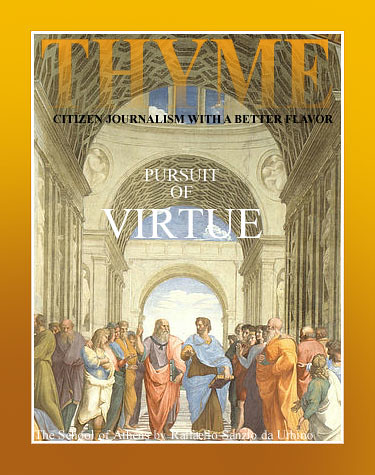
Pursuit of Virtue
Cover: The School of Athens by Raffaello Sanzio da Urbino

"Properly understood, therefore, when John Locke, Samuel Johnson, and Thomas Jefferson wrote of 'the pursuit of happiness,' they were invoking the Greek and Roman philosophical tradition in which happiness is bound up with the civic virtues of courage, moderation, and justice. Because they are civic virtues, not just personal attributes, they implicate the social aspect of eudaimonia. The pursuit of happiness, therefore, is not merely a matter of achieving individual pleasure." -- Carol V. Hamilton, Ph.d.

The 'other' weekly news magazine a while ago considered The Pursuit of Happiness [click to read]. Quoting the philosophers who say we're "wired for happiness," they then delve into the conundrum of why we are so unhappy. THYME once again ventures in where angels fear to tread... to consider the truth intended by the original writers.

Consider These Advertisements [click to read] for Colorado's Health Insurance Marketplace. While they are an insult to the fine young people I actually know and work with, they nonetheless represent the popular narrative's description of "Pursuit of Happiness." Really?, "Kegstands" and "shotsies?" Again, I have to wonder if ageing advertising executives are being allowed to define young people they really need to go out and talk to. One surprise in Virginia's recent gubernatorial election was that the Conservative candidate actually won a strong percentage of the so-called 'Millenial' vote. The 18-24 demographic broke strongly for the Conservative [1.] begging the question: "Is the self-actualization message of the popular culture deconstructing under its own weight as young people open their eyes and see the true cost?" 

Those who seek to write the narrative about modern Americans err because they've replaced the institutions of virtue and protection with the multiplex cinema and the mall as center of the settlement. Consider the first Jamestown settlement, where the church, the storehouse and the armory were at the center. Personal happiness, in the packaging of self-actualization demands we redefine marriage and reduce consequences for pleasurable behaviours. Society must now provide outcome instead of opportunity, even if that outcome is tepid compared to the results of mankind unchained to pursue loftier goals that are out of the direct pervue of government.

Thus, many are lauding the Supreme Court's latest "Dred Scott"  [2.] moment as an American triumph, overturning a portion of the Defense of Marriage Act and striking down the restoration of California's popularly ratified Proposition Eight. The portion of DOMA actually overturned has to do with an inheritance case and is NOT at all like Roe vs Wade, which nullified state abortion laws in a sweeping motion. The media rushes to herald it, but it does not really create what qualifies as a landmark decision. In fact it is but one more strike against traditional thinking which includes the government forcing Catholic Charities in Massachussetts to place children with same-sex couples (they folded rather than compromise their beliefs), the suit against a photographer who, on faith grounds, declined to photograph a same-sex ceremony and the Methodist group in New Jersey who were denied tax-exempt status because they would not allow a same-sex ceremony to be performed in their facility [3.]

Marriage Wins in the Big Picture [click to read]

In each of these cases, there were other options open to the couples and they were in no way forbidden from creating their covenant relationship. At issue, in each case, was the religious freedom of those who hold that G-d alone may define what is marriage. Beyond the religious freedom considerations, a strong body of research suggests that children are best raised by a father and a mother [4.] While the thought may nor be politically correct, the evidence is well-documented. State law is still able to support traditional marriage and may well strengthen the virtues epitomized in eudaimonia by doing so. Courage, moderation and justice would ask: "what is best for our children?"

The First Amendment of the Constitution both prohibits government establishment of a 'state' church and protects citizens in the free exercise of their faith. While it is a good thing to restrict the government's direction of the distribution of an estate (property being an important right), it also follows that the government has no business redefining what for many is a matter of faith (freedom of belief being one of the fundamental rights). Providing protection for a person's directives concerning shared property and hospital visitation priviledges is in keeping with the virtues of courage, moderation and justice. Creating a 'right' for someone to overwrite the tenets of faith with fines and sanctions is the antithesis of them.

Much of the so-called 'Affordable Care Act's' controversy surrounds the law's establishment of access to contraceptives and abortion as 'fundamental rights' in defiance of those institutions and traditions who's purpose is to instill virtue. Requiring Faith-based institutions to provide coverage for things they don't believe in violates the true spirit of "pursuit of Virtue." Mandating that Christian businessmen like David Green [click to read] provide them is equally intrusive on true personal liberty.

Indeed it would seem that the time has come to offer a clear alternative to the tired old cliche's that would reduce significant personal choices to the level of a Superbowl beer commercial. I am not a recognized expert on youth, but I have worked closely with enough young people to know that they can indeed wrap their fingers around noble purposes. History tells us that young people of old took up the task before them to survey great lands and build great works. They were not shipped off to "professionals" to be trained, but rather, received mentoring from older people, often in a highly individualized fashion. Older people were not always 'retired' from service in a mandatory fashion. In an era when few lived past the age of 62 they were a cherished resource. That changed when leaders like Prussia's Otto Von Bismark discovered that their most effective opposition was from people over the age of 65 [5.]. In the days before penicillin it was a safe bet to pension the relatively few Germans who did live past that age.

As one who is two years into his sixth decade, I can tell you that it is a great joy to freely share the things you have learned with a bright young apprentice! Sadly, this does not happen in a world where people enter productive life late and leave too early. There is more of a competitive than collaborative mindset in a workforce that excludes experience and enthusiasm found at the ends of the age spectrum. We need to return to a world where we train our own replacements, cherishing the creation of a legacy more than the accumulation of one's own accomplishment. We do not create a legacy for ourselves, rather we pass the baton and cheer. Virtue WANTS the next generation to run faster, farther and surer!

What better place for this to be reborn than in our churches. A couple of Sundays ago I heard a most inspiring message of intentional care for the younger generation. We were encouraged to pray for each child in our congregation... creating intentional relationships for mentoring, support and discipleship. All of the clever programs in the world cannot surpass the strength of such intentional relationships.

In Colossians 1:9-12 we read: "For this cause we also, since the day we heard it, do not cease to pray for you, and to desire that ye might be filled with the knowledge of his will in all wisdom and spiritual understanding; That ye might walk worthy of the Lord unto all pleasing, being fruitful in every good work, and increasing in the knowledge of G-d; Strengthened with all might, according to his glorious power, unto all patience and longsuffering with joyfulness; Giving thanks unto the Father, which hath made us meet to be partakers of the inheritance of the saints in light:" What would it look like to pray/model that for our young people? The results would certainly be changed young lives...and changed young lives would make an impact on their world! What if our young people were to be brought up in the narrative that they are for us a cherished investment?... Masterpieces of IMAGO DEI entrusted to our care?

Thursday, September 26, 2013

THYME Magazine

Citizen Journalism with a Better Flavor

THYME0444
Volume VI, Issue XV

A 'Best of THYMEs' Feature...

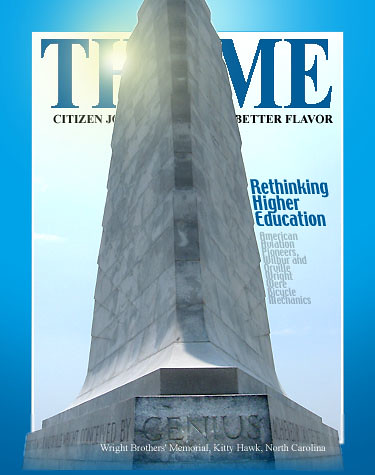
Rethinking College (and Education)

The 'other' weekly news magazine's U. S. Edition presents The Class of 2025 [click to read]. They ponder what they will have learned... and how they will pay for it! Clearly changes are needed. The average US student graduates with $26,000 in college debt, with total college debt around one trillion dollars. Unfortunately the job market often presents a hostile reality, the field they have prepared five years to enter isn't hiring. TIME's Amanda Ripley looks at new trends, such as online learning and how the way we learn is already changing in a Previous Article [click to read].

The rise in online learning and for-profit colleges is challenging the traditional academy. Ostensibly this is the underlying tension behind recent events at Charlottesville's University of Virginia, where popular President Teresa Sullivan was forced to resign and then quickly reinstated.

College costs are rising at a rate outpacing the economy at large. At the same time many are questioning its value, even as it is being touted as "being as essential now as high school was in the 'Fifties." Many young men are foregoing college and entering fields such as technology, finding that to offer a more rapid path to a paycheck.

My Father became an engineer in an era where Engineering schools did not bother to teach Literature. He struggled in high school, and framed a letter from a high school adviser stating bluntly that he should pursue a field other than Engineering. Undeterred, Dad enrolled in Junior College, then transferred to Notre Dame. He worked for Wright Aviation before taking a job at the Martin Company's Middle River Plant in Baltimore. He framed the letter.

Dad worked on the seaplanes that were used in WWII, then as Middle River closed down, he started his own test lab. He opened it in one of those buildings with spaces for contractors that had a garage door and an office. His neighbors were plumbers and HVAC companies. He hired a lot of his old colleagues from Martin. Then he was hired by NASA's Goddard Space Flight Center, where he wrote the procedures for testing spacecraft.

Though his education did not include great literature, Dad was a Renaissance man who built his own great library. He read the classics for the pure joy of learning, and was as knowledgeable about literature as many who teach it. When I was young he would read to me from great volumes such as the works of Rudyard Kipling. What magical moments those bedtime stories would become! Little did Dad know he was innoculating me to survive industrialized education.

My point? Learning can be more pragmatic, learning should be lifelong. More people need to read thick wonderful books to their kids. Making young minds cram great literature for exams may leave a bad taste and leaves no room for rumination. Dad often let me work alongside him doing projects. He taught me how to work, how to design a greenhouse, and most importantly; Dad taught me how to teach others.

I was the right-brained child who struggled in school. Dad apprenticed me in the skills I needed to eventually overcome that. It is my sincere hope that Apprenticeship will experience a Renaissance as we seek to develop the G-d-given gifts of the generations to follow. Will we again find deep satisfaction in training our own replacements? It is my sincere hope that industry, the professions, and most importantly gifted individuals will step up to the challenge!

openlawn
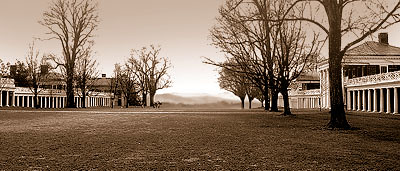
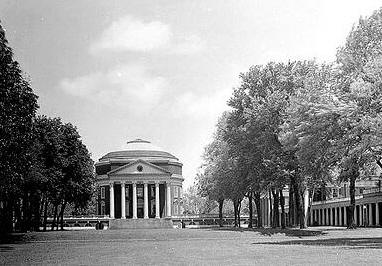
The Lawn of the University of Virginia originally opened to the surrounding community and countryside. Photos and rendering overlay by Bob Kirchman.

thymebanner

Friday, April 19, 2013

Remembering a Great Mentor

There was a Man who Convinced Me I Could Do This

Building a Railroad
Reconstructing my model of Ellicott's Mills for the B&O Railroad Museum.

A Milestone Monday Feature

In Chapter 14 of Chuck Balsamo's new book Make Me a Legend Pastor Balsamo talks about the importance of finding a good mentor. He brought back some important memories as I recalled the influence of a man named Reggie. Reggie served in the Navy during World War II and achieved the rank of Aviation Machinist's Mate, Second Class. He was a first class mentor.

I met this amazing man because I went to school with his daughter. He was a Chevrolet mechanic and an avid outdoorsman. He introduced me to the wonders of Coastal New Jersey as I happily paddled for hours through marshes and creeks. At about 50 years old, Reggie became an instructor at the vocational technology school. There he discovered his true gifts and passions.

At an age where most men are thinking about taking it easy, Reggie enrolled in Rutgers University and pursued a degree in administration. Education and young people had become his true calling and he graduated from college the same time one of his daughters did.

Days at Reggie's place where full ones. He lived in a little postwar bungalo and when his children and their assembled friends were descending on the place around ten in the evening, he'd put on a pot of coffee. It came as no surprise that Reggie enjoyed lively conversation and sometimes these talk sessions would end in the wee hours of the morning. Good coffee, however, always made up for sleep deprivation.

Reggie went on to become a high school principal, but I have to believe that the best classes he ever taught were at his own kitchen table. He noticed that I was a hands-on guy struggling with an academic world. He found information on architectural model making and shared it with me. "You'd be good at this, Bob." Years later I was literally living off of this compliment. My little studio built models for architects, including one famous one. I worked on several models for resort projects in Japan, though I'm not sure how a man who served in the Pacific Theatre would feel about that.

No doubt, this man has influenced many young lives in a similar manner. I am priviledged to have known him.

This week the 'other' weekly news magazine presents its list of 100 'most influential' people. THYME maintains that the most influential people are unsung and unknown.How many people know the name of Edward Kimball? [1.] Kimball led a shoe salesman to Faith in Christ. The shoe salesman happened to be Dwight L. Moody. Here in Volume V, Issue XIX, THYME celebrates the lives of those who truly influence others!

Thoughts on True Greatness [click to read] by Rabbi Yonason Goldson in Jewish World Review.

Thursday, October 18, 2012

THYME Magazine

Citizen Journalism with a Better Flavor

THYME0444
Volume IV, Issue XLIV

Rethinking College (& Education)

The 'other' weekly news magazine presents Reinventing College [click to read]. Clearly changes are needed. The average US student graduates with $26,000 in college debt, with total college debt around one trillion dollars. Unfortunately the job market often presents a hostile reality, the field they have prepared five years to enter isn't hiring. TIME's Amanda Ripley looks at new trends, such as online learning and how the way we learn is already changing.

The rise in online learning and for-profit colleges is challenging the traditional academy. Ostensibly this is the underlying tension behind recent events at Charlottesville's University of Virginia, where popular President Teresa Sullivan was forced to resign and then quickly reinstated.

College costs are rising at a rate outpacing the economy at large. At the same time many are questioning its value, even as it is being touted as "being as essential now as high school was in the 'Fifties." Many young men are foregoing college and entering fields such as technology, finding that to offer a more rapid path to a paycheck.

My Father became an engineer in an era where Engineering schools did not bother to teach Literature. He struggled in high school, and framed a letter from a high school advisor stating bluntly that he should pursue a field other than Engineering. Undeterred, Dad enrolled in Junior College, then transferred to Notre Dame. He worked for Wright Aviation before taking a job at the Martin Company's Middle River Plant in Baltimore. He framed the letter.

Dad worked on the seaplanes that were used in WWII, then as Middle River closed down, he started his own test lab. He opened it in one of those buildings with spaces for contractors that had a garage door and an office. His neighbors were plumbers and HVAC companies. He hired a lot of his old colleagues from Martin. Then he was hired by NASA's Goddard Space Flight Center, where he wrote the procedures for testing spacecraft.

Though his education did not include great literature, Dad was a Renaissance man who built his own great library. He read the classics for the pure joy of learning, and was as knowledgeable about literature as many who teach it. When I was young he would read to me from great volumes such as the works of Rudyard Kipling. What magical moments those bedtime stories would become! Little did Dad know he was innoculating me to survive industrialized education.

My point? Learning can be more pragmatic, learning should be lifelong. More people need to read thick wonderful books to their kids. Making young minds cram great literature for exams may leave a bad taste and leaves no room for rumination. Dad often let me work alongside him doing projects. He taught me how to work, how to design a greenhouse, and most importantly; Dad taught me how to teach others.

I was the right-brained child who struggled in school. Dad apprenticed me in the skills I needed to eventually overcome that. It is my sincere hope that Apprenticeship will experience a Renaissance as we seek to develop the G-d-given gifts of the generations to follow. Will we again find deep satisfaction in training our own replacements? It is my sincere hope that industry, the professions, and most importantly gifted individuals will step up to the challenge!

openlawn
The Lawn of the University of Virginia originally opened to the surrounding community and countryside. Photos and rendering overlay by Bob Kirchman.

thymebanner

Friday, September 10, 2010

THYME Magazine

Citizen Journalism with a Better Flavor

thyme0237
Volume II, Issue XXXVII

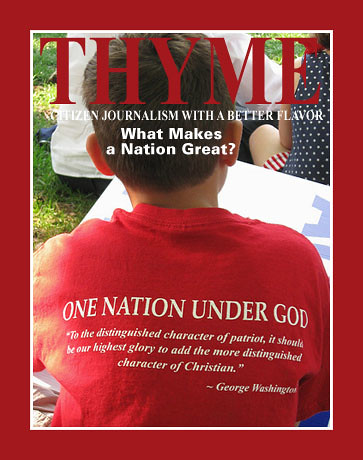
What Makes a Nation Great?

The 'other' Weekly News Magazine [click to read] asks: "What makes a school great?" THYME asks: "Why stop there, what makes a NATION great?" We can agree with the 'other' magazine that it takes great teachers, so here are some thoughts from our Founding Fathers:

John Adams and John Hancock:
We Recognize No Sovereign but God, and no King but Jesus! [April 18, 1775]

John Adams:
“ The general principles upon which the Fathers achieved independence were the general principals of Christianity… I will avow that I believed and now believe that those general principles of Christianity are as eternal and immutable as the existence and attributes of God.”
“[July 4th] ought to be commemorated as the day of deliverance by solemn acts of devotion to God Almighty.”
–John Adams in a letter written to Abigail on the day the Declaration was approved by Congress

"We have no government armed with power capable of contending with human passions unbridled by morality and religion. Avarice, ambition, revenge, or gallantry, would break the strongest cords of our Constitution as a whale goes through a net. Our Constitution was made only for a moral and religious people. It is wholly inadequate to the government of any other." --October 11, 1798

"I have examined all religions, as well as my narrow sphere, my straightened means, and my busy life, would allow; and the result is that the Bible is the best Book in the world. It contains more philosophy than all the libraries I have seen." December 25, 1813 letter to Thomas Jefferson

"Without Religion this World would be Something not fit to be mentioned in polite Company, I mean Hell." [John Adams to Thomas Jefferson, April 19, 1817]

Samuel Adams: He who made all men hath made the truths necessary to human happiness obvious to all… Our forefathers opened the Bible to all.” [ "American Independence," August 1, 1776. Speech delivered at the State House in Philadelphia]

“ Let divines and philosophers, statesmen and patriots, unite their endeavors to renovate the age by impressing the minds of men with the importance of educating their little boys and girls, inculcating in the minds of youth the fear and love of the Deity… and leading them in the study and practice of the exalted virtues of the Christian system.” [October 4, 1790]

John Quincy Adams:
“Why is it that, next to the birthday of the Savior of the world, your most joyous and most venerated festival returns on this day [the Fourth of July]?" “Is it not that, in the chain of human events, the birthday of the nation is indissolubly linked with the birthday of the Savior? That it forms a leading event in the progress of the Gospel dispensation? Is it not that the Declaration of Independence first organized the social compact on the foundation of the Redeemer's mission upon earth? That it laid the cornerstone of human government upon the first precepts of Christianity"?
--1837, at the age of 69, when he delivered a Fourth of July speech at Newburyport, Massachusetts.

“The Law given from Sinai [The Ten Commandments] was a civil and municipal as well as a moral and religious code.”
John Quincy Adams. Letters to his son. p. 61


Elias Boudinot: “Be religiously careful in our choice of all public officers . . . and judge of the tree by its fruits.”

Charles Carroll - signer of the Declaration of Independence
" Without morals a republic cannot subsist any length of time; they therefore who are decrying the Christian religion, whose morality is so sublime and pure...are undermining the solid foundation of morals, the best security for the duration of free governments." [Source: To James McHenry on November 4, 1800.]

Benjamin Franklin:
“ God governs in the affairs of man. And if a sparrow cannot fall to the ground without his notice, is it probable that an empire can rise without His aid? We have been assured in the Sacred Writings that except the Lord build the house, they labor in vain that build it. I firmly believe this. I also believe that, without His concurring aid, we shall succeed in this political building no better than the builders of Babel” –Constitutional Convention of 1787 original manuscript of this speech

“In the beginning of the contest with Britain, when we were sensible of danger, we had daily prayers in this room for Divine protection. Our prayers, Sir, were heard, and they were graciously answered… do we imagine we no longer need His assistance?” [Constitutional Convention, Thursday June 28, 1787]

In Benjamin Franklin's 1749 plan of education for public schools in Pennsylvania, he insisted that schools teach "the excellency of the Christian religion above all others, ancient or modern."

In 1787 when Franklin helped found Benjamin Franklin University, it was dedicated as "a nursery of religion and learning, built on Christ, the Cornerstone."

Alexander Hamilton:
Hamilton began work with the Rev. James Bayard to form the Christian Constitutional Society to help spread over the world the two things which Hamilton said made America great:
(1) Christianity
(2) a Constitution formed under Christianity.
“The Christian Constitutional Society, its object is first: The support of the Christian religion. Second: The support of the United States.”

On July 12, 1804 at his death, Hamilton said, “I have a tender reliance on the mercy of the Almighty, through the merits of the Lord Jesus Christ. I am a sinner. I look to Him for mercy; pray for me.”

"For my own part, I sincerely esteem it [the Constitution] a system which without the finger of God, never could have been suggested and agreed upon by such a diversity of interests." [1787 after the Constitutional Convention]

"I have carefully examined the evidences of the Christian religion, and if I was sitting as a juror upon its authenticity I would unhesitatingly give my verdict in its favor. I can prove its truth as clearly as any proposition ever submitted to the mind of man."


John Hancock:
“In circumstances as dark as these, it becomes us, as Men and Christians, to reflect that whilst every prudent measure should be taken to ward off the impending judgments, …at the same time all confidence must be withheld from the means we use; and reposed only on that God rules in the armies of Heaven, and without His whole blessing, the best human counsels are but foolishness… Resolved; …Thursday the 11th of May…to humble themselves before God under the heavy judgments felt and feared, to confess the sins that have deserved them, to implore the Forgiveness of all our transgressions, and a spirit of repentance and reformation …and a Blessing on the … Union of the American Colonies in Defense of their Rights [for which hitherto we desire to thank Almighty God]…That the people of Great Britain and their rulers may have their eyes opened to discern the things that shall make for the peace of the nation…for the redress of America’s many grievances, the restoration of all her invaded liberties, and their security to the latest generations.
"A Day of Fasting, Humiliation and Prayer, with a total abstinence from labor and recreation. Proclamation on April 15, 1775"


Patrick Henry:
"Orator of the Revolution."

This is all the inheritance I can give my dear family. The religion of Christ can give them one which will make them rich indeed.”
—The Last Will and Testament of Patrick Henry

“It cannot be emphasized too clearly and too often that this nation was founded, not by religionists, but by Christians; not on religion, but on the gospel of Jesus Christ. For this very reason, peoples of other faiths have been afforded asylum, prosperity, and freedom of worship here.” [May 1765 Speech to the House of Burgesses]

“The Bible is worth all other books which have ever been printed.”


John Jay:
“ Providence has given to our people the choice of their rulers, and it is the duty, as well as the privilege and interest of our Christian nation to select and prefer Christians for their rulers.” Source: October 12, 1816. The Correspondence and Public Papers of John Jay, Henry P. Johnston, ed., (New York: Burt Franklin, 1970), Vol. IV, p. 393.

“Whether our religion permits Christians to vote for infidel rulers is a question which merits more consideration than it seems yet to have generally received either from the clergy or the laity. It appears to me that what the prophet said to Jehoshaphat about his attachment to Ahab ["Shouldest thou help the ungodly and love them that hate the Lord?" 2 Chronicles 19:2] affords a salutary lesson.” [The Correspondence and Public Papers of John Jay, 1794-1826, Henry P. Johnston, editor (New York: G.P. Putnam's Sons, 1893), Vol. IV, p.365]

Thomas Jefferson:
“ The doctrines of Jesus are simple, and tend to all the happiness of man.”

“Of all the systems of morality, ancient or modern which have come under my observation, none appears to me so pure as that of Jesus.”

"I am a real Christian, that is to say, a disciple of the doctrines of Jesus."

“God who gave us life gave us liberty. And can the liberties of a nation be thought secure when we have removed their only firm basis, a conviction in the minds of the people that these liberties are a gift from God? That they are not to be violated but with His wrath? Indeed I tremble for my country when I reflect that God is just, and that His justice cannot sleep forever.” (excerpts are inscribed on the walls of the Jefferson Memorial in the nations capital) [Source: Merrill . D. Peterson, ed., Jefferson Writings, (New York: Literary Classics of the United States, Inc., 1984), Vol. IV, p. 289. From Jefferson’s Notes on the State of Virginia, Query XVIII, 1781.]

Samuel Johnston:
“It is apprehended that Jews, Mahometans (Muslims), pagans, etc., may be elected to high offices under the government of the United States. Those who are Mahometans, or any others who are not professors of the Christian religion, can never be elected to the office of President or other high office, [unless] first the people of America lay aside the Christian religion altogether, it may happen. Should this unfortunately take place, the people will choose such men as think as they do themselves.
[Elliot’s Debates, Vol. IV, pp 198-199, Governor Samuel Johnston, July 30, 1788 at the North Carolina Ratifying Convention]

James Madison:
“ We’ve staked our future on our ability to follow the Ten Commandments with all of our heart.”

“We have staked the whole future of American civilization, not upon the power of government, far from it. We’ve staked the future of all our political institutions upon our capacity…to sustain ourselves according to the Ten Commandments of God.” [1778 to the General Assembly of the State of Virginia]

• I have sometimes thought there could not be a stronger testimony in favor of religion or against temporal enjoyments, even the most rational and manly, than for men who occupy the most honorable and gainful departments and [who] are rising in reputation and wealth, publicly to declare the unsatisfactoriness [of temportal enjoyments] by becoming fervent advocates in the cause of Christ; and I wish you may give in your evidence in this way.
Letter by Madison to William Bradford (September 25, 1773)


• In 1812, President Madison signed a federal bill which economically aided the Bible Society of Philadelphia in its goal of the mass distribution of the Bible
.
“ An Act for the relief of the Bible Society of Philadelphia” Approved February 2, 1813 by Congress

“It is the mutual duty of all to practice Christian forbearance, love, and charity toward each other.”

• A watchful eye must be kept on ourselves lest, while we are building ideal monuments of renown and bliss here, we neglect to have our names enrolled in the Annals of Heaven. [Letter by Madison to William Bradford [urging him to make sure of his own salvation] November 9, 1772]

At the Constitutional Convention of 1787, James Madison proposed the plan to divide the central government into three branches. He discovered this model of government from the Perfect Governor, as he read Isaiah 33:22;
“For the LORD is our judge, the LORD is our lawgiver,
the LORD is our king;
He will save us.”
[Baron Charles Montesquieu, wrote in 1748; “Nor is there liberty if the power of judging is not separated from legislative power and from executive power. If it [the power of judging] were joined to legislative power, the power over life and liberty of the citizens would be arbitrary, for the judge would be the legislature if it were joined to the executive power, the judge could have the force of an oppressor. All would be lost if the same … body of principal men … exercised these three powers." Madison claimed Isaiah 33:22 as the source of division of power in government
See also: pp.241-242 in Teaching and Learning America’s Christian History: The Principle approach by Rosalie Slater]


James McHenry – Signer of the Constitution:
Public utility pleads most forcibly for the general distribution of the Holy Scriptures. The doctrine they preach, the obligations they impose, the punishment they threaten, the rewards they promise, the stamp and image of divinity they bear, which produces a conviction of their truths, can alone secure to society, order and peace, and to our courts of justice and constitutions of government, purity, stability and usefulness. In vain, without the Bible, we increase penal laws and draw entrenchments around our institutions. Bibles are strong entrenchments. Where they abound, men cannot pursue wicked courses, and at the same time enjoy quiet conscience.

Jedediah Morse:
"To the kindly influence of Christianity we owe that degree of civil freedom, and political and social happiness which mankind now enjoys. . . . Whenever the pillars of Christianity shall be overthrown, our present republican forms of government, and all blessings which flow from them, must fall with them."

John Peter Gabriel Muhlenberg
In a sermon delivered to his Virginia congregation on Jan. 21, 1776, he preached from Ecclesiastes 3.

Arriving at verse 8, which declares that there is a time of war and a time of peace, Muhlenberg noted that this surely was not the time of peace; this was the time of war. Concluding with a prayer, and while standing in full view of the congregation, he removed his clerical robes to reveal that beneath them he was wearing the uniform of an officer in the Continental army! He marched to the back of the church; ordered the drum to beat for recruits and over three hundred men joined him, becoming the Eighth Virginia Brigade. John Peter Muhlenberg finished the Revolution as a Major-General, having been at Valley Forge and having participated in the battles of Brandywine, Germantown, Monmouth, Stonypoint, and Yorktown.

Thomas Paine:
“ It has been the error of the schools to teach astronomy, and all the other sciences, and subjects of natural philosophy, as accomplishments only; whereas they should be taught theologically, or with reference to the Being who is the author of them: for all the principles of science are of divine origin. Man cannot make, or invent, or contrive principles: he can only discover them; and he ought to look through the discovery to the Author.”
“ The evil that has resulted from the error of the schools, in teaching natural philosophy as an accomplishment only, has been that of generating in the pupils a species of atheism. Instead of looking through the works of creation to the Creator himself, they stop short, and employ the knowledge they acquire to create doubts of his existence. They labour with studied ingenuity to ascribe every thing they behold to innate properties of matter, and jump over all the rest by saying, that matter is eternal.” “The Existence of God--1810”

Benjamin Rush:
• “I lament that we waste so much time and money in punishing crimes and take so little pains to prevent them…we neglect the only means of establishing and perpetuating our republican forms of government; that is, the universal education of our youth in the principles of Christianity by means of the Bible; for this Divine Book, above all others, constitutes the soul of republicanism.” “By withholding the knowledge of [the Scriptures] from children, we deprive ourselves of the best means of awakening moral sensibility in their minds.” [Letter written (1790’s) in Defense of the Bible in all schools in America]
• “Christianity is the only true and perfect religion.”
• “If moral precepts alone could have reformed mankind, the mission of the Son of God into our world would have been unnecessary.”

"Let the children who are sent to those schools be taught to read and write and above all, let both sexes be carefully instructed in the principles and obligations of the Christian religion. This is the most essential part of education”
Letters of Benjamin Rush, "To the citizens of Philadelphia: A Plan for Free Schools", March 28, 1787

Justice Joseph Story:
“ I verily believe Christianity necessary to the support of civil society. One of the beautiful boasts of our municipal jurisprudence is that Christianity is a part of the Common Law. . . There never has been a period in which the Common Law did not recognize Christianity as lying its foundations.”
[Commentaries on the Constitution of the United States p. 593]
“ Infidels and pagans were banished from the halls of justice as unworthy of credit.” [Life and letters of Joseph Story, Vol. II 1851, pp. 8-9.]
“ At the time of the adoption of the constitution, and of the amendment to it, now under consideration [i.e., the First Amendment], the general, if not the universal sentiment in America was, that Christianity ought to receive encouragement from the state, so far as was not incompatible with the private rights of conscience, and the freedom of religious worship.”
[Commentaries on the Constitution of the United States p. 593]

Noah Webster:
“ The duties of men are summarily comprised in the Ten Commandments, consisting of two tables; one comprehending the duties which we owe immediately to God-the other, the duties we owe to our fellow men.”

“In my view, the Christian religion is the most important and one of the first things in which all children, under a free government ought to be instructed...No truth is more evident to my mind than that the Christian religion must be the basis of any government intended to secure the rights and privileges of a free people.”
[Source: 1828, in the preface to his American Dictionary of the English Language]

Let it be impressed on your mind that God commands you to choose for rulers just men who will rule in the fear of God [Exodus 18:21]. . . . If the citizens neglect their duty and place unprincipled men in office, the government will soon be corrupted . . . If our government fails to secure public prosperity and happiness, it must be because the citizens neglect the Divine commands, and elect bad men to make and administer the laws. [Noah Webster, The History of the United States (New Haven: Durrie and Peck, 1832), pp. 336-337, 49]

“All the miseries and evils which men suffer from vice, crime, ambition, injustice, oppression, slavery and war, proceed from their despising or neglecting the precepts contained in the Bible.” [Noah Webster. History. p. 339]

“The Bible was America’s basic textbook
in all fields.” [Noah Webster. Our Christian Heritage p.5]

“Education is useless without the Bible” [Noah Webster. Our Christian Heritage p.5 ]


George Washington:

Farewell Address: The name of American, which belongs to you, in your national capacity, must always exalt the just pride of Patriotism, more than any appellation derived from local discriminations. With slight shades of difference, you have the same religion" ...and later: "...reason and experience both forbid us to expect, that national morality can prevail in exclusion of religious principle..."


“ It is impossible to rightly govern the world without God and Bible.”

“What students would learn in American schools above all is the religion of Jesus Christ.” [speech to the Delaware Indian Chiefs May 12, 1779]

"To the distinguished character of patriot, it should be our highest glory to add the more distinguished character of Christian" [May 2, 1778, at Valley Forge]

During his inauguration, Washington took the oath as prescribed by the Constitution but added several religious components to that official ceremony. Before taking his oath of office, he summoned a Bible on which to take the oath, added the words “So help me God!” to the end of the oath, then leaned over and kissed the Bible.

Nelly Custis-Lewis (Washington’s adopted daughter):
Is it necessary that any one should [ask], “Did General Washington avow himself to be a believer in Christianity?" As well may we question his patriotism, his heroic devotion to his country. His mottos were, "Deeds, not Words"; and, "For God and my Country."

“ O Most Glorious God, in Jesus Christ, my merciful and loving Father; I acknowledge and confess my guilt in the weak and imperfect performance of the duties of this day. I have called on Thee for pardon and forgiveness of my sins, but so coldly and carelessly that my prayers are become my sin, and they stand in need of pardon.”
“ I have sinned against heaven and before Thee in thought, word, and deed. I have contemned Thy majesty and holy laws. I have likewise sinned by omitting what I ought to have done and committing what I ought not. I have rebelled against the light, despising Thy mercies and judgment, and broken my vows and promise. I have neglected the better things. My iniquities are multiplied and my sins are very great. I confess them, O Lord, with shame and sorrow, detestation and loathing and desire to be vile in my own eyes as I have rendered myself vile in Thine. I humbly beseech Thee to be merciful to me in the free pardon of my sins for the sake of Thy dear Son and only Savior Jesus Christ who came to call not the righteous, but sinners to repentance. Thou gavest Thy Son to die for me.”
[George Washington; from a 24 page authentic handwritten manuscript book dated April 21-23, 1752
William J. Johnson George Washington, the Christian (New York: The Abingdon Press, New York & Cincinnati, 1919), pp. 24-35.]

"Although guided by our excellent Constitution in the discharge of official duties, and actuated, through the whole course of my public life, solely by a wish to promote the best interests of our country; yet, without the beneficial interposition of the Supreme Ruler of the Universe, we could not have reached the distinguished situation which we have attained with such unprecedented rapidity. To HIM, therefore, should we bow with gratitude and reverence, and endeavor to merit a continuance of HIS special favors". [1797 letter to John Adams]

James Wilson:
Signer of the Declaration of Independence and the Constitution
Supreme Court Justice appointed by George Washington
Spoke 168 times during the Constitutional Convention

"Christianity is part of the common law"
[Sources: James Wilson, Course of Lectures [vol 3, p.122]; and quoted in Updegraph v. The Commonwealth, 11 Serg, & R. 393, 403 (1824).]


Source: Quotes of the Founding Fathers [click to read].

Tuesday, October 27, 2009

It's Time to Refound Our Universities

They've Strayed Too Far from the Noble Purposes of their Founders

Rotunda
Jefferson's Rotunda, the center of his 'Academic Village.' Photo by Holsinger.

Did you know that Hamas enjoys more positive praise on some of our college campuses than it does on the West Bank? Just ask Khaled Abu Toameh, an Arab Muslim with Israeli citizenship who used to be with the Palestinian media but chose to move to the Israeli press where he was free to speak what was on his heart.

Toameh has observed a 'Pro Palestinian Junta' taking place on U.S. campuses as Middle-Eastern studies professors promote a pretty one-sided picture of a complex situation.

There is a problem here. Most of the kids attending 'Code Pink' antiwar presentations have never been to Israel and are swayed by the speech of people who conveniently ignore the nature of jihad and the refusal of Palestinian spokesmen to recognize Israel's right to exist. Playing on sympathy for the victims of this situation, they ignore the reality that many Hamas policies have continued the harm. They forget that the pullout from Gaza left the people there with beautiful greenhouses and the possibility of taking part in the 'miracle' agriculture that the region had enjoyed under Jewish control. The Palestinians trashed the facilities, shot rockets at Sderot and chose instead to live supplied through tunnels from Egypt.

Years ago, my sister-in-law was a young idealist who chose to go live with the Sandinistas for a bit, obviously inspired by some academic. Problem was when you actually got there you saw that the Sandinistas were not such idealists at all.

May I make the controversial statement that $20,000 a year is a bit much to be paying for such indoctrination.

Guardians of the Gate

Why do they get away with it? There is only one reason. They are the 'guardians of the gate' to a number of important and well paying careers. The computer revolution has begun to chip away at that as many young people have been able to bypass the four or five year path that was traditionally perscribed for success. That is not a bad thing, howls about lacking "well roundedness" aside.

In the Seventeenth Century colleges were founded in this land to train well read leaders and reach the Native population with the Gospel. That's why Dartmouth and William and Mary have Indians as mascots. A gentleman such as Thomas Jefferson was schooled in practical arts, such as Architecture, along with his Classical education.

Fast forward to the Twenty-first Century. Western Civilization has been effectively eliminated from the curriculum. Beauty and truth have been reduced to relative terms. They still exist, but not at the academy.

A Modest Proposal

Every year large coprporations hire the graduates of such prestigious institutions and then lament that they are then required to actually train them for the work! To add insult to injury, they are cooerced through alumni associations and endowments to pony up to maintain the status quo.

Here is the modest proposal. Industry and medicine need to reinstate the apprenticeship system of old and take the money they are throwing into a failed sytem to found their own institutes of Art, Architecture, Engineering, Medicine [yes, Medicine]! Hospitals need to own and operate the training of physicians.

Building upon the existing Community College system, they can provide the well-rounded education that Seventeenth Century students received. Prolonged adolescence would be replaced by a productive young adulthood and knowledge would be acquired over a lifetime instead of in a four year attempt to "force feed" young people who are frankly more interested in other things.

Citizens would pursue continuing education in their field and also in arts and letters. My own Father is my perfect man as a model of the Citizen-Scholar. He barely made it through high school and his advisor wrote a letter saying that he could not recommend that my Father pursue Engineering as a career. Dad went to a junior college for a year before applying to Notre Dame where he did indeed pursue his Engineering degree. Upon graduation he went to Wright doing structural analysis on aircraft. Eventually he ended up at the Martin Company in Baltimore doing structural analysis on the seaplanes used in the Pacific Theatre during WWII.

He married his chief number cruncher and eventually left Martin to start his own lab. He had one of those shop/garage units that plumbing contractors rent and he built shock and vibration test equipment in there. Eventually he was hired to write the test procedures for NASA. He became a department head there, having created a lot of the quality assurance methodology for spacecraft.

But I've digressed. In Dad's day they really did train Engineers who couldn't read and Liberal Arts Scholars who couldn't count. Dad slowly aquired a magnificent library and schooled himself in letters. He read all the noble works of Western literature and probably could have taught the courses! He was equally at home reading Plato or dissecting a roto-tiller. My complete man!

When I was twelve, he said "build me a greenhouse" and offered more moral support than knowledge as I did my own research and drew plans for the thing. He gave me a budget and helped me place the rafters. When I secured a good price for a set of old storm windows I think he was pleased. The redwood structure didn't succumb to termites until Reagan was president.

Farmington
Thomas Jefferson designed this addition to Farmington as well as Monticello and the University of Virginia.