
Volume VIII, Issue VII
The Mapmaker's Ethic II:
Reliable Directions for an Important Journey
Maps are an important tool for navigating what is often to the user unknown regions. The users' success and ultimately their safety in the journey requires that the mapmaker strive to provide the most accurate depiction his or her art can produce of the ways of travel, their conditions, and possible dangers!
No one would in any seriousness suggest that the only place that was significant or real was the part of the landscape he could see from his house, and that the rest, because it was unseen, either didn't exist or was of no consequence. Indeed, if you encountered such a person, you might refer to the most accurate map you could find. Pinpointing his house, you would proceed to show him the main arteries, the rivers, mountains and towns that await him outside of the realm he can see. Yet a scholar like Richard Dawkins can essentially use the same reasoning in writing The G-d Delusion and be lauded as brilliant!
But Dawkins as much as admits that he is 'not sure' if G-d exists in a discussion at Oxford University. [1.] It is time, I would say, to pull out the maps. Dawkins publicly dismisses religion because he feels it is the 'root of mankind's evils.' The problem is that if we look to history, we find a firm challenge to that mindset. In Why Religious Literacy Matters [click to read] we find that the evidence does NOT point us away from faith, rather it shows us instances where mankind has been lifted by something he clearly did not produce on his own.
One who wants to rest his argument on the premise that religion causes wars simply needs to look at the culture BEFORE the arrival of the religion he wishes to impune. In fact,honest history shows us that men's baser instincts resulted in a cycle of raiding and retribution LONG before white Christians ever arrived. Slavery existed for centuries where there was NO Christian influence, and succumbed to the influence of men like John Newton and William Wilberforce [2.] who were MOTIVATED by that faith.
The film: G-d's Not Dead [click to read] takes a look at the rational 'reasonable' men have for attacking faith. Indeed, the notion that unresolved evil discredits the existence of the Almighty is presented in a straightforward manner. The writings of great people OF faith, such as C. S. Lewis actually have much to say about this. The fact is that Lewis was as hard an Atheist as Dawkins, but guided by his friend and mentor: J. R. R. Tolkein, he found himself: "The most reluctant convert in all of England!"
The Catholic Tolkein had at his disposal a vast library of fine maps. The Christian recognizes Moses and the Prophets, just as G-d's Chosen do. Looking first to those texts that claim the authority of Divine Authorship through Inspired Writers, one then overlays them with good history to see what they reveal. It is not at all unlike the exercise employed in creating my historical map of Rockbridge County. [3.] One may wish to question the accuracy of the historic texts, but here more history witnesses to their reliability.
981 texts on scrolls discovered between 1946 and 1956 at Khirbet Qumran in the West Bank inside caves about a mile inland from the northwest shore of the Dead Sea, written in Hebrew, Aramaic, Greek, and Nabataean, mostly on parchment but with some on papyrus and bronze, are associated with the Essenes.What is fascinating is the fact that more modern texts are spot-on with these ancient manuscripts, save for a few punctuations and such.
The scribes who copied these documents worked to an ethic as rigorous as that of the mapmaker. A scribe would 'practice' reproducing texts and his work would be rejected for so much as a character omitted or out of place. Dawkins likes to claim that "we are all atheists" concerning most of the gods people have worshiped. Put it in the perspective though, that most such 'dieties' were slimly documented local gods associated with seasons, fertility and harvest. In 1 Kings 18:40 we see the prophet Elijah take on the priests of Baal. There were many such dieties, seemingly demanding that mankind placate them in return for good harvest.
Gods like Molech demanded the sacrifice of children by burning them. Indeed, if the G-d of Creation is like them then Dawkins has a point. But that the great body of revealed Scripture teaches a people that through them: "All the Nations of the Earth shall be blessed." and in a world of raiding and retribution teaches the new concept of kindness toward the stranger who lives in your midst, then we need to reexamine the wholesale dismissal of faith. The map will not allow us to.
Also, quite importantly, the Mapmaker's Ethic requires that we draw an accurate representation of faith as it runs through the landscape that we inhabit. We need to see the true course that it runs. That means we consider accurately the Crusades as well as Dorethea Dix and Florence Nightingale, who motivated by their faith, made strides in the care for the mentally ill and in the profession of nursing, respectively. We need to consider the very real occurrence of hypocrisy: those who speak in terms of faith but do not live as it requires. History is full of these as well.
But it must be noted that people of faith have often stood against the viler things. Slavery was maintained by professing Christians in the United States until the Abolition, but it was the teachings of Christianity itself that led to that Abolition. Martin Luther King's famous demand: "Let MY people go!" is a restatement of Moses' demand of Pharaoh.
Glimpses into a World Unseen
The electron microscope further reveals amazing patterns.
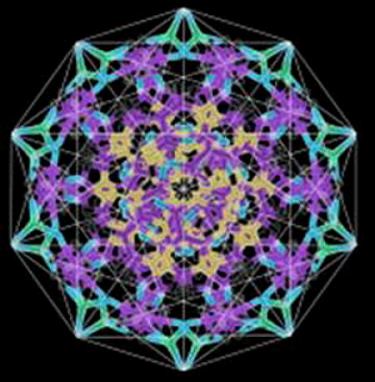
Vertical section of the human dna.
Evidence of Divine Design, Great and Small
"The Heavens Declare the Glory of G-d;
The Skies Proclaim the Work of His Hands." -- Psalm 19:1

Moth wing pattern.
I saw this little creature outside my studio one morning. It got me reflecting on the creative wonder, both large and small, that surround us.

M 51 Spiral Galaxy, NASA photo from the Hubble Space Telescope.

Detail of the 'X Structure' in M 51, NASA photo from the Hubble Space Telescope.
The artist is amazed. So much beauty and wonder in the very large cosmos and in the very small things as well! Can a G-d who spins galaxies into being be concerned with things small and personal? Such order and grace in the extreme scales of our world, yet often what we see before us is chaotic and makes no sense.
That is why we present here Lee Strobel's Case for a Creator. Also recommended are Strobel's Case for Faith and Case for Christ. You may view them Here [click to view]. If you had stepped into that Bethlehem stable many years ago, you would have not necessarily seen beauty and redemption. The smells of animals and the pain of labor and delivery would have overwhelmed contemplation. Yet Christians around the world will contemplate the wonder of that night; for what happened there ultimately made its mark on human history.
The Case for a Creator by Lee Strobel.
(to be continued).