Showing posts with label Citizen Statesmen. Show all posts

Tuesday, September 30, 2014

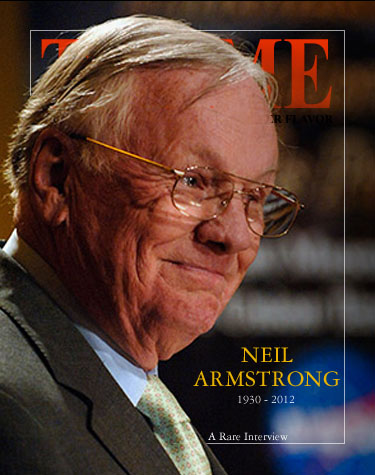
THYME Magazine: Neil Armstrong Interview

Citizen Journalism with a Better Flavor
THYME0814a
Volume VIII, Issue XIV

Interview with Neil Armstrong!


The first man to set foot on the moon!

In this rare series of interviews, Neil Armstrong, the first man to set foot on the moon, tells the story of the historic mission from his own perspective. Alex Malley of Australia's EvoTV's The Bottom Line looks at the life and leadership of the lunar mission's commander. Fascinated by aircraft, even at a very early age, Armstrong obtained his pilot's license at the age of fifteen!

He went on to fly combat missions during the Korean War and later became a test pilot. He then became an astronaut as NASA geared up to meet President John F. Kennedy's challenge to put a man on the moon in the decade and return him safely to earth.

The Russians had already orbited the first satellite, Sputnik, on October 4, 1957 and subsequently orbited cosmonaut Yuri Gagarin as the Americans struggled to develop a dependable booster. After Alan Shepard's short suborbital flight in 1961, President Kennedy challenged the fledgeling space agency to go to the moon.

Armstrong is refreshingly honest in his discussion with Malley. The interview is presented in four parts and is worth watching to the very end. Neil Armstrong expresses very real concern that the space agency lacks the vision and sense of purpose it had in those early years. He ends with a challenge that we as a people would do well to heed and pursue in our own time!


Forty-five years ago two human beings changed history by walking on the surface of the moon. But what happened before Buzz Aldrin and Neil Armstrong exited the Lunar Module is perhaps even more amazing, if only because so few people know about it.

Retake the Senate!

It is time for action! Many in this country have been discouraged and have been told that their vote didn't matter anymore. Even when the results were close, many Americans rightfully feel they were given lip service but then ignored as the Progressive Liberal faction took over the governance of our land. Are you shocked that you can't keep your health insurance (after you were PROMISED that you could)! Are you troubled by the weakening of our national defense, as we quickly send 3000 troops to 'fight' Ebola but can't seem to muster the resolve to face ISIS? Obamacare is a disaster and many Virginians feel frustrated that their two Senators voted for it. Ed Gillespie is outspoken in his criticism of the legislation that was ramrodded through the legislature despite many reasonable objections. As more and more of "what's in it" is seen, some provisions are being delayed. Even the most optimistic financial projections have the fully implemented program a financial disaster. Kicking the can down the road is suicidal for an economy as fragile as today's.

The media will likely try to paint Mark Warner as the 'moderate' he is not. Let us not forget that he does not even pretend to represent many Virginians' values. When he thought he was alone with his elite buddies he said: "One of the things you are going to see is a coalition that is just about completely taken over the Republican Party in this state and if they have their way it’s going to take over state government. It is made up of the Christian Coalition, but not just them. It is made up of the right-to-lifers, but not just them. It’s made up of the NRA, but not just them. It is made up of the home-schoolers, but not just them. It’s made up of a whole coalition of people that have all sorts of differing views that I think most of us in this room would find threatening to what it means to be an American."[1.] Is there no journalist curious about what being an American means to Senator Warner? Also the media will make much of the fact that Gillespie is the underdog in this race. What you WON'T hear is how he's closed the gap since he announced his candidacy... and he's brought his party to surprise victory before!

The Washington Post says this of him: "Gillespie believes in things, like conservative ideas of lower taxes and less regulation. These may sound bland, but Ed adds a personal perspective. Having grown up in a working-class family, he believes that the key to restored prosperity lies in a renewed middle class, one that relies on its own work ethic and a business-friendly government, not an expansion of a welfare state. He is, I imagine, rather angry with what he sees as liberals' condescension to the middle class and what he views as their assumption that only government can solve their problems." [2.] Unfortunately, the media will probably not underscore the fact that Gillespie can probably relate to us a whole lot better than many privileged politicians. He is wealthy, but he understands how wealth is ultimately created. He is one of the creators of the Contract with America, so instrumental in the 1994 victories by Republican candidates. He is considered a very important strategist and policy writer. Up to now he has remained largely behind the scenes.

Before running for office the first time, Warner said he got BILLIONS from taxpayers: “As Warner –himself a winner [in the FCC lotteries]- says, ‘The government has basically given away tens of billions of dollars of an asset that is yours and mine and everybody’s in the country.’”
-“Winners And Losers In The Great Cellular Giveaway,” Fortune Magazine, November 5, 1990

Running for Governor, Warner changed his story: “‘Nobody gave me anything,’ he said. ‘I’m proud of my business success . . .’”
-R.H. Melton, “Va. GOP Making Issue Of Warner’s Fortune,” The Washington Post, August 5, 2001

Mark Warner’s Former Business Partner Says Warner Is A “Vulture.” Peter Zecola, a Warner partner in a cellular company, described his former partner’s business practices by saying, “At the same time, these people are called by some ‘vulture capitalists,’ rather than venture capitalists. They’re basically in it to make a buck. They’re always there to grab that last crumb off the table.”
-Peter Baker, “Before Politics, A Run For His Money,” The Washington Post, September 2, 1996

The media Won't tell you that thanks to Obamacare implementation, Warner's support has significantly softened. As people "see what's in it," they realize it is going to have a negative effect on them personally. Many potential voters are disheartened now as Northern Virginia has thrown it's weight into the past few elections. Still, if voter percentages in the heartland of Virginia increased by just a small percentage, Northern Virginia would not be able to dominate the process. The statistics are worth repeating:

Time to Awaken a Sleeping Giant

In 2004, Christian voter turnout increased by 93 percent over the 2002 turnout, and 42 percent of voters identified abortion as an important issue. As a result:

• 63 percent of the freshman U.S. congressmen elected were pro-life.
• 77 percent of the freshman U.S. senators were pro-life.

By increasing pro-life representation in Congress in the 2002 and 2004 elections, America witnessed the first four major abortion-restricting bills enacted since Roe v. Wade:

• Infants Born Alive Protection Act
• Unborn Victims of Violence Act
• Partial-Birth Abortion Ban
• Fetal Farming Ban

In addition, those senators helped confirm strict constructionists John Roberts and Samuel Alito to the U.S. Supreme Court. By 2006, Christian voter turnout decreased by 30 percent from the 2004 numbers, and only 30 percent of voters said that abortion was an important issue. As a result:

• Only 31 percent of the freshman U.S. congressmen elected were pro-life.
• Only 10 percent of the freshman U.S. senators elected were pro-life.
• The Baltimore Sun labeled the 2007 Congress as “the most pro-choice Congress in the history of the Republic.”

Your vote does matter, and you have the opportunity to protect life, marriage and family. Will you commit to cast your vote in support of the family this November?

Virginia Voter Information:

State General Election: November 4, 2014
Virginia polling times: 6:00am to 7:00pm
Registration deadline October 14, 2014
Register Online [click to register].

A Call to Action!

Right around you, in your church or place of business, are the discouraged people who likely share your values but won't bother to vote! Elections have consequences and we are losing religious freedom and basic protections found in the Bill of Rights by our apathy. There are Excellent Resources [click to read] to help you get your friends and neighbors registered. There are voter guides to help them make informed decisions.

"And let us not be weary in well doing: for in due season we shall reap, if we faint not." -- Galatians 6:9

Solving an Age Old Problem


At Amsterdam's Schiphol Airport, items left on a plane are returned quickly as Sherlock sniffs out their owners!

Wednesday, September 17, 2014

THYME Magazine: Special Election Issue

Citizen Journalism with a Better Flavor
 
THYME0812
Volume VIII, Issue XII

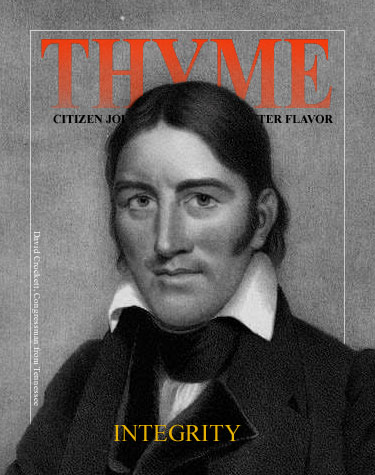
INTEGRITY: Special Election Issue


Davy Crockett's speech to Congress about the 'Indian Bill.' We need more like him!

The scene above is one of my all-time favorites from the movie starring Fess Parker. It brings tears to my eyes as Parker's portrayal of Davy Crockett shows us how a man of integrity stands on his word, even when it costs him his political career! As we move toward an important Senate Race it is imperative that we seek out men and women of integrity today. Watch the scene above if you haven't already. It is a model for what we need to restore to our civic discourse today.

The real skalwags in this here capital of the brave and free is us! YOU and ME, and I'm the worst of the lot!" -- Fess Parker as Davy Crockett, addressing Congress regarding the 1830 Indian Removal Bill.

David Crockett's Speech
by Rep. Dana Rohrabacher

Mr. Speaker, below is the text of a detailed report of a speech given on the floor of the House of Representatives that I believe will be of interest to my colleagues. The description was included in a book titled ``Speeches on the Passage of the Bill for the Removal of the Indians,'' published by Perkins and Marvin in 1830. The speech was given by Rep. David Crockett of Tennessee on May 19, 1830, in opposition to the Indian Removal Act. Unfortunately, the Congress disregarded Crockett's objections and passed the bill, which was then signed into law by President Jackson.A Sketch of the Remarks of the Hon. David Crockett, Representative From Tennessee, on the Bill for the Removal of the Indians, Made in the House of Representatives:

Mr. Crockett said, that, considering his very humble abilities, it might be expected that he should content himself with a silent vote; but, situated as he was, in relation to his colleagues, he felt it to be a duty to himself to explain the motives which governed him in the vote he should give on this bill. Gentlemen had already discussed the treaty-making power; and had done it much more ably than he could pretend to do. He should not therefore enter on that subject, but would merely make an explanation as to the reasons of his vote, He did not know whether a man (that is, a member of Congress) within 500 miles of his residence would give a similar vote; but he knew, at the same time, that he should give that vote with a clear conscience. He had his constituents to settle with, he was aware; and should like to please them as well as other gentlemen; but he had also a settlement to make at the bar of his God; and what his conscience dictated to be just and right he would do, be the consequences what they might. He believed that the people who had been kind enough to give him their suffrages, supposed him to be an honest man, or they would not have chosen him. If so, they could not but expect that he should act in the way he thought honest and right. He had always viewed the native Indian tribes of this country as a sovereign people. He believed they had been recognised as such from the very foundation of this government, and the United States were bound by treaty to protect them; it was their duty to do so. And as to giving to giving the money of the American people for the purpose of removing them in the manner proposed, he would not do it. He would do that only for which he could answer to his G-d. Whether he could answer it before the people was comparatively nothing, though it was a great satisfaction to him to have the approbation of his constituents. Mr. Crockett said he had served for seven years in a legislative body. But from the first hour he had entered a legislative hall, he had never known what party was in legislation; and G-d forbid he ever should. He went for the good of the country, and for that only. What he did as a legislator, he did conscientiously. He should love to go with his colleagues, and with the West and the South generally, if he could; but he never would let party govern him in a question of this great consequence. He had many objections to the bill--some of them of a very serious character.

One was, that he did not like to put half a million of money into the hands of the Executive, to be used in a manner which nobody could foresee, and which Congress was not to control. Another objection was, he did not wish to depart from from the foundation of the government. He considered the present application as the last alternative for these poor remnants of a once powerful people. Their only chance of aid was at the hands of Congress. Should its members turn a deaf ear to their cries, misery must be their fate. That was his candid opinion. Mr. Crockett said he was often forcibly reminded of the remark made by the famous Red Jacket, in the rotundo of this building, where he was shown the pannel which represented in sculpture the first landing of the Pilgrims, with an Indian chief presenting to them an ear of corn, in token of friendly welcome. The aged Indian said ``that was good.'' The Indian said, he knew that they came from the Great Spirit, and he was willing to share the soil with his brothers from over the great water. But when he turned round to another panel representing Penn's treaty, he said ``Ah! all's gone now.'' There was a great deal of truth in this short saying; and the present bill was a strong commentary upon it. Mr. Crockett said that four counties of his district bordered on the Chickasaw country. He knew many of their tribe; and nothing should ever induce him to vote to drive them west of the Mississippi. He did not know what sort of a country it was in which they were to be settled. He would willingly appropriate money in order to send proper persons to examine the country. And when this had been done, and a fair and free treaty had been made with the tribes if they were desirous of removing, he would vote an appropriation of any sum necessary; but till this had been done, he would not vote one cent. He could not clearly understand the extent of this bill. It seemed to go to the removal of all the Indians, in any State east of the Mississippi river, in which the United States owned any land; Now, there was a considerable number of them still neglected; there was a considerable number of them in Tennessee, and the United States' government owned no land in that State, north and east of the congressional reservation line. No man could be more willing to see them remove than he was if it could be done in a manner agreeable to themselves; but not otherwise.

He knew personally that a part of the tribe of the Cherokees were unwilling to go. When the proposal was made to them, they said, ``No; we will take death here at our homes. Let them come and tomahawk us here at home: we are willing to die, but never to remove.'' He had heard them use this language. Many different constructions might be put upon this bill. One of the first things which had set him against the bill, was the letter from the secretary of war to colonel Montgomery--from which it appeared that the Indians had been intruded upon. Orders had been issued to turn them all off except the heads of the Indian families, or such as possessed improvements Government had taken measures to purchase land from the Indians who had gone to Arkansas. If this bill should pass, the same plan would be carried further; they would send and buy them out, and put white men upon their land. It had never been known that white men and Indians could live together; and in this case, the Indians were to have no privileges allowed them, while the white men were to have all. Now, if this was not oppression with a vengeance, he did not know what was. It was the language of the bill, and of its friends, that the Indians were not to be driven off against their will. He knew the Indians were unwilling to go: and therefore he could not consent to place them in a situation where they would be obliged to go. He could not stand that. He knew that he stood alone, having, perhaps, none of his colleagues from his state agreeing in sentiment. He could not help that. He knew that he should return to his home glad and light in heart, if he voted against the bill. He felt that it was his wish and purpose to serve his constituents honestly, according to the light of his conscience.

The moment he should exchange his conscience for mere party views, he hoped his Maker would no longer suffer him to exist. He spoke the truth in saying so. If he should be the only member of that House who voted against the bill, and the only man in the United States who disapproved it, he would still vote against it; and it would be matter of rejoicing to him till the day he died, that he had given the vote. He had been told that he should be prostrated; but if so, he would have the consolation of conscience. He would obey that power, and gloried in the deed. He cared not for popularity, unless it could be obtained by upright means. He had seen much to disgust him here; and he did not wish to represent his fellow citizens, unless he could be permitted to act conscientiously. He had been told that he did not understand English grammar. That was very true. He had never been six months at school in his life; he had raised himself by the labor of his hands. But he did not, on that account, yield upon his privilege as the representative of freemen on this floor. Humble as he was, he meant to exercise his privilege. He had been charged with not representing his constituents. If the fact was so, the error (said Mr. Crockett) is here, (touching his head) not here (laying his hand upon his heart). He never had possessed wealth or education, but he had ever been animated by an independent spirit; and he trusted to prove it on the present occasion. [1.]

5th Grader Takes on 'Nanny State'

Eleven year old Grace Karaffa is not exactly a stranger to politics. Her father is Augusta County Supervisor David Karaffa, who ran for the office as an independent to restore integrity to local politics. His campaign stressed open dialogue and the practical addressing of issues, even when doing so was hard. Since second grade, Grace has suffered from bleeding lips and this causes her quite a bit of discomfort in school. When she asked if she could use Chapstick, she was told that it was not allowed. She could not use the over the counter lip balm because it was 'prohibited' as it was considered a 'medication.' Grace was forced to wet her cracked and bleeding lips in the school washroom as an alternative.

This year, encouraged by her father, Grace brought a petition before the Augusta County School Board asking for the ban on lip balm to be overturned. Citing concerns that students might 'share' medications, the board responded saying they would study the matter. We at THYME have covered 'Nanny State' overreach before, most notably the Wendy's Incident [click to read] but it tends to remain a local story, for the most part. Fox News [click to read], however picked up on Grace's petition, as did Independent Journalism Review [click to read]. The eleven year old's campaign had gone viral!

'Of the People'
Public Servants Should Remember Who They Serve

I grew up with Davy Crockett as a hero. I still remember the part where he rode through the night to defeat the Indian Bill, a bad piece of legislation that cost him his congressional career for opposing it. Davy Crockett was one of us! There was no question.

Fast forward to the past few elections and you have two 'public servants' who let their hair down with their elite buddies and say things like: "You go into some of these small towns in Pennsylvania, and like a lot of small towns in the Midwest, the jobs have been gone now for 25 years and nothing’s replaced them. … And it’s not surprising then they get bitter, they cling to guns or religion or antipathy to people who aren’t like them or anti-immigrant sentiment or anti-trade sentiment as a way to explain their frustrations." [2.]

Or consider this quote: "One of the things you are going to see is a coalition that is just about completely taken over the Republican Party in this state and if they have their way it’s going to take over state government. It is made up of the Christian Coalition, but not just them. It is made up of the right-to-lifers, but not just them. It’s made up of the NRA, but not just them. It is made up of the home-schoolers, but not just them. It’s made up of a whole coalition of people that have all sorts of differing views that I think most of us in this room would find threatening to what it means to be an American." [3.]

Scary stuff! The man responsible for the second quote is sitting in the U. S.  Senate from the State of Virginia. He once ran ads saying that then Senator Obama "respects" your Second Amendment rights! But even though he claims to be a 'moderate,' Senator Warner's voting record says otherwise. His vote gave us Obamacare, in spite of strong appeals (I went to his office with a lot of other people) to do otherwise. He has voted with the President 97% of the time, yet the media this fall will paint him as a Centrist!

Home schoolers, dangerous?, I've had home schoolers and former home schoolers work in our model shop and I can tell from the above quote that Mark Warner has far less experience with home schoolers than I do. I've seen fifteen year old kids who've developed professional proficiency and have pretty good heads on their shoulders to boot! I think I'll send Senator Warner a copy of Alvin Schmidt's book Under the Influence. I think there are many spiritual underpinnings to what it means to be an American. I don't think Governor Warner's coctail crowd should be so afraid of us.

In the early Nineteenth Century, Crockett's Tennessee was the Alaska of its day, sitting on the frontier with hostile forces beyond. I'll bet you their were no teenagers working out their angst either. Young people were working the farms and defending them. So, once again in troubled times, should we look to the frontier for leadership? I think so!

Still, it is not surprising that the press will repackage Elite Liberals as 'Centrists' as the election approaches. They all read Howard Zinn [1.] together in school and are steeped in his narrative. A recent piece I read by Gerry Warburg preaches: Lessons in the Wake of Watergate. [2.] It is interesting reading. Warburg went to Washington as a young Democrat aide in the wake of Nixon's resignation. He helped write Jimmy Carter's nuclear policy bill. Warburg calls those years: "...a time of national renewal. In crisis there is opportunity: Reformers of all political persuasions helped advance crucial measures..." So, while Warburg admits to the need for deficit reduction his call for "informed voters" to elect "Centrist" candidates needs some analysis.

In 2009, the Tea Party sounded the alarm about rising government debt and the folly of larger government. The media has worked overtime to marginalize it. Does Warburg not see that the activists from all backgrounds today are often calling for a return to Constitutional principles and a reigning in of the government as part of an overall strategy to return health to the country? President Obama took with him to Washington over fifty of the most overtly Leftist Idiologues as Czars. The media yawned. The IRS was employed to hobble the Conservative movement. The media yawned. Eric Holder's Justice Department ignored the New Black Panther Party suppression of white voters in Philadelphia. Rioters 'rightfully' burn down their neighborhood when a white policeman kills a black youth but hundreds of kids die in these neighborhoods at the hands of people the same race and the media yawns. The suspicious nature of Benghazi, 'Fast and Furious' Extortion 17 and the arm-twisting passage of the so-called "Affordable Care Act" might cause one to pause and ask": "What did Nixon do, again?"

Indeed, if one honestly considers Richard M. Nixon's place in history, the Watergate break-ins seem to be JV league compared to the weight of the present documented scandals. Warburg might do well to remember that Nixon, aside from Watergate, actually embodies the true Center-Right candidate. Under Nixon's leadership, the Environmental Protection Agency began. Nixon also is known for the controversial Wage/Price Controls, under which Insurance as an employment benefit became cemented. Rubbing shoulders with Robert C. Byrd, he should have realized where much of the ensconced racism of this country resided. In conclusion, I would have to agree with Gerry Warburg's desire for an informed electorate, but I would caution the media to report honestly and let the informed electorate, not the pundits, decide who is 'extreme.'

Serge Belo's Amazing Mosaic


To raise awareness among the general public about the global clean water crisis, the artist Serge Belo created an image composed of 66,000 cups of colored rainwater. (Contributed by Kristina Elaine Riley).

Wes Stafford in his book: Too Small to Ignore [click to read] speaks with affection of the time he lived in Africa with his missionary parents. One of his most cherished memories was digging out a well for a village with his father. Tired and muddy, they submitted their story to their mission board's newsletter. Sadly the newsletter overlooked this wonderful story and did not publish it. So many people in the world today would be spared so much suffering if they could just be provided with clean water! And clean water is such a practical testimony of G-d's Love!

Stafford went on to found Compassion International [click to read] and they have helped a lot of children with the basic necessities such as clean water, bringing the Love of G-d to their communities in practical acts of service. To this day, Wes Stafford and his partners continue to embrace the muddy work of building the Kingdom of G-d! But still, digging wells and fencing out cattle is often overlooked as a work of the Kingdom.

To raise awareness among the general public about the global clean water crisis, the artist Serge Belo created an image composed of 66,000 cups of colored rainwater simulating levels of impurities found in water all over the planet. This major work of 3,600 square feet, representing a baby in the maternal womb, emphasizes the necessity of water, even before birth, for each living person.

Does My Vote Matter?

Imagine the impact Americans of faith can have on the future of our nation, the character of its leadership, and the health of its families if we all applied biblical principles to every aspect of our lives — including committing to vote.

Commit to Vote 2014 [click to read]
Wednesday, May 7, 2014

THYME Magazine

Citizen Journalism with a Better Flavor

THYMEfibonacci
Volume VII, Issue XXI

"We hold these truths to be self-evident, that all men are created equal, that they are endowed by their Creator with certain unalienable Rights, that among these are Life, Liberty and the pursuit of Happiness." -- American Declaration of Independence.

The Divine Design
In Defense of 'Self Evident Truth'

There is in nature an element of beauty that transcends functionality. Observation of the created world leads us to see something of the nature of the Creator. Thus it is significant that the framers of our original documents saw the dignity and significance of individual men as rooted in the concept of Imago Dei -- that mankind was created in the image of the Divine. Consider the impact that observation has had on the affairs of mankind. Two hundred years ago these principles were invoked as the foundations for our nation. No, slavery was not immediately abolished and sin was not obliterated... but that such principles were laid as foundation for our revolution led to a place where they formed a clear and unmistakable map for our future direction.

Indeed these principles predate the American experiment, finding expression in the work of men such as John Locke. England's own move from absolute monarchy to Parliamentary government, as seen in her 'Glorious Revolution,' gave wind to the sails of representative government and individual dignity. William Wilberforce's faith led him to fight for decades to abolish slavery. He is most remembered for this but he also championed reform of the culture and humane treatment of animals. History shows us time and time again, that conviction and passion lead to action. What a person truly believes will direct his steps. That is why we should indeed ask our leaders what they believe. It affects their leadership!

Well into the Twentieth Century, we still find faith directed persons in conflict with the degrading of humanity. Dietrich Bonhoeffer is a prime example. The Lutheran theologian could not keep his faith 'personal' as the National Socialists oppressed the Jews. He spoke out against it. Then he joined in an attempt to assassinate Adolf Hitler. Many 'modern thinkers' will likely be repelled by the thought that a Christian's faith could be reconciled with the assassination plot. But consider this: Hitler's 'beliefs' in a superior race led to the deaths of millions of people. Hitler implemented HIS beliefs unashamedly. When the smoke had cleared over six million Jews, scores of Gypsies and other 'undesirables,' homosexuals and "Righteous Gentiles" lay dead!

Why do we universally condemn Hitler? 'Self Evident Truth' tells us to. In fact, without such self evident truth, we can actually argue for the elimination of those 'not like us' with some authority. This is the frightening dark side of Relativism. If nothing is 'right' or 'wrong,' then NOTHING is 'right' or 'wrong!' Pro-choice arguments for abortion reside here. Locke is careful to temper the reality of human freedom with the moral obligation to respect the freedoms of others. This underlying concern leads us to condemn slavery, leads to the actions of the 'Righteous Gentiles' and now leads us to plead the cause of the unseen unborn!

So, what do we do when modern leaders insist that we not question their beliefs? I think history tells us to question them anyway! What a man truly believes will indeed shape his actions. Simple due diligence requires that we ask our leaders to share the basis upon which they will act. To be fair, Barack Hussein Obama did so in his book: Dreams of My Father. The Obamas occassionally attend St. John’s Church, an Episcopalian church in Washington, but when he was a young Chicago politician he freely chose to attend the church of the Reverend Jeremiah Wright, a disciple of Black Liberation Theologian James Cone. This association with Liberation Theology would be in keeping with his father's stated Anti-colonialism.

Of course, privately held beliefs have no effect on public policy, right? If you consider Obama's policies carefully, you will find a Justice Department that overlooks VOTER INTIMIDATION by the New Black Panther Party while Obama's State Department virtually ignores the plight of evangelical Pastor Saeed Abedini, an American imprisoned in Iran! Obama's boyhood is remarkably removed from that of a typical American who would have experienced church picnics, Fourth of July celebrations and such. He studied at a Muslim school in Indonesia and was introduced to Hanuman the Monkey God by his stepfather Lolo.

While the American experience is quite tolerant of diversity, it is not at all unreasonable to ask a PRESIDENT what he believes. When Obama made a quite contorted and subservient bow to the Saudi King, Americans are right to ask what this means? If I am disturbed that Eric Holder's acceptance of voter intimidation seems similar to the 'righting of wrongs' between tribes in post-colonial Africa, is it unreasonable for me as a citizen journalist to draw comparisons to the ideals of Dreams of My Father? One only has to look at Uganda and Rwanda to see the results when settling the score for the oppressed peoples of the world becomes the goal rather than elevating the human condition.

The American experiment, rooted in a sense of Divinely ordained principle, created unprecedented opportunity for scores of people. Contrast that with the wreckage of a slew of Socialist 'utopias' that descended all too rapidly into dystopia. It would seem to me that America's founding, based on Divine insight into the nature of man, has produced far more good than subsequent attempts to 'reform' institutions with NO regard for Divine insight. That is at the heart of why I must be in Washington on May 16 to stand against those who would 'fundamentally change' that nation based on self evident truths.

Standing for Truth [click to listen], Some thoughts from Eric Metaxas, New York Times bestselling author of Amazing Grace: William Wilberforce and the Heroic Campaign to End Slavery.

How Do You Kill 11 Million People [click to listen], Are there really similarities between Nazi Germany and the government of the United States?  NY Times Best-selling author Andy Andrews answers that very question, while also helping us discover a way to turn our country back to the truth on which it was founded.

advert

Wednesday, March 12, 2014

THYME Magazine: A Case for Vision IX

Citizen Journalism with a Better Flavor

THYME0712
Volume VII, Issue XII

A Case for Vision IX
© 2014 The Kirchman Studio.

So why do nations fail? While a case can be made for institutional integrity, it is also clear that simply transplanting working institutions (such as the U. S. Constitution) into other societies does not necessarily guarantee success. Post-Colonial Africa testifies starkly to this, as do the wreckages of a succession of Socialist Utopia/Dystopias. If better institutions can be constructed, what are they to be made of? Acemoglu and Robinson argue for good institutions, but cannot tell us what the foundations should be. Even those who would argue that the "American" solution is the right one need to confont the reality of America today. America is in Decline. As her leaders saddle her with $17 Trillion in debt, she becomes increasingly weaker as an agent for providing for the basic security of the society. Her leaders are content to entrust our energy production to unfriendly regimes in the Middle-East, our financial and manufacturing security to unfriendly regimes in Asia and our physical security to a despot-heavy United Nations. How did we get to this point? In this conclusion to the series: A Case for Vision, we will look at some possible reasons.

As America grew increasingly secure in its prosperity, it turned its energies increasingly towards a 'consumer mentality.' Note that this is in stark contrast to the earlier mindset that America was to be a blessing to the rest of the world. The drive to send missionaries, provide clean water and cure disease took a back seat to building bigger houses and bigger televisions. Now we could outsource our manufacturing, enjoying more and cheaper goods. No longer would we have to live next to 'dirty' old factories. They could be converted into trendy botiques, lofts and coffee shops. Sadly, those jobs they created went away too! No worry!, everyone can go to college now. The problem is that the Professional sector grows only insofar as it is the supportive branch of the creation of real productivity. No problem. After college you can work/hang out in the trendy coffee shop. Gratification became a larger motivating force than the securing of Faith and Freedom. The Mall and the Multiplex Theater replaced the church and the armory at the center of the commons. Manufacturing centers could be re-purposed as shopping areas too. Religion diminished as a force for living everyday life, becoming an inspirational hour for refreshment rather than a challenge to be lived throughout the week. Hillary Clinton carefully crafted her own description of Religious Freedom to narrowly define it as the 'private practice of Faith.' Her description actually perscribes its exclusion from the public square! [1.]

Next came a sense of 'entitlement.' How else do you explain unmarried Georgetown University student Sandra Fluke DEMANDING that her school, a Faith institution run by the Jesuits, provide HER with recreational contraceptives? [2.] That she was invited to speak at the Democrat Convention and now is exploring a run for Congress speaks volumes to this new sense of 'entitlement!' There is something fundamentally wrong here... far more than the economic reality that she, as a law student, can anticipate far more income than I will ever see. She does not NEED Georgetown University to provide her with recreational contraceptives. The real travesty is that while the church is being told that it has no place in the commons, those in the commons are all to eager to place such limitations and demands on the house of Faith! A major retailer, a major furniture manufacturer and a chicken sandwich restaurant who seek to live their faith in the marketplace are all under attack. This is not an accident. The inclination of mankind towards morality has been repackaged in electric cars, cloth grocery bags and tilting at the windmill of 'Global Warming.' Stewardship of the earth, a noble thing in and of itself, can attain the status of civil Religion. Traditional Religion can get out of the way of our pursuit of Hedonism. Why should we cry out to G-d if we can make government our provider?

Finally, there is a wrongly placed national pride. This is the arrogant assertion that we somehow no longer need to rely on Divine Providence, humbly petitioning Heaven for our daily bread. We can do it all ourselves if we somehow correctly organize the commons. Thus we eschew the functions of Faith and Defense rightly performed in the commons as the commons takes upon itself to do the work of G-d! But what is the result? May I suggest it is nothing but a high-tech serfdom. Because 'we' can change the climate, we will do so by strangling the very engines of industry and ingenuity that have actually improved man's stewardship of the world (actually we've simply placed our manufacturing offshore. Our 'clean' Priuses receiving toxic batteries from a Chinese factory that would not meet the standards of our own EPA). [3.] We come to the conclusion that 'we' must alone end Acquired Immune Deficiency and balance the temperature of the planet. We will pay carbon taxes to despot regimes while stifling the energy production that will free us to advance to the next generation of propulsion! We forget the wisdom of Samuel Morse, who telegraphed: "What hath G-d Wrought?" upon the successful operation of the telegraph. We forget humility.

And yet, if you are reading this, you might realize that we might indeed pursue a better course. We might look to Bless future generations rather than feather our own nests. We might pursue our science with humble faith as opposed to arrogance, looking to a G-d who I believe is all too eager to reveal new secrets to trustworthy men and women. We might, as we realize the roots of our prosperity, seek to share those roots with our fellow man. We will not kick against Constitutions that limit institutions, seeing that the limitless resource of Divine Revelation can indeed fuel our aspirations. What drew me to Asmus and Gruden's work was their optimism in presenting a universally implementable strategy for improving the human condition. What compelled me to write this series was the burning sense that I was holding in my hands a map, if you will, showing the location of treasure far greater than the Count of Monte Cristo's map to the lost treasure of Sparta. Like the old priest, I want to press it into the hands of someone who will use it for good.

Crocus 1
Spring Crocus.

Wednesday, March 5, 2014

THYME Magazine: A Case for Vision VIII

Citizen Journalism with a Better Flavor

Thyme0711
Volume VII, Issue XI

A Case for Vision VIII
© 2014 The Kirchman Studio.

What model best advances a society? What will propel us to new frontiers in creativity and to meet the needs of humankind most effectively? Again, history provides examples to learn from. We know intuitively that the American Revolution didn't happen in a vacuum. We know that John Locke's writings provided a model for Jefferson, but like any great work there is more to its creation than first meets the eye. If one takes a magnifying glass and looks closely, what might we learn? Before Bristol could revitalize itself, before the good of eliminating slavery could be accomplished that would necessitate Bristol's revitalization, there was profound societal change that would usher it in. In their book The Poverty of Nations [click to read] Wayne Grudem and Barry Asmus present the story behind the story, as it were. In 1688 England experienced its Glorious Revolution, where leaders of Parliament asked William of Orange to invade England and take the throne from James II. With an army of fifteen thousand Dutch soldiers, William overthrew James II who did not even resist his removal. The Glorious Revolution had the effect of limiting the king's power while vesting the power to govern in Parliament. Here we have a representative body assume real power and a firm check against absolute monarchy. The result was a greater pluralism in representation and what Daron Acemoglu and James A. Robinson hail as: "the world's first set of inclusive political institutions" in their book: Why Nations Fail. [1.]

William of Orange had been schooled in the thought of the Reformation. That Revolution, though many think of it as 'merely' spiritual, actually caused a paradigm shift in the culture as men and women were encouraged to pursue relationship with the Divine through each one's reading of the Scripture. The result was that personal literacy was encouraged, education flourished and everyone in the society was now able to work with new ideas. Jewish culture already encouraged such individual study and those cities in Europe who encouraged their Jewish communities rather than surpress them enjoyed the fruits of inventiveness and industry as well. Conversely, those who's cultures maintained the creative sector in the hands of a powerful few often surpressed this wonderful culture of creativity. The pograms of Czarist Russia and the Inquisition of Spain ultimately had the effect of squelching the healthy freedom of inquiry and exchange of ideas that propelled Post-reformation Northern Europe forward. Religious Freedom was a necessary byproduct of Reformation. It did come into being in at least limited form in some countries of Northern Europe. The desire for Religious Freedom spurred a number of diverse Faith communities to come to the new world. New England's Pilgrims and Maryland's Catholics sought it. The Anabaptists and the Presbyterians who crossed Virginia's Blue Ridge did as well. [2.]

The advancement of human freedoms seen in the Eighteenth Century might well be seen in the light of the quest for Religious Freedom. The First Amendment of our Constitution, if you read it in its entirety (not just, as some do, for the 'Establishment' clause), places Religious Freedom as a basic right and prohibits government from infringing upon it. It is a 'Negative Liberty' to be sure, but an essential one. The First Amendment also protects thought and speech from government 'oversight.' That is why the recent selective enforcement actions of the Internal Revenue Service are so unconstitutional. In surpressing Conservative and Religious speech they have become an agency of the government to trample on a hard-won expression of a basic human right! [3.]

"Let thy work appear unto thy servants, and thy glory unto their children. And let the beauty of the Lord our G-d be upon us: and establish thou the work of our hands upon us; yea, the work of our hands establish thou it." -- Psalm 94:16, 17

In 1776, more than a hundred years after the Glorious Revolution, Adam Smith wrote in An Inquiry into the Nature and Causes of the Wealth of Nations: "That security, which the laws of Great Britian give to every man that he shall enjoy the fruits of his own labor, is alone sufficient to make any country flourish. The natural effort of every individual to better his own condition, when suffered to exert itself with freedom and security, is so powerful a principle, that it alone, and without any assistance, not only is capable of carrying on the society of wealth and prosperity but of surmounting a hundred impertinent obstructions with which the folly of human laws too often encumbers its operations; though the effect of these obstructions is always more or less either to encroach upon its freedom or to diminish its security. In Great Britain industry is perfectly secure; and though it is far from being perfectly free, it is as free or freer than in any other part of Europe."  [4.] The Eighteenth Century saw the results of mankind loosed from the bonds of serfdom where he toiled under the oversight of a Lord for protection and also loosed from the constraints of the 'Divine Right of Kings,' also a supposed provider of protection. The grim reality was that such 'protection' included the obligation to fight in the king's wars, be they righteous or capricious. Meno Simonsz had resisted this policy and he and his followers endured much persecution for it. [5.]

The American Experiment owes much to the migration of persecuted Religious people to her shores. The Pilgrims landed in Massachussetts and proceeded to build their community. At first they held all things in the commons, no doubt seeing it necesary to be unified in carving out a new life in the frontier, but after a disasterous start this changed. William Bradford assigned each family their own plot of ground and since everyone 'owned' his productivity; productivity soared. The starvation and lackluster participation of some citizens in the common agriculture was changed as each man pushed his own farm to thrive. [6.] The new model, seen in the Jamestown colony as well, placed the armory in the commons but placed industry in private hands. Now a man had incentive to learn better methods, since he and his family would literally reap the benefits. This was not so much 'rugged individualism' as modern writers often surmise, but a cooperation of free individuals each pursuing their own industry, but coming together to protect themselves from common threats and coming together to bring in their bountiful harvests. Next to the armory, in the center of the commons, was the church. Faith was even more essential than dry powder for the security of the community.

When the Moravians setled in the Piedmont of North Carolina to peacefully farm, they built the town of Bethabara. At the center of Bethabara was the Gemeinhaus, where the Moravians met for worship. There was a bell that was rung several times a day to remind the faithful to pray. Bethabara was never attacked by Native Americans and in fact developed good relationships with the surrounding tribes. They later learned that hostile factions in those tribes had indeed organized a number of attacks on Bethabara in its earlier days. Sneaking up on the little community they had assumed they had been scouted out when they heard the ringing of the village bell and they rapidly reatreated! The Moravians, in fact, long enjoyed good relations with nations like the Cherokee, since single Moravians lived as a longhouse people, much as the Native Americans. There was, in fact, a large Moravian Cherokee settlement in the pre-removal era. Sadly, they were massacred in the buildup to the Cherokee Removal. The Moravians became for a time a major force in world evangelism, living the promise of the Gospel among people around the globe. [7.]

Acemoglu and Robinson note that some institutions produce great freedom and advancement while others do not. They seem to argue that institutions can be perfected but are at a loss as to how this actually happens. In the Nineteen-sixties nations around the world seemed poised to participate in the American Experiment. Colonialism was coming to an end. In African nations freed from colonialism. Beautiful African delegates in traditional robes met in gleaming new assembly halls as they proudly presided over an entire Continent emerging from Colonialism. The U. S. Constitution was frequently used as a model as these nations set a new course. National Geographic photos and articles from the period paint the picture of a bright future emerging. But as Uganda, once the 'Pearl of Africa' sank into horrible despotism; tribalism intermixed with 'anticolonial' Marxist politics resulting in the wholesale slaughter of millions; much of Africa descended into a new Post-Colonial period of darkness. Hutus and Tutsis warred in a costly conflict that destroyed their society. What happened? The models were good. But something was lacking in the foundation. Acemoglu and Robinson have no explaination as to why some institutions succeed and other, similar institutions fail. Asmus and Gruden present a compelling case that the whole model includes soundness in the culture, a soundness rooted in faith. (to be continued)

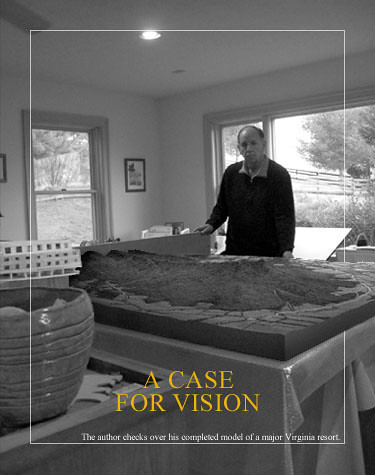
MASS00001

MASS00002

MASS00003
Scale model of Massanutten Resort by the Kirchman Studio.

Wednesday, February 26, 2014

THYME Magazine: A Case for Vision VII

Citizen Journalism with a Better Flavor

THYME0709
Volume VII, Issue X

A Case for Vision VII
© 2014 The Kirchman Studio.

Our nation is in need of an I. K. Brunel's vision today.  Our situation is no less dire than that of Bristol in the Nineteenth Century and we need to find direction, both in spirit and economically, if we are to emerge successfully. [1.] Looking at what is happening in North Dakota it is imperative that we find similar opportunity for people in every state of the union. Where shall we look for a vision of the future? Certainly not to an administration that sees massive unemployment and underemployment as a good thing! Many of us have seen our hopes and dreams take a serious hit from the policies of this administration. The marketplace has less resources available to support the creative endeavors we are now supposedly 'free' to pursue. Just ask anyone actually selling fine art these days. People need to be making money in order to spend it! If you are looking to the National Endowment for the Arts to fund your work, guess what? Diminishing tax revenues means less money to fund 'public' art. In fact, the government will be hard pressed to meet obligations such as Social Security and Medicare.

The current administration has no intention of encouraging the true creative sector in this country. In fact, it is becoming quite clear that they WANT us discouraged. Our discouragement is essential for them to implement their 'fundamental change' to the country we live in. That is why we must not succumb. I would like to, in the spirit of Theodor Herzl's Aultneuland, give you reason for hope and reason to stay in the fight as well! Herzl was a man with a vision. In Altneuland he was spot-on in describing the nation that was born, or reborn, if you will in the creation of modern day Israel. When Herzl wrote his novel the land was securely in the hands of the Ottoman Empire. In 1917 England's foreign secretary Arthur Balfour wrote a declaration stating that this land should indeed be given as a homeland to the people who had inhabited it since ancient times. World War I saw the end of the empire and British control. It wasn't until 1947 that Israel was truly 'reborn' in the wake of that terrible war.

So, it is essential for us in our time to keep the vision alive that created our own republic. We need to teach our young people, instructing them in the Faith and values that are the true foundation of America's remarkable story. Just like Bristol, England in the Nineteenth Century, we need to look beyond our immediate boundaries and see new possibilities. I believe that ultimately the unseen hand of creativity and human ingenuity can prevail. Will we live to see new wonders? I believe in G-d. I believe in inspiration, and I believe in Imago Dei... the knowledge that in creation G-d did indeed give mankind a small spark of His own creative energy. When Samuel Morse telegraphed: "What hath G-d wrought?" he was correct in his attribution even as he worked with his own hands to make the device. Now we need to be open to the same sort of inspiration. There are things we can make again (or for the first time)!

Consider the more recent story of R. G. LeTourneau, who's company had been awarded a contract to build a machine to lift airplanes by the government during the great war. No one had ever built such a machine before, and the engineers were stumped. Wednesday evening rolled around and LeTourneau announced to his stunned team that he was going to a prayer meeting. "But, sir,... We've got a deadline on this thing!" The great industrialist replied: "But I have a deadline with G-d." LeTourneau went to the prayer meeting. He sang praises and poured out his heart in earnest prayer. He said that walking back to his office from the prayer meeting, he 'saw' the design he was seeking for the machine clearly in his head! What if a modern-day Brunel were indeed to create new dorways for American commerce, as American ingenuity continues to finds new sources for energy to power that commerce. Just think, new geothermal resources powering new frontiers in American inventiveness.

I, for one, refuse to believe that the age of inspiration is past. I do believe that it is essential that we return to the roots of Faith and freedom that have given birth to the American experiment and sustained it. It is not enough to be brilliant in business if we squander the return it gives us in a false sense of entitlement: "For unto whomsoever much is given, of him shall be much required." -- Luke 12:8 So, come with me, in the spirit of Aultneuland, to an America not too far in the distant future. Let us visit a land where a greater vision prevails than simply profit or personal reward. In my youth we once rode the train into Philadelphia from Baltimore. At the time, when you entered into Pennsylvania from Delaware, you were greeted by a large sign that read: "What Chester Makes Makes Chester." The city of Chester was at the time a center of manufacturing and it indeed saw itself in terms of its contributions to the world.

Would that we would see ourselves as contributors to the world once more! If Herzl were to step into his beloved Zion today, he would be amazed to see the center of advanced technology she has become. He would wonder at technologies being developed there that might one day give sight to the blind! Though he forsaw them, the modern cities such as Tel Aviv would still astound him! He would see the amazing works of irrigation that have made Israel the garden state of the world. The flowers we had at our wedding in 1980 came in boxes that proudly proclaimed that they were grown in Israel. Abraham the Patriarch was given the promise in Genesis 22:18: "And in thy seed shall all the nations of the earth be blessed; because thou hast obeyed my voice." What wonderful contributions might we as a people make to the world if we will ourselves heed the voice of the One who created creativity itself?

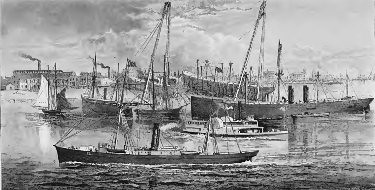
chesterport2
The waterfront of Chester, Pennsylvania in 1875.

Wednesday, October 16, 2013

THYME Magazine Special Shutdown Edition IV

Citizen Journalism with a Better Flavor

THYME0620
Volume VI, Issue XX

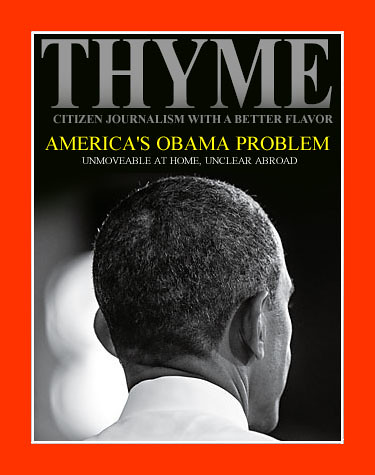
America's Obama Problem

The 'other' weekly news magazine last week featured an interesting cover on their Overseas Editions [click to read]. Michael Bloomberg may aspire to be "Mayor of the World," but Barack Hussein Obama seems to be more intent on conquering his own country's Tea Party than asserting the cause of stability, peace and freedom around the world.

Edward Klein, in his book The Amateur [click to read]  has some harsh criticism for the President, presenting us with: "a withering portrayal of a radical adrift, in over his head, drowning in his own incompetency -- while being weighed down by a small circle of "advisers" who are compounding the problem of the Amateur in the White House."

"On issue after issue, President Obama remains his insular self, refusing to seek counsel or input from others with more experience. Critics believe he has made a mess of foreign policy precisely because not only does he have a dearth of experience in this area, but because, under our system, foreign policy is one of the few areas where a president enjoys almost unlimited power. Thus, he is free to formulate his own agenda regardless of the views of others and the damage these policies cause."-- Ed Lasky

Indeed it is Obama's inability to deliver the sort of openness and constructive dialogue he promised in his campaigns that is dogging him now. Seeking to "fundamentally transform" this country, he and his fellow Progressives pushed their unpopular healthcare law through Congress in spite of strong and reasoned opposition. Rather than listen to less disruptive ways to deal with The Preexisting Condition Problem [click to read], Obama insisted that the ONLY solution was to create a massive government driven solution encompassed in a 2000+ page piece of legislation which was merely the outline of a structure to be designed later by bureaucrats. Indeed, the scope of the legislation seems driven by the desire of Progressives to eventually arrive at a Single Payer system, though that end is clearly unpopular.

As the Manhattan Institute's Roy Avok points out: "Obamacare’s approach to pre-existing conditions helps a small number of people gain coverage in the short term, but the law makes the fundamental problems worse by driving up the cost of health insurance and requiring employers to sponsor health coverage for their workers, even when workers would be better off owning their own policies."

So, Obama wrestles with a Congress essentially doing its job. "Legislation by Appropriation" is nothing new. Already scores of Obama friends in business have received waivers from the "employer mandate," the exchange website is beset with glitches and in spite of a fawning media there is no way to gloss over the fact that this legislation is wreaking havoc on the system. Costs are rising, employers are shifting thousands of employees to 'part time' status to control their budgets. When the dust settles it is estimated that there will still be thousands uninsured and projections do not show that there will be funds to care for them.

As Obama fiddles, the world burns. The President is missing the opportunity to speak forcefully into the Iranian nuclear crisis and his generally weak and ambiguious foreign policy leaves a gap that nations like China, who DO aspire to world leadership, are moving to fill. Thankfully there are leaders like Binyamin Netanyahu who are not afraid to assume the authority American Presidents once possessed in world affairs. It is THEIR leadership that will have to carry us through this present time of crisis.

Thursday, July 11, 2013

THYME Magazine

Citizen Journalism with a Better Flavor

THYME0449
Volume VI, Issue IV

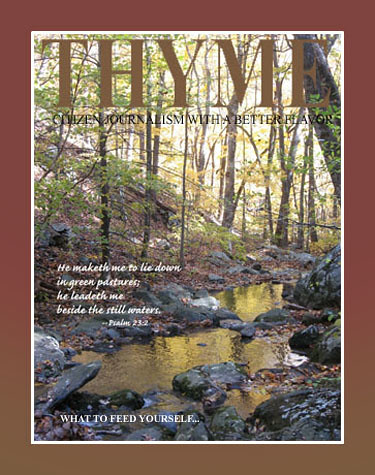
What to Feed Your Soul

A 'Best of THYMEs' Feature...

The 'other' weekly news magazine once featured, just in time for Thanksgiving reading, What to Eat Now [click to read]. While not disparaging the discussion of good nutrition, THYME explores the satisfaction of a different sort of hunger.

This week, the 'other' weekly news magazine looks at the precarious situation in Egypt. The World's Best Protesters/The World's Worst Democrats [click to read]. Indeed, nations can be carried away on a precarious course. How best can concerned citizens chart their way when the critical mass of leadership (or lack thereof) in the land they love is hurtling out of control.

On November 7th, 2012; many of us awoke to a gnawing inside that would not be satisfied by any meal. We saw ourselves losing our beloved country. It was an emptiness that could not be explained away. Steve Elliott of Grassfire offered this bit of wisdom from Jeremiah 29: 

Build! Plant! Bless! And Pray!


Thriving_bumpersticker_(Rnd2)

"Now these are the words of the letter that Jeremiah the prophet sent from Jerusalem unto the residue of the elders which were carried away captives, and to the priests, and to the prophets, and to all the people whom Nebuchadnezzar had carried away captive from Jerusalem to Babylon;
 
(After that Jeconiah the king, and the queen, and the eunuchs, the princes of Judah and Jerusalem, and the carpenters, and the smiths, were departed from Jerusalem;)

By the hand of Elasah the son of Shaphan, and Gemariah the son of Hilkiah, (whom Zedekiah king of Judah sent unto Babylon to Nebuchadnezzar king of Babylon) saying,

Thus saith the Lord of hosts, the God of Israel, unto all that are carried away captives, whom I have caused to be carried away from Jerusalem unto Babylon;

Build ye houses, and dwell in them; and plant gardens, and eat the fruit of them;

Take ye wives, and beget sons and daughters; and take wives for your sons, and give your daughters to husbands, that they may bear sons and daughters; that ye may be increased there, and not diminished. And seek the peace of the city whither I have caused you to be carried away captives, and pray unto the Lord for it: for in the peace thereof shall ye have peace.

For thus saith the Lord of hosts, the God of Israel; Let not your prophets and your diviners, that be in the midst of you, deceive you, neither hearken to your dreams which ye cause to be dreamed. For they prophesy falsely unto you in my name: I have not sent them, saith the Lord.

For thus saith the Lord, That after seventy years be accomplished at Babylon I will visit you, and perform my good word toward you, in causing you to return to this place.

For I know the thoughts that I think toward you, saith the Lord, thoughts of peace, and not of evil, to give you an expected end.

Then shall ye call upon me, and ye shall go and pray unto me, and I will hearken unto you. And ye shall seek me, and find me, when ye shall search for me with all your heart.

And I will be found of you, saith the Lord: and I will turn away your captivity, and I will gather you from all the nations, and from all the places whither I have driven you, saith the Lord; and I will bring you again into the place whence I caused you to be carried away captive." -- Jeremiah 29:1-14

Did you know that: "Jews make up 0.2 percent of the world population, but 54 percent of the world chess champions." -- David Brooks

I found an interesting article by Rabbi Nathan Lopez Cardozo in Jewish World Review. The Greatest Chess Game on Earth [click to read] shows how the people who followed Jeremiah's advice learned how, not only to survive, but to thrive in exile. After the destruction of the Temple, the development of small fellowships in Synagogues fed the spiritual hunger of those who had been carried away. Central to this community were the Holy Scriptures. Rabbi Lopez gives us a unique perspective on the Scripture. We should not see the constraints of Faith as restrictive. Rather, they are the structural rules which allow us to pursue great works, and in the process bless those around us.

The game of Chess, Cardozo writes, has strict rules. Yet, within these rules there are an unlimited amount of possibilities:

"He who knows all the rules is not automatically a good player. What makes him a great player is his ability to use these rules to unleash an outburst of creativity, which resides deep within him and emerges only because of the "unbearable" limitations. He then strikes! One small move forces everything to shift around, creating total upheaval and causing the opponent to panic as he never did before. And all this without ever violating one chess rule. This is mental torture. But it is also the height of beauty. It is the poetry of the game, like a melody is to music. Like one gentle brushstroke of Rembrandt on a colorful canvas, making everything look radically different, or like the genius musician playing her Stradivarius, re-creating the whole of Mozart's Violin Concerto No. 5. It transports the chess player to heaven. His body must be in top form because his playing ability deteriorates when his body does. Body and mind are inseparable. An entire world of feelings, images, ideas, emotions and passions come to the forefront." -- Rabbi Cardozo

Rabbi Cardozo offers deep nourishment for the journey ahead, as well as unique insight into how to live in the light of Holy Scripture. I LOVE the implications of his final thoughts:

" Surely chess is just a game, while Halacha, if properly understood and lived, deals with real life, deep religiosity, moral dilemmas, emotions and intuitions far more significant in man's life than a chess game.

But the man who plays chess in real life as suggested by Halacha will realize that if he "plays" well he is on the track to drawing closer and closer to the King, until he is checkmated and, unlike in a chess game, falls into the arms of the King." -- Rabbi Cardozo

IMG_0488
The woods I played in as a boy...

IMG_0487
...still offer endless adventures.

thymebanner

Thursday, July 4, 2013

THYME Magazine

Citizen Journalism with a Better Flavor

THYME 
Volume VI, Issue III

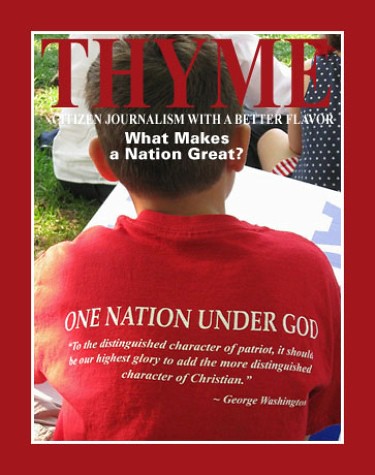
What Makes a Nation Great?
A 'Best of THYMEs' Feature for Independence Day

This is a reprinting of the September 10, 2010 issue of THYME, which we feel is appropriate for our time as well. The 'other' weekly news magazine does not publish this week.

The 'other' Weekly News Magazine [click to read] asked a while ago: "What makes a school great?" THYME asks: "Why stop there, what makes a NATION great?" We can agree with the 'other' magazine that it takes great teachers, so here are some thoughts from our Founding Fathers:

John Adams and John Hancock:
We Recognize No Sovereign but G-d, and no King but Jesus! [April 18, 1775]

John Adams:
“ The general principles upon which the Fathers achieved independence were the general principals of Christianity… I will avow that I believed and now believe that those general principles of Christianity are as eternal and immutable as the existence and attributes of G-d.”
“[July 4th] ought to be commemorated as the day of deliverance by solemn acts of devotion to God Almighty.”
–John Adams in a letter written to Abigail on the day the Declaration was approved by Congress

"We have no government armed with power capable of contending with human passions unbridled by morality and religion. Avarice, ambition, revenge, or gallantry, would break the strongest cords of our Constitution as a whale goes through a net. Our Constitution was made only for a moral and religious people. It is wholly inadequate to the government of any other." --October 11, 1798

"I have examined all religions, as well as my narrow sphere, my straightened means, and my busy life, would allow; and the result is that the Bible is the best Book in the world. It contains more philosophy than all the libraries I have seen." December 25, 1813 letter to Thomas Jefferson

"Without Religion this World would be Something not fit to be mentioned in polite Company, I mean Hell." [John Adams to Thomas Jefferson, April 19, 1817]


Samuel Adams: He who made all men hath made the truths necessary to human happiness obvious to all… Our forefathers opened the Bible to all.” [ "American Independence," August 1, 1776. Speech delivered at the State House in Philadelphia]

“ Let divines and philosophers, statesmen and patriots, unite their endeavors to renovate the age by impressing the minds of men with the importance of educating their little boys and girls, inculcating in the minds of youth the fear and love of the Deity… and leading them in the study and practice of the exalted virtues of the Christian system.” [October 4, 1790]


John Quincy Adams:
“Why is it that, next to the birthday of the Savior of the world, your most joyous and most venerated festival returns on this day [the Fourth of July]?" “Is it not that, in the chain of human events, the birthday of the nation is indissolubly linked with the birthday of the Savior? That it forms a leading event in the progress of the Gospel dispensation? Is it not that the Declaration of Independence first organized the social compact on the foundation of the Redeemer's mission upon earth? That it laid the cornerstone of human government upon the first precepts of Christianity"?
--1837, at the age of 69, when he delivered a Fourth of July speech at Newburyport, Massachusetts.

“The Law given from Sinai [The Ten Commandments] was a civil and municipal as well as a moral and religious code.”
John Quincy Adams. Letters to his son. p. 61


Elias Boudinot: “Be religiously careful in our choice of all public officers . . . and judge of the tree by its fruits.”

Charles Carroll - signer of the Declaration of Independence
" Without morals a republic cannot subsist any length of time; they therefore who are decrying the Christian religion, whose morality is so sublime and pure...are undermining the solid foundation of morals, the best security for the duration of free governments." [Source: To James McHenry on November 4, 1800.]

Benjamin Franklin:
“ G-d governs in the affairs of man. And if a sparrow cannot fall to the ground without his notice, is it probable that an empire can rise without His aid? We have been assured in the Sacred Writings that except the Lord build the house, they labor in vain that build it. I firmly believe this. I also believe that, without His concurring aid, we shall succeed in this political building no better than the builders of Babel” –Constitutional Convention of 1787 original manuscript of this speech

“In the beginning of the contest with Britain, when we were sensible of danger, we had daily prayers in this room for Divine protection. Our prayers, Sir, were heard, and they were graciously answered… do we imagine we no longer need His assistance?” [Constitutional Convention, Thursday June 28, 1787]

In Benjamin Franklin's 1749 plan of education for public schools in Pennsylvania, he insisted that schools teach "the excellency of the Christian religion above all others, ancient or modern."

In 1787 when Franklin helped found Benjamin Franklin University, it was dedicated as "a nursery of religion and learning, built on Christ, the Cornerstone."


Alexander Hamilton: Hamilton began work with the Rev. James Bayard to form the Christian Constitutional Society to help spread over the world the two things which Hamilton said made America great:
(1) Christianity
(2) a Constitution formed under Christianity.
“The Christian Constitutional Society, its object is first: The support of the Christian religion. Second: The support of the United States.”

On July 12, 1804 at his death, Hamilton said, “I have a tender reliance on the mercy of the Almighty, through the merits of the Lord Jesus Christ. I am a sinner. I look to Him for mercy; pray for me.”

"For my own part, I sincerely esteem it [the Constitution] a system which without the finger of G-d, never could have been suggested and agreed upon by such a diversity of interests." [1787 after the Constitutional Convention]

"I have carefully examined the evidences of the Christian religion, and if I was sitting as a juror upon its authenticity I would unhesitatingly give my verdict in its favor. I can prove its truth as clearly as any proposition ever submitted to the mind of man."


John Hancock:
“In circumstances as dark as these, it becomes us, as Men and Christians, to reflect that whilst every prudent measure should be taken to ward off the impending judgments, …at the same time all confidence must be withheld from the means we use; and reposed only on that God rules in the armies of Heaven, and without His whole blessing, the best human counsels are but foolishness… Resolved; …Thursday the 11th of May…to humble themselves before G-d under the heavy judgments felt and feared, to confess the sins that have deserved them, to implore the Forgiveness of all our transgressions, and a spirit of repentance and reformation …and a Blessing on the … Union of the American Colonies in Defense of their Rights [for which hitherto we desire to thank Almighty G-d]…That the people of Great Britain and their rulers may have their eyes opened to discern the things that shall make for the peace of the nation…for the redress of America’s many grievances, the restoration of all her invaded liberties, and their security to the latest generations.
"A Day of Fasting, Humiliation and Prayer, with a total abstinence from labor and recreation. Proclamation on April 15, 1775"


Patrick Henry:
"Orator of the Revolution."

This is all the inheritance I can give my dear family. The religion of Christ can give them one which will make them rich indeed.”
—The Last Will and Testament of Patrick Henry

“It cannot be emphasized too clearly and too often that this nation was founded, not by religionists, but by Christians; not on religion, but on the gospel of Jesus Christ. For this very reason, peoples of other faiths have been afforded asylum, prosperity, and freedom of worship here.” [May 1765 Speech to the House of Burgesses]

“The Bible is worth all other books which have ever been printed.”


John Jay:
“ Providence has given to our people the choice of their rulers, and it is the duty, as well as the privilege and interest of our Christian nation to select and prefer Christians for their rulers.” Source: October 12, 1816. The Correspondence and Public Papers of John Jay, Henry P. Johnston, ed., (New York: Burt Franklin, 1970), Vol. IV, p. 393.

“Whether our religion permits Christians to vote for infidel rulers is a question which merits more consideration than it seems yet to have generally received either from the clergy or the laity. It appears to me that what the prophet said to Jehoshaphat about his attachment to Ahab ["Shouldest thou help the ungodly and love them that hate the Lord?" 2 Chronicles 19:2] affords a salutary lesson.” [The Correspondence and Public Papers of John Jay, 1794-1826, Henry P. Johnston, editor (New York: G.P. Putnam's Sons, 1893), Vol. IV, p.365]


Thomas Jefferson:
“ The doctrines of Jesus are simple, and tend to all the happiness of man.”

“Of all the systems of morality, ancient or modern which have come under my observation, none appears to me so pure as that of Jesus.”

"I am a real Christian, that is to say, a disciple of the doctrines of Jesus."

“G-d who gave us life gave us liberty. And can the liberties of a nation be thought secure when we have removed their only firm basis, a conviction in the minds of the people that these liberties are a gift from G-d? That they are not to be violated but with His wrath? Indeed I tremble for my country when I reflect that God is just, and that His justice cannot sleep forever.” (excerpts are inscribed on the walls of the Jefferson Memorial in the nations capital) [Source: Merrill . D. Peterson, ed., Jefferson Writings, (New York: Literary Classics of the United States, Inc., 1984), Vol. IV, p. 289. From Jefferson’s Notes on the State of Virginia, Query XVIII, 1781.]


Samuel Johnston:
“It is apprehended that Jews, Mahometans (Muslims), pagans, etc., may be elected to high offices under the government of the United States. Those who are Mahometans, or any others who are not professors of the Christian religion, can never be elected to the office of President or other high office, [unless] first the people of America lay aside the Christian religion altogether, it may happen. Should this unfortunately take place, the people will choose such men as think as they do themselves.
[Elliot’s Debates, Vol. IV, pp 198-199, Governor Samuel Johnston, July 30, 1788 at the North Carolina Ratifying Convention]


James Madison:“ We’ve staked our future on our ability to follow the Ten Commandments with all of our heart.”

“We have staked the whole future of American civilization, not upon the power of government, far from it. We’ve staked the future of all our political institutions upon our capacity…to sustain ourselves according to the Ten Commandments of G-d.” [1778 to the General Assembly of the State of Virginia]

• I have sometimes thought there could not be a stronger testimony in favor of religion or against temporal enjoyments, even the most rational and manly, than for men who occupy the most honorable and gainful departments and [who] are rising in reputation and wealth, publicly to declare the unsatisfactoriness [of temportal enjoyments] by becoming fervent advocates in the cause of Christ; and I wish you may give in your evidence in this way.
Letter by Madison to William Bradford (September 25, 1773)


• In 1812, President Madison signed a federal bill which economically aided the Bible Society of Philadelphia in its goal of the mass distribution of the Bible
.
“ An Act for the relief of the Bible Society of Philadelphia” Approved February 2, 1813 by Congress

“It is the mutual duty of all to practice Christian forbearance, love, and charity toward each other.”

• A watchful eye must be kept on ourselves lest, while we are building ideal monuments of renown and bliss here, we neglect to have our names enrolled in the Annals of Heaven. [Letter by Madison to William Bradford [urging him to make sure of his own salvation] November 9, 1772]

At the Constitutional Convention of 1787, James Madison proposed the plan to divide the central government into three branches. He discovered this model of government from the Perfect Governor, as he read Isaiah 33:22;
“For the LORD is our judge, the LORD is our lawgiver,
the LORD is our king;
He will save us.”
[Baron Charles Montesquieu, wrote in 1748; “Nor is there liberty if the power of judging is not separated from legislative power and from executive power. If it [the power of judging] were joined to legislative power, the power over life and liberty of the citizens would be arbitrary, for the judge would be the legislature if it were joined to the executive power, the judge could have the force of an oppressor. All would be lost if the same … body of principal men … exercised these three powers." Madison claimed Isaiah 33:22 as the source of division of power in government
See also: pp.241-242 in Teaching and Learning America’s Christian History: The Principle approach by Rosalie Slater]


James McHenry – Signer of the Constitution: Public utility pleads most forcibly for the general distribution of the Holy Scriptures. The doctrine they preach, the obligations they impose, the punishment they threaten, the rewards they promise, the stamp and image of divinity they bear, which produces a conviction of their truths, can alone secure to society, order and peace, and to our courts of justice and constitutions of government, purity, stability and usefulness. In vain, without the Bible, we increase penal laws and draw entrenchments around our institutions. Bibles are strong entrenchments. Where they abound, men cannot pursue wicked courses, and at the same time enjoy quiet conscience.

Jedediah Morse:
"To the kindly influence of Christianity we owe that degree of civil freedom, and political and social happiness which mankind now enjoys. . . . Whenever the pillars of Christianity shall be overthrown, our present republican forms of government, and all blessings which flow from them, must fall with them."

John Peter Gabriel Muhlenberg
In a sermon delivered to his Virginia congregation on Jan. 21, 1776, he preached from Ecclesiastes 3.

Arriving at verse 8, which declares that there is a time of war and a time of peace, Muhlenberg noted that this surely was not the time of peace; this was the time of war. Concluding with a prayer, and while standing in full view of the congregation, he removed his clerical robes to reveal that beneath them he was wearing the uniform of an officer in the Continental army! He marched to the back of the church; ordered the drum to beat for recruits and over three hundred men joined him, becoming the Eighth Virginia Brigade. John Peter Muhlenberg finished the Revolution as a Major-General, having been at Valley Forge and having participated in the battles of Brandywine, Germantown, Monmouth, Stonypoint, and Yorktown.

Thomas Paine:
“ It has been the error of the schools to teach astronomy, and all the other sciences, and subjects of natural philosophy, as accomplishments only; whereas they should be taught theologically, or with reference to the Being who is the author of them: for all the principles of science are of divine origin. Man cannot make, or invent, or contrive principles: he can only discover them; and he ought to look through the discovery to the Author.”
“ The evil that has resulted from the error of the schools, in teaching natural philosophy as an accomplishment only, has been that of generating in the pupils a species of atheism. Instead of looking through the works of creation to the Creator himself, they stop short, and employ the knowledge they acquire to create doubts of his existence. They labour with studied ingenuity to ascribe every thing they behold to innate properties of matter, and jump over all the rest by saying, that matter is eternal.” “The Existence of G-d--1810”


Benjamin Rush: “I lament that we waste so much time and money in punishing crimes and take so little pains to prevent them…we neglect the only means of establishing and perpetuating our republican forms of government; that is, the universal education of our youth in the principles of Christianity by means of the Bible; for this Divine Book, above all others, constitutes the soul of republicanism.” “By withholding the knowledge of [the Scriptures] from children, we deprive ourselves of the best means of awakening moral sensibility in their minds.” [Letter written (1790’s) in Defense of the Bible in all schools in America]
• “Christianity is the only true and perfect religion.”
• “If moral precepts alone could have reformed mankind, the mission of the Son of G-d into our world would have been unnecessary.”

"Let the children who are sent to those schools be taught to read and write and above all, let both sexes be carefully instructed in the principles and obligations of the Christian religion. This is the most essential part of education”
Letters of Benjamin Rush, "To the citizens of Philadelphia: A Plan for Free Schools", March 28, 1787


Justice Joseph Story:
“ I verily believe Christianity necessary to the support of civil society. One of the beautiful boasts of our municipal jurisprudence is that Christianity is a part of the Common Law. . . There never has been a period in which the Common Law did not recognize Christianity as lying its foundations.”
[Commentaries on the Constitution of the United States p. 593]
“ Infidels and pagans were banished from the halls of justice as unworthy of credit.” [Life and letters of Joseph Story, Vol. II 1851, pp. 8-9.]
 

“ At the time of the adoption of the constitution, and of the amendment to it, now under consideration [i.e., the First Amendment], the general, if not the universal sentiment in America was, that Christianity ought to receive encouragement from the state, so far as was not incompatible with the private rights of conscience, and the freedom of religious worship.”
[Commentaries on the Constitution of the United States p. 593]


Noah Webster:
“ The duties of men are summarily comprised in the Ten Commandments, consisting of two tables; one comprehending the duties which we owe immediately to G-d - the other, the duties we owe to our fellow men.”

“In my view, the Christian religion is the most important and one of the first things in which all children, under a free government ought to be instructed...No truth is more evident to my mind than that the Christian religion must be the basis of any government intended to secure the rights and privileges of a free people.”
[Source: 1828, in the preface to his American Dictionary of the English Language]

Let it be impressed on your mind that God commands you to choose for rulers just men who will rule in the fear of G-d [Exodus 18:21]. . . . If the citizens neglect their duty and place unprincipled men in office, the government will soon be corrupted . . . If our government fails to secure public prosperity and happiness, it must be because the citizens neglect the Divine commands, and elect bad men to make and administer the laws. [Noah Webster, The History of the United States (New Haven: Durrie and Peck, 1832), pp. 336-337, 49]

“All the miseries and evils which men suffer from vice, crime, ambition, injustice, oppression, slavery and war, proceed from their despising or neglecting the precepts contained in the Bible.” [Noah Webster. History. p. 339]

“The Bible was America’s basic textbook
in all fields.” [Noah Webster. Our Christian Heritage p.5]

“Education is useless without the Bible” [Noah Webster. Our Christian Heritage p.5 ]


George Washington:

Farewell Address: The name of American, which belongs to you, in your national capacity, must always exalt the just pride of Patriotism, more than any appellation derived from local discriminations. With slight shades of difference, you have the same religion" ...and later: "...reason and experience both forbid us to expect, that national morality can prevail in exclusion of religious principle..."

“ It is impossible to rightly govern the world without G-d and Bible.”

“What students would learn in American schools above all is the religion of Jesus Christ.” [speech to the Delaware Indian Chiefs May 12, 1779]

"To the distinguished character of patriot, it should be our highest glory to add the more distinguished character of Christian" [May 2, 1778, at Valley Forge]

During his inauguration, Washington took the oath as prescribed by the Constitution but added several religious components to that official ceremony. Before taking his oath of office, he summoned a Bible on which to take the oath, added the words “So help me G-d!” to the end of the oath, then leaned over and kissed the Bible.

Nelly Custis-Lewis (Washington’s adopted daughter):
Is it necessary that any one should [ask], “Did General Washington avow himself to be a believer in Christianity?" As well may we question his patriotism, his heroic devotion to his country. His mottos were, "Deeds, not Words"; and, "For G-d and my Country."

“ O Most Glorious G-d, in Jesus Christ, my merciful and loving Father; I acknowledge and confess my guilt in the weak and imperfect performance of the duties of this day. I have called on Thee for pardon and forgiveness of my sins, but so coldly and carelessly that my prayers are become my sin, and they stand in need of pardon.”
“ I have sinned against heaven and before Thee in thought, word, and deed. I have contemned Thy majesty and holy laws. I have likewise sinned by omitting what I ought to have done and committing what I ought not. I have rebelled against the light, despising Thy mercies and judgment, and broken my vows and promise. I have neglected the better things. My iniquities are multiplied and my sins are very great. I confess them, O Lord, with shame and sorrow, detestation and loathing and desire to be vile in my own eyes as I have rendered myself vile in Thine. I humbly beseech Thee to be merciful to me in the free pardon of my sins for the sake of Thy dear Son and only Savior Jesus Christ who came to call not the righteous, but sinners to repentance. Thou gavest Thy Son to die for me.”
[George Washington; from a 24 page authentic handwritten manuscript book dated April 21-23, 1752
William J. Johnson George Washington, the Christian (New York: The Abingdon Press, New York and Cincinnati, 1919), pp. 24-35.]

"Although guided by our excellent Constitution in the discharge of official duties, and actuated, through the whole course of my public life, solely by a wish to promote the best interests of our country; yet, without the beneficial interposition of the Supreme Ruler of the Universe, we could not have reached the distinguished situation which we have attained with such unprecedented rapidity. To HIM, therefore, should we bow with gratitude and reverence, and endeavor to merit a continuance of HIS special favors". [1797 letter to John Adams]


James Wilson:
Signer of the Declaration of Independence and the Constitution
Supreme Court Justice appointed by George Washington
Spoke 168 times during the Constitutional Convention

"Christianity is part of the common law"
[Sources: James Wilson, Course of Lectures [vol 3, p.122]; and quoted in Updegraph v. The Commonwealth, 11 Serg, and; R. 393, 403 (1824).]


Source:  Quotes of the Founding Fathers.

PNOVS at AGO
The American Flag Glass Organ Pipes by Xaver Wilhelmy.

thymebanner